
成本支撑逻辑

Search documents
镍:结构性过剩转变,博弈矛盾并未改变,不锈钢:供需延续双弱运行,成本支撑逻辑增强
Guo Tai Jun An Qi Huo· 2025-12-07 07:28
1. Report Industry Investment Rating No relevant content provided. 2. Core Viewpoints of the Report - For nickel, the structural change in nickel surplus is expected to keep nickel prices stable in the short - term. The supply - demand of refined nickel has turned weak. Although the accumulation of refined nickel inventory has eased slightly, the overall surplus and the expectation of low - cost wet - process production may still drag down nickel prices. Considering the high uncertainty of Indonesian policy news from the end of this year to the first quarter of next year, short - selling at low levels is not recommended, and opportunities for short - selling at high levels can be considered with options for risk protection [1]. - For stainless steel, the supply - demand is weakly balanced, and cost limits the downside potential. The market is in the off - season, and the fundamentals lack upward drivers. However, the supply growth has slowed down following the demand, and the cost has increased, providing a certain safety margin. Interval trading strategies are recommended [2]. 3. Summary by Related Catalogs 3.1 Inventory Tracking - **Refined nickel**: On December 5th, China's social inventory increased by 262 tons to 54,978 tons. Among them, warehouse - receipt inventory increased by 1,455 tons to 34,764 tons, spot inventory decreased by 1,193 tons to 16,444 tons, and bonded - area inventory remained unchanged at 3,770 tons. LME nickel inventory decreased by 1,644 tons to 253,116 tons [3]. - **New energy**: On November 28th, the inventory days of SMM's upstream, downstream, and integrated production lines of nickel sulfate changed by +1, 0, 0 month - on - month to 5, 9, 7 days respectively. On December 4th, the precursor inventory changed by +0.2 week - on - week to 12.8 days. On December 5th, the ternary material inventory remained unchanged at 6.8 days week - on - week [4][5]. - **Nickel - iron - stainless steel**: On November 30th, SMM's nickel - iron inventory was 29,346 tons, a month - on - month decrease of 3%. In October, SMM's stainless - steel factory inventory was 1.574 million tons, a year - on - year and month - on - month increase of 9% and 3% respectively. On December 4th, the total social inventory of stainless steel in the Steel Union was 1,080,275 tons, a week - on - week decrease of 0.54%. Among them, the inventory of cold - rolled stainless steel was 626,481 tons, a week - on - week decrease of 0.69%, and the inventory of hot - rolled stainless steel was 453,794 tons, a week - on - week decrease of 0.33% [5]. 3.2 Market News - On September 12th, the Indonesian forestry working group took over more than 148 hectares of the PT Weda Bay Nickel mining area due to violations of forestry license regulations, which is expected to affect nickel ore production by about 600 metal tons per month [6]. - China has suspended an unofficial subsidy for copper and nickel imports from Russia [6]. - On September 22nd, the Indonesian Ministry of Energy and Mineral Resources imposed sanctions on 190 mining companies in various regions of Indonesia for failing to provide claim and refund guarantees as required [6]. - On September 30th, the Indonesian Ministry of Energy and Mineral Resources issued Ministerial Regulation No. 17 (2025) regarding the procedures for the preparation, submission, and approval of the work plan and budget for mineral and coal mining business activities and the procedures for activity execution reports [7]. - US President Trump announced on October 10th that he might impose an additional 100% tariff on China from November 1st and implement export controls on "all key software" [7]. - The Indonesian government has suspended the issuance of new smelting licenses through the OSS platform, targeting projects producing restricted products such as Nickel matte, MHP, FeNi, and NPI [8]. - Due to strengthened safety inspections in Indonesian industrial parks, some nickel wet - process projects will reduce production in December, affecting about 6,000 nickel metal tons of production [8]. - On November 21st, New York Fed President John Williams and Fed Governor Stephen Miran made dovish remarks, increasing investors' expectations of a 25 - basis - point interest rate cut in December [8]. 3.3 Weekly Key Data Tracking of Nickel and Stainless Steel The report provides data on various indicators such as the closing price, trading volume, price differentials, and import profits of nickel and stainless - steel futures and related products, including the closing price of the main contract of Shanghai nickel at 117,790 yuan, the closing price of the main contract of stainless steel at 12,500 yuan, etc. [10].
运行逻辑切换 螺纹钢存在阶段性反弹的可能
Qi Huo Ri Bao· 2025-12-05 00:43
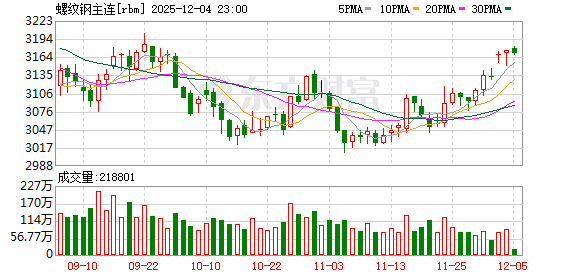
Group 1 - The rebar steel market is operating weakly, with the main contract closing at 3110 CNY/ton, a monthly increase of 0.13%, while the East China spot price is at 3250 CNY/ton, up 0.69% month-on-month, indicating a potential for a short-term rebound in December [2] - The apparent consumption of rebar steel decreased from 232.18 million tons at the end of October to 216.37 million tons by mid-November, with steel mills facing losses leading to negative feedback across the industry chain [3] - The macroeconomic outlook has strengthened, with expectations of a Federal Reserve interest rate cut rising from 63% to 87% by December, alongside positive signals in domestic PMI data, suggesting improved demand [4] Group 2 - Environmental production restrictions in Tangshan have tightened, potentially affecting daily iron output by approximately 3.91 thousand tons, with further inspections and adjustments likely due to violations found in steel production capacity [5] - Demand for rebar steel has outperformed expectations, with a year-on-year increase of 1.15% in apparent demand during the last week of November, marking the first positive growth in four months [6] - The cost support logic remains intact, with iron ore inventories at a five-year low and coking coal inventories also relatively low, indicating room for replenishment and reinforcing cost support for steel production [8]

沪镍创五年新低 成本支撑逻辑还有效吗?【机构会诊】
Wen Hua Cai Jing· 2025-11-18 09:55
Core Viewpoint - Nickel prices have recently hit five-year lows after a prolonged period of fluctuation around the 120,000 yuan mark, primarily due to oversupply and weakening demand in the market [1] Supply and Demand Factors - Nickel has been in a state of oversupply for over two years, with production capacity in Indonesia and domestically slowing down, yet still releasing excess capacity [2] - LME refined nickel inventories have surpassed 200,000 tons, with a recent increase of over 5,000 tons, indicating growing industry pressure [2] - Demand from the downstream sector, particularly for nickel sulfate used in electric vehicles, has shown signs of slowing, contributing to market pressure [2][3] Price Dynamics - The recent decline in nickel prices is attributed to both fundamental and financial factors, including a slight decrease in benchmark prices for nickel ore and weak demand from stainless steel and new energy sectors [3] - LME nickel inventory reached 257,694 tons, with domestic SMM social inventory exceeding 50,000 tons, indicating significant inventory pressure [3] - Nickel and stainless steel prices are expected to remain in a bearish trend, with prices recently breaking below the 120,000 yuan support level [4] Cost Support Logic - Recent price adjustments in Indonesian nickel ore have shown a slight decline, with domestic benchmark prices dropping by 0.14-0.39 USD per wet ton [5] - The cost support for nickel may become more pronounced as the profitability of nickel iron is squeezed by both upstream and downstream pressures [5] - Current price levels have fallen below the cost of fire refining, suggesting that cost support may hinge on wet refining costs [5][6] Future Price Trends - High inventory levels are expected to suppress prices in the short term, but potential cost support may emerge as nickel iron prices approach production cost levels [7] - Future price movements will depend on whether domestic primary nickel production shows signs of slowing and if Indonesia implements new industrial policies [7] - Recent reports indicate that Indonesia may limit new smelting plant licenses and adjust nickel production targets, which could impact future supply dynamics [7][8]
成本支撑逻辑仍在 铸造铝合金偏弱走势能否持续
Jin Tou Wang· 2025-11-05 06:03
Core Viewpoint - The casting aluminum alloy futures market is experiencing a weak performance, with the main contract trading at 20,815.0 CNY/ton, down 0.72% as of November 5 [1] Market Summary - The average price of ADC12 in major domestic regions decreased by 75 CNY/ton, with relatively low transaction volumes, while imported ADC12 prices remained stable, indicating a stalemate between bulls and bears [2] - As of November 5, the total social inventory of recycled aluminum alloy ingots in Foshan, Ningbo, and Wuxi was 49,895 tons, a decrease of 136 tons from the previous trading day but an increase of 1,430 tons compared to the previous week [2] - The Shanghai Futures Exchange announced that starting from November 10, 2025, the trading fees for casting aluminum alloy futures and offset printing paper futures will be adjusted to 0.0005 of the transaction amount, with no fees for intra-day closing positions [2] Institutional Perspectives - Yide Futures noted that profits have turned negative, and with tight supply of scrap aluminum, there is an expectation of reduced supply; however, the automotive sector is still in a growth phase, maintaining expectations for strong seasonal demand [3] - Ruida Futures observed that the main contract for casting aluminum is showing weak fluctuations, with tight supply of scrap aluminum supporting costs; the domestic casting aluminum production growth may slow due to tight scrap supply, while demand is supported by recovery in the economy and increased consumption expectations in the automotive and motorcycle sectors [3] - Overall, the casting aluminum alloy market is expected to face a scenario of slowing supply and rising demand, with recommendations for light trading and careful risk management [3]
甲醇陷入震荡整理格局
Bao Cheng Qi Huo· 2025-08-07 02:09
Group 1: Report Industry Investment Rating - No relevant content provided Group 2: Core View of the Report - As the previous policy's bullish expectations are digested by the market, the coal - chemical sector has corrected, and the cost support for methanol has weakened. The fundamental logic will dominate the futures market. With domestic methanol plants resuming production, supply pressure is rising, imports are sufficient, and port inventory is expected to increase significantly. In a weak supply - demand context, the methanol futures 2509 contract is expected to maintain a volatile consolidation pattern [2][6] Group 3: Summary by Related Catalogs Supply Situation - Although there was concentrated maintenance in domestic methanol production areas in early July, the spot price didn't rise significantly due to sufficient downstream inventory. Since late July, previously shut - down plants have resumed production, and the methanol operating rate will gradually increase. As of the week of August 1, the domestic average methanol operating rate was 81.92%, a 0.26 - percentage - point increase from the previous week, a 3.28 - percentage - point decrease from the same period last month, and an 11.46 - percentage - point increase from the same period last year. The weekly average methanol output was 193.02 tons, a 3.13 - ton increase from the previous week, a 5.69 - ton decrease from the same period last month, and a 31.20 - ton increase from the same period last year. Short - term domestic methanol supply recovery is greater than maintenance losses [3] - Since the third quarter, methanol supply in the Middle East, Southeast Asia, and South America has been sufficient. Although weather affected the arrival and unloading of imported methanol in China, the overall impact was limited, and the expectation of significant inventory accumulation at ports in East and South China is strong. In July, due to typhoons, only 110.69 tons of imported methanol were unloaded, and over 20 tons were postponed to August. Longzhong Information predicts that without weather interference, China's methanol imports in August will reach 155 tons, a monthly record high [4] Demand Situation - The recent shutdown of olefin plants in Zhejiang has increased the inventory accumulation pressure at methanol ports in East China. Although inland CTO procurement has improved apparent port demand, with the expected significant increase in methanol imports in August and no increase in the load of coastal olefin plants, the expectation of port inventory accumulation has risen, possibly leading to methanol flowing from ports to inland areas. As of the week of August 1, the methanol port inventory in East and South China was about 65.03 tons, a 6.32 - ton increase from the previous week, a 15.06 - ton increase from the same period last month, and a 15.80 - ton decrease from the same period last year. The inventory accumulation pressure, low trader purchasing willingness, weak basis, and weak supply - demand expectations have led to a significant decline in spot trading volume [5]
成本支撑出现松动,镍价僵局能否打破?
Wen Hua Cai Jing· 2025-05-20 13:58
Core Viewpoint - Nickel prices have experienced significant fluctuations due to trade tensions and changes in Indonesian policies, leading to a complex supply-demand dynamic in the nickel market [2][4][6]. Group 1: Price Dynamics - Nickel prices dropped to a low of 115,000 yuan/ton in early April due to heightened risk aversion from trade conflicts, but later recovered to a range around 125,000 yuan/ton as market sentiment improved [2]. - The price of nickel has been constrained within a narrow range, primarily due to a shift in trading logic and the oversupply in the nickel industry, particularly from Indonesia [4][16]. - The Indonesian government has adjusted the tax rates on nickel products, increasing the nickel ore tax from a fixed 10% to a floating rate of 14%-19%, which is expected to provide some price support [6]. Group 2: Supply and Demand Factors - Indonesia's nickel resources are becoming increasingly significant in the global market, with the country implementing various policies that impact nickel pricing and supply [5][6]. - The global supply of refined nickel has been in surplus, with inventories rising from 50,000 tons to around 250,000 tons, indicating a growing imbalance in the market [13]. - Domestic demand for nickel, particularly in the stainless steel sector, is under pressure due to slow recovery in real estate transactions and seasonal demand fluctuations [8][15]. Group 3: Production and Capacity - China's refined nickel production has increased significantly, with a cumulative output of 140,000 tons in the first four months of 2025, marking a year-on-year increase of 44.94% [11]. - The production capacity utilization rate for domestic refined nickel enterprises remains high at 96.94%, indicating robust production levels despite external challenges [11]. - New production capacities in Indonesia and China are gradually displacing traditional high-cost nickel producers, leading to a shift in the global supply landscape [11]. Group 4: Future Outlook - The nickel market is expected to remain in a state of wide-ranging fluctuations, with strong cost support from Indonesian policies and ongoing supply constraints limiting downward price movements [16]. - The end of the rainy season in the Philippines is anticipated to increase nickel ore shipments, which may lead to a more relaxed supply situation [16]. - The overall sentiment in the nickel market is cautious, with steel mills adopting a conservative approach to raw material procurement amid a backdrop of weakening demand [16].
