
报废更新政策

Search documents
二手车交易量创新高背后
第一财经· 2026-02-09 12:09
Core Viewpoint - The second-hand car market in China is experiencing significant growth, with transaction volumes reaching 20.1 million units in 2025, but profit margins are declining, leading to a challenging environment for dealers [3][12]. Group 1: Market Growth and Trends - In 2025, the second-hand car transaction volume reached 20.1 million units, marking a new peak, with used new energy vehicles (NEVs) accounting for over 1.6 million units, a year-on-year growth of over 40% [3][10]. - The average transaction price of second-hand cars decreased from 66,700 yuan in March 2025 to 61,600 yuan in September 2025, indicating a price drop in the market [3][7]. - The average profit margin in the second-hand car industry is approximately 4%, reflecting a significant decline compared to previous years [3][9]. Group 2: Profitability Challenges - The average profit margin for second-hand car dealers has decreased, with individual dealers like Wang Yang reporting a drop in profit from 15,000 yuan to 10,000 yuan for a 100,000 yuan vehicle over five years [7][9]. - Factors contributing to declining profits include increased competition, price transparency, and fluctuations in new car prices, which directly affect second-hand car pricing [7][9]. - Major dealer groups are also facing similar challenges, with companies like Yongda Automotive reporting a 60.2% decline in comprehensive profits from their second-hand car business [9][12]. Group 3: New Energy Vehicles as a Growth Opportunity - The penetration rate of second-hand NEVs increased from 3.6% at the end of 2022 to 12% by December 2025, indicating a growing market segment [10][11]. - The average three-year depreciation rate for NEVs is significantly higher than that of traditional fuel vehicles, with NEVs averaging a 43% retention rate compared to 62% for fuel vehicles [11][12]. - Despite the challenges, NEVs are seen as a new growth opportunity for second-hand car dealers, with companies like Yongda Automotive planning to accelerate their focus on this segment [11][12].


崔东树:12月乘用车均价18.4万元 提升0.3万 新能源车量跌价升
智通财经网· 2026-01-11 07:27
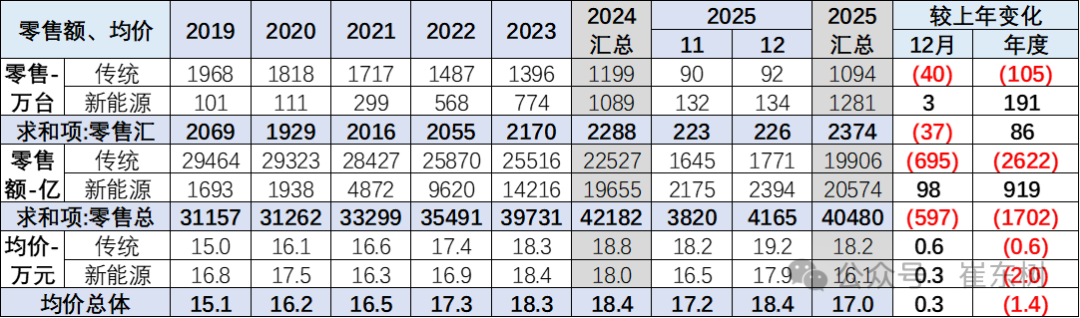
Core Insights - The automotive market is experiencing a gradual increase in average retail prices due to slow sales growth, with the average price rising from 151,000 yuan in 2019 to 183,000 yuan in 2023, and projected to be 184,000 yuan in 2024 before decreasing to 170,000 yuan in 2025 [1][4][6] - The average price of traditional fuel vehicles has been increasing, while the market for mid-to-low-end vehicles is shrinking significantly, with high-end vehicles experiencing slower declines [1][4] - The average price of new energy vehicles (NEVs) is expected to decrease from 184,000 yuan in 2023 to 161,000 yuan in 2025, indicating a structural change in consumer preferences [1][4][6] Retail Sales and Price Trends - Retail sales of traditional vehicles have decreased from 1,968,000 units in 2019 to 1,396,000 units in 2023, while NEV sales have increased from 101,000 units in 2019 to 774,000 units in 2023 [2][5] - The average price of traditional vehicles rose from 150,000 yuan in 2019 to 183,000 yuan in 2023, while NEV prices increased from 168,000 yuan in 2019 to 184,000 yuan in 2023, before declining in subsequent years [2][5] - The overall average price of vehicles is projected to decrease to 170,000 yuan in 2025, reflecting a 1.4 million yuan drop from 2024 [1][4] Market Structure and Consumer Behavior - The market is seeing a shift towards lower-priced vehicles, with the penetration of NEVs in lower price segments increasing significantly, particularly in the A0 and A segments [11][12] - The share of vehicles priced above 150,000 yuan is declining, while the share of vehicles priced between 200,000 and 300,000 yuan is increasing, indicating a shift in consumer purchasing behavior [10][14] - The exit of tax exemptions for vehicle purchases is expected to impact the NEV market, with a potential increase in demand for mid-to-low-end vehicles as consumers seek more affordable options [1][4][6] Future Projections - The average price of NEVs is expected to continue declining, with projections of 180,000 yuan in 2024 and 161,000 yuan in 2025, while the average price of traditional vehicles is expected to stabilize around 182,000 yuan in 2025 [1][4] - The market for NEVs is projected to reach a penetration rate of 48% by 2024 and 59% by December 2025, reflecting a strong growth trajectory [14][15] - The overall automotive market is under pressure, with a notable decline in sales volume in December, despite an increase in average prices, indicating significant market challenges ahead [6][10]
【乘联分会论坛】6月狭义乘用车零售预计200.0万辆,新能源预计110万辆
乘联分会· 2025-06-20 13:18
Market Overview - During the "May Day" holiday, car manufacturers launched promotional policies, leading to a strong performance in the car market in May, with retail sales of narrow-sense passenger vehicles reaching 1.938 million units, a year-on-year increase of 13.7% and a month-on-month increase of 10.0% [1] - New energy vehicle retail sales in May reached 1.027 million units, a year-on-year increase of 28.9% and a month-on-month increase of 12.7%, with a penetration rate rising to 53.0% [1] June Market Outlook - The car market is expected to continue its upward trend in June, supported by the "trade-in" and "scrap renewal" policies, despite some regions experiencing temporary tightness in subsidy amounts [2] Manufacturer Sales Trends - In June, manufacturers are intensifying promotional efforts to meet quarterly and semi-annual targets, with an overall market discount rate of approximately 24.8% [3] - Retail targets for leading manufacturers are projected to grow by 15% year-on-year compared to May of last year, with an estimated total retail market of around 2 million units in June, a year-on-year increase of 13.4% and a month-on-month increase of 3.2% [3] Weekly Sales Projections - The first week of June saw a decline in daily retail to 42,100 units, a year-on-year decrease of 16.9% and a month-on-month decrease of 13.9% [4] - The second week showed a recovery with daily retail reaching 52,700 units, a year-on-year increase of 22.7% [4] - The third week, boosted by the "618" e-commerce promotion, is expected to see daily retail reach 68,600 units, a year-on-year increase of 10.7% [4] - The fourth week is projected to achieve daily sales of 101,800 units, a year-on-year increase of 10.1% [4] June Market Heat - The arrival of the "618" e-commerce season has prompted manufacturers to launch new promotional campaigns, with the overall market discount rate reaching approximately 25.2% in mid-June [5] - As of May 31, the number of applications for the trade-in subsidy reached 4.12 million, providing significant momentum for the car market [5] - However, some regions are experiencing temporary tightness in trade-in subsidy funds, which may lead to increased consumer hesitation and potential consumption risks in the third quarter [5]

潍柴动力(000338):一季度收入表现稳健 剔除凯傲一次性因素后盈利同比高增
Xin Lang Cai Jing· 2025-04-30 06:38
Core Viewpoint - The company reported a stable performance in Q1 2025, with revenue of 57.46 billion yuan, showing a quarter-on-quarter increase of 1.9% and a year-on-year increase of 6.9%. The net profit attributable to the parent company was 2.71 billion yuan, with a quarter-on-quarter increase of 4.3% but a year-on-year decrease of 9.7% [1]. Group 1: Business Performance - The heavy truck industry saw a total sales volume of 265,000 units in Q1 2025, a year-on-year decrease of 2.7%. However, the company achieved a revenue increase of 1.9% year-on-year, outperforming the industry [1]. - The company's heavy-duty truck engine market position remains strong, with a high market share in natural gas engines. The sales volume of high-end products, particularly large-bore engines for data center applications, is expected to see significant growth [1]. - The company sold 43,000 vehicles in Q1 2025, representing a year-on-year increase of 10.4%, which is better than the industry average [2]. Group 2: Financial Metrics - The company achieved a gross profit margin of 22.2% in Q1 2025, with a year-on-year increase of 0.1 percentage points but a quarter-on-quarter decrease of 1.9 percentage points. The actual gross profit margin showed a more significant improvement compared to the same period last year [2]. - Management expenses reached 7.1% in Q1 2025, with a notable increase due to expenses related to the efficiency plan of the subsidiary KION, impacting the quarter's expenses by approximately 1.47 billion yuan [2]. - After accounting for KION's one-time expenses, the net profit attributable to the parent company was 3.18 billion yuan, reflecting a year-on-year increase of 22.4% and a quarter-on-quarter increase of 6% [2]. Group 3: Future Outlook - The heavy truck industry is expected to maintain steady growth, driven by the expansion of domestic scrapping and replacement policies and the continuous growth of non-Russian export markets [3]. - The company anticipates strong growth in its large-bore engine business, with nearly 400 units shipped for data center applications in 2024, representing a year-on-year increase of 148%. This trend is expected to continue into 2025, significantly enhancing the company's profitability [3]. - Revenue projections for 2025-2027 are estimated at 240.66 billion yuan, 260.94 billion yuan, and 275.17 billion yuan, respectively, with net profits of 13.06 billion yuan, 14.85 billion yuan, and 15.97 billion yuan [3].
国内汽车产销保持两位数增长 一季度汽车行业喜提“开门红”
Zhong Guo Chan Ye Jing Ji Xin Xi Wang· 2025-04-24 00:54
Core Viewpoint - The domestic automotive market in China has shown strong growth in the first quarter of this year, with double-digit increases in production and sales, laying a solid foundation for continued market improvement throughout the year [1][2]. Production and Sales Growth - In March, domestic automotive production and sales reached 3.006 million and 2.915 million units, respectively, marking year-on-year increases of 11.9% and 8.2% [2]. - For the first quarter, production and sales totaled 7.561 million and 7.47 million units, reflecting year-on-year growth of 14.5% and 11.2% [2]. - The growth rates for production and sales in the first quarter narrowed by 1.7 and 1.9 percentage points compared to January-February [2]. Market Dynamics - The passenger vehicle market has outperformed the commercial vehicle sector, with retail sales in March approaching the historical high levels of March 2018 [2]. - The "dual new" policies (trade-in and scrappage incentives) have positively influenced the market, leading to a more favorable competitive environment and improved retail growth in March [2][3]. Future Outlook - Experts maintain confidence in the automotive market's growth for the second quarter, supported by ongoing policy effects and promotional activities [4]. - The upcoming Shanghai International Auto Show is expected to catalyze consumer demand and further stimulate market growth [4]. - The implementation of the new scrappage policy on April 24, 2024, is anticipated to contribute to a gradual recovery in the market [4]. Policy Support - The National Development and Reform Commission and the Ministry of Finance have issued a notice to expand the scope of scrappage and trade-in subsidies for vehicles, including certain models meeting the National IV emission standards [5]. - Despite external pressures and changes in consumer sentiment, the government's policies aimed at boosting domestic demand are expected to continue to have a positive impact on the passenger vehicle market [5].