
新能源汽车购置税补贴退坡

Search documents
车企在激烈厮杀中告别2025 未来竞争将更残酷
Xin Lang Cai Jing· 2025-12-22 05:13
Core Viewpoint - The competitive landscape of the Chinese automotive market is rapidly changing, with significant shifts expected by 2025, as highlighted by the comments from Xiaopeng Motors' CEO, He Xiaopeng [1] Group 1: Market Dynamics - The leading position among new energy vehicle manufacturers has shifted from Li Auto to Leap Motor, indicating a change in competitive dynamics [1] - BYD, the current leader among domestic automakers, is facing increasing competition from SAIC Group and Geely [1] Group 2: Pricing Strategies - A price war characterized by "limited-time fixed prices" intensified in the first half of 2025 but abruptly ceased in the second half, leading to a collective call from automakers to initiate a "value war" [1] - The reduction of purchase tax subsidies for new energy vehicles is expected to intensify competition among automakers [1] Group 3: Future Outlook - The chairman of Lantu Motors, Lu Fang, indicated that the automotive industry may soon witness a decisive confrontation between fuel vehicles and new energy vehicles [1]




国内车企11月销量,“冰火两重天”
DT新材料· 2025-12-02 16:05
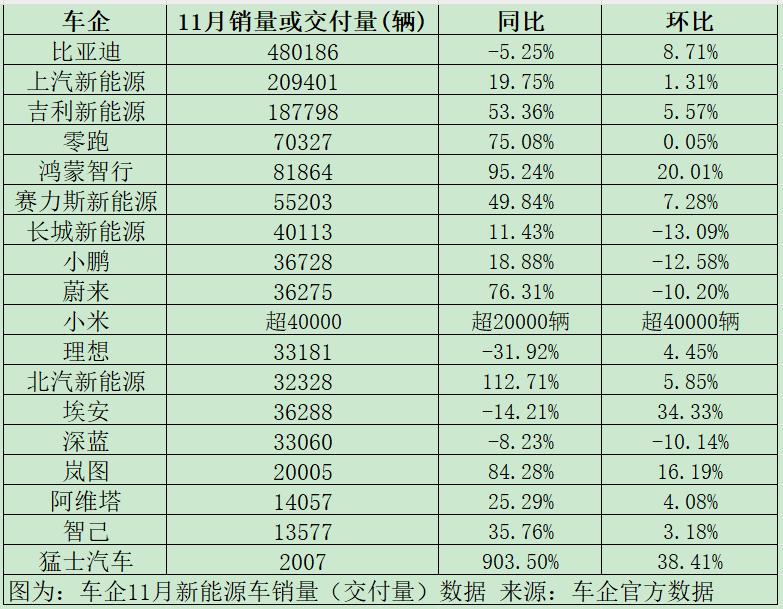
Core Viewpoint - The domestic automotive industry is experiencing a "two extremes" situation in November, with some leading companies showing a decline in sales while others report significant growth [2]. Group 1: Sales Performance - BYD's November sales reached 480,186 units, a year-on-year decrease of 5.25%, with domestic sales down by 26.81% [3][4]. - SAIC Group and Geely's new energy vehicle sales in November were 209,401 units and 187,798 units, respectively, showing year-on-year growth of 19.75% and 53.36% [3][4]. - Geely's high-end new energy vehicle brand, Galaxy, achieved sales of 132,700 units, a remarkable year-on-year increase of 76% [3]. - New car manufacturers like Leap Motor, Xiaomi Auto, and Xpeng Auto have completed their annual delivery targets ahead of schedule, with Xpeng achieving a 100% year-on-year growth, totaling 380,200 units [3]. - Lantu and Avita, state-owned new energy vehicle companies, reported record monthly sales of 20,005 units and 14,057 units, reflecting year-on-year growth of 84.28% and 25.29% respectively [3][4]. Group 2: Market Trends - The overall sales performance in November 2025 is weaker compared to November 2024, indicating potential short-term disruptions due to various factors [3]. - The implementation of the new energy vehicle purchase tax subsidy reduction starting January 1, 2026, is prompting companies to accelerate sales efforts by the end of 2025 [3].




“比较冷”,比亚迪,跌了
3 6 Ke· 2025-12-02 02:27
Core Viewpoint - The automotive industry in November showed a mixed performance, with some leading companies experiencing a slowdown in sales growth, while others achieved significant increases in sales [1][17]. Group 1: Sales Performance - BYD's November sales reached 480,186 units, a year-on-year decrease of 5.25%, with domestic sales dropping by 26.81% [1][3][8]. - Other companies like SAIC and Geely saw significant year-on-year growth in their electric vehicle sales, with SAIC's sales at 209,401 units (up 19.75%) and Geely's at 187,798 units (up 53.36%) [2][10]. - New energy vehicle sales for November showed a total of 474,175 units produced, with a cumulative year-on-year increase of 7.29% [5]. Group 2: Emerging Players - New energy vehicle startups like Leap Motor achieved impressive results, with November deliveries reaching 70,327 units, completing their annual target ahead of schedule [14]. - Other new entrants, such as Xiaomi and XPeng, also reported strong performance, with Xiaomi estimated to exceed 350,000 units in total deliveries for the year [14][15]. Group 3: Market Trends - The anticipated year-end sales surge, known as the "tailwind" effect, appears to be cooling down, with many companies reporting lower growth rates compared to the previous year [17]. - NIO's CEO noted that recent policy changes, such as the suspension of vehicle trade-in subsidies in various regions, have impacted the market, leading to a decline in new orders [18][19].
“比较冷”!比亚迪,跌了
中国基金报· 2025-12-01 15:39
Core Insights - The automotive industry in China is experiencing a mixed performance in November, with some leading companies showing a slowdown in sales growth or declines, while others achieve record sales [2][4][20] - BYD's November sales reached 480,186 units, a year-on-year decrease of 5.25%, and domestic sales fell by 26.81% [5][8] - New energy vehicle companies like Leap Motor and others have successfully met their annual delivery targets ahead of schedule [14][15] Sales Performance - BYD's November sales were 480,186 units, failing to surpass the 500,000 mark [5][6] - In contrast, SAIC and Geely saw significant year-on-year growth in their new energy vehicle sales, with increases of 19.75% and 53.36%, respectively [8][9] - Leap Motor's November deliveries reached 70,327 units, contributing to a total of 536,100 units delivered in the first eleven months of 2025, exceeding their annual target [14][15] Market Trends - The anticipated year-end sales surge, known as the "tailwind" effect, appears to be cooling off, with many companies reporting lower growth rates compared to the previous year [20] - The suspension of vehicle trade-in subsidies in several regions has impacted the market, leading to a decline in new orders [20][21] - NIO maintains its fourth-quarter delivery guidance, expecting to deliver between 120,000 and 125,000 units, despite market challenges [21] Competitive Landscape - Geely's new energy vehicle penetration rate reached a record high of 60.50% in November, driven by strong sales from its Galaxy brand [9][11] - Leap Motor and Xiaomi are also on track to exceed their revised annual delivery targets, indicating a competitive shift in the market [14][16] - The performance of state-owned enterprises like Lantu and Avita has also improved, with significant year-on-year sales growth [17][18]
岚图,“争峰”!
Zhong Guo Ji Jin Bao· 2025-11-19 03:49
Core Viewpoint - Lantu Motors is actively preparing for intensified competition between fuel vehicles and new energy vehicles (NEVs) as the purchase tax subsidy will be reduced starting January 1, 2026, prompting both sectors to enhance their readiness for market challenges [1][2][4]. Group 1: Company Developments - Lantu Motors, established in April 2019 and a high-end smart NEV brand under Dongfeng Motor Corporation, has recently filed for a listing on the Hong Kong Stock Exchange on October 2, 2023, planning to go public through an introduction listing [1]. - The company launched its flagship SUV, Lantu Taishan, on November 18, 2023, aiming to elevate its brand positioning [1][6]. - Lantu Motors is noted for being the fastest NEV company to achieve quarterly profitability and positive operating cash flow [3][5]. Group 2: Industry Trends - The transition from full exemption to a 50% reduction in vehicle purchase tax is expected to impact consumer purchasing decisions and costs, leading to increased scrutiny from automakers and the industry [2][3]. - The Chinese NEV industry has shown significant growth, with production and sales reaching 1.772 million and 1.715 million units respectively in October 2025, marking year-on-year increases of 21.1% and 20% [3]. - The market penetration rate for NEVs exceeded 50% for the first time, reaching 51.6% [3]. Group 3: Competitive Landscape - The competition between fuel vehicles and NEVs is anticipated to intensify as policy incentives for NEVs diminish, necessitating a shift towards core technology reliance for sustainable growth [4][5]. - Lantu Motors emphasizes the importance of product, technology, and marketing strategies to resonate emotionally with consumers in the face of upcoming market challenges [5]. - The Lantu Taishan features advanced technology, including the world's first 800V Lanhai intelligent hybrid system and a three-chamber air suspension, showcasing the company's commitment to innovation [5][6].
岚图,“争峰”!
中国基金报· 2025-11-19 03:38
Core Viewpoint - The article discusses the competitive landscape of the automotive industry, particularly focusing on the transition from fuel vehicles to electric vehicles (EVs) as the purchase tax subsidies for EVs will be halved starting January 1, 2026, prompting companies to prepare for intensified competition [2][4][8]. Group 1: Company Developments - Lantu Motors, a high-end smart EV brand under Dongfeng Motor Corporation, has been actively pursuing growth, including filing for a listing on the Hong Kong Stock Exchange on October 2 [2]. - The company launched its flagship SUV, Lantu Taishan, on November 18, aiming to elevate its brand positioning [2][11]. - Lantu Motors is noted for being the fastest EV company to achieve quarterly profitability and positive operating cash flow [6]. Group 2: Market Dynamics - The transition to a new tax regime is expected to impact consumer purchasing decisions and costs, leading to increased competition between fuel and electric vehicles [4][8]. - The Chinese automotive industry is predicted to shift from reliance on policy incentives to focusing on core technologies for sustainable growth [9]. - As of October 2025, the production and sales of EVs in China reached 1.772 million and 1.715 million units, respectively, marking year-on-year growth of 21.1% and 20% [4]. Group 3: Product and Technology - Lantu Taishan is highlighted as the world's first SUV equipped with the 800V Lanhai Intelligent Super Hybrid System and features a 65-degree ternary lithium battery [9]. - The vehicle also includes advanced technology such as Huawei's Qian Kun Intelligent Driving ADS 4 and Harmony OS cockpit, enhancing its smart capabilities [9]. - Lantu Motors aims to establish a comprehensive product lineup covering sedans, SUVs, and MPVs, with the Lantu Zhuiguang L luxury sedan set to launch in December [11].
华源证券:2026年购置税补贴减半 预计电车销量仍可维持中高个位数增长
Zhi Tong Cai Jing· 2025-11-04 09:03
Core Viewpoint - The report from Huayuan Securities indicates that from 2024 to the end of 2025, new energy vehicles (NEVs) will continue to be exempt from vehicle purchase tax, with a maximum exemption of 30,000 yuan per vehicle. However, from 2026 to 2027, the purchase tax will be halved, with a maximum exemption of 15,000 yuan per vehicle. Despite the current NEV penetration rate exceeding 50%, it is expected to maintain a slight growth due to quality supply, channel expansion, and potential subsidy sharing by manufacturers and dealers [1][2][4]. Summary by Sections Purchase Tax Policy Changes - The vehicle purchase tax exemption for NEVs has been in place since August 2014, with no limits until the end of 2023. From 2024 to 2025, the exemption will be capped at 30,000 yuan per vehicle. In 2026-2027, the exemption will be reduced to 15,000 yuan per vehicle, with stricter technical requirements for subsidies [2][3]. Impact of Tax Subsidy Reduction - The reduction in purchase tax subsidies will significantly affect approximately 90% of NEV consumers, especially those purchasing vehicles priced below 300,000 yuan, who will experience a noticeable increase in tax burden [2][3]. - The expected reduction in subsidies will be the highest historically, particularly affecting vehicles priced below 450,000 yuan, with about 40% of plug-in hybrid and extended-range vehicles potentially losing their subsidy eligibility due to increased technical requirements [3][4]. Market Dynamics and Sales Projections - Despite the anticipated negative impact of subsidy reductions on NEV sales, the overall market is expected to maintain slight growth due to factors such as quality supply and the gradual expansion of NEV channels. The projected number of NEV insurance registrations for 2025 is approximately 12.83 million, representing a year-on-year increase of 19%, with a 9% growth expected in 2026 [4][5]. Investment Recommendations - The industry is expected to see structural opportunities despite modest growth in NEV sales. Recommendations include focusing on high-end manufacturers less affected by subsidy reductions, companies with strong new vehicle cycles, and those leveraging technological innovations like autonomous driving to create additional demand [6].
2026年购置税补贴减半,预计电车销量仍可维持中高个位数增长 | 投研报告
Zhong Guo Neng Yuan Wang· 2025-11-03 09:40
Core Insights - The Chinese government has extended the exemption of vehicle purchase tax for new energy vehicles (NEVs) multiple times since August 1, 2014, with no limit on the exemption amount from September 1, 2014, to the end of 2023 [1][2] - From 2024 to the end of 2025, NEVs will continue to be exempt from vehicle purchase tax, but the exemption amount will be capped at 30,000 yuan per vehicle [2] - The purchase tax subsidy for NEVs is set to be halved in 2026, with a maximum exemption of 15,000 yuan per vehicle during 2026-2027 [2][3] Summary by Sections Policy Changes - The vehicle purchase tax exemption for NEVs will see a significant reduction starting in 2026, with the subsidy amount being halved and stricter technical requirements for vehicles [2][3] - The pure electric range requirement for plug-in hybrid electric vehicles (PHEVs) will increase from a minimum of 43 km (2021-2025) to 100 km (2026-2027) [2] Market Impact - Approximately 90% of NEV consumers will be significantly affected by the halving of the purchase tax subsidy, particularly those purchasing lower-priced models [3] - The reduction in subsidies will have the most substantial impact on vehicles priced below 450,000 yuan, which account for about 95% of NEV sales [3] Sales Projections - Despite the subsidy reduction, the NEV penetration rate is expected to maintain a slight growth of a few percentage points in 2026, driven by quality supply and potential support from manufacturers and dealers [4] - The projected number of NEV registrations in 2025 is expected to reach 12.83 million, a year-on-year increase of 19%, with 2026 expected to see a 9% growth [4] Investment Opportunities - Companies less affected by the subsidy reduction include high-end automakers such as Jianghuai Automobile [5] - Firms with strong new vehicle cycles that can offset the impact of subsidy reductions include Geely Automobile, SAIC Group, BAIC Blue Valley, and Leap Motor [5] - Companies leveraging technological innovations like autonomous driving to create additional demand include Li Auto-W and Xpeng Motors-W [5]
华源证券:纯电和混动价差缩小 并非一定导致混动销量承压
智通财经网· 2025-10-22 03:51
Core Viewpoint - Despite the reduction of subsidies for new energy vehicle (NEV) purchase tax in 2026-2027 and the increase in technical requirements, the introduction of quality supply is expected to drive growth in NEV sales, maintaining a "positive" rating for the automotive sector [1] Group 1: Impact of Subsidy Changes - The new technical requirements for plug-in hybrid and extended-range vehicles will increase the pure electric range requirement by over 100%, potentially affecting around 40% of these vehicles' eligibility for subsidies [2] - The new requirement states that the pure electric range for eligible plug-in hybrid vehicles must be no less than 100 kilometers, up from the previous requirement of 43 kilometers [2] Group 2: Market Dynamics and Competitiveness - The expected increase in prices for plug-in hybrid and extended-range vehicles due to enhanced range requirements will make product and brand strength, as well as cost control capabilities, critical competitive factors [3] - Companies like BYD are expected to launch new long-range models that meet the new subsidy criteria, with prices increasing by several thousand to over ten thousand yuan compared to older models [3] Group 3: Price Dynamics and Consumer Behavior - The narrowing price gap between pure electric and plug-in hybrid/extended-range vehicles may not necessarily lead to a significant decline in sales for the latter, as consumer concerns about range anxiety remain a key factor [4] - Consumer preferences for vehicle type are influenced by factors such as model positioning and the electric version's range, as seen in the sales performance of different models [4]
26年汽车总量思考(1):纯电和混动价差缩小,并非一定导致混动销量承压:汽车行业双周报(20251006-20251019)-20251021
Hua Yuan Zheng Quan· 2025-10-21 11:06
Investment Rating - The report maintains a "Positive" investment rating for the automotive industry [3] Core Insights - The price gap between pure electric and hybrid vehicles is narrowing, but this does not necessarily lead to a significant decline in hybrid sales [3][21] - The requirement for the pure electric range of plug-in hybrid and extended-range vehicles to qualify for tax exemptions will increase significantly, potentially affecting around 40% of these vehicles [5][9] - Despite the reduction in tax incentives and increased technical requirements, the report anticipates continued growth in new energy vehicle sales due to the introduction of high-quality supply [5][21] Summary by Sections Section 1: Tax Exemption Requirements - The pure electric range requirement for plug-in hybrid and extended-range vehicles to enjoy tax exemptions will increase to a minimum of 100 km, up from 43 km, starting in 2026-2027 [5][9] - Approximately 40% of plug-in hybrid and extended-range vehicles may not qualify for tax exemptions, particularly affecting compact and mid-size models priced between 70,000 to 200,000 yuan [5][9] Section 2: Price and Product Strategy - Manufacturers like BYD are expected to launch new long-range versions of their vehicles that meet the new tax exemption criteria, with prices generally higher than previous low-range models [14][20] - The competition will likely split into two strategies: maintaining cost-effectiveness or focusing on high-value offerings with enhanced features [16][19] Section 3: Market Dynamics - The narrowing price gap between pure electric and hybrid vehicles does not guarantee a significant drop in hybrid sales, as consumer preferences for range and vehicle positioning play crucial roles [21] - The report highlights that consumer anxiety regarding range remains a significant factor influencing the choice between hybrid and pure electric vehicles [21]