旅游强国建设

Search documents
关于推进文旅深度融合的思考
Xin Lang Cai Jing· 2026-01-25 23:27
Core Viewpoint - The construction of a tourism powerhouse in China requires a transition from "scale expansion" to "quality efficiency" and from "resource advantages" to "cultural advantages," with cultural and tourism integration serving as a vital link throughout this process [1][2]. Economic Dimension - Cultural and tourism integration is a key engine for building a new development pattern, responding to the need for improved consumption mechanisms and stimulating private investment [2]. - The Taizhou Cultural Tourism Area in Zhejiang has seen a significant increase in visitor numbers, reaching 15.37 million in 2023 (up nearly 100% year-on-year) and projected to reach 23.45 million in 2024 (up approximately 53%) [2]. Cultural Dimension - Cultural and tourism integration serves as a vibrant carrier for the inheritance and innovation of civilization, allowing traditional culture to engage with younger generations through immersive experiences [3]. - Examples include the popularity of the Yuncheng Wooden Pagoda due to the game "Black Myth: Wukong" and the use of digital technology to bring Dunhuang murals to life [3]. Social Dimension - Cultural and tourism integration is an effective path to promote common prosperity, connecting urban and rural areas and driving economic growth through events like the "Village Super" and "Village BA" [4]. - In places like Sichuan's Gulu Village, improved infrastructure has transformed it into a tourism hub, showcasing how cultural tourism can address urban-rural development imbalances [4]. International Dimension - Cultural and tourism integration is a crucial window for telling China's story internationally, with iconic sites attracting more foreign tourists and enhancing cross-cultural exchanges [4]. Practical Examples - In Xi'an, immersive cultural experiences have transformed traditional sightseeing into interactive engagements, blending history with modern entertainment [6]. - In Guizhou, the "Village Super" sports events have integrated local culture, benefiting the community economically while preserving its heritage [6]. - Technological innovations in places like Yangzhou and Hangzhou have enhanced visitor experiences through digital and smart solutions [7]. Pathways for Deepening Integration - Despite progress, challenges such as homogenization and insufficient public service supply remain, necessitating reforms to enhance the quality and depth of cultural and tourism integration [8]. - Emphasizing unique cultural identities and avoiding superficial integration can help create distinctive tourism experiences [9]. - Leveraging technology to enhance both virtual and real-world experiences is essential for improving the quality of cultural tourism [10]. Talent Development - The integration of culture and tourism requires a skilled workforce that understands both cultural heritage and tourism operations, necessitating educational reforms and talent cultivation [11].
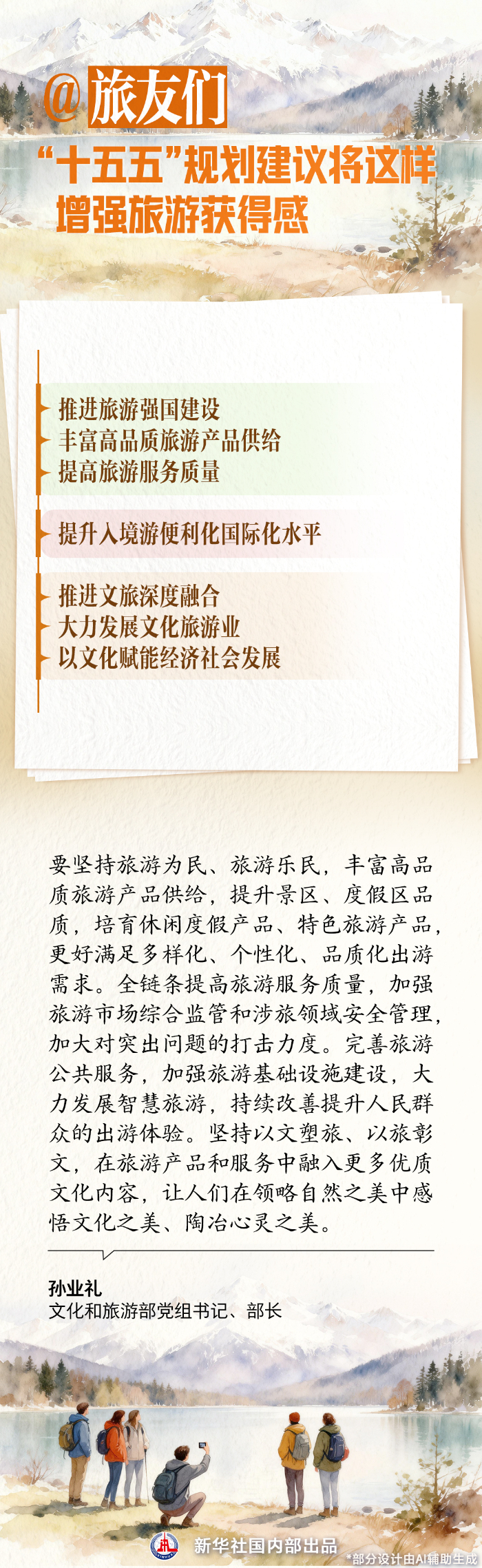
@旅友们,“十五五”规划建议将这样增强旅游获得感
Xin Hua Wang· 2025-12-29 06:14
Core Viewpoint - The article emphasizes the importance of enhancing the quality and diversity of tourism products and services in order to build a strong tourism nation and improve the overall travel experience for citizens [3][4]. Group 1: Tourism Development Strategies - The focus is on enriching high-quality tourism product supply and improving the quality of scenic spots and resorts to better meet diverse and personalized travel demands [4]. - There is a call for comprehensive improvement in tourism service quality, including strengthening market regulation and safety management in the tourism sector [4]. - The development of smart tourism and enhancement of public tourism services are highlighted as essential for improving the travel experience for the public [4]. Group 2: Cultural Integration in Tourism - The integration of culture into tourism products and services is emphasized, aiming to allow people to appreciate both natural beauty and cultural richness [4]. - The article advocates for deepening the fusion of culture and tourism, promoting cultural tourism as a means to empower economic and social development [3].

扎实推进文化强国、旅游强国建设——访文化和旅游部党组书记、部长孙业礼(权威访谈·学习贯彻党的二十届四中全会精神)
Ren Min Ri Bao· 2025-12-20 22:19
Core Viewpoint - The construction of a cultural and tourism power is essential for China's modernization, national rejuvenation, and international competitiveness, as emphasized by General Secretary Xi Jinping [1]. Group 1: Significance of Cultural and Tourism Power - Cultural prosperity is a key indicator of Chinese-style modernization, with significant achievements made since the 18th National Congress under the leadership of Xi Jinping [2]. - Promoting cultural and tourism power enhances the spiritual strength of the Chinese modernization process, which requires both material and spiritual resources [2]. - Meeting the high-quality life demands of the people is a primary goal of the 15th Five-Year Plan, with culture and tourism being vital components [3]. - The integration of culture and tourism is crucial for driving high-quality economic and social development, enhancing social civilization, and stimulating economic growth [3]. - Strengthening national soft power and cultural influence is increasingly important in the context of global competition [3]. Group 2: Implementation of Cultural Development - The cultural sector aims to provide richer and higher-quality cultural experiences for the people, ensuring cultural rights and promoting comprehensive human development [4]. - Creating high-quality artistic works that resonate with the times is essential, with a focus on nurturing talent and improving cultural production mechanisms [4]. - Enhancing public cultural services is a priority, aiming to increase accessibility and quality of cultural offerings through innovative and technology-driven solutions [5]. - Protecting and inheriting cultural heritage is vital for preserving Chinese civilization, with initiatives for systematic protection and innovative development [6]. Group 3: Development of Cultural and Tourism Industries - The integration of cultural and tourism industries is seen as a pathway to develop them into pillar industries that enhance people's livelihoods and happiness [7]. - Establishing a robust cultural industry system and market framework is necessary to stimulate innovation and competitiveness in the cultural sector [7]. - Promoting high-quality tourism development involves improving service quality and enhancing the overall tourist experience [8]. - Deepening the integration of culture and tourism will create new business models and extend industry chains, contributing to urban renewal and rural development [8]. Group 4: International Cultural Exchange - Enhancing international cultural exchange and cooperation is crucial for improving the global influence of Chinese civilization [9]. - Establishing a network for cultural dialogue and cooperation, particularly with countries involved in the Belt and Road Initiative, is a strategic focus [9]. - Promoting Chinese culture globally through traditional festivals and modern digital platforms will enhance cultural visibility [9]. - Improving the convenience and internationalization of inbound tourism services is essential for attracting more international visitors to China [10].
发展文化事业和文化产业
Ren Min Ri Bao· 2025-12-13 01:12
Group 1 - The core task of the 15th Five-Year Plan is to stimulate cultural innovation and development, emphasizing the importance of cultural prosperity and the development of the cultural industry [1][2] - The development of cultural undertakings and industries is crucial for enhancing the spiritual strength of the Chinese nation and meeting the new expectations of the people for cultural life [3][4] Group 2 - The cultural industry is recognized as a vital sector of the national economy, with recent years seeing a rapid integration of culture and technology, leading to new business models and consumption scenarios [11] - The plan emphasizes the need for a robust cultural industry system, including supportive economic policies and the cultivation of excellent cultural enterprises and brands [11][12] Group 3 - The proposal highlights the importance of high-quality public cultural services as a means to enhance the cultural rights and interests of the people, with a focus on improving service quality and accessibility [9][10] - The development of tourism is positioned as a key area for cultural and economic growth, with an emphasis on integrating cultural and tourism sectors to enhance the overall experience and quality of services [13][14]
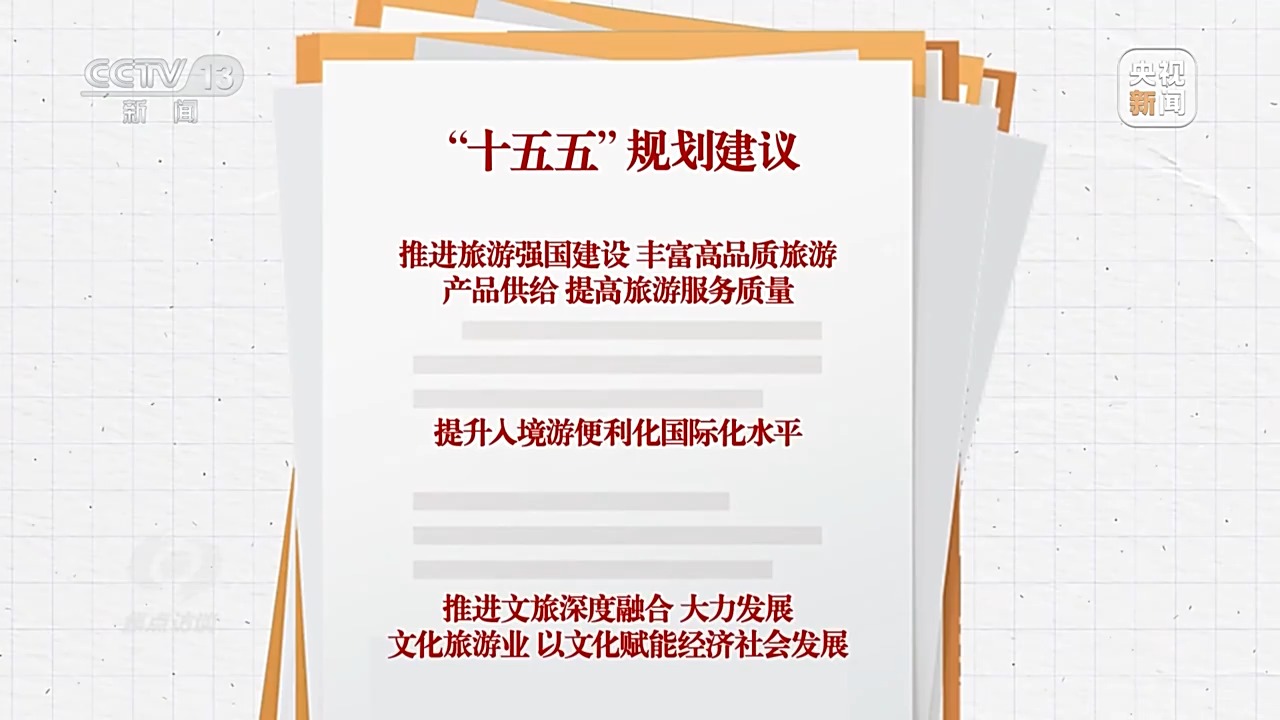
文旅融合再升级 “十五五”旅游新蓝图来了
Yang Shi Xin Wen Ke Hu Duan· 2025-12-11 13:09
Core Viewpoint - The article discusses the development of China's tourism industry under the "14th Five-Year Plan," emphasizing the goal of building a "tourism powerhouse" to enhance the quality and competitiveness of tourism services and products, while also integrating cultural elements into tourism experiences [3][12][31]. Group 1: Tourism Development Goals - The "14th Five-Year Plan" proposes to advance the construction of a tourism powerhouse, aiming to enrich high-quality tourism product supply and improve service quality [3][9]. - The plan highlights the importance of cultural tourism, aiming to empower economic and social development through deep integration of culture and tourism [31][12]. - The goal is to create a tourism industry that benefits both visitors and local residents, enhancing employment and local economies [11][12]. Group 2: Market Performance and Trends - In the first half of the year, domestic tourist trips reached 3.285 billion, a year-on-year increase of 20.6%, with spending reaching 3.15 trillion yuan, up 15.2% [9]. - China has established itself as the world's largest domestic tourism market, indicating a robust recovery and growth potential in the sector [9]. - The government has implemented various policies to stimulate tourism consumption, including measures to promote service consumption and develop new growth points in cultural tourism [7][26]. Group 3: Quality Improvement Initiatives - The plan emphasizes the need for high-quality tourism products that leverage local strengths, such as unique landscapes and cultural heritage, to create diverse and engaging travel experiences [18][21]. - Improving service quality is crucial, focusing on practical aspects like cleanliness and safety in tourism facilities, which directly impact visitor satisfaction [23][24]. - The government has built over 3,500 tourism service centers and renovated approximately 150,000 public toilets to enhance the tourism infrastructure [24][26]. Group 4: International Tourism and Policy Enhancements - The plan aims to enhance the convenience and internationalization of inbound tourism, with a target of 131.9 million inbound tourists by 2024, reflecting a 60.8% year-on-year increase [26][27]. - Recent policy changes include optimizing duty-free shop regulations and expanding visa-free transit policies to attract more foreign visitors [27][26]. - The government is addressing barriers faced by international tourists, such as payment and accommodation challenges, to improve the overall travel experience [26][27]. Group 5: Cultural Integration in Tourism - The integration of culture and tourism is identified as a key strategy for enhancing the tourism experience, allowing for a richer and more meaningful engagement with local heritage [31][33]. - Successful examples of cultural tourism initiatives include immersive experiences in historical sites and the promotion of local crafts and traditions [33][35]. - The article envisions a future where tourism experiences are deeply connected to cultural narratives, enriching both visitors and local communities [35].
新华鲜报·“十四五”发展亮点|1.65万家A级景区!越来越“美”的旅游
Xin Hua She· 2025-12-04 03:10
Core Insights - The "14th Five-Year Plan" period has seen the addition of approximately 2,600 new A-level scenic spots, bringing the total to 16,500 [1] - The "15th Five-Year Plan" aims to promote the construction of a strong tourism nation, enhance the supply of high-quality tourism products, and improve service quality [1] Group 1: Tourism Development - The number of new national-level tourism resorts, leisure streets, and night-time cultural tourism consumption areas has increased significantly, with 40 new resorts, 204 leisure streets, and 345 night-time cultural tourism areas established [2] - There are 1,597 key rural tourism villages and towns, along with over 1,400 provincial-level resorts and leisure areas, enhancing accessibility to beautiful scenic spots [2] Group 2: Industry Integration - The tourism sector is increasingly integrating with agriculture, industry, and sports, extending the industrial chain and fostering new growth points [2] - Localized development of rural tourism is being emphasized, with industrial production lines and heritage sites being transformed into tourism products [2] Group 3: Technological Advancements - Significant advancements in smart tourism have been made, with the establishment of 36 smart tourism solutions and 39 typical cases of age-friendly smart tourism [2] - The development of immersive experience spaces in tourism has been accelerated, enhancing service quality through technology [2] Group 4: Consumer Trends - There is a growing focus on diverse and personalized tourist demands, leading to the emergence of customized travel, educational tours, and family-oriented travel products [3] - The domestic tourism market is experiencing a resurgence, with a high growth rate in the number of trips and total spending, reaching new highs in the first half of 2025 [3] Group 5: Future Vision - The tourism industry is expected to play a crucial role in serving quality of life, promoting economic development, and enhancing China's image on the global stage [4]
新华鲜报·“十四五”发展亮点丨1.65万家A级景区!越来越“美”的旅游
Xin Hua Wang· 2025-12-04 01:29
Core Insights - The article highlights the significant growth in China's tourism sector during the "14th Five-Year Plan" period, with approximately 2,600 new A-level scenic spots established, bringing the total to 16,500 [1] - The "15th Five-Year Plan" aims to enhance the quality of tourism services and diversify high-quality tourism products, contributing positively to economic and social development [1] Group 1: Tourism Development - The introduction of 40 national-level tourist resorts, 204 national-level leisure streets, and 345 national-level night cultural and tourism consumption clusters showcases the expansion of tourism infrastructure [1] - The article emphasizes the accessibility of beautiful scenic spots and the variety of experiences available to tourists, with over 1,597 key rural tourism villages and towns and more than 1,400 provincial-level resorts and leisure areas [1] Group 2: Industry Integration - The integration of tourism with agriculture, industry, and sports has extended the industry chain and fostered new growth points, promoting rural tourism tailored to local conditions [2] - The transformation of industrial production lines and heritage sites into tourism products illustrates the potential of the "tourism+" model, which is gaining traction [2] Group 3: Technological Advancements - The development of smart tourism has accelerated, with 36 smart tourism solutions and 39 examples of age-friendly smart tourism, enhancing the overall visitor experience [2] - The article notes the increasing emphasis on technology in tourism, making services more personalized and immersive [2] Group 4: Visitor Experience - The tourism industry is focusing on diverse and personalized visitor needs, leading to the emergence of customized travel options, educational tours, family trips, and popular cruise and yacht experiences [5] - The recovery of the tourism sector post-pandemic is evident, with domestic travel and spending showing high growth rates, indicating a robust rebound [5] Group 5: Future Outlook - The tourism sector is positioned to better serve quality living, promote economic development, and enhance cultural exchange, contributing to China's modernization goals [6]
热词看未来|丰富高品质旅游产品供给
Xin Hua Wang· 2025-11-20 13:03
Group 1 - The core viewpoint of the article emphasizes the importance of advancing the construction of a tourism powerhouse and enhancing the quality of tourism services and product offerings [1][4]. - During the "14th Five-Year Plan" period, China's tourism industry is expected to see continuous optimization in product supply and service quality, with domestic travel and total spending maintaining a high growth rate [2]. - The integration of culture and tourism is being deeply promoted, creating new momentum and advantages for the cultural tourism industry through mutual empowerment [2][5]. Group 2 - The modernization of the tourism governance system in China has significantly improved, with the strategic position of tourism services in national economic and social development becoming increasingly prominent [4]. - The article outlines a series of reform and development tasks aimed at achieving high-quality development in the tourism sector over the next five years, based on the foundation laid during the "14th Five-Year Plan" [4]. - The focus on innovation and technology is highlighted as a means to create new tourism products, business models, and experiences, thereby enhancing the quality of life for the public and empowering economic and social development [5].
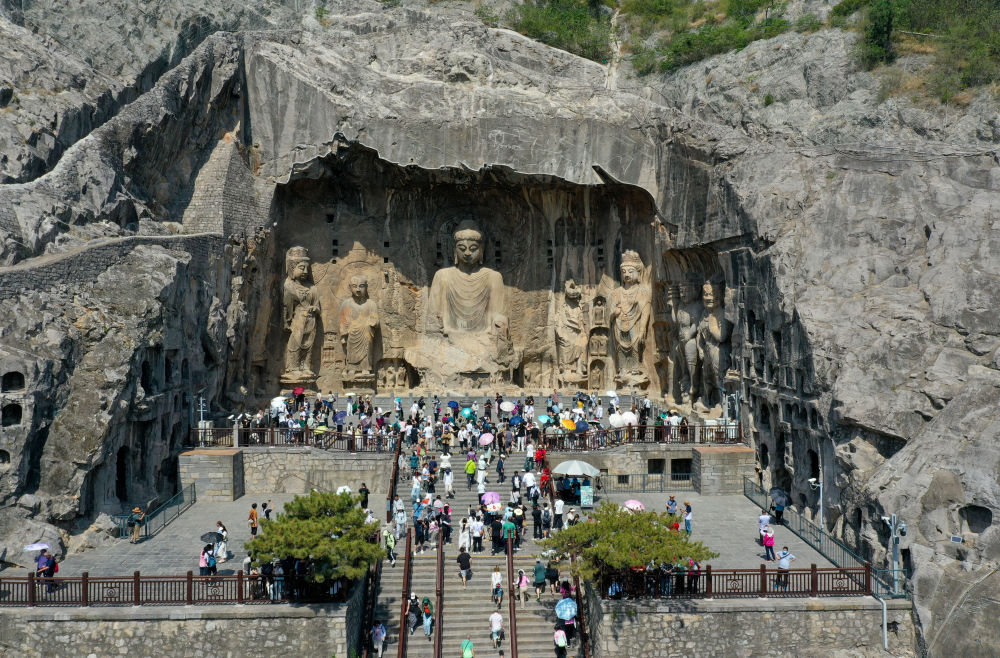
热词看未来丨丰富高品质旅游产品供给
Xin Hua She· 2025-11-19 02:26
Group 1 - The core viewpoint of the article emphasizes the importance of advancing the construction of a tourism powerhouse and enhancing the quality of tourism services and product supply [2][3] - During the "14th Five-Year Plan" period, China's tourism industry is expected to see continuous optimization in product supply and service quality, with domestic travel and total spending maintaining a high growth rate [3][5] - The integration of culture and tourism is highlighted as a key driver for new momentum and advantages in the tourism industry, with initiatives like "Cultural Tourism + Various Industries" stimulating consumption and job creation [3][5] Group 2 - The article outlines that the modernization of the tourism governance system in China has significantly improved, with the strategic importance of tourism services to the national economy and social development being increasingly recognized [5][7] - To achieve the goal of becoming a tourism powerhouse, the focus should be on enhancing tourism supply, releasing new tourism demands, and leveraging technology to create new products, business models, and experiences [7][9] - The article illustrates the role of cultural empowerment in economic and social development, aiming to enrich the lives of the people through innovative tourism offerings [7]
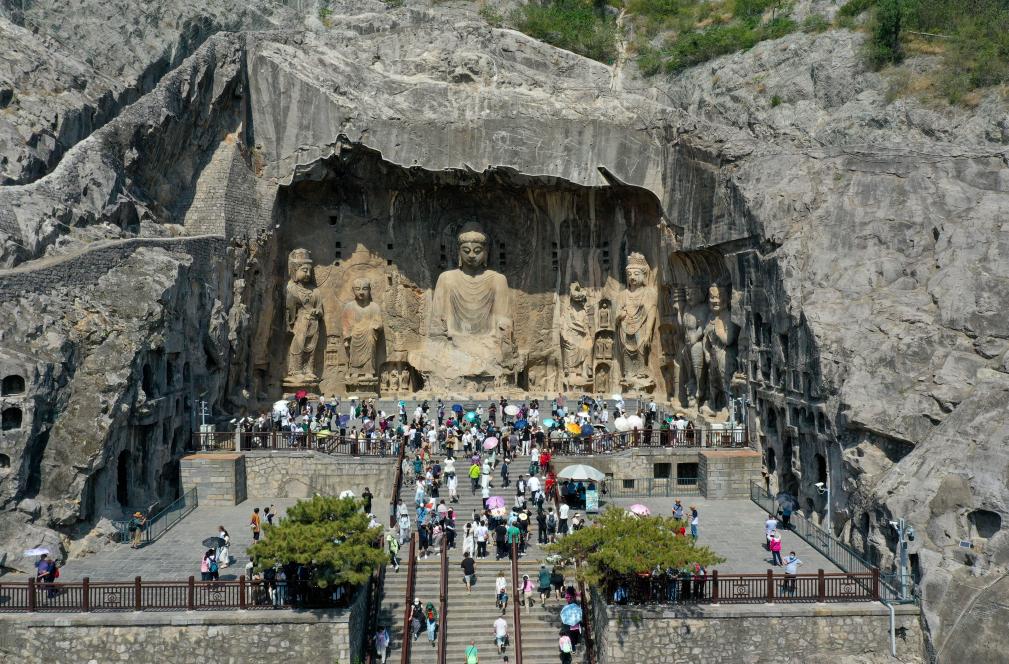
新征程·新蓝图|丰富产品供给提高服务质量 推进旅游强国建设
Xin Hua She· 2025-11-15 08:22
Core Insights - The central viewpoint emphasizes the importance of advancing the construction of a tourism powerhouse, enhancing the supply of high-quality tourism products, and improving service quality in the tourism sector [1][5]. Group 1: Tourism Development Strategy - The "14th Five-Year" period sees continuous optimization in the supply of tourism products and service quality, with domestic travel participation and total spending maintaining a high growth rate [3]. - The integration of culture and tourism is deepening, with a dual empowerment approach of "using culture to enhance tourism and using tourism to highlight culture," fostering new momentum and advantages for the cultural tourism industry [3]. Group 2: Policy Recommendations - The recommendations highlight the need to enhance the convenience and internationalization of inbound tourism, promoting deep integration of culture and tourism, and significantly developing the cultural tourism sector [5]. - The suggestions reflect a focus on supply-side reforms in the tourism industry during the "15th Five-Year" period, aiming to meet the people's needs for a better life through improved product supply and service quality [5].