
普信债

Search documents
1月PMI数据点评:制造业PMI超季节性回落,价格指数抬升
Western Securities· 2026-02-01 13:06
1. Report's Investment Rating for the Industry - No information provided regarding the industry investment rating in the report. 2. Core Viewpoints of the Report - In January 2026, the manufacturing PMI declined more than seasonally with supply - demand converging and enterprise - scale differentiation intensifying, while price indices rose. The service industry PMI slightly dropped and the construction industry's prosperity significantly declined, thus more efforts are needed to promote economic - stabilizing policies [1][10][34]. - In January, the shock of sentiment was gradually digested, and the bond market recovered after adjustment. However, there were still some constraints for a smooth short - term decline. The 10Y Treasury bond yield may return to the central part of the oscillation range in February. Two structural investment opportunities are recommended: the allocation opportunities of 5Y government - financial bonds and 3 - 5Y general - credit bonds, and the spread - compression opportunities such as 10Y CDB - 10Y Treasury bonds [4][34][35]. 3. Summary According to the Directory 3.1 1 - month PMI Data Overview - Manufacturing PMI declined by 0.8 percentage points to 49.3% in January, returning to the contraction range and being weaker than the seasonal average. The production index expansion slowed, demand was under pressure, price indices rose, and enterprises replenished inventory passively with a decline in purchasing willingness [10]. - In the non - manufacturing sector, the service industry PMI slightly decreased by 0.2 percentage points to 49.5%, and the construction industry's business activity index dropped by 4.0 percentage points to 48.8%, both showing different degrees of deviation from seasonal performance [11][14]. 3.2 Manufacturing: Demand - side Operation Under Pressure, Both Price Indices Rising - **Production**: The manufacturing PMI production index was 50.6% in January, down 1.1 percentage points month - on - month, weaker than the seasonal level. The slowdown was due to factors like cold weather and approaching Spring Festival, especially the over 4 - percentage - point decline in the consumer goods manufacturing production index [17]. - **Demand**: The new order index and new export order index of manufacturing PMI decreased by 1.6 and 1.2 percentage points respectively. The "new order - new export order" index dropped to 1.4%. Seasonal factors and external policy changes affected demand, but the proportion of manufacturing enterprises reporting insufficient market demand decreased [19]. - **Enterprise Scale and New Kinetic Energy**: The PMI of large, medium, and small enterprises decreased by 0.5, 1.1, and 1.2 percentage points respectively. New kinetic energy industries continued to lead, while traditional industries' prosperity declined [20]. - **Price**: Affected by multiple factors, the main raw material purchase price index and ex - factory price index were 56.1% and 50.6% respectively, up 3.0 and 1.7 percentage points month - on - month. The index difference reached 5.5 percentage points, compressing the profit space of mid - and downstream enterprises [23]. - **Inventory**: The raw material inventory index decreased by 0.4 percentage points, and the finished - product inventory increased by 0.4 percentage points. The economic kinetic energy index decreased by 2.0 percentage points, and the purchasing volume index dropped to 48.7%. The start of the replenishment cycle depends on the recovery of market demand [24]. 3.3 Non - manufacturing: Slight Decline in Service Industry PMI, Significant Decline in Construction Industry - **Service Industry**: In January, the service industry PMI slightly declined. The strong support from the financial industry, the stable development of new kinetic energy, and the good performance of some consumption - related service industries maintained its stability. However, the real - estate industry's business activity index fell below 40.0%, and Spring Festival consumption may boost the consumption - related service industries [29]. - **Construction Industry**: Due to cold weather and the approaching Spring Festival, the construction industry's business activity index decreased by 4.0 percentage points to 48.8% in January. Both housing construction and civil engineering construction activities slowed down, and the off - season characteristics may continue in February [32]. 3.4 Impact on the Bond Market - In January, after the shock of sentiment was digested, the bond market recovered. The 10Y Treasury bond yield dropped to the lower limit of the 1.8% - 1.9% oscillation range. With insufficient broad - money expectations and increased local - bond supply in February, the 10Y Treasury bond yield may return to the central part of the oscillation range. Two parts of structural investment opportunities are recommended [4][34][35].
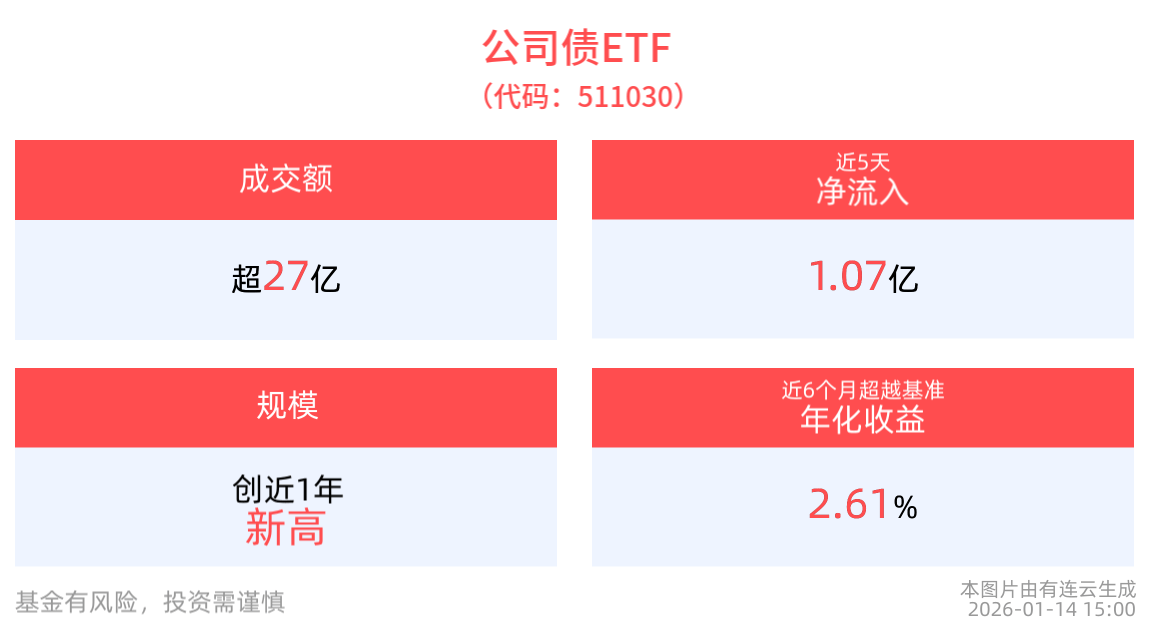
成交额超27亿元,公司债ETF(511030)近5个交易日净流入1.07亿元
Sou Hu Cai Jing· 2026-01-15 01:46
Group 1: Credit Bond Market Performance - Credit bond yields showed mixed results, with 10Y major bank secondary bonds down by 2.05 basis points, while 7Y bonds increased by 0.5 basis points [1] - In the industrial bond sector, yields varied, with notable decreases in 25 Hebei Zhongfeng MTN001A by 4.22 basis points and 25 BWS SCP006 by 3.35 basis points, while 25 Anhui Investment MTN002 increased by 10.13 basis points [1] - City investment bonds also exhibited mixed performance, with 25 Linggui City Investment SCP002 down by 12.83 basis points and 21 Gantou 01 up by 47.59 basis points [1] Group 2: Institutional Investment Trends - Institutions recommend continuing to favor equities over bonds, with net selling of long-term bonds decreasing significantly [2] - On January 14, net buying of 10Y government bonds by securities firms reached 17 billion, while insurance funds increased their holdings by 65 billion [2] - The trading volume in the stock market reached 4 trillion, contributing to the recent rise in DR001 rates [2] Group 3: Company Bond ETF Insights - As of January 14, 2026, the company bond ETF (511030) was priced at 106.76, with a 1.48% increase over the past year [5] - The latest scale of the company bond ETF reached 34.115 billion, marking a one-year high, with a recent inflow of 1.07 million over the last five trading days [6] - The company bond ETF has maintained a tracking error of 0.003% this year, closely following the China Bond - Medium to High Grade Corporate Bond Spread Factor Index [7]

11月信用策略:信用利差压缩后半场
GOLDEN SUN SECURITIES· 2025-11-09 07:10
Core Insights - The report indicates that the credit spread compression is entering its second half, with expectations of further declines in the bond market during November and December due to central bank actions and reduced government bond supply [5][8]. - The credit market has shown limited room for further gains, particularly for short to medium-term credit bonds, as many have approached or breached previous lows [2][13]. - The behavior of institutional investors is constrained by upcoming regulatory changes and valuation adjustments, leading to limited incremental funds for credit bonds [3][14]. Credit Market Performance - In October, the bond market experienced fluctuations, with credit spreads narrowing as the 10-year government bond yield decreased from 1.788% to 1.741% by the end of the month [1][8]. - The narrowing of credit spreads was more pronounced in medium to long-term credit bonds compared to short-term ones, indicating a preference for longer durations [1][8]. - The report highlights that the valuation of credit bonds, particularly those rated AAA and AA+, has limited downward space, with most nearing previous lows [2][13]. Institutional Behavior - The anticipated reform of fund fee structures has led to a significant reduction in bond fund volumes, with a cautious approach expected from funds until the formal guidelines are released [3][14]. - Wealth management products are expected to maintain stable incremental funds, but their allocation to bonds may remain conservative due to valuation adjustments required by year-end [3][14]. - The recent performance of the Sci-Tech Innovation Bond ETF has shown limited growth, indicating a lack of substantial incremental demand in the credit market [3][14]. Seasonal Trends - Historically, credit spreads tend to fluctuate towards the end of the year, with limited independent trends observed in the fourth quarter [4][5]. - The report notes that while the credit market may not perform poorly at year-end, it often lags behind interest rate movements, with institutions prioritizing government bonds [4][5]. Future Outlook - The report suggests that the credit spread compression is likely to continue, with a focus on structural opportunities within the credit market as incremental funds remain limited [5][8]. - For investors seeking excess returns, the report recommends exploring lower-rated bonds in the 4-5 year range or focusing on longer-duration bonds with stable liquidity [5][8].