
城投债

Search documents
【立方债市通】河南再添AAA主体/河南港航集团增资至50亿/豫资控股集团拟发债20亿
Sou Hu Cai Jing· 2026-02-26 13:13
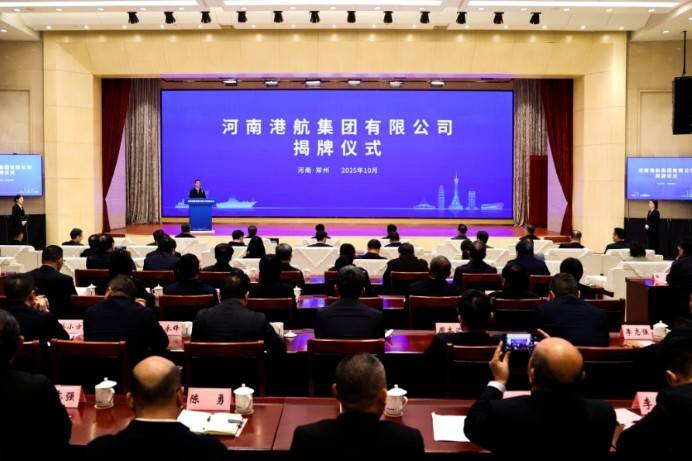
Group 1 - Henan Port and Shipping Group has increased its registered capital from 1 billion RMB to 5 billion RMB, marking a 400% increase [1] - Zhengzhou Aviation Port Science and Technology Group has received an AAA credit rating from China Chengxin International, with a stable outlook [3] - The Ministry of Finance plans to issue a 182-day discount treasury bond with a total face value of 45 billion RMB, with bidding scheduled for March 4, 2026 [4] Group 2 - The People's Bank of China conducted a 3,205 billion RMB 7-day reverse repurchase operation at a fixed rate of 1.40%, resulting in a net withdrawal of 795 billion RMB for the day [6] - The issuance of technology innovation bonds in Henan Province has surpassed 20 billion RMB, with a focus on financing technology-oriented enterprises [7] - The Anhui Capital Operation Group has submitted a registration for a public issuance of corporate bonds amounting to 5 billion RMB, with funds allocated for debt repayment and equity investment [12] Group 3 - The Guizhou Industrial Development Holding Group has appointed a new chairman, indicating a shift in leadership [13] - The Shenzhen Stock Exchange has terminated the review of two asset-backed securities projects totaling 2.7 billion RMB [15] - Zhejiang Fixed Income reports a slight decline in risk appetite for urban investment bonds, with cautious duration strategies being adopted [16]

渤海证券研究所晨会纪要(2026.02.25)-20260225
BOHAI SECURITIES· 2026-02-25 00:24
Group 1: Fixed Income Research - The core viewpoint indicates a slight increase in transaction scale with a majority of credit spreads narrowing, as the overall issuance guidance rates have mostly decreased by -4 basis points to 0 basis points [2] - The issuance scale of credit bonds has decreased on a month-on-month basis, with corporate bonds maintaining zero issuance, while other varieties have seen a reduction in issuance amounts [2] - The secondary market has experienced a slight increase in credit bond transaction amounts, with corporate bonds and medium-term notes seeing increases, while company bonds, short-term financing bonds, and targeted tools have decreased [2] - The report suggests that the overall conditions for a bear market in credit bonds are still insufficient, with a long-term downward trend in future yields expected, and a strategy of increasing allocation during adjustments remains feasible [2] Group 2: Real Estate Policy and Market - Continuous optimization of real estate policies by central and local governments is positively impacting the stabilization of the real estate market, with a shift from large-scale expansion to quality improvement [3] - The recovery process in real estate sales will significantly affect bond valuations, and investors with higher risk tolerance may consider early positioning, especially in companies showing improved financing and sales performance [3] - The focus for allocation remains on historically stable valuations of high-performing state-owned enterprises and quality private enterprise bonds with strong guarantees, which can enhance yields over longer durations [3] Group 3: Industry Research on Light Industry and Textiles - The U.S. Supreme Court ruled that the large-scale tariff policies of the Trump administration were illegal, leading to a marginal decrease in tariffs on imports from China [5][6] - The light industry manufacturing sector outperformed the CSI 300 index by 0.17 percentage points, while the textile and apparel sector underperformed by 3.14 percentage points [6] - The report maintains a "neutral" rating for the light industry and textile sectors, with specific companies like Oppein Home (603833) and Sophia (002572) receiving "overweight" ratings [7]
2026政府平台融资新政:专项债+特别国债发力,6大工具+4大模式合规指南
Sou Hu Cai Jing· 2026-01-29 08:58
Core Viewpoint - The financing landscape for government platform companies in 2026 is undergoing significant adjustments, focusing on market-oriented transformations and compliance requirements, supported by proactive fiscal and moderate monetary policies [1]. Group 1: Government Bond Financing - Local government special bonds will see a major breakthrough in quota, usage, and duration, serving as a cornerstone for platform company financing [3]. - The new special bond quota will be determined by the Ministry of Finance, with early allocations expected to meet the funding needs of key projects [3]. - The proportion of project capital that can be covered by special bonds remains stable at 30%, effectively leveraging market financing [3]. Group 2: Policy and Market Tools - Policy-driven financial tools will provide over 1 trillion yuan in credit and 500 billion yuan in structural tools, targeting key strategic projects [8]. - New regulations for trust financing will introduce four compliant products, allowing white-listed enterprises to access funds within one month [9]. - Bank loans will benefit from reduced interest rates and innovative collateral options, with guarantee fees dropping below 1% [10]. Group 3: Innovative Financing and Industry Empowerment - The focus on "stock activation" and "industry empowerment" will drive new financing models, including REITs and data asset financing [11]. - Infrastructure REITs will expand rapidly, with new asset classes being included and approval processes streamlined [12]. - Industry funds will target strategic emerging industries, leveraging government and social capital partnerships to enhance investment [13]. Group 4: Debt Resolution and Credit Enhancement - A plan for replacing 2.8 trillion yuan of hidden debt will be implemented, emphasizing the use of various channels for debt optimization [17]. - Government financing guarantees will be enhanced, allowing for a tenfold increase in support for market-oriented projects [18]. - State-owned capital operations will focus on integrating quality assets to improve financing capabilities [20]. Group 5: Compliance Requirements for Financing - Platform companies must meet six core compliance requirements to secure financing, including a minimum credit rating of AA- and restrictions on financing purposes [21]. - The focus areas for financing are limited to compliant sectors such as infrastructure and urban renewal, with strict prohibitions on real estate investments [21]. - Clear repayment sources and robust credit enhancement measures are essential for compliance with market financing requirements [21].

每日债市速递 | 本周央行公开市场将有9515亿元逆回购到期
Wind万得· 2026-01-18 23:55
Group 1: Open Market Operations - The central bank conducted a 7-day reverse repurchase operation of 867 billion yuan at a fixed rate of 1.40% on January 16, resulting in a net injection of 527 billion yuan for the day after accounting for 340 billion yuan in reverse repos maturing [2] - For the week, a total net injection of 812.8 billion yuan was achieved [2] - Upcoming reverse repos of 9.515 billion yuan are set to mature from January 19 to 23, along with 1.5 billion yuan in treasury cash deposits maturing on the 23rd [2] Group 2: Funding Conditions - The interbank market is gradually becoming more relaxed, with the weighted average rate of DR001 dropping over 4 basis points to around 1.32% [4] - Overnight rates in the anonymous click (X-repo) system have also decreased to approximately 1.30%, with supply around 100 billion yuan [4] - Non-bank institutions are borrowing overnight against pledged credit bonds at rates concentrated around 1.45% [4] Group 3: Interest Rates and Yields - The yield on major interbank bonds has generally declined [6] - The latest one-year interbank certificates of deposit are trading around 1.63%, showing a slight decrease from the previous day [7] - Government bond futures closed mostly higher, with the 10-year main contract rising by 0.01% [11] Group 4: Regulatory Developments - The China Securities Regulatory Commission (CSRC) emphasized maintaining stability in the market and preventing large fluctuations, while also promoting reforms in the ChiNext and STAR Market to enhance refinancing convenience [12] - The State-owned Assets Supervision and Administration Commission (SASAC) is focusing on optimizing the layout and structure of state-owned enterprises in 2026 [12] Group 5: Global Macro Insights - The Bank of Japan is increasingly concerned about the risks of inflation due to a weakening yen, potentially leading to an upward revision of economic growth and inflation expectations for the fiscal year 2026 [14] - Barclays analysts project that U.S. corporate bond issuance will reach $2.46 trillion in 2026, an 11.8% increase from 2025, driven by demand in the artificial intelligence sector [14] Group 6: Bond Market Events - Fitch Ratings upgraded the long-term credit rating of Dalian Wanda Commercial Management Group from RD to CC [16] - Goldman Sachs plans to issue bonds to raise $16 billion, setting a record for Wall Street banks [16] - U.S. overseas investors increased their net holdings of U.S. Treasury bonds by $85.6 billion in November 2025 [16]

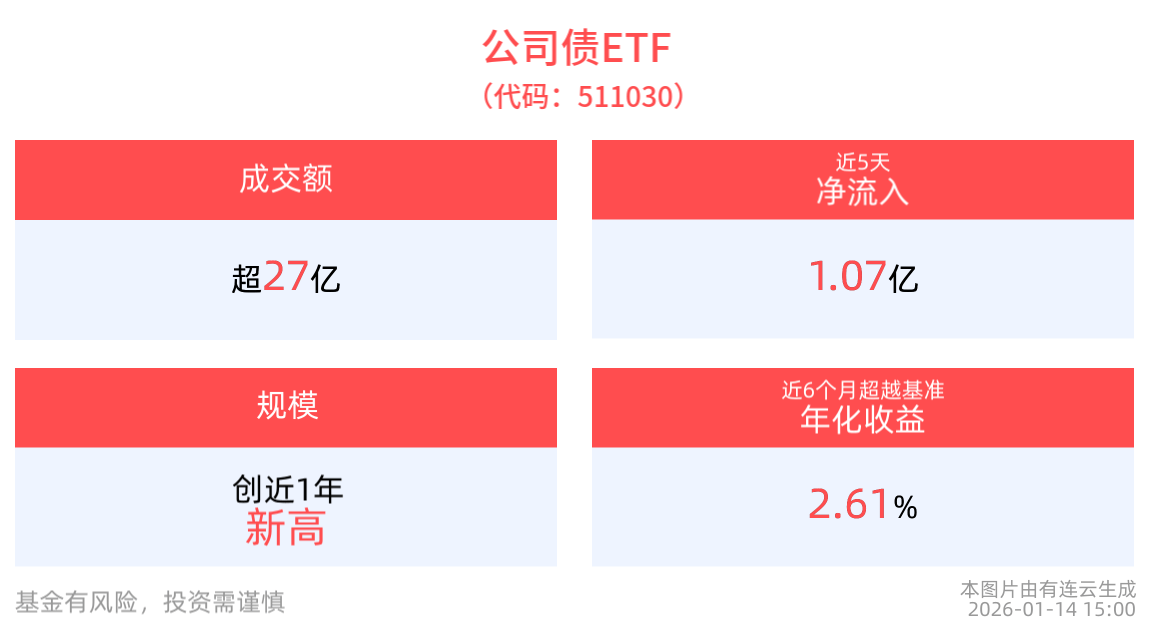
成交额超27亿元,公司债ETF(511030)近5个交易日净流入1.07亿元
Sou Hu Cai Jing· 2026-01-15 01:46
Group 1: Credit Bond Market Performance - Credit bond yields showed mixed results, with 10Y major bank secondary bonds down by 2.05 basis points, while 7Y bonds increased by 0.5 basis points [1] - In the industrial bond sector, yields varied, with notable decreases in 25 Hebei Zhongfeng MTN001A by 4.22 basis points and 25 BWS SCP006 by 3.35 basis points, while 25 Anhui Investment MTN002 increased by 10.13 basis points [1] - City investment bonds also exhibited mixed performance, with 25 Linggui City Investment SCP002 down by 12.83 basis points and 21 Gantou 01 up by 47.59 basis points [1] Group 2: Institutional Investment Trends - Institutions recommend continuing to favor equities over bonds, with net selling of long-term bonds decreasing significantly [2] - On January 14, net buying of 10Y government bonds by securities firms reached 17 billion, while insurance funds increased their holdings by 65 billion [2] - The trading volume in the stock market reached 4 trillion, contributing to the recent rise in DR001 rates [2] Group 3: Company Bond ETF Insights - As of January 14, 2026, the company bond ETF (511030) was priced at 106.76, with a 1.48% increase over the past year [5] - The latest scale of the company bond ETF reached 34.115 billion, marking a one-year high, with a recent inflow of 1.07 million over the last five trading days [6] - The company bond ETF has maintained a tracking error of 0.003% this year, closely following the China Bond - Medium to High Grade Corporate Bond Spread Factor Index [7]
每日债市速递 | 中国11月经济“成绩单”出炉
Wind万得· 2025-12-15 22:38
Monetary Policy Operations - The central bank conducted a 7-day reverse repurchase operation on December 15, with a fixed rate and a total of 130.9 billion yuan, at an interest rate of 1.40%. The total bid and awarded amount was also 130.9 billion yuan. On the same day, 122.3 billion yuan of reverse repos matured, resulting in a net injection of 8.6 billion yuan [1]. Market Liquidity - The interbank market maintained a loose liquidity environment, with the overnight repo weighted average rate (DR001) slightly decreasing. The overnight quotes in the anonymous click (X-repo) system remained around 1.25%, but supply showed a significant contraction. Non-bank institutions' pledging of credit bonds for overnight funding was quoted at around 1.45% [3]. Interbank Certificates of Deposit - The latest transaction for one-year interbank certificates of deposit among major banks was around 1.66%, showing little change from the previous day [7]. Government Bond Futures - The closing prices for government bond futures showed declines: the 30-year main contract fell by 0.99%, the 10-year by 0.12%, the 5-year by 0.03%, the 2-year by 0.01% [12]. Economic Performance - In November, the industrial added value above designated size increased by 4.8% year-on-year and 0.44% month-on-month. The service production index rose by 4.2% year-on-year. However, the total retail sales of consumer goods grew by only 1.3% year-on-year, with a month-on-month decline of 0.42%. From January to November, fixed asset investment (excluding rural households) decreased by 2.6%, while investment excluding real estate development increased by 0.8%. Real estate development investment fell by 15.9%, and the sales area of new commercial housing dropped by 7.8% [13]. Technological Advancements - The Ministry of Industry and Information Technology announced the first batch of L3 conditional autonomous driving vehicle permits, marking a significant step towards commercial application in designated areas of Beijing and Chongqing [13]. Global Trade Developments - India is nearing a "framework" agreement with the U.S. but has not provided a timeline. The country is also negotiating with Mexico regarding tariff increases, which could impact approximately 2 billion USD in exports. In November, India's trade deficit was 24.53 billion USD, better than the expected 32 billion USD, driven by exports in engineering, electronics, and gems [16].

交易型指数基金资金流向周报-20250922
Great Wall Securities· 2025-09-22 09:21
Group 1: Core Insights - The report analyzes the fund flow of exchange-traded index funds from September 15 to September 19, 2025, highlighting significant trends in various categories [1][2]. - The overall fund flow indicates a mixed performance across different index categories, with notable outflows in major indices like the Shanghai Composite and CSI 300 [6][7]. Group 2: Fund Flow by Category - The Shanghai 50 index had a fund size of 159.46 billion yuan, with a weekly decline of 1.71% and a net outflow of 5.98 billion yuan [6]. - The CSI 300 index, with a fund size of 983.45 billion yuan, experienced a slight decline of 0.39% and a significant net outflow of 33.92 billion yuan [6]. - The ChiNext index showed a positive trend with a weekly increase of 2.17% and a net inflow of 5.76 billion yuan, indicating investor interest in growth sectors [6]. - In the technology sector, the large technology category saw a fund size of 216.69 billion yuan, with a weekly increase of 2.20% and a substantial net inflow of 58.01 billion yuan [7]. - The large financial category faced a decline of 3.20% with a net inflow of 140.61 billion yuan, suggesting a shift in investor sentiment [7]. Group 3: Sector Performance - The healthcare sector had a fund size of 100.16 billion yuan, with a weekly decline of 2.11% and a modest net inflow of 5.94 billion yuan, reflecting cautious investor behavior [7]. - The manufacturing sector reported a fund size of 72.82 billion yuan, with a weekly increase of 2.19% and a net inflow of 64.79 billion yuan, indicating resilience in this area [7]. - The consumer sector showed a slight decline of 0.24% with a net inflow of 32.55 billion yuan, suggesting mixed investor confidence [7]. Group 4: International Indices - The Nasdaq 100 index had a fund size of 78.42 billion yuan, with a weekly increase of 1.84% and a net outflow of 0.67 billion yuan, indicating fluctuating investor interest [11]. - The S&P 500 index reported a fund size of 20.84 billion yuan, with a slight increase of 0.50% and a net inflow of 0.77 billion yuan, reflecting stable performance [11]. - The Hang Seng index had a fund size of 19.17 billion yuan, with a weekly increase of 0.40% and a net outflow of 3.72 billion yuan, suggesting challenges in the Hong Kong market [11].
政府债周报:2万亿化债再融资债即将发完-20250919
Guoxin Securities· 2025-09-19 11:03
Report Industry Investment Rating No relevant content provided. Core View No specific core view was clearly presented in the given text. Summary by Related Content Government Bond Net Financing - Government bond net financing was 60.84 billion yuan in Week 37 (9/8 - 9/14) and 31.79 billion yuan in Week 38 (9/15 - 9/21). As of Week 37, the cumulative amount reached 1.11 trillion yuan, exceeding the same period last year by 490 billion yuan [1][7]. - The sum of national debt net financing and new local bond issuance was 56.22 billion yuan in Week 37 and 40.56 billion yuan in Week 38. As of Week 37, the cumulative general deficit was 870 billion yuan, with a progress of 78.5%, surpassing the same period last year [1][7]. National Debt - National debt net financing was 41.56 billion yuan in Week 37 and 28.71 billion yuan in Week 38. The total national debt net financing for the year is 666 billion yuan. As of Week 37, the cumulative amount was 530 billion yuan, with a progress of 78.9%, exceeding the average of the past five years [10]. Local Debt - Local debt net financing was 19.28 billion yuan in Week 37 and 3.09 billion yuan in Week 38. As of Week 37, the cumulative amount was 590 billion yuan, exceeding the same period last year by 280 billion yuan [12]. - New general debt issuance was 1.47 billion yuan in Week 37 and 2.07 billion yuan in Week 38. The local deficit for 2025 is 80 billion yuan. As of Week 37, the cumulative new general debt was 63.55 billion yuan, with a progress of 79.4%, exceeding the same period last year [12]. - New special - purpose debt issuance was 13.19 billion yuan in Week 37 and 9.78 billion yuan in Week 38. The planned new special - purpose debt for 2025 is 440 billion yuan. As of Week 37, the cumulative amount was 340 billion yuan, with a progress of 77.6%, exceeding the same period last year. Special new special - purpose debt of 118.19 billion yuan has been issued, including 21.4 billion yuan since September. Land reserve special - purpose debt of 33.02 billion yuan has been issued [2][15]. Special Refinancing Bonds - Special refinancing bond issuance was 2.62 billion yuan in Week 37 and 2.14 billion yuan in Week 38. As of Week 37, the cumulative amount was 196 billion yuan, with a issuance progress of 98% [2][30]. Urban Investment Bonds - Urban investment bond net financing was 1.55 billion yuan in Week 37 and is expected to be - 0.7 billion yuan in Week 38. As of this week, the balance of urban investment bonds is 1.02 trillion yuan [3][33].
交易型指数基金资金流向周报-20250828
Great Wall Securities· 2025-08-28 03:37
Report Information - Report Title: Weekly Report on Capital Flows of Exchange-Traded Index Funds [1] - Data Date: August 18 - 22, 2025 [1] - Analyst: Jin Ling [1] - Report Date: August 28, 2025 [1] Core Findings Domestic Passive Equity Funds - Different index funds showed varying performance in terms of fund size, weekly returns, and net weekly capital inflows. For example, the Shanghai - Shenzhen 300 index fund had a size of 983.449 billion yuan, a weekly return of 4.27%, and a net weekly capital outflow of 34.74 billion yuan; while the ChiNext Index fund had a size of 126.448 billion yuan, a weekly return of 5.81%, and a net weekly capital inflow of 22.61 billion yuan [4]. Overseas Index Funds - International index funds also had diverse performance. The Nasdaq 100 index fund had a size of 78.421 billion yuan, a weekly return of -3.08%, and a net weekly capital inflow of 7.78 billion yuan; the S&P 500 index fund had a size of 20.837 billion yuan, a weekly return of -1.63%, and a net weekly capital outflow of 1.44 billion yuan [5]. Bond Funds - Bond funds had different performance based on factors such as maturity and credit rating. The 30 - year bond fund had a size of 8.969 billion yuan, a weekly return of -1.25%, and a net weekly capital inflow of 59.60 billion yuan; the short - term financing bond fund had a size of 29.341 billion yuan, a weekly return of 0.01%, and a net weekly capital outflow of 28.50 billion yuan [6]. Commodity Funds - Commodity funds, including gold, soybean meal, and others, also had distinct performance. The gold fund had a size of 70.887 billion yuan, a weekly return of -0.29%, and a net weekly capital outflow of 0.94 billion yuan; the energy and chemical fund had a size of 2.93 billion yuan, a weekly return of 0.76%, and a net weekly capital inflow of 0.88 billion yuan [6]. Index - Enhanced Funds - Index - enhanced funds based on different indices had different performance. The CSI 500 index - enhanced fund had a size of 1.978 billion yuan, a weekly return of 3.76%, and a net weekly capital inflow of 0.12 billion yuan; the ChiNext Index - enhanced fund had a size of 0.469 billion yuan, a weekly return of 5.46%, and a net weekly capital outflow of 0.04 billion yuan [6].
财达证券助力淄博城运成功发行18亿元公司债券
Zheng Quan Ri Bao Wang· 2025-08-05 12:40
Group 1 - The core viewpoint of the news is that Zibo Urban Asset Operation Group successfully issued non-public corporate bonds, indicating strong market interest and favorable financing conditions [1][2] - The bond issuance consists of two varieties: the first with a scale of 1.3 billion yuan and a 3-year term at a coupon rate of 2.28%, and the second with a scale of 500 million yuan and a 5-year term at a coupon rate of 2.67% [1] - Zibo Urban Asset Operation Group, established in July 2003, is a key player in infrastructure investment and state asset operation in Zibo City, with diversified business operations including trade, chemical, engineering, mining, land consolidation, and asset management [1] Group 2 - Since 2025, the city investment bond market has seen a contraction in net financing, with a downward trend in credit bond issuance costs and average coupon rates [2] - The issuance of long-term bonds allows issuers to lock in lower financing costs amid a declining interest rate environment, attracting a wide range of investors including banks, securities firms, and asset management companies [2] - The successful bond issuance reflects strong market recognition of Zibo Urban Asset Operation Group and is expected to enhance strategic cooperation with financial institutions for better financing services [2]
