
景气成长

Search documents
我们基金经理榜单是如何筛选的?有哪些基金经理今年值得关注?
Sou Hu Cai Jing· 2026-01-08 13:06
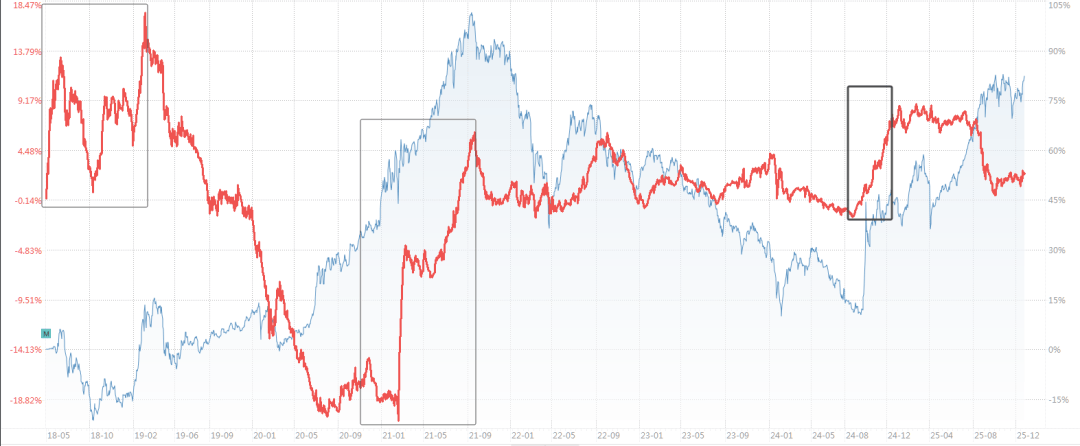
Core Viewpoint - The article emphasizes the importance of "long-term excess return stability" as the primary criterion for selecting fund managers, highlighting the significance of consistent performance over time rather than short-term gains [2][11]. Group 1: Key Metrics for Fund Selection - The main indicator for selecting fund managers is "long-term excess return stability," which reflects three key dimensions: stable fund manager style, sustained alpha capability, and large strategy capacity [2]. - The observation method involves comparing fund performance against corresponding style beta indices, with a stable line indicating stable excess returns [2]. - A preference is shown for funds with consistent excess returns rather than those with sporadic high performance, which may be influenced by luck [2]. Group 2: Notable Fund Managers - Several fund managers from E Fund are highlighted for their stable excess returns, including Yang Zhenshao, Chen Hao, Wang Xiaocheng, Qi He, and Zhang Qinghua, all of whom have demonstrated strong performance over extended periods [4][5][7][8][9]. - Zheng Xi, a veteran fund manager with 19 years of experience, is noted for his consistent performance in the technology sector, achieving significant returns in 2025 [12]. - Wu Yang is recognized for his ability to adapt investment strategies in response to market changes, showcasing flexibility in portfolio management [18][21]. Group 3: Market Insights - The article discusses the current underperformance of quality style investments, suggesting that the market may soon favor these strategies as economic conditions improve [24][27]. - The article indicates that the consumer index is currently undervalued, with a PE ratio of 19.5, suggesting potential for future growth as market conditions stabilize [26][27]. - The overall strength of E Fund's investment team is highlighted, suggesting that a strong research platform and talent development contribute to the consistent performance of its fund managers [28].

中金公司:逢低布局跨年行情 建议关注三条主线
Zheng Quan Shi Bao Wang· 2025-12-22 00:19
Core Viewpoint - Recent fluctuations in A-shares have led to divergent expectations among investors during the "cross-year" phase, but the short-term impact of internal and external factors on A-shares may be nearing its end, with a relatively loose liquidity environment expected to persist into the first quarter of next year [1] Group 1: Market Environment - The current low-interest-rate environment is likely to continue driving the trend of "deposit migration" among residents, providing a favorable opportunity for investors to position themselves for the "cross-year" market [1] - The recent pullback in indices has created a good entry point for investors looking to capitalize on upcoming market trends [1] Group 2: Investment Strategy - Investors are advised to focus on growth styles during market dips, while dividend styles should emphasize phase-specific and structural opportunities [1] - Three main investment themes are recommended: 1. **Growth in Prosperous Sectors**: The AI technology sector is expected to transition into an application phase next year, with opportunities in computing power, optical modules, and cloud computing infrastructure, particularly in domestic markets. Key application areas include robotics, consumer electronics, intelligent driving, and software applications. Additionally, innovative pharmaceuticals, energy storage, and solid-state batteries are entering a prosperous cycle [1] 2. **External Demand Breakthrough**: The trend of going overseas presents a relatively certain growth opportunity. Sectors to focus on include home appliances, construction machinery, commercial buses, power grid equipment, gaming, and globally priced resources such as non-ferrous metals [1] 3. **Cyclical Reversal**: Attention should be given to sectors nearing improvement points in supply-demand dynamics or benefiting from policy support, such as chemicals, aquaculture, and new energy [1] - Dividend sectors possess defensive attributes but may still be more phase-specific and structural in nature, suggesting a bottom-up stock selection approach based on quality free cash flow [1]

港股通50ETF(159712)涨超1.1%,景气成长与红利策略受关注
Sou Hu Cai Jing· 2025-12-19 05:23
Group 1 - The core viewpoint emphasizes a "growth and dividend" strategy in industry allocation, favoring high-quality large internet companies, particularly in e-commerce, media, and entertainment sectors, with a focus on leading AI enterprises [1] - There is a strong demand in technology hardware supply sectors driven by global AI infrastructure capital expenditure growth, particularly in areas like optical modules, PCBs, and AI data center cooling [1] - The "anti-involution" policy is expected to optimize industry supply and demand, leading to potential profit margin recovery in sectors such as photovoltaics, batteries, and chemicals [1] Group 2 - The Hong Kong Stock Connect 50 ETF (159712) tracks the Hong Kong Stock Connect 50 Index (930931), which selects the 50 largest listed companies within the Stock Connect range, covering 18 industries and primarily focusing on large-cap leading stocks [1] - The index exhibits a balanced industry distribution, incorporating characteristics of both new and traditional economies, including finance, discretionary consumption, and communication services, reflecting the overall performance of large-cap leading enterprises in the Hong Kong Stock Connect [1]
中信建投:市场或继续维持震荡轮动状态
Zheng Quan Shi Bao Wang· 2025-11-16 23:53
Group 1 - The core viewpoint of the article is that after the improvement in China-US relations, market risk appetite has decreased, leading to fluctuations around the 4000-point mark for the Shanghai Composite Index [1] - The average trading volume for the entire A-share market has decreased to around 2 trillion yuan [1] - Recent capital flows have been active in thematic investments and sectors with growth potential, indicating a shift in market focus [1] Group 2 - The market is expected to continue its oscillating and rotating characteristics, with the key to breaking the current state lying in capital attacking new main lines [1] - The mid-term allocation strategy suggested is to adopt a balanced approach, focusing on clear growth signals without excessive switching [1] - Key sectors to watch include dividends, new chemical materials, superhard materials, lithium battery materials, steel, agriculture, forestry, animal husbandry, batteries, and AI [1]

2026年A股市场风格可能更趋于均衡,建议关注三条主线
Mei Ri Jing Ji Xin Wen· 2025-11-10 01:21
Group 1 - CITIC Securities maintains a bullish outlook on gold stocks, indicating a decrease in volatility for commodities and stock indices [1] - The sentiment index for A-shares and Hong Kong stocks has declined, with a notable drop in the VIX for major indices [1] - Institutional focus is shifting towards defense, military, and non-bank financial sectors, while interest in the telecommunications sector is decreasing [1] Group 2 - CICC forecasts a more balanced market style for A-shares by 2026, driven by the restructuring of the international monetary order and the AI revolution [2] - The report emphasizes the importance of fundamentals and the movement of global and domestic funds in shaping market dynamics [2] - Three main investment themes are suggested: growth in prosperous sectors, breakthroughs in external demand, and cyclical reversals [2] Group 3 - China Galaxy Securities highlights the ongoing adjustment in the technology sector, with a focus on the rotation of market themes [3] - The report notes that the market is expected to maintain rapid rotation, with sectors like electric grid equipment, lithium batteries, and chemicals showing upward trends [3] - Key investment themes include anti-involution, new productive forces, consumer sectors, and "dual heavy" areas benefiting from project construction [3]
中金公司:2026年A股市场风格可能更趋于均衡 建议关注三条主线
Ge Long Hui A P P· 2025-11-10 00:38
Core Viewpoint - The report from China International Capital Corporation (CICC) suggests that by 2026, the restructuring of the international monetary order will be further reinforced, and the AI revolution will enter a critical application phase, supporting the performance of Chinese assets [1] Group 1: Market Outlook - By 2026, the importance of A-share fundamentals will continue to rise, with global and domestic capital flows being significant factors [1] - The current global macro environment and trends in innovative industries remain favorable for growth styles, although valuations have increased after more than a year of growth in these sectors [1] Group 2: Investment Strategy - The market style in A-shares may become more balanced by 2026, driven by a three-year de-capacity cycle and policies promoting "anti-involution," leading to more cyclical industries approaching supply-demand balance [1] - Three main investment themes are recommended: 1) Growth in favorable conditions, 2) Breakthroughs in external demand, 3) Cyclical reversals [1]
中金:2026年A股市场风格可能更趋于均衡,建议关注三条主线
Zheng Quan Shi Bao Wang· 2025-11-10 00:29
Core Viewpoint - The report from China International Capital Corporation (CICC) suggests that by 2026, the restructuring of the international monetary order will be further reinforced, and the AI revolution will enter a critical application phase, supporting the performance of Chinese assets [1] Group 1: Market Outlook - By 2026, the importance of fundamentals in the A-share market will continue to rise, with global and domestic capital flows being significant factors [1] - The current global macro environment and trends in innovative industries remain relatively favorable for growth styles, although valuations in growth sectors have increased after more than a year of gains [1] Group 2: Investment Strategy - The market style in A-shares may trend towards balance in 2026, driven by a three-year capacity reduction cycle and policies promoting "anti-involution," leading to more cyclical industries approaching supply-demand balance [1] - Three main investment themes are recommended: 1) Prosperous growth, 2) Breakthroughs in external demand, 3) Cyclical reversals [1]
基金经理研究系列报告之八十五:中欧基金邓欣雨:借助基本面量化打造景气成长风格固收+产品
Shenwan Hongyuan Securities· 2025-10-29 09:43
1. Report Industry Investment Rating There is no information about the industry investment rating in the report. 2. Core Viewpoints of the Report - Deng Xinyu, a fund manager at China - Europe Fund, uses fundamental quantitative methods for the "plus" part of the "fixed - income +" investment framework, with multiple strategies such as dividend, value, quality, growth, and micro - cap strategies, and a macro - based asset allocation framework [3][9]. - China - Europe Dingli is a medium - to - high - volatility secondary bond fund with a quantitative boom - growth strategy. It emphasizes the company's financial health, profit sustainability, and growth momentum, and shows high return - risk performance and increasing investor profitability over time [12][14][32]. - China - Europe Enhanced Return is a low - volatility absolute - return product aiming for an absolute return within a 2% drawdown target. It emphasizes the safety margin of equity assets through valuation and has excellent performance in multiple core indicators [44][45][46]. 3. Summary by Relevant Catalogs 3.1. China - Europe Fund Deng Xinyu: A Practitioner of Fundamental Quantitative Fixed - Income + - Personal resume: Deng Xinyu joined China - Europe Fund in October 2023. He currently serves as a member of the fixed - income investment decision - making committee, the head of the hybrid asset group, and a fund manager. He manages multiple funds including China - Europe Dingli and China - Europe Enhanced Return [7]. - Investment framework: The "plus" part of the "fixed - income +" uses fundamental quantitative methods, with multiple strategies based on fundamental analysis and a macro - based asset allocation framework [9][11]. - Managed products: He manages products worth 8.768 billion yuan, covering first - tier and second - tier bond funds and flexible - allocation funds, achieving over 7% and 2% returns for China - Europe Dingli and China - Europe Enhanced Return respectively [8]. 3.2. China - Europe Dingli: A Medium - to - High - Volatility Secondary Bond Fund with a Boom - Growth Strategy - Product positioning: It is a medium - to - high - volatility secondary bond fund using a quantitative boom - growth strategy with three nested layers [12]. - Boom judgment: It uses financial statements to assess a company's financial health, profit sustainability, and growth momentum [14]. - Comparison with other products: It is comparable to Smart Beta products. Growth - style products have high volatility and high long - term returns, and China - Europe Dingli's equity return in 2025 has exceeded the growth index [19][30]. - Product characteristics: It has high return - risk performance, with a 2025 - to - date return of 11.41% (in the 10.16% percentile) and an annualized volatility of 8.44% (in the 8.59% percentile). Investor profitability increases with holding time [32][33]. - Portfolio: It has a stock position of 16.29% and a convertible bond position of 13.14%, with a focus on growth - oriented industries such as electronics, machinery, and power equipment [37]. 3.3. China - Europe Enhanced Return: A Low - Volatility Absolute - Return Product - Product positioning: It aims to create an absolute return within a 2% drawdown target, emphasizing the safety margin of equity assets through valuation [44][45]. - Performance: In 2025, it achieved a cumulative return of 3.53% with an annualized volatility of 2.26%, ranking in the 14.21% and 16.50% percentiles among first - tier bond funds with equity. Multiple core indicators rank high in the industry [45][46]. - Investor profitability: Investor profitability increases with holding time, with average returns of 0.49%, 1.08%, and 1.54% for 1 - month, 2 - month, and 3 - month holding periods respectively, and a 100% winning rate for 2 - and 3 - month holding periods [47].
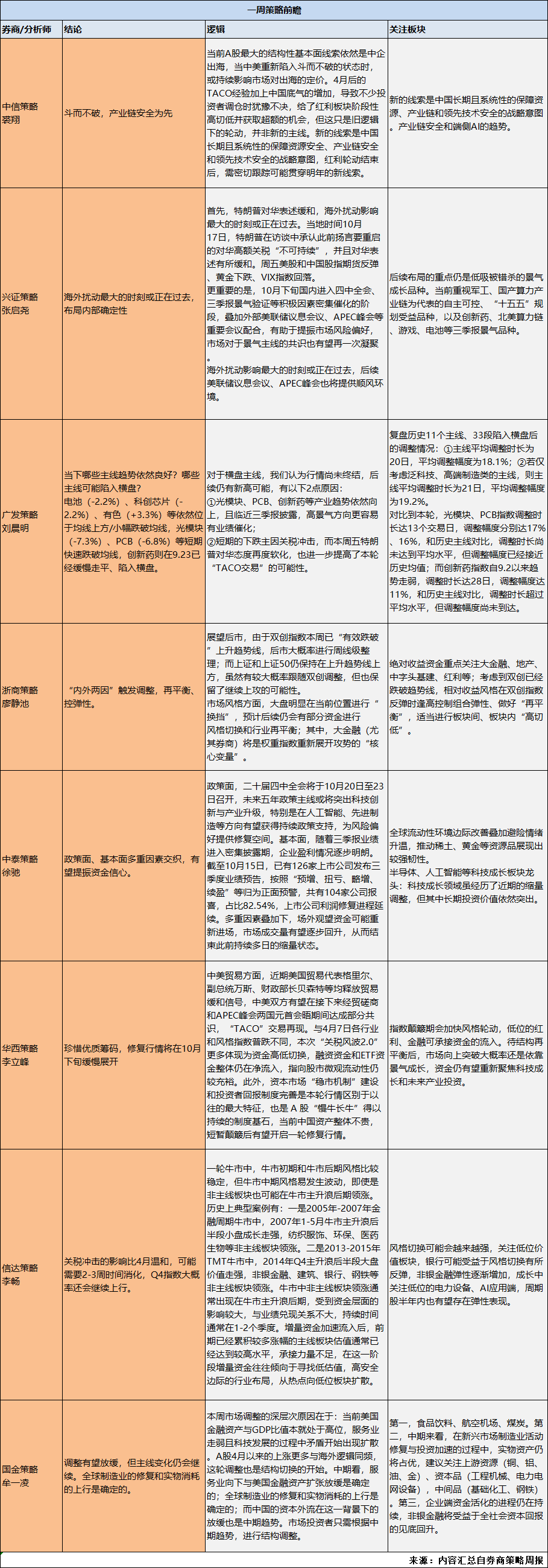
A股分析师前瞻:海外扰动最大时刻或将过去,10月下旬修复行情将缓慢展开
Xuan Gu Bao· 2025-10-19 13:50
Core Viewpoint - The overall sentiment among brokerage strategies is optimistic about the market outlook, with a focus on balanced asset allocation and the importance of monitoring new strategic themes related to resource and supply chain security in China [1][2]. Group 1: Market Sentiment and Strategic Shifts - The recent experience from TACO and increased confidence in China have led to investor hesitation in reallocating assets, creating opportunities in dividend sectors [1]. - The easing of tensions in U.S.-China relations, particularly with Trump's recent comments on tariffs, suggests that the most disruptive period may be passing, which could enhance market risk appetite [2][3]. - The upcoming political events and economic reports, including the Fourth Plenary Session and third-quarter earnings, are expected to catalyze positive market sentiment [1][2]. Group 2: Sector Focus and Investment Opportunities - Analysts emphasize the importance of focusing on sectors that are likely to benefit from internal certainty, such as technology growth and future industry investments, particularly in the context of a potential "slow bull market" [2][3]. - The construction of a "stable market mechanism" and improvements in investor return systems are highlighted as key factors supporting the current market dynamics, differentiating this cycle from previous ones [2][3]. - There is a recommendation to pay attention to low-valued sectors that may attract capital inflows, particularly in the context of a structural rebalancing of the market [2][3].
申万宏源研究晨会报告-20250903
Shenwan Hongyuan Securities· 2025-09-03 00:34
Core Insights - The report highlights the profitability pressure faced by the North Exchange in Q2 2025, primarily due to overseas disturbances and high fixed asset growth, with a forecasted turning point in the second half of the year [3][8]. - The technology manufacturing sector is leading the growth, driven by a combination of cyclical recovery and AI industry trends, while consumer sectors show a mixed performance [3][8]. - The report suggests three strategies to identify high-growth opportunities: selecting companies with sustained revenue growth, those with upward revisions in profit forecasts, and those with high contract liabilities and advance payments [3][8]. Summary by Sections Profitability Analysis - As of Q2 2025, the North Exchange reported a revenue growth rate of +4.9% and a net profit growth rate of -16.6%, indicating significant profitability challenges [8]. - The decline in net profit is attributed to a sharp drop in export growth to the U.S., with over 50% of companies experiencing negative net profit growth [8]. - Fixed asset growth reached a historical high of +30.2%, contributing to the pressure on profitability, with a gross margin of 22.4% [8]. Industry Structure - The technology manufacturing sector is experiencing high growth, with key industries such as computing, telecommunications, and electrical equipment showing positive trends [8]. - The report notes a structural recovery in midstream manufacturing, particularly in traditional robotics and engineering machinery, alongside emerging industries [8]. - Consumer sectors are experiencing a mixed recovery, with agriculture and forestry showing potential for improvement [8]. Investment Strategies - The report recommends identifying companies with consistent upward trends in revenue and net profit growth over the past four quarters, highlighting specific companies like Kaiter and Fujida [3][8]. - It also suggests focusing on companies with upward revisions in profit forecasts, such as Shuguang Shuchuang and Naconoer, which have seen significant increases in expected net profit growth [3][8]. - Companies with high contract liabilities and advance payments, like Kangnong Agriculture and Kun工科技, are also highlighted as potential investment opportunities [3][8].