止损止盈

Search documents
股票一旦出现“平底”形态,毫不犹豫满仓,不是涨停就是涨个不停
Sou Hu Cai Jing· 2026-02-08 14:22
Core Insights - The article emphasizes that stock market research is multifaceted, with various methods leading to different investment decisions and outcomes for individuals [1][2] Group 1: Stock Trading Strategies - Stock trading is fundamentally a probability game, and it is advisable to focus on stocks in an upward trend, using moving averages like the 5-day, 10-day, and 20-day lines to gauge short-term and medium-term trends [3] - Proper position management is crucial; dividing funds into five equal parts and adhering to strict stop-loss and take-profit rules can mitigate losses and maximize gains [3] - Investors should remain clear-headed, as stock prices are influenced by emotions, and once a price movement starts, it often does not provide an opportunity to enter [3] - Avoiding excessive focus on short-term trading is recommended; maintaining a rational approach to trading decisions is essential for long-term success [3][4] Group 2: Technical Patterns - The "Three Flat Bottoms Turning Red" pattern indicates a potential reversal after a significant decline (over 50%), where the stock price stabilizes and begins to rise again, suggesting a buying opportunity [6][9][11] - The "Soldier Pit" pattern occurs during a bullish trend when the stock price consolidates after a rise, indicating a potential entry point for investors once the price breaks out of the consolidation phase [13][15][16] Group 3: Market Psychology - The article highlights the importance of optimism in trading; being overly pessimistic can hinder profitability, while a positive outlook is essential for success [4] - It is crucial for investors to follow price movements rather than resist them, and to adapt quickly to market changes without being hindered by fear or doubt [17]


深圳男子劝父亲卖掉45公斤白银,三天后暴跌31%!普通人最容易踩的3个投资坑曝光
Sou Hu Cai Jing· 2026-02-03 13:11
Core Viewpoint - The article discusses the significant drop in silver prices and highlights the common pitfalls that retail investors face, emphasizing the importance of strategic decision-making over emotional reactions [3][20]. Group 1: Market Events - A retail investor advised his father to sell 45 kilograms of silver at approximately 30 yuan per gram, just before a 31% drop in international silver prices occurred three days later [3]. - The drop represents the largest single-day decline in silver prices in nearly half a century, leading to panic in the domestic market [3]. Group 2: Common Pitfalls for Retail Investors - **Blindly Following Trends**: Retail investors often get caught up in market excitement, leading to poor decision-making. Historical patterns show that significant price increases are usually followed by deep corrections [5][6]. - **Overconfidence**: Many retail investors believe they can time the market perfectly, but silver prices are influenced by various global factors, making accurate predictions challenging [8][9]. - **Emotional Trading**: Investors often react emotionally to market fluctuations, resulting in buying high and selling low. This behavior is driven by fear of missing out or fear of losses [12][14]. Group 3: Strategies for Better Investment Decisions - **Contrarian Investment Approach**: Successful investors maintain composure during market extremes, reducing positions during euphoria and gradually building them during panic [16]. - **Setting Stop-Loss and Take-Profit Levels**: Professional investors establish clear rules for exiting positions to avoid emotional decision-making, ensuring that one mistake does not lead to significant losses [18]. Group 4: Conclusion - The case of the retail investor who sold silver illustrates that avoiding common pitfalls—such as following trends, overconfidence, and emotional trading—can lead to better investment outcomes [20].

蜂拥入市,00后想变身“古希腊掌管涨跌的神”
Xin Lang Cai Jing· 2026-01-30 05:42
Group 1 - The A-share market has shown a strong performance with a "17 consecutive days of gains," pushing the Shanghai Composite Index close to 4200 points, continuing the "long bull" market since September 24, 2025, and leading to a surge in new account openings [1][16] - Young investors, particularly those under 35, accounted for over 45% of new accounts in 2025, becoming a significant force in the investment market [1][16] - The rise of the internet-native generation, represented by those born in the 2000s, has led to a shift in investment behavior, with these young investors actively sharing their investment experiences on social media platforms [1][16] Group 2 - The 00s generation, as "digital natives," has grown up in an environment where information is instant, trading is online, and social interactions are networked, shaping their approach to investment [3][18] - The accessibility of online brokerage apps and low thresholds for investment, such as 1 yuan for ETF investments, have allowed young individuals to enter the capital market with small amounts of money [3][18] - Compared to previous generations, the 00s have a more integrated view of investment as part of life, influenced by social media and online content rather than traditional financial news [3][18] Group 3 - A case study of a university student, Li Yang, illustrates the typical investment journey of the 00s, starting with small investments and gradually learning to manage risks and establish rules for trading [4][20] - Li Yang's experience reflects a broader trend among young investors who are learning to balance emotional responses with disciplined investment strategies [4][20] - The shift from chasing emotions to establishing rules is a common lesson learned by young investors in the current market environment [4][20] Group 4 - As young investors deepen their understanding of the capital market, they are transitioning from single-category investments to diversified portfolios, exploring various asset classes including index funds, foreign currency investments, and commodities [6][22] - The use of online resources and platforms for learning investment strategies is prevalent among the 00s, indicating a strong adaptability and willingness to learn [6][22] - Kendra, a young investor, exemplifies this trend by developing a systematic investment methodology and adapting her strategies based on market experiences [7][23] Group 5 - Kendra's investment approach emphasizes technical analysis and a focus on market dynamics rather than relying solely on fundamental news, showcasing a shift in investment philosophy among young investors [9][25] - The importance of risk management and disciplined investment practices is highlighted, with Kendra implementing strict stop-loss measures to mitigate potential losses [11][27] - The tendency for young investors to engage in high-risk investments without adequate strategy underscores the need for a balanced approach to asset allocation [13][29] Group 6 - The emotional aspect of investing is significant for the 00s, with many using social media and cultural references to process their experiences in the market [11][27] - Despite understanding the concept of stop-loss, executing it remains a challenge for many young investors, often leading to larger losses due to emotional decision-making [12][28] - The journey of investing for the 00s is characterized by early trial and error, allowing them to learn valuable lessons in a less pressured environment [15][31]

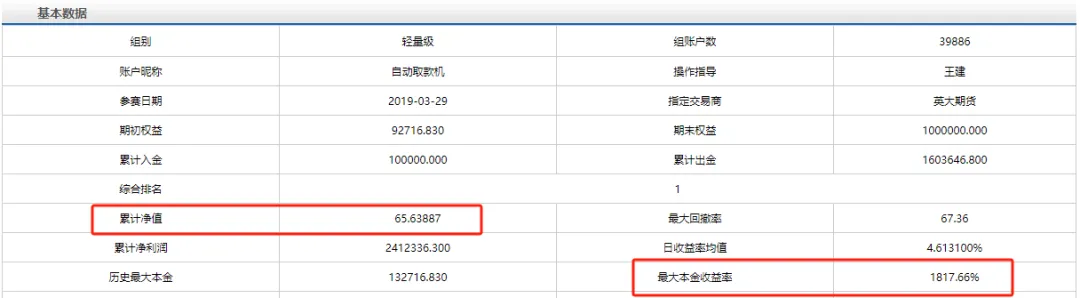
“自动取款机”王建最新战绩:一个半月做到净值50!
Qi Huo Ri Bao· 2026-01-27 23:55
Core Insights - The article highlights the impressive trading performance of "Automatic ATM," a participant in the 2019 National Futures Daily Real Trading Competition, who achieved an annual profit of 10 million yuan through a technical analysis-based trading strategy [1][3]. Group 1: Trading Performance - From October 2019 to February 2020, an investment of 1.6 million yuan yielded a profit of 16 million yuan [3]. - From February 2020 to February 2021, an investment of 4.47 million yuan generated a profit of 19.53 million yuan [3]. - In a single month from September 8 to October 8, 2021, the return reached 1200% [3]. - From November 2021 to March 2022, an investment of 620,000 yuan resulted in a profit of 31.48 million yuan [3]. - From September to mid-December 2022, an investment of 2 million yuan yielded a profit of 17.8 million yuan [3]. - In 2023, various trading periods showed significant profits, including an investment of 260,000 yuan yielding 4.99 million yuan and another of 301,000 yuan yielding 582,000 yuan [4]. Group 2: Trading Strategies and Insights - The article discusses the harsh reality of the futures market, where only about 3% of traders can sustain a living through trading, primarily due to human psychological weaknesses [11]. - Key strategies for successful trading include strict capital management, where funds are divided into portions to limit exposure, and the importance of preserving capital to allow for recovery opportunities [12]. - The necessity of implementing stop-loss and take-profit strategies is emphasized, with a focus on maintaining a favorable risk-reward ratio to avoid significant losses [13]. - Developing good trading habits is crucial, as consistent adherence to strategies can lead to recovery from losses and ultimately higher returns [14].
血亏百万老股民泣血总结:A股散户最常跳的六个坑,希望你没有
Sou Hu Cai Jing· 2025-12-19 00:08
Core Insights - Retail investors in A-shares face high loss rates due to a lack of discipline and understanding of market dynamics, often falling into six controllable pitfalls [1][4]. Group 1: Common Pitfalls - The first pitfall is the failure to set stop-loss orders, which accounts for 32% of retail investor losses, with those not using stop-losses averaging a 45% loss, 2.3 times higher than disciplined investors [1]. - The second pitfall involves emotional trading, where retail investors have a turnover rate nine times that of institutions, with a win rate of less than 30% when chasing stocks hitting the daily limit up [1][3]. - The third pitfall is frequent trading, with retail investors holding positions for an average of only 3.2 months, leading to lower returns due to high transaction costs [3]. Group 2: Misguided Strategies - The fourth pitfall is reliance on rumors and tips, with 40% of losses attributed to following recommendations from influencers or online forums, often entering at high price points [3][4]. - The fifth pitfall is using leverage, which has a 78% probability of leading to liquidation for retail investors, resulting in total loss of capital and potential debt to trading platforms [4]. - The sixth pitfall is a lack of understanding of fundamental metrics, with 70% of retail investors unable to interpret key indicators like PE and PB, leading to poor investment decisions [4]. Group 3: Recommendations for Improvement - To mitigate losses, retail investors should establish a simple system that includes setting stop-loss and take-profit levels, defining their investment capabilities, and maintaining a cash reserve to manage volatility [4][5].

开仓自带云服务的止损止盈功能,博易7自动止损止盈功能了解一下
Xin Lang Cai Jing· 2025-12-05 12:51
Core Viewpoint - The article introduces the automatic stop-loss and take-profit feature of the Boyi 7 software, emphasizing its effectiveness in risk control and reducing the pressure of monitoring positions. Group 1: Automatic Stop-Loss and Take-Profit Functionality - The automatic stop-loss and take-profit feature allows users to set parameters for contracts they hold, triggering automatic closing orders when market prices reach specified stop-loss or take-profit levels [3][6]. - Users can set these parameters before opening a position, and the software will automatically calculate the corresponding stop-loss and take-profit prices based on the average opening price of the contract [3][6][19]. - The feature is designed to operate seamlessly, requiring only initial setup before opening a position, thus enhancing trading efficiency [3][8]. Group 2: Setting Up the Feature - To set up the automatic stop-loss and take-profit, users must log into their trading account, navigate to the parameter settings, and select the appropriate options for the desired contracts [5][7]. - Users can specify the stop-loss and take-profit price differences, which are not based on minimum price fluctuations but rather on actual price differences [18]. - Once set, the parameters will apply to all new contracts opened under the specified conditions, while previous positions will not be affected [19][20]. Group 3: Monitoring and Modifying Settings - Users can view, modify, or delete their stop-loss and take-profit settings through the trading interface, where a checkmark indicates active settings [11][15]. - Modifications can be made before or after opening a position, allowing flexibility in managing risk [15][19]. - The automatic stop-loss and take-profit settings are stored in the cloud, ensuring they remain effective even if the software is closed or the network is interrupted [18][19].

我们给六个 AI 同一段市场数据,它们生成了六种完全不同的交易策略 | Jinqiu Scan
锦秋集· 2025-11-19 07:34
Core Insights - The article discusses an experiment involving six AI models generating trading strategies for XAU/USD (gold against USD) under identical conditions, revealing diverse approaches and decision-making styles among the models [1][4][5]. Experiment Overview - The experiment utilized hourly market data for XAU/USD, chosen for its volatility, clear structure, and continuous data, making it suitable for observing AI reasoning and strategy differences [2][3]. - The AI models involved were ChatGPT, Claude, Gemini, DeepSeek, Qwen, and Grok, each starting with an initial capital of $10,000 [1][6]. Results and Analysis - The AI models produced six distinct trading strategies, ranging from conservative to aggressive, and from mechanical trend-following to emotional testing, highlighting their unique "personalities" in trading [4][5]. - The focus of the analysis is not on profitability but rather on the underlying thought processes and decision-making logic of each strategy [5]. Performance Metrics - The performance of each model was tracked, with Grok showing the least loss at -0.04%, while Qwen had the highest loss at -0.88% [6][7]. - Current equity values and cumulative returns for each model were provided, indicating varying degrees of success in the trading environment [6][7]. Trading Strategies - ChatGPT's strategy emphasized trend-following based on moving averages, with a disciplined approach to risk management and a preference for not leveraging or shorting [9][12][14]. - Claude's strategy focused on mid-term trend tracking, considering macroeconomic factors and geopolitical events to identify buying opportunities [15][20]. - Gemini's approach involved trading only in bullish market conditions, using long-term moving averages to guide entry and exit points [21][24]. - DeepSeek's strategy was centered on long-term upward trends, avoiding leverage and emphasizing patience in waiting for clear signals [25][26]. Conclusion - The experiment illustrates the potential of AI in trading, showcasing how different models can interpret the same data in varied ways, leading to distinct trading strategies and outcomes [1][4][5].

“止损止盈”不是“凭感觉”,得有“固定的实操方法”
Sou Hu Cai Jing· 2025-10-13 01:23
Core Methodology - The most suitable method for beginners is the "fixed ratio method," where predetermined stop-loss and take-profit levels are set, such as "stop-loss at 5% and take-profit at 10%" [3] - Another approach is the "key price level method," which involves identifying support and resistance levels, for instance, selling if the stock price drops below a support level of 10 yuan and taking profit if it rises to a resistance level of 12 yuan [3] Execution Techniques - After purchasing stocks, it is crucial to immediately record the stop-loss and take-profit points, and even set "conditional orders" in trading software for automatic execution at these levels [3] - Many beginners struggle with execution due to emotional hesitation, leading to losses or missed profits, emphasizing the importance of decisive action [3] Investment Philosophy - Stop-loss is viewed as a means to "preserve capital for future trades," while take-profit is about "securing profits," highlighting the necessity of strict adherence to these strategies for long-term survival in the A-share market [3]
股指期货日内交易如何设置止损止盈?
Sou Hu Cai Jing· 2025-09-16 07:58
Core Viewpoint - Setting stop-loss and take-profit points in stock index futures trading is essential for risk management and profit locking, and various methods can be employed based on individual risk tolerance. Group 1: Stop-Loss Point Setting - Fixed Amount Stop-Loss: Investors can set a predetermined loss amount, and if losses reach this amount, they will close their positions regardless of market conditions. For example, with an opening price of 5000 points and a maximum loss of 1000 yuan, the stop-loss point would be set at 4966.67 points [3]. - Percentage Stop-Loss: This method involves setting a stop-loss point based on a percentage of the total account funds. For instance, if set at 2%, the stop-loss point would be at 4900 points when the opening price is 5000 points [3]. - Technical Indicator Stop-Loss: Utilizing technical analysis indicators such as support lines, resistance lines, or moving averages to set stop-loss points. For example, a stop-loss could be triggered if the price falls below a significant moving average [3]. - Support Level Stop-Loss: Setting the stop-loss point below a critical support level. If a support level is identified at 4900 points, the stop-loss could be set at 4880 points [4]. - Volatility Stop-Loss: This method sets the stop-loss based on historical market volatility, such as using 1 to 1.5 times the recent average volatility [4]. - Time Stop-Loss: Establishing a time limit for holding positions, where positions are closed regardless of profit or loss after a predetermined time [4]. Group 2: Take-Profit Point Setting - Fixed Amount Take-Profit: Investors can set a specific profit target. For example, with an opening price of 5000 points and a target profit of 1500 yuan, the take-profit point would be at 5050 points [6]. - Percentage Take-Profit: Setting a take-profit point based on a fixed percentage of profit. For instance, with a target of 8%, the take-profit point would be at 5400 points when the opening price is 5000 points [7]. - Technical Indicator Take-Profit: Using technical analysis indicators to determine take-profit points. For example, considering taking profit when the Relative Strength Index (RSI) enters the overbought zone [8]. - Resistance Level Take-Profit: Setting the take-profit point above a significant resistance level. If a resistance level is identified at 5200 points, the take-profit could be set at 5220 points [9]. - Trailing Stop-Loss to Take-Profit: Adjusting the original stop-loss point upwards as prices rise to lock in profits, executing a close when prices revert to the new stop-loss point [10].

帮主郑重:散户避坑指南!避开这5个,技术面才算入门!
Sou Hu Cai Jing· 2025-08-02 08:18
Group 1 - The article discusses common challenges faced by retail investors in technical analysis, emphasizing the importance of understanding key indicators and market behavior [1][3] - It highlights that using only two indicators, moving averages and trading volume, can provide a clearer picture of market trends compared to relying on multiple complex indicators [3] - The article stresses the significance of identifying support and resistance levels based on historical trading volume rather than arbitrary price points [3][4] Group 2 - It addresses the common frustration of buying high and selling low, suggesting that true market movements can be confirmed by analyzing trading volume during breakouts or breakdowns [3][4] - The article advises against a one-size-fits-all approach to setting stop-loss and take-profit levels, recommending adjustments based on the investor's holding period and market volatility [4] - It concludes that technical analysis should adapt to market conditions, emphasizing the need for investors to understand the underlying market dynamics rather than relying solely on indicators [4]