消费市场趋势

Search documents
服饰鞋履卷设计,家居内衣“拼体感”|世研消费指数品牌榜Vol.96
3 6 Ke· 2026-01-12 06:12
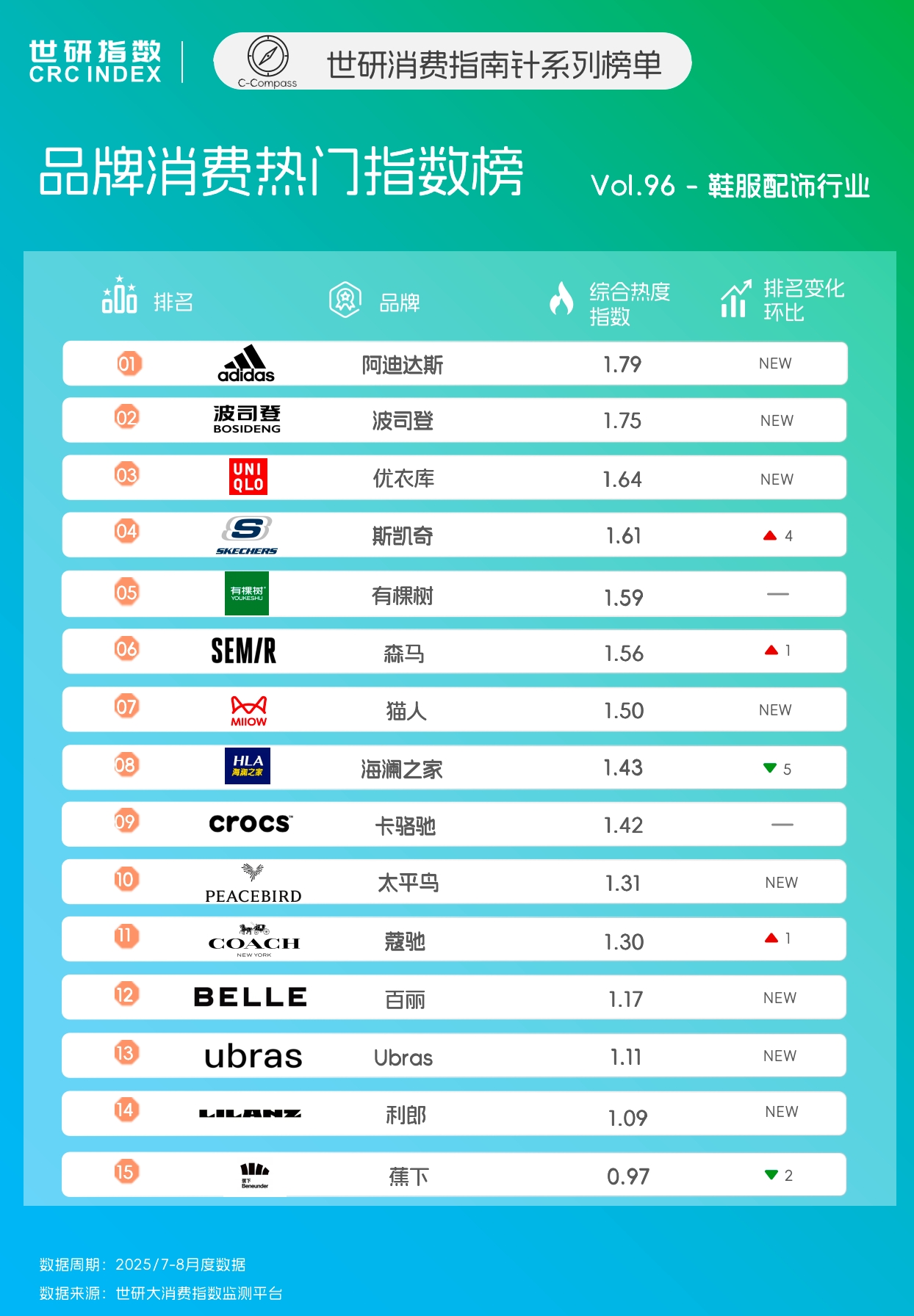
Group 1: Industry Trends - The footwear and apparel industry is undergoing a transformation from "external expression" to "internal experience," with a diverse consumption pattern that includes both basic styles and design-oriented products [1] - Brands are leveraging cultural integration to break into high-end markets, while the innerwear and homewear segments are driven by both technological experiences and emotional values [1] - As competition shifts from functionality to emotional and lifestyle aspects, brands must build an irreplaceable connection with consumers [1] Group 2: Brand Performance - Adidas, Bosideng, and Uniqlo lead the comprehensive popularity index with scores of 1.79, 1.75, and 1.64 respectively [4][5] - The demand for high-cost performance basic items and comfortable products with design elements is strong among consumers, particularly for brands like Uniqlo and Semir [5] - Taiping Bird has launched a high-end series that combines New York ready-to-wear language with Eastern aesthetics, targeting younger consumers born in the 1980s and 1990s [5] Group 3: Footwear Segment Insights - Young consumers are no longer satisfied with just durable shoes; they seek comfort and aesthetics, using footwear to express emotions and identity [5] - Belle, a mature national brand, connects product functionality with emotional values and has expanded into the "fashion leisure" segment, creating memorable shoe models that resonate with users [5] Group 4: Homewear and Innerwear Innovations - The focus in homewear and innerwear consumption is shifting from external design to internal experience, with "perceptible technology" becoming a key factor [6] - Brands like Catman and Ubras are innovating by emphasizing technological advancements and emotional connections, with Catman focusing on "tech innerwear" and Ubras promoting a "female value co-builder" concept [6] - Ubras has upgraded its signature breast health initiative and opened a "Comfort Aesthetics Collection Store," enhancing its offline presence and high-end experience [6]




2026中国零售消费市场十大趋势:全面进入“我”时代
Jing Ji Guan Cha Bao· 2026-01-11 14:03
Core Insights - The report by NielsenIQ highlights that the Chinese retail market is entering a critical transformation phase, where the focus will shift from foot traffic and price subsidies to meeting consumers' emotional and personal needs by 2026 [1][8] Consumer Behavior Trends - Consumers are transitioning from merely "buying products" to "buying lifestyles," with 68% valuing atmosphere in physical stores, 61% prioritizing service, and 54% willing to pay a premium for quality [2] - Emotional consumption is evolving towards self-value, with single economy, pet consumption, and silver economy identified as high-potential growth areas [2][3] Pricing and Value Perception - Consumers are becoming more rational and cautious, willing to pay a premium for genuine efficacy and innovation rather than brand reputation [3] - The competition will focus on perceived value rather than price, emphasizing the importance of delivering both cost-effectiveness and value [3] Channel Transformation - Retail channels are shifting from merely selling products to creating lifestyle experiences, with supermarkets and hypermarkets needing to transform into immersive spaces [4] - Private labels are gaining traction, with 69% of consumers perceiving them as more valuable, leading to a 12.9% growth in private label sales compared to a mere 0.1% for branded products [4] Collaboration Between Retailers and Brands - Retailers and brands are encouraged to shift from competition to collaboration, co-developing products and optimizing pricing to enhance category growth [5] Market Growth Drivers - The report identifies key growth drivers for the retail market in 2026, including the down-market expansion, Generation X consumers, overseas market opportunities, and instant retail [6][7] - Generation X, characterized by stable income and mature judgment, is expected to be a significant growth demographic, willing to spend on products that resonate with their values [7] Global Expansion of Chinese Brands - The report suggests that Chinese brands are transitioning from merely selling products to establishing a strong brand presence in overseas markets, particularly in Southeast Asia, Japan, and Singapore [7] Instant Retail Evolution - The shift towards instant retail reflects consumers' increasing desire for immediate gratification, moving from planned to spontaneous purchases [7][8]
这份最新趋势报告,为2026年消费市场划出重点(附下载链接)
Sou Hu Cai Jing· 2025-12-23 18:45
Core Insights - The report highlights a "moderate recovery with structural differentiation" in China's consumption market for the period from January to November 2025, with total retail sales of consumer goods reaching 45.6 trillion yuan, a year-on-year increase of 4% [1][2][8]. Consumption Market Overview - Total retail sales of consumer goods reached 45.6 trillion yuan, growing by 4% year-on-year, indicating a gradual release of domestic demand recovery [1][8]. - Significant growth was observed in discretionary consumption categories such as communication equipment (20.9%), gold and silver jewelry (13.5%), and home appliances (14.8%) [11]. - Service consumption continues to rise, with per capita service consumption accounting for 46.8% in the first three quarters [2][32]. - Online retail remains stable, accounting for approximately 25.9% of total retail sales, with a 5.7% increase in physical goods sold online [9]. Consumption Trends - The report identifies six major trends in the consumption market: 1. Stabilizing consumer confidence with internal differentiation 2. Coexistence of rational consumption and quality upgrades, with "value for money" becoming a core logic 3. The rise of emotional consumption, driven by Generation Z 4. Strong growth in lower-tier markets 5. Flourishing cultural and sports consumption driving surrounding economies 6. Acceleration of domestic brands going global, particularly in trendy toys, new energy vehicles, and smart home appliances [2][29]. Policy Impact on Consumption - Policies aimed at stimulating consumption include expanding the scope of trade-in programs to digital products and providing subsidies for consumer loans and childcare, effectively stimulating consumption potential [1][21][24]. - The report emphasizes that expanding domestic demand is crucial for economic rebalancing, requiring industrial upgrades and income distribution reforms to build a sustainable and healthy consumption market ecosystem [2][21]. Future Outlook - Looking ahead to 2026, the report anticipates a moderate recovery in total consumption volume, supported by the wealth effect, coordinated policy efforts, and gradual income improvements, with a projected retail sales growth rate of around 5% [2][63]. - The consumption structure is expected to evolve towards service consumption, emotional consumption, and green consumption, with traditional industries facing transformation challenges [2][70].

顶级资本正在“抄底”消费
Xin Lang Cai Jing· 2025-11-16 02:14
Core Insights - The recent surge in mergers and acquisitions in the consumer sector contrasts with the sluggish growth of the consumption market, raising questions about the underlying investment logic of top-tier capital [1][4]. Group 1: Current Market Conditions - The retail sales of consumer goods in China reached 36.59 trillion yuan in the first three quarters, growing by 4.5% year-on-year, which is still below the 8% growth rate seen in 2019 [1]. - The performance of listed consumer companies shows significant divergence, with major players like Kweichow Moutai and Yum China experiencing slowed growth compared to previous years [2]. - Smaller food and beverage companies are facing considerable operational pressure, with many reporting declines in both revenue and net profit [2]. Group 2: Investment Logic Behind Mergers - The first logic is that target companies possess strong cash flow and a solid foundation, making them attractive despite slower growth rates [4]. - The second logic highlights the brand influence of the target companies, which have established networks and consumer loyalty, making them appealing for capital investment [5]. - The third logic suggests that the current market downturn presents a "buying opportunity" for capital, allowing for acquisitions at reasonable prices [5]. - The fourth logic emphasizes the ongoing opportunities in the consumer sector, as the majority of production activities ultimately cater to consumer needs [5]. Group 3: Future Trends in the Consumer Market - Companies face challenges in understanding new consumer demographics, adapting to new marketing methods, and embracing innovative organizational structures [6]. - Three key trends to watch include a focus on cost-effective innovation, the rise of niche products that provide immediate satisfaction, and growth in self-improvement sectors such as health investments and knowledge-based services [6]. - The exit strategies for capital in the consumer market are evolving, with a shift towards long-term investment approaches rather than relying solely on rapid growth and IPOs [7].




重要信号!顶级资本正在“抄底”消费
证券时报· 2025-11-15 00:14
Core Viewpoint - The article discusses the recent surge in mergers and acquisitions (M&A) in the consumer sector, highlighting the contrast between significant capital investments by top firms and the sluggish growth of the consumer market in China. It explores the underlying investment logic driving this trend. Group 1: M&A Activity - Recent strategic partnerships and acquisitions include CPE Yuanfeng's collaboration with Burger King, Dazhang Capital's potential bid for Costa Coffee, and Boyu Capital acquiring a 60% stake in Starbucks China. KKR also completed the acquisition of the national soda brand, Diao Soda [1][2]. - The consumer market is experiencing a slowdown, with retail sales growth at 4.5% year-on-year for the first three quarters, which is below the 8% growth seen in 2019 [2][3]. Group 2: Financial Performance of Companies - Major companies like KFC China reported a 4% increase in revenue to $3.2 billion, while Yili's revenue grew by 1.71% to 90.564 billion yuan, but its net profit fell by 4.07% [3]. - Smaller food and beverage companies are facing significant operational pressures, with many reporting declines in both revenue and net profit [3]. Group 3: Investment Logic - Four key investment rationales are identified: 1. Target companies have strong cash flows and solid foundations, with examples like Starbucks maintaining over $6 billion in cash flow [5]. 2. The brands involved possess significant brand equity and established networks, making them attractive to investors [6]. 3. The current market downturn presents a "buying opportunity" for capital, allowing for acquisitions at lower prices [6]. 4. The consumer sector remains promising, with potential for growth despite current challenges [6]. Group 4: Future Trends in Consumer Market - The article identifies three trends in the consumer market: 1. Emphasis on cost-performance innovation as consumers prioritize practical value [8]. 2. Increased interest in niche products that provide immediate satisfaction [8]. 3. Growth in self-improvement sectors, including health investments and knowledge-based spending [8]. Group 5: Exit Strategies for Capital - The challenges of exiting investments in the consumer sector are noted, with a shift towards long-term strategies rather than quick exits through IPOs. This includes designing preferential dividend clauses to ensure returns even without an IPO [9].