
消费新热点

Search documents
夯实就业根基 护航“一老一小”——多地聚力勾勒2026民生“幸福图”
Xin Lang Cai Jing· 2026-02-03 00:12
Group 1 - The core focus of local government work reports for 2026 emphasizes "stabilizing employment" and "strengthening livelihoods," with specific actions outlined for job creation and service improvements for the elderly and children [1][5] - Multiple regions have set ambitious employment targets, such as Beijing aiming for at least 280,000 new urban jobs and Guangdong targeting over 1.1 million new urban jobs, alongside measures to support industries that absorb more employment [1][2] - Skills training is highlighted as a crucial element for stabilizing employment and increasing income, with over 11 million subsidized training sessions conducted in 2025 [2][3] Group 2 - Various provinces have detailed plans for skills training, with Shandong aiming to train 400,000 individuals and Guangdong focusing on enhancing vocational skills and education [3][4] - The reports also address the need for improved elderly care services, with Beijing planning to establish 20 regional elderly service centers and Guangdong aiming for a 40% rate of integrated medical and elderly care services for seniors aged 65 and above [4] - In terms of childcare, provinces like Shandong and Guangdong have set specific goals for enhancing childcare services and facilities, reflecting a strong governmental focus on family welfare [4][5]
夯实就业根基 护航“一老一小”多地聚力勾勒2026民生“幸福图”
Xin Lang Cai Jing· 2026-02-02 19:04
Group 1 - The core focus of local government work reports for 2026 emphasizes "stabilizing employment" and "enhancing people's livelihoods" as key priorities [1] - Multiple regions have set specific employment targets, such as Beijing aiming for at least 280,000 new urban jobs and Guangdong targeting over 1.1 million new urban jobs [1] - The implementation of "stabilizing jobs, expanding capacity, and improving quality" actions is highlighted as a crucial strategy to address current employment challenges [2][3] Group 2 - Skills enhancement is identified as a critical factor for stabilizing employment and increasing income, with over 11 million subsidized training sessions planned for 2025 [2] - Various provinces have detailed skill training initiatives, such as Shandong's plan to train 400,000 individuals and Guangdong's focus on vocational skill improvement [3] - The Ministry of Human Resources and Social Security plans to implement targeted training actions for key groups and sectors, including youth and migrant workers [3] Group 3 - The reports also address the "one old and one young" support system, focusing on elderly care and childcare services as essential components of social welfare [4] - Specific measures include the establishment of new elderly service centers and the enhancement of long-term care insurance systems in regions like Beijing and Guangdong [4] - Childcare initiatives are also emphasized, with plans for new childcare service centers and quality improvement actions in provinces like Shandong and Guangdong [4] Group 4 - Experts note that the government's focus on employment, elderly care, and childcare reflects a strong commitment to improving the quality of life for families [5] - The financial allocation towards social welfare is expected to create a supportive environment for employment, elderly care, and childcare, enhancing overall public satisfaction and happiness [5]
透过税收数据看亮点!沉浸式、场景式、个性化、健康类……消费新热点持续涌现
Yang Shi Wang· 2025-12-09 04:05
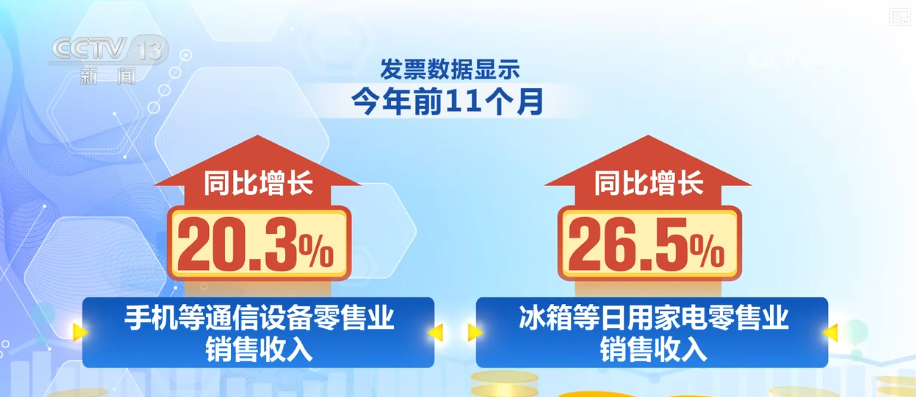
Group 1 - The core viewpoint of the news is that consumer demand in China has been continuously released since 2025, driven by policies such as the trade-in of old consumer goods, leading to significant growth in sales across various sectors including home appliances and new energy vehicles [1][4]. - In the first 11 months of 2025, retail sales in the communication equipment sector, such as mobile phones, increased by 20.3%, while daily household appliances like refrigerators saw a 26.5% rise in sales revenue [4]. - The sales revenue from new energy passenger vehicles also showed a positive trend, with a year-on-year growth of 19.1% [4]. Group 2 - The cultural and tourism sectors have experienced robust growth, with sales revenue from artistic creation and performance, as well as film screenings, increasing by 15.6% and 19.1% respectively [6]. - The integration of cultural activities with the tourism industry has led to a surge in immersive and scenario-based tourism consumption, with travel agencies and related services seeing a 10.8% increase in sales revenue [6]. - The sales revenue from scenic spots and leisure sightseeing activities grew by 29.4% and 16.6% respectively, while the accommodation sector, particularly homestays, saw a 13.1% increase in sales revenue [6]. Group 3 - The sports and health sectors are also witnessing high consumer enthusiasm, with sports exhibition services and retail of sports goods increasing by 29.7% and 6.6% respectively in the first 11 months of 2025 [11]. - Health-related consumption has emerged as a new hotspot, with sales of health auxiliary treatment equipment and health consulting services maintaining double-digit growth [11]. Group 4 - The manufacturing sector is experiencing accelerated high-end development, with sales revenue in the equipment manufacturing industry growing by 8.3% year-on-year [11]. - Notably, sales revenue in the computer and communication equipment manufacturing sector increased by 12.3%, while the instrument and meter manufacturing sector saw a 10.3% rise [11]. - The implementation of large-scale equipment renewal policies has led to a 14.2% year-on-year increase in the procurement of automation equipment by manufacturing enterprises, indicating a faster pace of intelligent upgrades in the manufacturing industry [15].

提供多样化就业渠道 全国城市联合秋招专场活动启动
Yang Shi Xin Wen· 2025-09-07 03:34
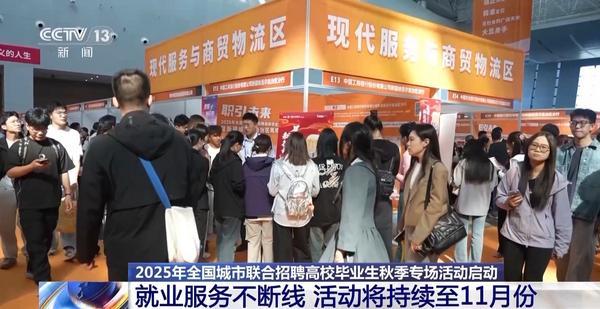
Group 1 - The 2025 National Urban Joint Recruitment Autumn Event for College Graduates has been launched in Urumqi, Xinjiang, marking the first event of its kind this autumn [1][3] - The recruitment fair attracted over 20,000 participants and featured more than 500 enterprises and institutions from various sectors, including energy resources, trade logistics, information technology, and advanced manufacturing, offering over 15,000 job positions [3] - The event includes 13 sub-venues across Xinjiang, providing diverse employment channels for graduates [3] Group 2 - The recruitment event will continue until November 2025, focusing on college graduates and targeting key areas such as new productive forces, new consumption hotspots, and livelihood services [3] - AI smart interview booths have been introduced at the event to provide personalized, precise, and intelligent employment support, including talent assessment, mock interviews, and resume optimization [3]
金秋消费季 各地真金白银促消费
Jing Ji Wang· 2025-09-03 03:05
Core Viewpoint - The "Golden September and Silver October" period is recognized as a traditional peak consumption season in China, with various regions launching distinctive promotional activities to stimulate consumer spending and support steady economic growth [1][7]. Group 1: Consumption Promotion Activities - The Ministry of Commerce encourages local governments to host unique consumption promotion events, leading to a nationwide response with diverse activities aimed at unlocking consumer potential [2][7]. - In Chongqing, the "Shopping in China · Love Chongqing 2025 Golden Autumn Consumption Season" will run from September 1 to October 31, featuring over 500 promotional events and an investment of more than 1.7 billion yuan, expected to directly drive consumption exceeding 10 billion yuan [2]. - Jilin Province launched its "Golden Autumn Consumption Season" with a 63-day campaign, involving over 1,300 enterprises and hundreds of promotional events across various sectors, aiming to create a vibrant consumer atmosphere [3]. Group 2: Local Resource Utilization - Regions are leveraging local特色资源 to create unique consumption experiences, such as cultural tourism events in Xi'an and autumn-themed tourism routes in Liaoning, enhancing consumer engagement and market vitality [4][5]. - In Shandong, the city of Heze is innovating consumption scenes by organizing diverse activities that highlight local intangible cultural heritage, while Guangdong plans to launch a "Golden Autumn Cultural and Tourism Consumption Season" with a budget of 20 million yuan for consumer vouchers [5]. Group 3: Policy and Financial Support - Local governments are implementing supportive policies and utilizing financial resources to boost consumption, including a 1% interest subsidy on personal consumption loans from September 1 to August next year [6]. - The People's Bank of China in Chongqing is facilitating financial institutions to enhance auto consumption financing services, with over 600 million yuan allocated for promotional activities in the automotive sector [6]. Group 4: Market Outlook - Experts indicate that the combination of distinctive promotional activities, the cultivation of new service consumption hotspots, and robust policy support is revitalizing the consumption market, contributing to sustained economic growth [7].
理解“四稳”之首加力稳就业
Jing Ji Ri Bao· 2025-05-15 22:09
Group 1 - The core viewpoint emphasizes that "stabilizing employment" is not a passive defense but an active approach to enhance economic internal dynamics and create job opportunities, addressing the issue of "having jobs but no one to fill them" and "having people but no jobs" [1][3] - In May, over 250 provincial recruitment events are expected to provide more than 900,000 job positions, while nearly 3,000 campus recruitment events will offer over 2 million positions for college graduates [1] - The employment situation in China is more severe this year, with the number of college graduates reaching a record high of 12.22 million, and the workforce from poverty alleviation needing to remain above 30 million [1][2] Group 2 - A series of policies aimed at stabilizing and expanding jobs have been launched, with a focus on key sectors, industries, and small to medium enterprises, indicating a strong commitment to employment stability [2] - The central government has allocated 66.7 billion yuan in employment subsidies to support policy implementation, highlighting the urgency of stabilizing employment, especially for key groups such as college graduates and migrant workers [2][3] - The demand for skilled labor in emerging industries such as digital economy and smart manufacturing is rapidly increasing, with job postings for AI engineers and related positions growing by over 30% year-on-year [3][4] Group 3 - The implementation of major engineering projects and the provision of basic public services are crucial for releasing job potential at the grassroots level, particularly in the labor-intensive service sector [4] - The proportion of migrant workers engaged in the tertiary industry is projected to reach 54.6% by 2024, indicating a shift towards service-oriented employment [4] - There is a need to enhance vocational training effectiveness and increase the competitiveness of laborers to better meet the demands of the evolving job market [4]
六方面24条举措 吉林省全方位提振消费
Zheng Quan Shi Bao Wang· 2025-04-22 12:38
Core Viewpoint - The Jilin Provincial Government has issued an implementation plan aimed at boosting consumption and enhancing economic growth through various measures focused on increasing income, reducing burdens, improving consumption quality, and optimizing the consumption environment [1][2][3][4][5][6][7][8] Group 1: Income Enhancement - The plan includes measures to increase wage income, such as adjusting the minimum wage and unemployment insurance in line with wage standards, and providing support for skilled workers and unemployed individuals to encourage entrepreneurship [1][2] - It aims to expand property income by promoting investments from commercial insurance funds and social security funds, and encouraging financial institutions to develop diverse financial products [2] - The target is to achieve over 2.7 million rural labor transfers by 2025 and create over 180,000 new jobs [1] Group 2: Burden Reduction - The plan outlines support for child-rearing through subsidies and the development of public childcare services, with specific financial support for different regions [3][4] - It aims to enhance medical insurance services, including expanding coverage for maternity insurance and children's medication [4] - The initiative includes innovative insurance products for new employment forms and aims to provide insurance for at least 40,000 new workers by 2025 [4] Group 3: Consumption Quality Improvement - The plan supports tourism consumption by promoting cultural and artistic activities in scenic areas and developing diverse tourism routes [5] - It emphasizes the development of winter sports and activities, with financial incentives for ski resorts based on visitor numbers [6] - The initiative includes the establishment of new consumption models, such as night markets and online shopping platforms, to enhance consumer experience [7] Group 4: Financial Support - The plan aims to strengthen financial support for enterprises, particularly in the cultural and tourism sectors, by improving credit ratings and financing capabilities [8] - It encourages financial institutions to enhance credit support for service consumption and to offer differentiated credit based on customer repayment capabilities [8] - The government will maintain low financing rates for agricultural and small business support, ensuring accessibility to financial resources [8]