
AI电力需求

Search documents
中国加入三倍核能宣言-核电产业链机会分析
2026-03-16 02:20
Summary of Key Points from the Conference Call Industry Overview - **Industry**: Nuclear Power Industry in China - **Key Drivers**: The surge in AI electricity demand is driving nuclear power growth, with China's AIDC electricity consumption expected to rise from 160 billion kWh in 2024 to 700 billion kWh by 2030, increasing its share to 5.5% [1][3] Core Insights and Arguments - **Triple Nuclear Declaration**: China's commitment to the "Triple Nuclear Declaration" aims for a global installed capacity of 1.2 billion kW by 2050, with an additional 800 million kW, which is over six times China's current total capacity [1][3] - **Investment Opportunities**: Each new nuclear unit requires an investment of approximately 16 to 20 billion RMB, indicating a significant market potential for equipment suppliers and construction firms [1][5] - **Technological Advancements**: The shift from third-generation to fourth-generation nuclear reactors (e.g., thorium molten salt reactors) is expected to reshape the industry, allowing for applications beyond electricity generation, such as hydrogen production and industrial heating [6][7] - **Cost Structure**: The construction cost of nuclear power plants is primarily divided into three parts: nuclear island (50%), conventional island (30%), and auxiliary facilities (20%) [8] Competitive Landscape - **Market Concentration**: The nuclear construction market in China is highly concentrated, with China Nuclear Engineering Corporation holding nearly 90% market share in nuclear island construction, while China Energy Engineering Corporation leads in conventional island design and construction [9] Valuation Insights - **Valuation Discrepancies**: Compared to upstream nuclear power (PB 11x) and computing equipment (PB 10x), construction companies like China Nuclear Engineering (PB 2.6x), China Energy Engineering (PB 1.4x), and China Power Construction (PB 0.8x) are significantly undervalued, indicating potential for valuation recovery [2][10][11] Additional Important Points - **AI and Energy Bottleneck**: The rapid development of AI is creating a global energy bottleneck, with small nuclear reactors predicted to be widely used for AI systems in the next decade, presenting new growth opportunities for the nuclear sector [3][4] - **Global Market Potential**: The global nuclear market is expected to see substantial growth, with the 800 million kW increase representing a market size equivalent to over six times China's current nuclear capacity [5] - **Investment in New Technologies**: The evolution of nuclear technology will create demand for new materials and components, similar to how advancements in AI have transformed related industries [7]


煤炭周期拐点到来,红利板块蓄势待发,国企红利ETF(159515)上涨0.25%
Sou Hu Cai Jing· 2026-02-27 02:12
Group 1 - The core viewpoint of the articles indicates a positive outlook on the coal sector, suggesting that the cyclical bottom was confirmed in Q2 2025, with a reversal in supply-demand dynamics and manageable downside risks, leading to a strategic bullish perspective for the next 5-10 years in the energy cycle [1][2] - The China Securities Index Co. reported that the CSI State-Owned Enterprises Dividend Index rose by 0.42% on February 27, 2026, with notable increases in constituent stocks such as CITIC Special Steel (up 2.60%) and Shenhua Shares (up 2.20%) [1] - The CSI State-Owned Enterprises Dividend ETF (159515) closely tracks the CSI State-Owned Enterprises Dividend Index, which includes 100 listed companies with high and stable cash dividend yields, reflecting the overall performance of high-dividend securities among state-owned enterprises [2] Group 2 - Shanxi Securities highlighted that the loosening of the US dollar credit system continues to strengthen the revaluation logic of physical assets like coal, which is experiencing an upward trend in pricing power despite short-term fluctuations due to factors like Indonesian production cuts and geopolitical tensions [2] - The top ten weighted stocks in the CSI State-Owned Enterprises Dividend Index as of January 30, 2026, include COSCO Shipping Holdings, Lu'an Environmental Energy, and Western Mining, collectively accounting for 16.61% of the index [2]
北美缺电主线,燃气发电三大路径与产业链机遇
2026-02-25 04:13
Summary of Conference Call on Gas Turbine Industry Industry Overview - The conference focused on the gas turbine industry, particularly in the context of North America's electricity shortage and the demand for gas turbines, gas internal combustion engines, and diesel generators [2][4]. Key Points and Arguments 1. **Global Demand and Supply Dynamics**: - In 2022, global gas turbine demand was 40 GW, increasing to 44 GW in 2023 and projected to reach 58 GW in 2024. New orders for 2025 are around 85 GW, with a forecasted average annual demand of approximately 30 GW from 2025 to 2030 [3]. - By 2030, demand is expected to exceed 200 GW, driven by increased electricity needs from AI and aging infrastructure in North America [4]. 2. **Supply Constraints**: - Current global supply is only 57 GW, with major manufacturers' deliveries scheduled until 2029. The supply chain is constrained, particularly in high-temperature components like turbine blades, leading to extended delivery times [3][4][6]. - The gas turbine market is characterized by high concentration, with domestic manufacturers still in a catch-up phase. Short-term shortages and price increases are prevalent across the supply chain [5][6]. 3. **Investment Opportunities**: - The investment focus should be on segments with the tightest supply constraints, such as turbine blades and large-bore engines, as well as companies positioned for domestic and export substitution [7]. - The gas turbine service market is also growing, with expectations of reaching approximately $87 billion by 2033, indicating a significant compound annual growth rate [8]. 4. **Comparative Analysis of Technologies**: - Gas turbines dominate the market, accounting for 81-82% of projects in North America, while reciprocating internal combustion engines hold about 19% [8][9]. - The cost per kilowatt-hour for gas turbines is comparable to high-speed engines but 20-30% higher than medium-speed engines. Medium-speed engines are favored in specific applications due to their lower costs [9]. 5. **Company Recommendations**: - **Jereh**: Strong performance in gas turbine orders and global supply chain advantages, positioned to capitalize on North America's electricity shortage [12]. - **Yingliu**: Key player in turbine blade manufacturing, with strong ties to global leaders like Siemens and GE, expected to see significant order growth [13]. - **Haomai**: A leading supplier of cold-end components for gas turbines, with stable growth prospects across its product lines [14]. - **Dongfang Electric**: Leading domestic gas turbine manufacturer with a 70% market share, benefiting from low valuations and strong growth potential [15]. - **Lian De**: Focused on expanding its market share in light and medium gas turbines and diesel generators, with strong growth expected in 2025 [16]. Additional Important Insights - The gas turbine industry is experiencing a multi-technology adjustment phase, similar to the solar industry a couple of decades ago, with no clear winner yet due to the significant demand gap [4]. - The diesel generator market is also growing, particularly in North America, with major players like Caterpillar and Cummins holding over 90% market share in high-power segments [11]. This summary encapsulates the critical insights and recommendations from the conference call regarding the gas turbine industry and its associated investment opportunities.

东吴证券:北美缺电逻辑持续演绎 重视各类技术路径的相关投资机会
智通财经网· 2026-02-09 08:54
Core Insights - The report from Dongwu Securities highlights the contradiction between the non-linear growth of AI electricity demand and the aging infrastructure of the power grid in North America [2] Demand Side - The surge in AIDC projects in the U.S. has led to a non-linear increase in electricity demand [2] - By 2025, total supply is expected to meet short-term demand, but long-term projections indicate a decline in stable supply and regional electricity shortages [2] Supply Side - The decline in stable supply is attributed to aging power grids, frequent outages, and the upcoming retirement peak of coal power plants [2] - Renewable energy sources like wind and solar are unstable, while nuclear and geothermal projects have long construction cycles, necessitating reliance on natural gas for current gaps [2] - Regional electricity shortages are exacerbated by over 50% of data centers being built in Texas, California, and Virginia, leading to significant supply pressure in these areas [2] - The North American Electric Reliability Corporation (NERC) projects an average peak gap of over 20 GW from 2027 to 2030, with Texas, the Mid-Atlantic, the Midwest, and California facing high risks [2] - The Department of Energy (DOE) forecasts an average peak gap of 20-40 GW by 2030 [2] Investment Opportunities - Considering cost, construction time, and environmental factors, gas turbines are identified as the optimal solution for AIDC self-built power [2] - Gas turbines can achieve over 60% efficiency, with the lowest cost per kilowatt-hour, and are seeing accelerated installation trends [2] - The global new installation scale of gas turbines is expected to approach the previous cycle's peak by 2025, with leading manufacturers like GE, Siemens, and Mitsubishi Heavy Industries having orders scheduled until 2029 [2] - Gas internal combustion engines, while slightly less efficient, offer rapid delivery and deployment, with Wärtsilä's new equipment orders increasing by 111% year-on-year for Q1-Q3 2025 [2] - Solid Oxide Fuel Cells (SOFC) have high efficiency but are still in early stages of commercialization and cost control, making them less viable in the short term [2] - Diesel generators provide quick start-stop advantages and are optimal for backup power, with Cummins reporting a revenue growth of about 20% year-on-year for Q1-Q3 2025 [2]

AIDC发电专题报告:北美缺电逻辑持续演绎,相关投资线索再梳理
Soochow Securities· 2026-02-09 08:24
Investment Rating - The report suggests a positive investment outlook for the North American electricity sector, particularly focusing on gas turbines and related technologies due to the ongoing electricity shortage driven by AI data center demands [2][6][30]. Core Insights - The North American electricity shortage is characterized by a contradiction between the non-linear growth of AI electricity demand and the aging infrastructure of the power grid. The demand side sees a surge in AIDC projects, while the supply side faces challenges with declining stable supply and regional electricity shortages [2][6][24]. - The report highlights that gas turbines are currently the optimal solution for AIDC self-built power generation, with gas internal combustion engines, SOFC, and diesel generation serving as effective supplements [2][37]. - The North American Electric Reliability Corporation (NERC) predicts an average peak electricity gap of over 20GW from 2027 to 2030, with significant risks in Texas, the Mid-Atlantic, the Midwest, and California [2][32]. Summary by Sections Section 1: Current Electricity Shortage in North America - The electricity shortage is driven by the non-linear growth of AI demand and the aging power grid infrastructure. The electricity consumption in the U.S. is expected to reach historical highs in 2025-2026, with data centers' planned installed capacity increasing from 5GW in early 2023 to over 245GW by October 2025 [6][19]. - The average lifespan of power infrastructure in the U.S. is around 35-40 years, leading to frequent outages and an inability to meet the reliability demands of AIDC [15][19]. Section 2: Power Source Selection - Gas turbines are identified as the primary power source, with gas internal combustion engines, SOFC, and diesel generation as supplementary options. The report emphasizes the efficiency and cost-effectiveness of gas turbines, which can achieve over 60% efficiency and have the lowest cost per kilowatt-hour [2][37]. - The report also discusses the expected increase in gas turbine installations, with global new installations projected to approach previous cycle peaks by 2025, driven by the surge in AIDC electricity demand [48][52]. Section 3: Investment Recommendations - The report recommends focusing on various technologies due to the ongoing electricity shortage, suggesting investments in gas turbines, gas internal combustion engines, SOFC, and diesel generation. Specific companies are highlighted for potential investment opportunities, including Jerry Holdings, Yingliu Co., Dongfang Electric, and others [2][37][39].


罕见,集体涨停!
Zhong Guo Zheng Quan Bao· 2026-01-23 12:19
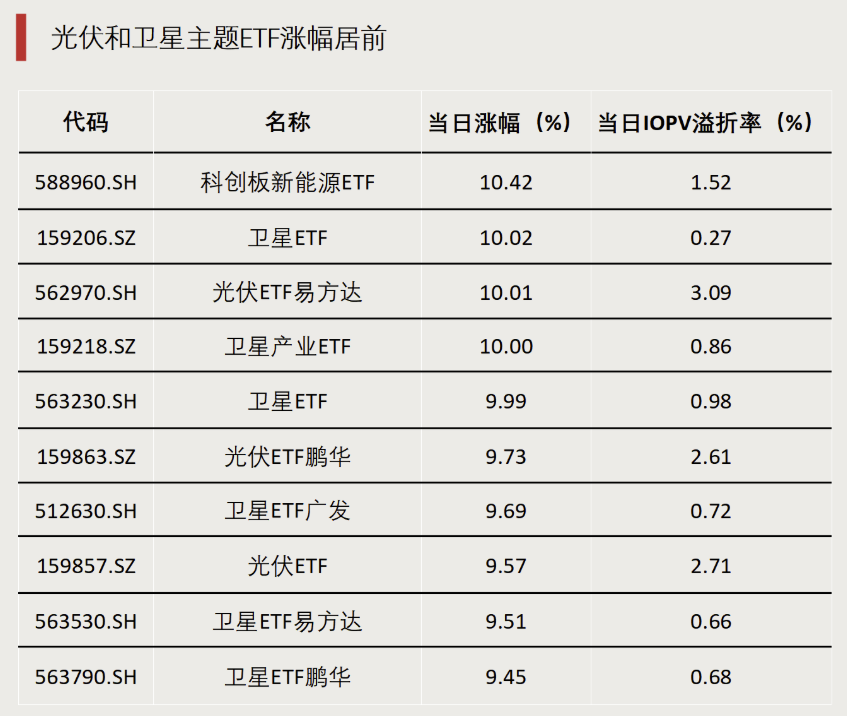
Core Viewpoint - The space photovoltaic and commercial aerospace concept stocks experienced significant gains, with multiple ETFs reaching their daily limit up on January 23, indicating strong market interest in these sectors [1][3]. Group 1: ETF Performance - On January 23, the A-share market saw a rise, particularly in space photovoltaic and commercial aerospace stocks, with several ETFs, including the New Energy ETF (588960), achieving a daily increase of 10.42% [3][4]. - Multiple ETFs, such as the Satellite ETF (159206), Photovoltaic ETF (562970), and Satellite Industry ETF (159218), all reached a rare 10% limit up on the same day [3][4]. - The trading volume for the Huatai-PineBridge CSI 300 ETF (510300) and the E Fund CSI 300 ETF (510310) exceeded 30 billion yuan each, reflecting active trading in broad-based ETFs [7][8]. Group 2: Market Trends - The commercial aerospace market in China has been rapidly growing since 2015, with projections indicating a market size of 7 trillion to 10 trillion yuan by 2030, driven by policy support and technological advancements [4]. - The energy sector saw some declines, with the Energy ETF (159930) leading the losses at -1.63% on the same day [5][6]. Group 3: Fund Flows - On January 22, the overall market saw a net outflow of approximately 67.7 billion yuan from ETFs, with a total net outflow of 259 billion yuan over the first four trading days of the week [2][9]. - Specific ETFs, such as the Huatai-PineBridge CSI 300 ETF and E Fund CSI 300 ETF, experienced significant net outflows exceeding 16 billion yuan and 15 billion yuan, respectively [9][10]. Group 4: Future Outlook - Fund managers express optimism about structural opportunities in the space photovoltaic and commercial aerospace sectors, anticipating a new cycle in the energy industry driven by energy transition and AI power demand [11]. - The aerospace sector is expected to perform well, particularly in the fourth quarter of 2025, with ongoing developments in commercial aerospace likely to benefit index component stocks [11].

四万亿投资来袭!募密集加仓,你的基金触“电”了吗?
Xin Lang Cai Jing· 2026-01-19 08:59
Group 1 - The core message is that the State Grid plans to invest 4 trillion yuan in fixed assets during the 14th Five-Year Plan, representing a 40% increase compared to the previous plan, which will significantly impact the entire power industry chain [1] - The average annual investment in the national power grid is expected to exceed 1 trillion yuan, indicating a strong commitment to energy infrastructure development [1] - The investment shift is expected to transition valuation models to "Energy Infrastructure 2.0," highlighting the potential for significant growth in the power system [1] Group 2 - The overall electricity consumption in China is shifting from moderate growth to steep increases, with a reported 7.2% year-on-year growth in electricity consumption for the first 11 months of 2025, the highest since 2012 [2] - The National Energy Administration projects a compound annual growth rate of 6.3% to 6.8% for electricity consumption from 2026 to 2028, significantly higher than the 4.2% average from 2016 to 2020 [2] Group 3 - The demand for electricity is being driven by the increasing need for AI, with the number of standard racks expected to exceed 12 million by the end of 2025, leading to an additional electricity demand of 260 billion kilowatt-hours [5] - Globally, electricity demand is projected to reach 29,038 TWh in 2024, with a year-on-year increase of 4.3%, surpassing both global energy demand growth and GDP growth rates [5][8] - The International Energy Agency warns that by 2030, global data center electricity demand will exceed 900 TWh, with NVIDIA's GPU clusters alone consuming 150-200 GW of power [8] Group 4 - Public funds have begun to actively invest in the power sector, with major institutions increasing their holdings in smart distribution and gas turbine sectors, reflecting a strong interest in the electricity market [9] - The trading volume of power equipment has surpassed that of the electronics sector, indicating heightened market activity and investor enthusiasm for the power sector [9] Group 5 - The investment landscape is divided between power generation and grid equipment, with power generation focusing on renewable energy sources and benefiting from long-term demand growth, while grid equipment investments are driven by policy and infrastructure needs [11] - The performance of grid equipment ETFs has shown significant returns, with some experiencing nearly 90% growth year-to-date, compared to more modest gains in power generation indices [12][14] - The choice between investing in power generation or grid equipment depends on the investor's risk appetite and market outlook, with grid equipment expected to deliver higher returns but with greater volatility [14]
中广核矿业早盘涨超4% 第4季度共生产天然铀702.5tU
Xin Lang Cai Jing· 2026-01-16 02:27
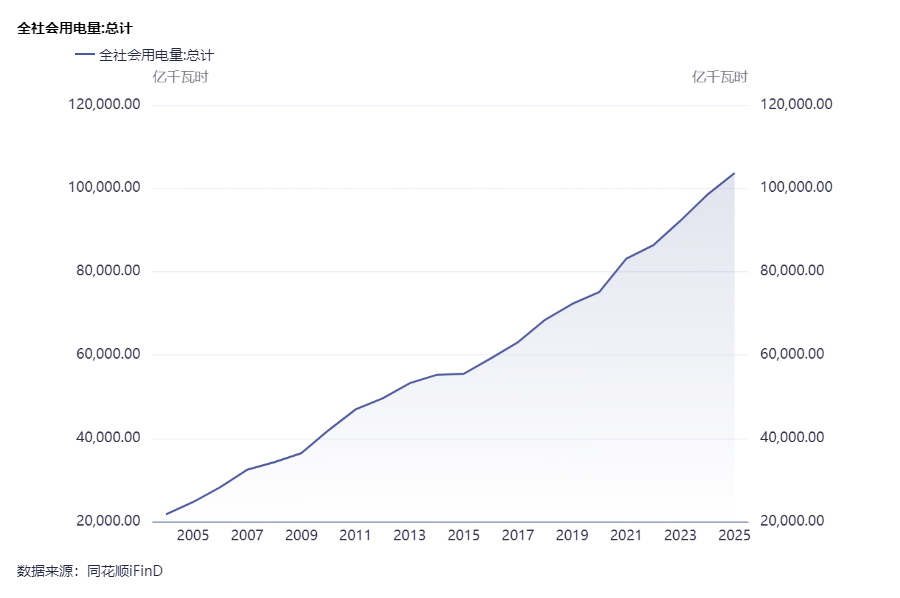
Core Viewpoint - China General Nuclear Power Corporation (CGN) Mining's stock price increased by 4.40%, currently trading at HKD 3.80, with a transaction volume of HKD 112 million [5]. Group 1: Company Performance - In 2025, CGN's 49%-owned Xie Company produced 862.2 tons of natural uranium, while another 49%-owned Ao Company produced 1,836.8 tons, achieving completion rates of 100.1% and 102.0% respectively [5]. - In the fourth quarter of 2025, CGN's invested mines produced a total of 702.5 tons of natural uranium, with a quarterly completion rate of 94.6%. Xie Company produced 249.2 tons, and Ao Company produced 453.3 tons [5]. Group 2: Industry Insights - According to Guojin Securities, the primary supply of uranium is expected to recover in the short term due to the resumption of mining operations, but the long-term supply capacity is facing continuous decline. Secondary supply is unlikely to generate effective increments in the short term [5]. - On the demand side, nuclear power installations are steadily increasing due to energy security, the transition to clean energy, and AI-driven electricity demand, leading to a persistent global supply-demand gap for natural uranium. Expectations of tight supply are driving up long-term contract prices for uranium [5].

港股异动 | 中广核矿业(01164)再涨超4% 第四季度共生产天然铀702.5tU 铀长协价有望持续上行
智通财经网· 2026-01-16 02:06
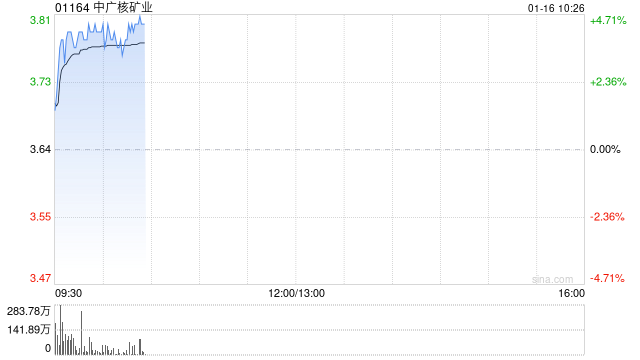
Group 1 - The core viewpoint of the article highlights the significant increase in the stock price of China General Nuclear Power Corporation Mining (CGN Mining), which rose by 4.12% to HKD 3.79, with a trading volume of HKD 87.39 million [1] - CGN Mining announced that its 49% owned Xie Company produced 862.2 tons of natural uranium in 2025, while its other 49% owned Ao Company produced 1,836.8 tons, achieving completion rates of 100.1% and 102.0% respectively [1] - In the fourth quarter of 2025, the total production of natural uranium from the group's invested mines was 702.5 tons, with a completion rate of 94.6% for the quarter [1] Group 2 - According to Guojin Securities, the supply side of uranium is expected to recover in the short term due to the resumption of mining operations, but the long-term supply capacity is facing continuous decline [1] - On the demand side, the growth of nuclear power installations is driven by energy security, the transition to clean energy, and the demand for AI-powered electricity, leading to a persistent global supply-demand gap for natural uranium [1] - The expectation of tight supply is likely to push up the long-term contract prices of uranium [1]
中广核矿业再涨超4% 第四季度共生产天然铀702.5tU 铀长协价有望持续上行
Zhi Tong Cai Jing· 2026-01-16 02:05
Core Viewpoint - China General Nuclear Power Corporation (CGN) Mining has seen its stock price increase by over 4%, currently trading at HKD 3.79 with a transaction volume of HKD 87.39 million. The company announced its uranium production figures for 2025, indicating strong performance in both its joint ventures [1]. Group 1: Company Performance - In 2025, CGN's 49%-owned Xie Company produced 862.2 tons of natural uranium, achieving a completion rate of 100.1% of its annual plan, while the 49%-owned Ao Company produced 1,836.8 tons, with a completion rate of 102.0% [1]. - For the fourth quarter of 2025, CGN's invested mines produced a total of 702.5 tons of natural uranium, with a completion rate of 94.6% for the quarter. Xie Company contributed 249.2 tons, and Ao Company contributed 453.3 tons [1]. Group 2: Industry Insights - According to Guojin Securities, the supply side of uranium is expected to see a short-term recovery due to the resumption of mining operations, but the long-term supply capacity is facing continuous decline. Additionally, secondary supply is unlikely to generate effective increments in the short term [1]. - On the demand side, the growth of nuclear power installations is being driven by energy security, the transition to clean energy, and the demand for AI-related electricity, leading to a steady increase in demand for natural uranium. The global supply-demand gap for natural uranium is expected to persist [1]. - With expectations of tight supply, the long-term contract prices for uranium are anticipated to continue rising [1].