
牛市整理期

Search documents
红利板块成资金“避风港”,恒生红利低波ETF(159545)月内吸金逾12亿元,规模创新高
Mei Ri Jing Ji Xin Wen· 2025-11-21 05:50
Core Viewpoint - The A-share market is experiencing a downward adjustment, with the dual innovation sector leading the declines, while the dividend sector is acting as a "safe haven" for funds amid market fluctuations [1] Market Performance - The Hang Seng High Dividend Low Volatility Index fell over 1%, and the Hang Seng Dividend Low Volatility ETF (159545) saw net subscriptions exceeding 17 million units during the session [1] - As of November 20, the Hang Seng Dividend Low Volatility ETF (159545) has received a cumulative net inflow of over 1.2 billion yuan since the beginning of November, reaching a product scale of 5.43 billion yuan, marking a historical high [1] Market Trends - Following a peak in trading activity in the computing power sector in early September, the market has entered a consolidation phase characterized by high capital rotation, index stagnation, and reduced trading volume [1] - Despite the current adjustments, the overall bull market logic remains intact, supported by deepening capital market reforms and structural prosperity, with ample liquidity suggesting limited downside potential [1] Investment Strategy - A style shift has begun in mid-term allocations, with short-term focus on "countermeasures + risk aversion," and a recommendation to pay attention to dividend styles towards the end of the year [1] - E Fund is noted as the only fund company offering low fee rates for all dividend ETFs, with management fees for products like the Hang Seng Dividend Low Volatility ETF (159545) set at 0.15% per year, facilitating low-cost investments in high-dividend assets [1]
红利板块震荡分化,恒生红利低波ETF(159545)全天获1500万份净申购
Sou Hu Cai Jing· 2025-11-20 10:42
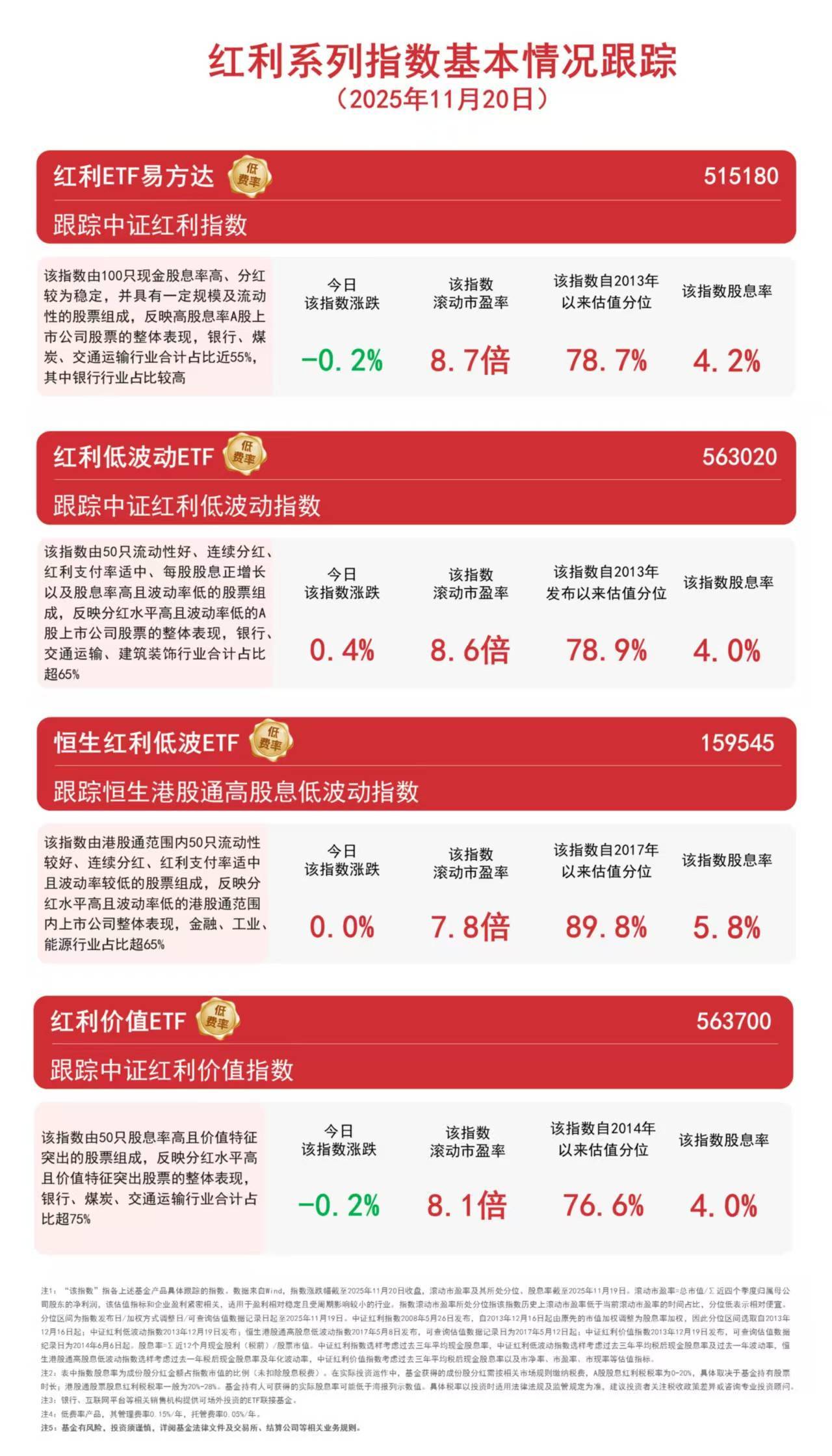
Group 1 - The core viewpoint indicates that the market is currently in a bull market consolidation phase, characterized by high capital flow into low volatility stocks and a horizontal index movement with reduced trading volume [1] - The China Securities Index shows that the CSI Dividend Low Volatility Index increased by 0.4%, while the CSI Dividend Index and CSI Dividend Value Index both decreased by 0.2% [1] - The market is supported by structural prosperity and ample liquidity, suggesting limited downside potential [1] Group 2 - The banking, coal, and transportation sectors collectively account for nearly 55% of the high dividend yield A-share market, with the banking sector having a significant weight [3] - The rolling price-to-earnings ratio for the CSI Dividend Index is reported at 8.7 times, with a valuation percentile of 78.7% since its inception [3] - The market is advised to focus on dividend styles towards the end of the year, with a shift in investment style already underway [1]

市场震荡调整,中证A500指数下跌0.54%,3只中证A500相关ETF成交额超29亿元
Sou Hu Cai Jing· 2025-11-17 03:53
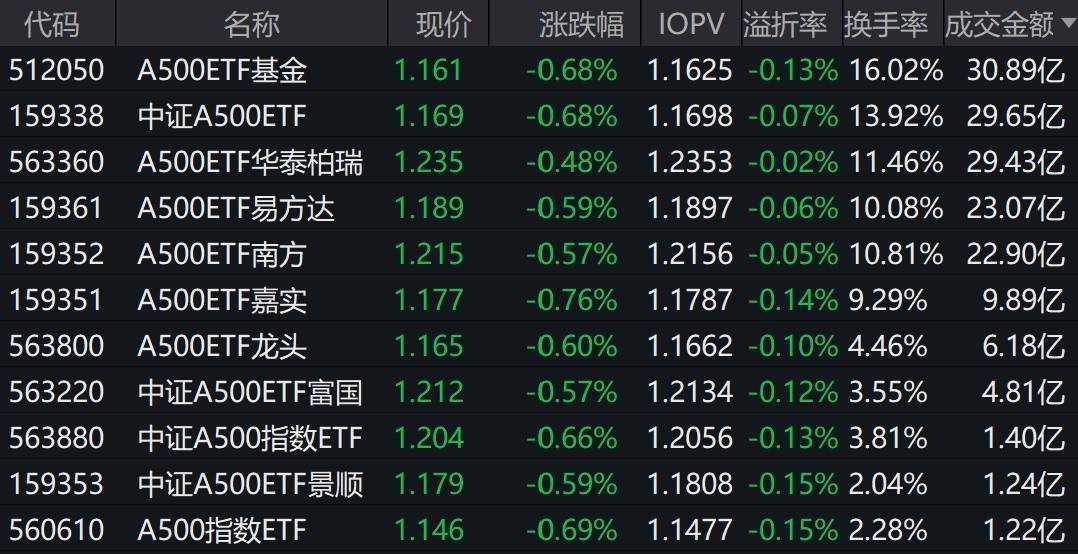
Market Overview - The market is experiencing fluctuations, with the Shenzhen Component Index briefly turning positive before declining again, and the CSI A500 Index dropping by 0.54% [1] - The Fujian sector has shown a resurgence, AI application concepts are gaining strength, the military industry sector remains robust, and lithium mining concepts are active [1] ETF Performance - As of the morning close, ETFs tracking the CSI A500 Index saw slight declines, with 11 related ETFs having transaction volumes exceeding 100 million yuan, and 3 surpassing 2.9 billion yuan [1] - Specific transaction volumes for A500 ETFs include: A500 ETF Fund at 3.089 billion yuan, CSI A500 ETF at 2.965 billion yuan, and A500 ETF Huatai-Pinebridge at 2.943 billion yuan [1] Market Sentiment - Brokerages indicate that the market is still in a bull market consolidation phase, with the Shanghai Composite Index moving sideways due to several factors: 1. Short-term profit-taking pressure from funds at year-end is causing market hotspots to disperse, making it difficult to form a consensus [1] 2. The core logic of the current slow bull market remains intact, supported by capital market reforms, structural prosperity, and long-term macro liquidity [1] 3. The market may be entering the later stage of the bull market consolidation, with future funds likely to focus on new main lines of attack [1]
红利风向标 | 市场或进入牛市整理期,红利配置价值凸显
Xin Lang Ji Jin· 2025-11-12 01:11
Group 1 - The latest dividend yield for Hwabao Fund is 4.92% as of November 12, 2025 [1] - The S&P China A-Share Dividend Opportunity Index is being tracked by the fund [1] - The fund's performance over the past year shows a return of 11.74%, outperforming the Shanghai Composite Index which had a return of 0.84% [1] Group 2 - The S&P Hong Kong Stock Connect Low Volatility Dividend Index is being tracked by another fund, which has shown a return of 30.93% over the past year [2] - The annualized volatility for this fund is reported at 3.44% [2] - The A500 Low Volatility Dividend ETF has a return of 8.30% over the past month, with an annualized volatility of 9.86% [2] Group 3 - The MACD golden cross signal has formed, indicating a positive trend for certain stocks [4]

机构建议关注“避险”红利风格,红利ETF易方达(515180)和恒生红利低波ETF(159545)获资金持续布局
Sou Hu Cai Jing· 2025-10-31 11:54
Core Viewpoint - The dividend sector experienced slight declines this week, with various indices showing negative performance, while certain dividend-focused ETFs attracted significant capital inflows [1][3]. Index Performance - The CSI Dividend Index fell by 0.5%, the CSI Low Volatility Dividend Index decreased by 0.9%, and the Hang Seng High Dividend Low Volatility Index dropped by 1.4% [1][3]. - The dividend yield for the CSI Dividend Index is 4.3%, while the rolling P/E ratio stands at 8.4 times [3][5]. - The CSI Low Volatility Dividend Index has a dividend yield of 4.2% and a rolling P/E ratio of 8.3 times [3][5]. - The Hang Seng High Dividend Low Volatility Index has a higher dividend yield of 5.9% and a rolling P/E ratio of 7.5 times [3][5]. Fund Inflows - The E Fund Dividend ETF (515180) and the Hang Seng Low Dividend ETF (159545) saw net inflows of 260 million yuan and 120 million yuan, respectively, this week [1]. Market Analysis - CITIC Securities noted that after a peak in trading activity in the computing power sector in early September, the market has entered a consolidation phase characterized by high capital rotation and low trading volume [1]. - The overall market sentiment remains bullish, supported by ongoing capital market reforms and structural economic stability, with limited downside potential [1]. Sector Composition - The CSI Dividend Index comprises 100 stocks with high cash dividend yields and stable dividends, with significant representation from the banking, coal, and transportation sectors, accounting for nearly 55% [4]. - The CSI Low Volatility Dividend Index consists of 50 stocks with low volatility and stable dividends, with over 60% representation from banking, coal, and transportation sectors [4]. - The Hang Seng High Dividend Low Volatility Index includes 50 stocks from the Hong Kong stock market, with over 60% representation from financial, real estate, and energy sectors [4].

【红包】养基陪伴 | “924”一周年,从2800-3800,行情到哪一步了?
Sou Hu Cai Jing· 2025-09-25 10:21
Core Viewpoint - The A-share market has experienced significant fluctuations and a recent surge in technology stocks, particularly in AI, leading to a complex investment environment as the market approaches the 3900-point mark [1][5]. Market Performance - The Shanghai Composite Index rose from 2800 points to 3800 points, marking a 39.03% increase since the policy announcement on September 24 last year [1]. - The communication, electronics, and comprehensive industry indices have seen gains exceeding 100%, while coal, oil, and public utilities indices have increased by less than 10% [1]. Market Dynamics - Historical data indicates that even during bull markets, indices often experience pullbacks of over 10% after significant rises, suggesting that volatility and corrections are part of the risk management process [2]. - The current market liquidity is driven by an increase in risk appetite, with margin trading balances reflecting this change [3]. Valuation Insights - Major indices are currently at relatively high valuation levels, with the following P/E ratios indicating a need for caution: - CSI All Share: 21.38x (96.70% percentile) - ChiNext Index: 43.62x (59.21% percentile) - CSI 500: 34.17x (99.59% percentile) - CSI 1000: 46.91x (95.13% percentile) - CSI 2000: 61.09x (99.09% percentile) - STAR 50: 182.15x (99.42% percentile) [6][5]. AI Sector Analysis - The AI sector has been a major driver of market performance, with significant advancements in technology and commercialization contributing to its rise [8]. - The P/E ratio for the CSI AI index is currently at 74.86x, placing it in the 97.36% percentile over the past five years, indicating a high valuation [8]. - Major tech companies have reported strong earnings, supported by AI investments, suggesting a positive investment narrative for the sector [9]. Precious Metals Performance - The precious metals index surged by 17.20% in September, driven by expectations of Federal Reserve interest rate cuts and geopolitical tensions [10]. - The relationship between gold prices and the US dollar indicates that a weaker dollar enhances the attractiveness of precious metals [12]. Hong Kong Tech Sector Outlook - The Hong Kong tech sector, particularly the Hang Seng Tech Index, has shown strong performance recently, suggesting potential for a rebound [13]. - The current P/E ratio for the Hang Seng Tech Index is 23.47x, which is attractive compared to A-share tech stocks [14]. - The recent Federal Reserve rate cut is expected to improve liquidity, making Hong Kong tech stocks more appealing to investors [14].
牛市整理期的市场特征——“策略周中谈”
2025-09-10 14:35
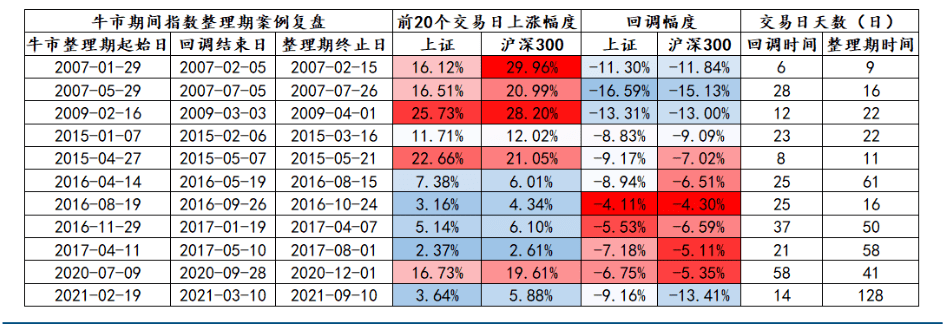
Summary of Conference Call Records Industry or Company Involved - The discussion primarily revolves around the stock market, particularly focusing on the AI computing sector, TMT (Technology, Media, and Telecommunications) sector, and various emerging industries such as renewable energy, new consumption, innovative pharmaceuticals, non-bank financials, and basic chemicals. Core Points and Arguments 1. **Market Sentiment and Trends** - Market sentiment is currently in an exuberant phase but has not peaked, similar to early 2015 and March-April 2019, indicating a potential for either a peak reversal or sideways consolidation [1][2][4] - The trading structure has deteriorated, with the AI computing sector experiencing overcrowding, while the communication and electronics sectors have seen transaction volume ratios of 99.6% and 95.6% respectively [2][5] 2. **Historical Patterns of Market Consolidation** - Historical analysis of 11 previous consolidation periods shows they typically last 1-2 months, with maximum index drawdowns of 7%-9% [3][9] - A trading volume turnover rate exceeding 2% signals overheating, with a potential for significant corrections if it reaches 3% [3][5] 3. **Investment Opportunities Post-Consolidation** - After the current consolidation phase, the market is expected to continue its upward trend, with a focus on emerging sectors such as AI computing, renewable energy, new consumption, innovative pharmaceuticals, and non-bank financials [4][19] - The AI computing sector remains a core investment theme despite recent cooling [14] 4. **Current Market Downturn Causes** - The market downturn is attributed to trading overheating and structural deterioration, with significant transaction volume in the TMT sector nearing 40% [5][6] - Investor risk appetite has decreased, contributing to market adjustments [2][5] 5. **Sector Focus and Fund Flow Trends** - Current high interest in the electric equipment and renewable energy sectors, with notable increases in transaction volume for biopharmaceuticals and consumer sectors [6] - Attention should be paid to fund flows and rotation opportunities among sectors, especially as AI computing cools down [6] 6. **Short-term Risks in TMT and AI Computing Sectors** - The TMT and AI computing sectors are not expected to face significant short-term declines, with potential for continued investment opportunities [7] - The market sentiment remains high, influenced by expectations of Federal Reserve interest rate cuts [7] 7. **Investment Strategy During Market Consolidation** - Focus on mid-cap and large-cap growth stocks, as small-cap valuations are considered too high [11][12] - Emphasis on stocks that have underperformed but show potential for recovery during the consolidation phase [12] 8. **Key Sectors for Future Investment** - Renewable energy, particularly energy storage and solid-state batteries, are highlighted as key areas for investment [15][16] - New consumption sectors are also deemed worthy of attention, especially with upcoming holidays potentially boosting consumer spending [17] 9. **Impact of Federal Reserve Rate Cuts** - Federal Reserve rate cuts are expected to benefit sectors such as innovative pharmaceuticals and precious metals, with implications for non-bank financials and technology stocks [18] Other Important but Possibly Overlooked Content - The need for a comprehensive evaluation of industry conditions, policy directions, and sector performance to ensure a robust investment portfolio during periods of market volatility [12] - The potential for significant shifts in investment focus as market conditions evolve, particularly in response to macroeconomic trends and investor sentiment [19]