
生态优先绿色发展

Search documents
长江经济带十年奔腾动能澎湃 撑起全国经济总量“半壁江山”
Chang Jiang Shang Bao· 2026-02-09 01:58
Core Viewpoint - The Yangtze River Economic Belt has become a crucial national development strategy, contributing nearly 50% of the national economic output and serving as a key ecological protection barrier in China [1][2][4]. Group 1: Economic Contribution - The Yangtze River Economic Belt covers about one-fifth of China's land area and contributes nearly 50% of the national economic total, solidifying its role as a vital economic corridor [2][4]. - By 2025, the economic output of the Yangtze River Economic Belt is projected to reach approximately 66.8 trillion yuan, more than doubling over the past decade with an average growth rate of 5.4%, surpassing the national average by 0.4 percentage points [4]. Group 2: Ecological and Environmental Initiatives - The concept of "grasping major protection without large-scale development" has taken root in the Yangtze River Economic Belt, leading to significant ecological improvements, including the enhancement of water quality from class V to class II along the main river [6][7]. - The region has implemented pollution control measures across various sectors, including industrial and agricultural pollution, resulting in the closure or transformation of nearly 10,000 chemical enterprises and the elimination of 1,361 illegal docks [6][7]. Group 3: Industrial Transformation and Innovation - The Yangtze River Economic Belt has fostered industrial transformation by nurturing 41 national-level advanced manufacturing clusters and 30 strategic emerging industry clusters, accounting for 51% and 45% of the national totals, respectively [6][7]. - The region is actively promoting the green transformation of traditional industries, establishing 24 national carbon peak pilot cities and parks, and supporting the scrapping and updating of approximately 10,000 old operating vessels [7]. Group 4: Future Development Plans - The next phase of development will focus on high-level ecological protection, enhancing innovation support systems, and strengthening regional collaboration, with an emphasis on building a "Five Great Yangtze" framework encompassing ecological, innovative, open, cultural, and happy aspects [8].
共饮一江水|长江经济带发展十周年 中国银行与区域重大战略同向而行
财联社· 2026-01-23 06:47
Core Viewpoint - The article emphasizes the transformation and development of the Yangtze River Economic Belt, highlighting the importance of ecological protection, innovation, and open development as key themes for sustainable growth in the region [2][6][12]. Group 1: Ecological Protection - Over the past decade, the company has actively supported ecological restoration and environmental governance along the Yangtze River Economic Belt, increasing support for projects related to urban sewage and industrial pollution control [6]. - The company has issued over 12 billion yuan in loans to support ecological environment governance projects in areas like Ma'anshan, transforming former mining sites into urban gardens [4][5]. - As of September 2025, the loan balance for ecological and environmental protection in the Yangtze River Economic Belt exceeded 100 billion yuan [6]. Group 2: Innovation - The company has established a government industry fund management project with a total of 1 billion yuan to support the breakthrough development of leading commercial aerospace enterprises [8][9]. - The company has set up a technology finance center and dedicated teams to provide targeted support for emerging industries, with a total technology finance loan balance exceeding 730 billion yuan in the Yangtze River Delta region as of September 2025 [10]. Group 3: Open Development - The company has provided 2.51 billion yuan in loans to support the construction of the Changjing-Huang High-speed Railway, enhancing connectivity within the Yangtze River Economic Belt [13]. - Over the past decade, the company has increased credit support for transportation infrastructure projects, facilitating the development of a comprehensive transportation network in the Yangtze River Economic Belt [15]. Group 4: Improving Livelihoods - The company has actively supported key livelihood areas such as food security and rural revitalization, with loans exceeding 20 billion yuan for grain production and supply enterprises in major grain-producing regions [19]. - The company aims to enhance the quality of life in the Yangtze River Economic Belt by promoting sports events like marathons, which inject vitality into regional economic development [17][18]. Group 5: Future Outlook - Looking ahead to the next decade, the company plans to continue focusing on key areas to promote green economic transformation, support technological industry growth, and improve transportation networks while enhancing livelihood security [20].

坚定不移走好生态优先绿色发展之路
Xin Lang Cai Jing· 2026-01-07 06:54
Core Viewpoint - The article emphasizes the importance of addressing ecological and environmental issues in Huairou District, highlighting the need for effective management and rectification of identified problems to support sustainable development and ecological protection [1][3]. Group 1: Ecological and Environmental Management - Huairou District has completed the rectification of issues related to the illegal occupation of river management areas and the inadequate restoration of forest land in Jiu Du River Town [2]. - The district is implementing a detailed management system for the problems identified during the central ecological environment protection inspection, ensuring accountability and clear objectives for rectification [2][3]. - The focus is on enhancing the urban and rural living environment, promoting beautiful countryside construction, and strengthening ecological protection to support high-quality regional development [2][3]. Group 2: Disaster Recovery and Infrastructure - The article outlines the need for high-quality and efficient disaster recovery efforts, with a focus on completing basic recovery projects before the flood season [3]. - Emphasis is placed on ensuring safety and scientific planning in the construction of new projects, including residential buildings, nursing homes, and schools [3]. - There is a call for improving disaster resilience in mountainous areas and enhancing emergency response capabilities [3]. Group 3: Governance and Accountability - The article stresses the importance of party leadership in driving the implementation of various tasks, with a focus on environmental protection responsibilities [4]. - It highlights the need for strict oversight and accountability measures for rectification and reconstruction tasks, ensuring dynamic management throughout the process [4]. - The article also mentions the importance of maintaining market stability and ensuring the supply of essential services as the Spring Festival approaches [4].
数据里的中国|10年,长江经济带的故事更“绿”更“新”
Xin Lang Cai Jing· 2026-01-07 04:51
Core Viewpoint - The Yangtze River Economic Belt has made significant progress over the past decade, balancing ecological protection with economic development, contributing nearly half of China's GDP while accounting for about one-third of the country's energy consumption and carbon emissions [1]. Group 1: Economic Development - The Yangtze River Economic Belt has contributed nearly 50% of China's GDP over the past decade [1]. - The cargo throughput of major ports along the Yangtze River has increased by 100%, reaching 2.7 billion tons, maintaining its position as the world's leading inland river [10]. - The number of national-level advanced manufacturing clusters has reached 4, while strategic emerging industry clusters have reached 30, accounting for 51% and 45% of the national total, respectively [4]. Group 2: Ecological Protection - The implementation of the "Ten-Year Fishing Ban Plan" on the Yangtze River has provided support for 231,000 retired fishermen, with 12,000 difficult fishermen included in the social security system [15]. - The South-to-North Water Diversion Project has delivered over 84 billion cubic meters of water, benefiting 48 cities and 195 million people along the route [16]. Group 3: Cultural Heritage - The Longzhou Ancient City Ruins have been successfully listed as a World Cultural Heritage site, and the archaeological discoveries at Sanxingdui have garnered global attention [11]. - The establishment of the Yangtze National Cultural Park aims to protect and utilize cultural heritage along the river [11].
打开长江经济带高质量可持续发展之窗
Ren Min Ri Bao· 2026-01-06 23:29
Core Viewpoint - The development of the Yangtze River Economic Belt is a crucial strategy for China's high-quality and sustainable development, emphasizing ecological protection and green growth as foundational principles [1][3]. Group 1: Development and Protection - The proportion of good water quality in the Yangtze River Economic Belt has increased from 67% to 96.5% over the past decade [3]. - The regional GDP share has risen from 42.2% to 47.3%, indicating significant economic growth [3]. - Per capita disposable income has increased from 23,000 yuan to 44,000 yuan, reflecting a 91% growth [3]. Group 2: Ecological and Economic Integration - The strategy emphasizes the need to balance ecological protection with economic development, advocating for high-level protection to support high-quality growth [4][5]. - The transformation of traditional industries into green and sustainable practices is highlighted, with examples of companies investing in environmental upgrades and circular economy initiatives [4][11]. Group 3: Innovation and New Growth Drivers - The focus on technological innovation is essential for transitioning to new productive forces, with an emphasis on developing advanced production capacities [6][8]. - The integration of scientific research and talent into economic development is crucial for fostering new growth areas and competitive advantages [9][10]. Group 4: Regional Coordination and Integration - The importance of regional collaboration among provinces along the Yangtze River is stressed, promoting shared development and ecological governance [15][21]. - Initiatives like the Yangtze River Delta ecological integration demonstrate the effectiveness of coordinated planning and management across administrative boundaries [16][20]. Group 5: Long-term Vision and Strategy - The overarching strategy aims for sustainable development that harmonizes economic growth with ecological preservation, ensuring the long-term viability of the Yangtze River as a vital resource for the nation [22][23].
优良水质比例提升近30个百分点,地区生产总值翻一番多(权威发布)
Ren Min Ri Bao· 2026-01-06 00:28
Core Viewpoint - The development of the Yangtze River Economic Belt has achieved significant progress over the past decade, focusing on ecological protection and green development, resulting in improved water quality, economic growth, and increased residents' disposable income. Group 1: Environmental Improvements - The proportion of good water quality in the Yangtze River has increased from 67% to 96.5% [1] - The water quality of the main stream has maintained a Class II standard for six consecutive years, with flagship species like the Yangtze River dolphin showing population recovery [4] - A total of 1361 illegal docks have been thoroughly cleaned up, and black and odorous water bodies in cities along the river have been largely eliminated [2] Group 2: Economic Growth - The regional GDP of the Yangtze River Economic Belt has more than doubled, increasing its share of the national GDP from 42.2% to 47.3% [1] - Residents' per capita disposable income has risen from 23,000 yuan to 44,000 yuan, representing a 91% increase [1][3] Group 3: Industrial and Technological Development - The Yangtze River Economic Belt has fostered the emergence of innovative companies and advanced technology in fields such as artificial intelligence and quantum information [6] - A total of 41 national-level advanced manufacturing clusters and 30 strategic emerging industry clusters have been cultivated, accounting for 51% and 45% of the national totals, respectively [6] Group 4: Infrastructure and Transportation - The high-grade navigable waterways of the Yangtze River have increased from 8,000 kilometers to 11,000 kilometers, with cargo throughput at trunk ports growing by 71% to reach 4.2 billion tons [3] - The construction of green service facilities along the Yangtze River has been completed, including 20 green service areas and 13 washing stations [7] Group 5: Disaster Prevention and Management - The water and drought disaster prevention system in the Yangtze River basin has shown significant effectiveness, successfully managing major floods and droughts in recent years [5] - The Yangtze River fishing ban has led to a positive recovery in aquatic biodiversity, with the number of native fish species monitored increasing by 36 since the ban [5]
长江经济带发展十年:GDP占全国比重升至47.3%
Di Yi Cai Jing· 2026-01-05 13:23
Core Insights - The "14th Five-Year Plan" emphasizes the continuous development of the Yangtze River Economic Belt, highlighting the importance of ecological protection and high-quality development [1][3] Group 1: Economic Growth and Development - The Yangtze River Economic Belt has seen its GDP more than double over the past decade, increasing its share of the national GDP from 42.2% to 47.3% [1] - The per capita disposable income of residents in the region has risen from 23,000 yuan to 44,000 yuan, marking a 91% increase [1] - The region has established a complete industrial chain in sectors such as electronics, automotive, pharmaceuticals, and chemicals, contributing to its status as a major area for industrial aggregation [3][4] Group 2: Environmental Protection and Sustainability - The proportion of good water quality in the Yangtze River has improved from 67% to 96.5% over the past decade [1] - The ecological environment capacity of the Yangtze River basin is limited, necessitating a focus on green, high-end, and intelligent economic growth [3] - Efforts are being made to promote the green transformation of traditional industries, with 24 national carbon peak pilot cities and parks established in the region [4] Group 3: Transportation and Logistics - The Yangtze River's high-grade waterway mileage has reached 11,500 kilometers, significantly enhancing shipping capabilities [6] - By 2025, the throughput of major ports along the Yangtze River is expected to reach 4.2 billion tons, with the number of large ports increasing to 18 [6] - The development of multimodal transport is being prioritized to optimize transportation structure and reduce logistics costs, with a focus on enhancing intermodal connectivity [7]
47.3%、42亿吨、96.5% 一组数据梳理长江经济带发展“多点开花”
Yang Shi Wang· 2026-01-05 12:51
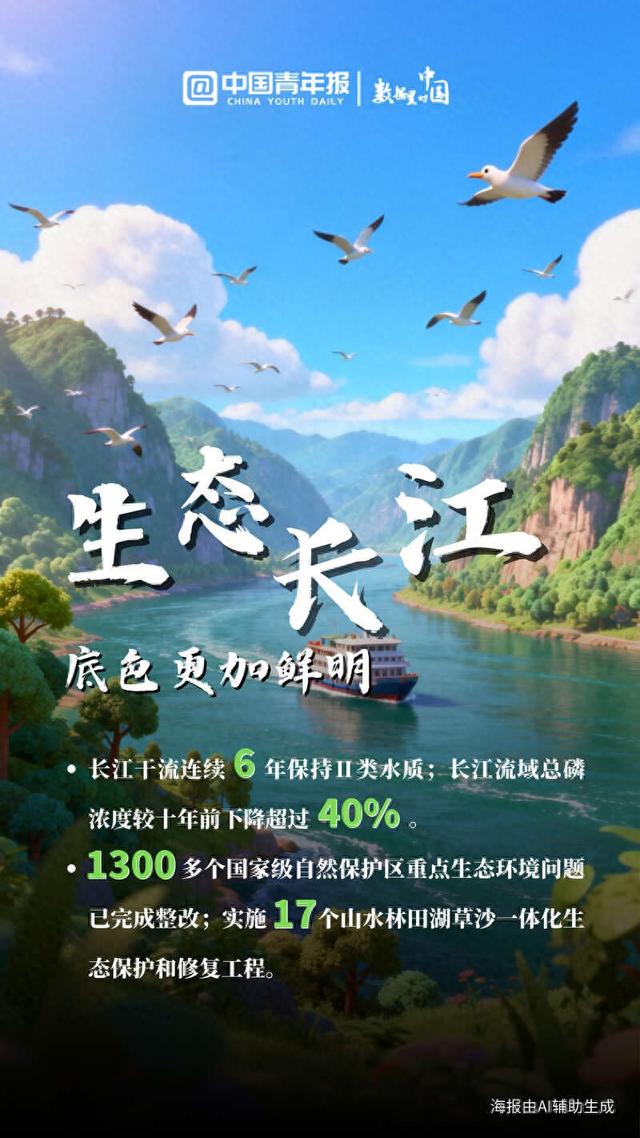
Core Insights - The Yangtze River Economic Belt, covering 11 provinces and cities, contributes over 40% of the national population and GDP, representing a vital economic area for China [1] Group 1: Economic Growth - The GDP of the Yangtze River Economic Belt has more than doubled over the past decade, increasing its share of the national GDP from 42.2% to 47.3% [3] - Per capita disposable income in the region rose from 23,000 yuan to 44,000 yuan, marking a 91% increase [3] Group 2: Transportation Development - The length of high-grade navigable waterways in the Yangtze River system increased from 8,000 kilometers to 11,000 kilometers over the past decade [5] - The cargo throughput at the main ports along the Yangtze River grew by 71%, reaching 4.2 billion tons, maintaining its position as the world's leading inland river in terms of cargo throughput [5] Group 3: Environmental Protection - The proportion of Class I to III water quality in the Yangtze River Economic Belt improved from 67% in 2015 to 96.5%, an increase of nearly 30 percentage points [7] - The water quality of the main stem of the Yangtze River improved from some sections being Class V to the entire river being classified as Class II [7]
“数”览长江经济带发展十年“成绩单”
Yang Shi Wang· 2026-01-05 07:27
Core Insights - The Longjiang Economic Belt has achieved significant ecological and economic progress over the past decade, emphasizing ecological priority and green development [1] Group 1: Environmental Achievements - The proportion of good water quality in the Yangtze Economic Belt increased from 67% to 96.5%, with the water quality of the main river improving from some Class V to Class II [1][4] - The proportion of Class I-III water quality rose by nearly 30 percentage points over ten years [4] - The total phosphorus concentration in the Yangtze River basin has decreased by over 40% compared to ten years ago [4] Group 2: Economic Growth - The GDP of the Yangtze Economic Belt more than doubled, increasing its share of the national economy from 42.2% to 47.3% [1] - Per capita disposable income rose from 23,000 yuan to 44,000 yuan, representing a growth of 91% [1] Group 3: Infrastructure Development - The length of high-grade navigable waterways in the Yangtze River system increased from 8,000 kilometers to 11,500 kilometers [3] - The cargo throughput of mainline ports grew by 71%, reaching 4.2 billion tons, maintaining the position as the world's leading inland river [1][3] - By 2025, the expected cargo throughput of the Yangtze mainline ports is projected to reach 4.2 billion tons, with the number of major ports increasing to 18 [3] Group 4: Future Plans - The next steps include implementing the "14th Five-Year" development plan for the Yangtze Economic Belt and advancing the three-year action plan for major ecological protection [2][6] - A monitoring and regulatory system for river pollution discharge will be established to enhance biodiversity and promote the protection of beautiful rivers and lakes in the Yangtze River basin [6]
智库报告展示长江经济带十年发展的“八大成效”
Zhong Guo Xin Wen Wang· 2026-01-04 09:11
Core Viewpoint - The report highlights the significant achievements of the Yangtze River Economic Belt over the past decade in eight key areas, including ecological protection, transportation infrastructure, industrial transformation, urbanization, openness, regional coordination, high-quality development, and cultural heritage [1][2]. Group 1: Ecological Protection - The Yangtze River Economic Belt has made notable progress in ecological protection under the "coordinated protection and not large-scale development" strategy, with the water quality of the Yangtze River maintaining Class II for several consecutive years [1]. - Various provinces and cities along the river have implemented institutional frameworks and ecological compensation mechanisms to promote regional collaborative governance [1]. Group 2: Transportation Infrastructure - The construction of a comprehensive transportation corridor has been advanced, linking shipping centers such as Shanghai, Wuhan, and Chongqing, and promoting the coordinated development of railways, highways, aviation, and water transport [1]. - The China-Europe Railway Express and the Yangtze River Golden Waterway have achieved mutual support, enhancing the level of openness [2]. Group 3: Industrial Transformation - There has been a significant improvement in industrial transformation, with the roles of national independent innovation demonstration zones, economic and technological development zones, and high-tech industrial development zones being highlighted [1]. - The central and upper reaches of the Yangtze River have become important areas for industrial transfer, gradually perfecting a modern industrial system [1]. Group 4: Urbanization - New urbanization is progressing steadily, with an increasing trend of urban-rural integration, accelerated construction of urban clusters and characteristic towns, and an orderly process of urbanization for the agricultural transfer population [1][2]. Group 5: Openness and Regional Coordination - A new pattern of openness is becoming more prominent, with regions like Shanghai, Chongqing, and Sichuan promoting high-level openness through free trade pilot zones and comprehensive trials of open economic systems, significantly improving resource allocation efficiency [2]. - The regional coordination mechanism has been continuously optimized, with inter-provincial consultation and cooperation mechanisms established in the upper, middle, and lower reaches of the Yangtze River, achieving substantial progress in ecological joint prevention and control, infrastructure connectivity, and industrial collaboration [2]. Group 6: High-Quality Development - The GDP share of the Yangtze River Economic Belt in the national economy has been continuously increasing, with significant agglomeration effects of high-tech enterprises and listed companies in the Yangtze River Delta region [2]. - Jiangsu, Zhejiang, and Hubei have shown outstanding performance in high-quality development [2]. Group 7: Cultural Heritage - Initial achievements have been made in the protection and promotion of Yangtze culture, with steady progress in the construction of the Yangtze National Cultural Park, enhancing the trend of cultural and economic integration [2].