真实利率

Search documents
张斌:货币政策如何扩大内需
3 6 Ke· 2026-01-07 11:10
Group 1: Monetary Policy and Demand Expansion - Monetary policy can expand domestic demand by changing the interaction behaviors of countless micro-individuals, encouraging businesses to invest and residents to buy homes and consume [1][7] - The key to achieving these changes lies in the central bank's firm stance on inflation targets and significantly lowering policy interest rates [1][14] - Fiscal policy complements monetary policy by increasing government spending and leveraging its multiplier effect to expand domestic demand [1] Group 2: Historical Context and Examples - Since the 1990s, central banks have been the main force behind policies to expand domestic demand, often relying solely on monetary policy [1] - During the 2008 financial crisis, the Federal Reserve, under Bernanke, lowered the federal funds rate from 5.25% to 0.25%, a reduction of 500 basis points, which led to a significant rebound in the S&P 500 index [3] - Japan's central bank, under Kuroda, adopted aggressive monetary policies, including quantitative easing and negative interest rates, which resulted in a substantial increase in the Nikkei 225 index and a recovery in housing prices [5][6] Group 3: Current Economic Challenges in China - China's economy is currently facing challenges of insufficient demand, with private fixed asset investment experiencing negative growth for the first time since 2005, at -0.4% in 2023 [12][13] - Consumer confidence remains low despite some recovery in capital markets and a slight improvement in expectations following proactive counter-cyclical policies [12] - The attractiveness of private investment is low, with the difference between return on assets (ROA) and long-term financing rates at only 0.2% in 2024, the worst level in 20 years [13] Group 4: Mechanisms for Stimulating Investment and Consumption - To stimulate investment and consumption, the central bank must clearly communicate future inflation targets and further reduce policy interest rates, making investments and home purchases more attractive [14] - The relationship between interest rates and housing prices is significant; even a small decrease in interest rates can create substantial upward pressure on housing prices [10][11] - For businesses, lower interest rates reduce financing costs, while for residents, they influence the decision to buy or rent, impacting overall demand [9][10]
黄金站历史高位吵翻了!看多喊冲2600、看空喊跌2200,谁靠谱?
Sou Hu Cai Jing· 2025-11-17 06:09
Core Viewpoint - The recent surge in gold prices is attributed to a combination of factors including interest rate expectations, central bank purchases, geopolitical tensions, and increased investment flows into gold as a safe haven asset [1][3][20]. Group 1: Interest Rates and Central Bank Actions - The shift in market sentiment regarding interest rates, with expectations of 2-3 rate cuts by the Federal Reserve by May 2025, has reduced the opportunity cost of holding gold [5][6]. - Central banks have been consistently increasing their gold reserves, with China adding nearly 30 tons in Q1 2025, indicating a long-term strategy to hold gold as a stable asset [6][7]. Group 2: Geopolitical Tensions and Investment Flows - Ongoing geopolitical tensions, particularly in the Middle East and Europe, have heightened market anxiety, leading to increased demand for gold as a defensive asset [9][11]. - In Q2 2025, global gold ETF holdings increased by 5%, with significant inflows from the US and Europe, as investors shifted back to gold after previously reducing their positions [12][14]. Group 3: Market Dynamics and Future Outlook - The current high gold prices are influenced by both emotional market responses to geopolitical events and substantial capital inflows, creating a feedback loop that drives prices higher [11][14]. - There are mixed opinions on future gold price movements, with some predicting a rise to $2,600 per ounce while others caution about potential corrections to $2,200 per ounce due to over-optimism regarding interest rate cuts [16][18].

11月11日市场点评:金价企稳,新能源频传利好
Mei Ri Jing Ji Xin Wen· 2025-11-11 10:19
Market Overview - The market experienced fluctuations with the three major indices opening high but closing lower, while the Shanghai Composite Index remained above 4000 points [1] - The trading volume in the Shanghai and Shenzhen markets was below 2 trillion yuan, a decrease of 180.9 billion yuan compared to the previous trading day [1] - By the close, the Shanghai Composite Index fell by 0.39%, the Shenzhen Component Index by 1.03%, the ChiNext Index by 1.4%, and the CSI 500 Index by 0.84% [1] Future Outlook - Liquidity for equity assets is expected to remain ample both domestically and internationally, with ongoing investment and industrial opportunities driven by AI [1] - The market is likely to experience normal fluctuations or adjustments following a phase of upward movement, suggesting that investors should consider positioning in high-growth or policy-supported sectors during pullbacks [1] Gold Market Insights - After a recent rapid adjustment, gold prices have stabilized and are expected to rise in the medium to long term due to factors such as (a) unsustainable high debt models in major global economies, (b) strategic allocations by central banks and long-term investors, (c) declining real interest rates, and (d) increasing global risk events [1] - UBS has projected that gold prices may reach a historical high of $5000 per ounce at some point next year or the year after [1] - It is suggested that gold should be viewed as a fundamental currency, with investors advised to hold a portion of it, indicating that the recent pullback may present a good opportunity to invest in the gold sector [1] Renewable Energy Sector Developments - The renewable energy sector has received positive news, with the National Development and Reform Commission and the National Energy Administration releasing guidelines to promote the integration of renewable energy with industry and optimize the operation of energy and computing facilities [2] - The lithium battery sector is benefiting from the ongoing expansion of energy storage and new energy vehicles, with the China Association of Automobile Manufacturers reporting that in October, new energy vehicle sales exceeded 50% of total new car sales for the first time [2] - In the photovoltaic sector, efforts to reduce internal competition are ongoing, with expected implementation of silicon material mergers and acquisitions, as well as production limits and sales policies [2]
币爆了,黄金呢?
Hu Xiu· 2025-10-11 06:39
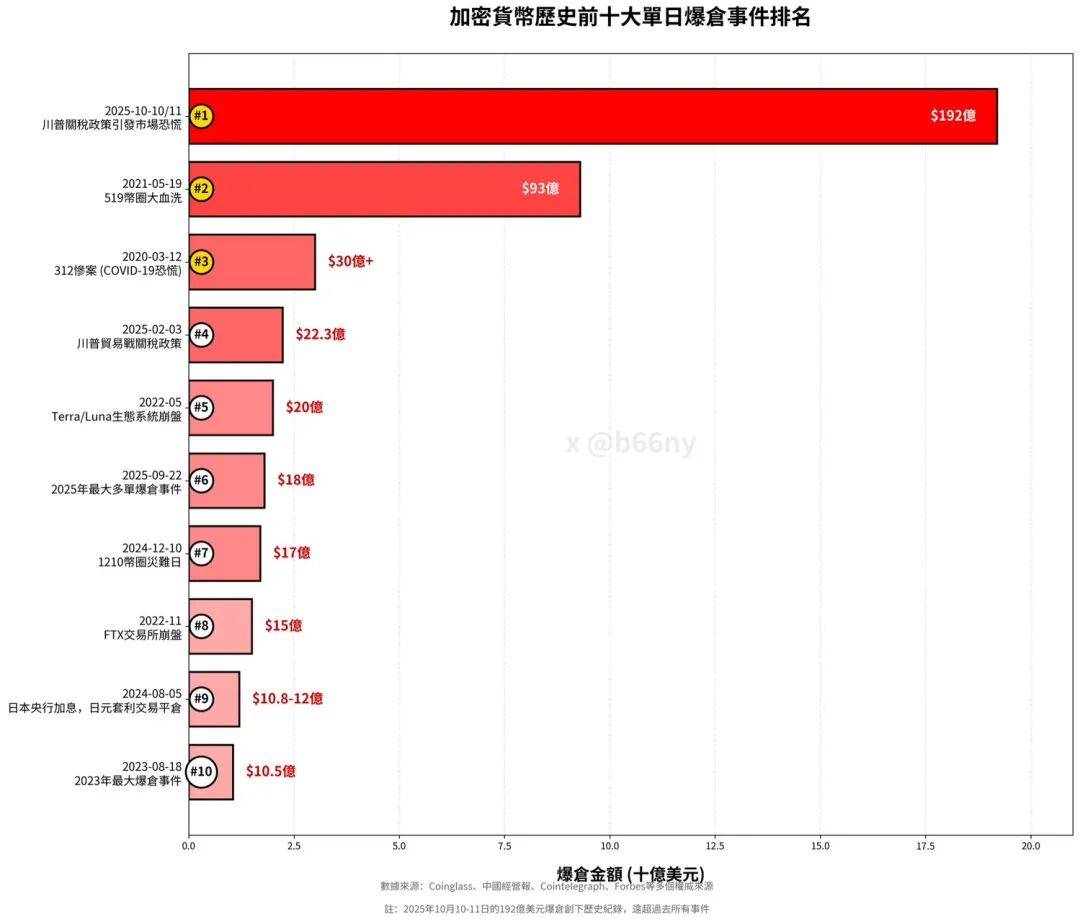
Group 1 - The cryptocurrency market experienced a significant crash on October 11, with Bitcoin dropping below $110,000 and altcoins plummeting to near-zero levels [1] - The primary cause of the crash is attributed to high leverage in the market, where many gains were made through contracts, loans, and liquidity mining, leading to a snowball effect of selling pressure when negative news emerged [3] Group 2 - Despite high leverage in gold trading, gold has not experienced a major crash, suggesting that the current turmoil in cryptocurrencies may be driven by retail investors and central banks holding physical gold [4] - There is a growing trend of using gold to measure the value of other assets, such as real estate, oil, and stocks, which reflects a shift in market sentiment towards gold [5][6][8][10] Group 3 - The relationship between gold prices and real interest rates, as well as risk sentiment, is crucial; when real interest rates decline or fear increases, gold prices tend to rise independently of other asset prices [14] - Charts comparing asset prices to gold are more indicative of gold's purchasing power cycles rather than the actual value of the assets being measured [18] - The current proliferation of gold pricing charts may indicate a shift in market sentiment, suggesting that emotions may be running high in the current environment [19]