
经济数据发布延迟

Search documents
Third-Quarter GDP, October Spending Data to Be Delayed
WSJ· 2025-11-20 16:48
Core Points - Two economic-data releases originally scheduled for next week will be delayed due to the government's statistics agencies recovering from a recent prolonged shutdown [1] Group 1 - The delay in economic-data releases indicates potential disruptions in the flow of economic information, which may impact market expectations and investment decisions [1] - The prolonged shutdown of government statistics agencies highlights vulnerabilities in the data collection and reporting processes that are critical for economic analysis [1] - Stakeholders may need to adjust their timelines and strategies in response to the delayed data, which could affect various sectors reliant on timely economic indicators [1]


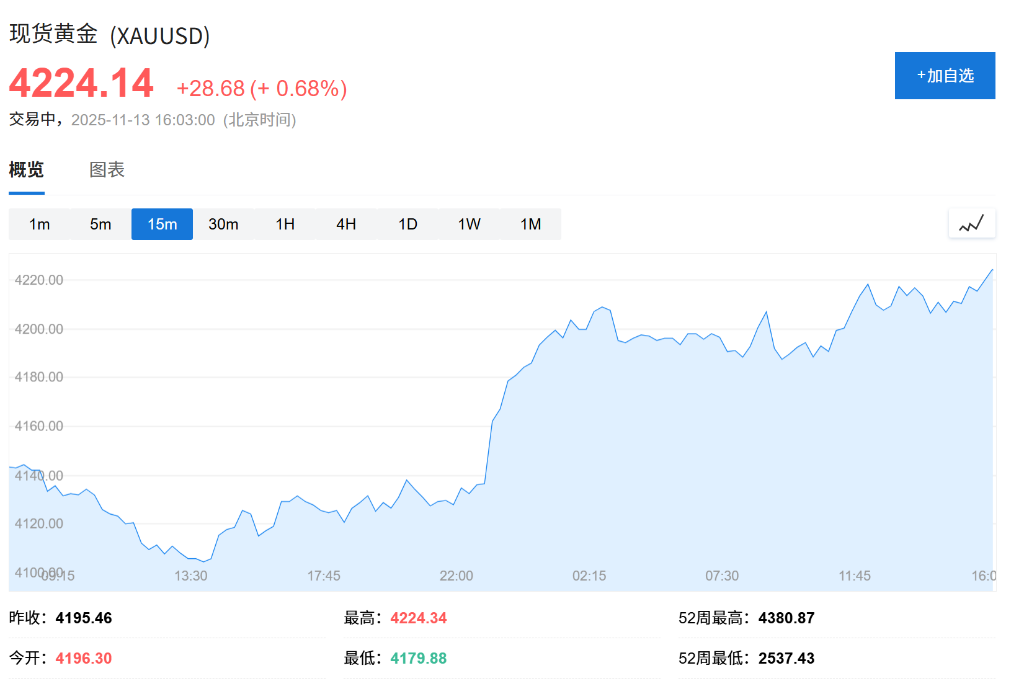
美国政府结束停摆,美股期货走高,现货黄金涨破4220美元,原油企稳
Hua Er Jie Jian Wen· 2025-11-13 08:12
Core Points - The U.S. government shutdown has officially ended, leading to a rally in global stock markets, with the S&P 500 futures and European stock futures approaching historical highs [1][2] - Investors are now focused on the uncertainty surrounding delayed economic data due to the shutdown, which could impact the Federal Reserve's future interest rate decisions [2][7] - Gold prices have risen for five consecutive days, reaching over $4220 per ounce, as expectations of potential interest rate cuts by the Federal Reserve grow [3][6] Market Reactions - U.S. stock futures have recovered losses, with the Nasdaq 100 futures up by 0.3% and the S&P 500 futures up by 0.2% [6] - European and Asian stock markets also showed positive movements, with the Euro Stoxx 50 futures up by 0.3% and Japan's Nikkei 225 index rising by 0.4% [6] - The 10-year U.S. Treasury yield increased by 2 basis points to 4.09%, indicating a shift in investor sentiment [6] Economic Data Concerns - The prolonged government shutdown has created a significant "data vacuum," complicating economic forecasts for investors and policymakers [2] - Key economic indicators, including employment data and the Consumer Price Index (CPI) for October, are delayed, raising concerns about the accuracy of market pricing [2] - Analysts warn that political risks remain, with potential for another funding impasse in February [2] Federal Reserve Outlook - There is a growing expectation that the Federal Reserve may consider interest rate cuts in December, contingent on the release of economic data [7] - Some Federal Reserve officials express caution, with Boston Fed President Susan Collins advocating for maintaining current interest rates due to strong economic growth [7] Trade Developments - Positive signals have emerged regarding trade negotiations, with the EU preparing to propose a plan to implement a trade agreement with the U.S. [8] - The Japanese yen is under pressure, with concerns about the new government's ability to support its currency through intervention [8] Commodity Market Movements - Gold prices have reached their highest level since October 21, reflecting investor sentiment amid economic uncertainty [3][6] - Oil prices have stabilized after experiencing significant declines, with WTI prices around $58 per barrel [8]
The shutdown put jobs and inflation data on hold. Here's when it could be back — and what it might say
CNBC· 2025-11-11 20:03
Core Insights - The U.S. federal government shutdown has delayed nearly all federal economic data releases for September and October, but it appears to be nearing an end, which will allow for the resumption of data collection and reporting [2][3] - The Bureau of Labor Statistics (BLS) is responsible for key reports such as nonfarm payrolls and the Consumer Price Index (CPI), which are expected to be released soon after the government reopens [4] - Economic indicators suggest a slowing labor market and inflation remaining above the Federal Reserve's comfort level, with expectations of gradual deceleration through 2026 [6][8] Economic Data Delays - The shutdown has caused significant delays in the release of important economic reports, including nonfarm payrolls, CPI, retail sales, and personal spending and income [2][5] - Goldman Sachs anticipates that the October jobs report will be released shortly after the reopening, potentially by next Tuesday or Wednesday, but other major data releases may be delayed by at least a week [4][5] Federal Reserve Insights - Federal Reserve Chair Jerome Powell indicated that despite the data freeze, alternative data sources suggest that the macroeconomic picture has not changed significantly [6][7] - Powell noted that the labor market is gradually cooling, and inflation remains elevated, with the key inflation rate estimated at 2.8% for September, above the Fed's 2% target [7][8] Economic Growth Projections - The Atlanta Fed's GDPNow tracker estimates third-quarter growth at a 4% rate, while Goldman Sachs projects fourth-quarter growth at 1.3%, an upward revision from previous forecasts, indicating a full-year growth pace of 2% [9]

即便美国政府本周“重开”,美联储12月决议前也拿不到“关键数据”?
Hua Er Jie Jian Wen· 2025-11-11 00:38
Group 1 - The U.S. government shutdown has created a "black hole" in economic data, making it difficult for the Federal Reserve to make informed decisions ahead of the December meeting [2][5] - Economists predict that the delayed September employment report may be released shortly after the government reopens, but the October and November data will face significant delays due to the shutdown [2][3] - The current shutdown is the longest in history, lasting more than twice as long as the one in 2013, which has severely impacted the release of economic data for multiple months [4] Group 2 - The uncertainty surrounding economic data is causing the Federal Reserve to be more cautious in its monetary policy adjustments, as highlighted by KPMG's chief economist [5] - The reliance on estimation models for calculating the Consumer Price Index (CPI) for October and November may lead to greater inaccuracies in the data [5] - Key retail sales and inflation data for October are expected to be released around December 18, after the Federal Reserve's meeting has concluded [7]

铜产业链周度报告-20251010
Zhong Hang Qi Huo· 2025-10-10 09:41
1. Report Industry Investment Rating No relevant information provided in the text. 2. Core Viewpoints of the Report - Short - term copper prices are likely to remain high, which may suppress consumption and pose a risk of adjustment and decline. In the medium - term, the strategy of buying on dips remains unchanged [5][62]. 3. Summary According to the Directory 3.1 Report Summary - US employment data showed an unexpected decline, far lower than market expectations, which may lead the Federal Reserve to implement further monetary easing policies [5]. - China's manufacturing PMI rose by 0.4 percentage points, non - manufacturing PMI fell by 0.3 percentage points, and the comprehensive PMI output index rose by 0.1 percentage points, indicating a slight acceleration in overall economic output expansion [5]. - The US government "shutdown" increased overseas macro - uncertainty, and the release of economic data was delayed, making it difficult for the Federal Reserve to make accurate monetary policies [5]. - Due to the mud accident at the Indonesian mine, copper supply was disrupted. Domestic smelters were in a high - maintenance period, and refined copper production was expected to decline, but inventory would increase [5]. - High copper prices may suppress consumption in the short - term, but in the medium - term, copper prices are likely to remain high and volatile [5]. 3.2 Multi - empty Focus - **Bullish Factors**: Refined copper production is expected to decline, and the copper concentrate processing fee remains low, indicating tight supply at the mine end [8]. - **Bearish Factors**: Social inventory is accumulating, high copper prices may suppress consumption, and overseas macro - uncertainty has increased [8]. - Overseas political fluctuations have increased, further strengthening the market's expectation of the Federal Reserve's interest rate cut [9]. 3.3 Data Analysis - **Copper Ore Imports**: In August, China's copper ore and concentrate imports were 2.759 million tons, and the cumulative imports from January to August were 20.054 million tons, a year - on - year increase of 7.9% [20]. - **Copper Concentrate TC**: As of the week of September 26, the Mysteel standard clean copper concentrate TC weekly index was - 40.68 US dollars per dry ton, up 0.66 US dollars per dry ton from the previous week. The mud accident at the Indonesian mine increased market concerns about copper supply [24]. - **Refined Copper Supply**: In August, China's refined copper output was 1.301 million tons, a year - on - year increase of 14.8%. In October, domestic smelters will conduct large - scale maintenance, which may lead to a phased tightening of refined copper supply [28]. - **Scrap Copper Imports**: In August, China's scrap copper imports were 179,400 tons, a month - on - month decrease of 5.6% and a year - on - year increase of 5.8%. The decline was due to factors such as import losses, extreme weather, and reduced overseas exports [32]. - **Copper Products Output**: In August, China's copper products output was 2.222 million tons, a year - on - year increase of 9.8% and a month - on - month increase of 2%, reaching a high level in the same period over the years [36]. - **Copper Consumption**: The price of refined copper spot has risen significantly, which is not conducive to refined copper consumption. As of October 9, the refined - scrap spread was around 390 yuan per ton [40]. - **Inventory**: LME copper inventory continued to decline last week, while SHFE copper inventory decreased by 3.79% in the week of September 30. Domestic social inventory increased, with the electrolytic copper spot inventory reaching 167,900 tons on October 9, an increase of 11,200 tons compared with September 29 [55]. - **Spot Premium**: On October 9, the spot premium of Shanghai Wumaotrade 1 copper changed from discount to premium, and the LME 0 - 3 spot discount narrowed [59]. 3.4 Fundamental Analysis - **Home Appliance Industry**: In August, the output of household refrigerators increased by 2.5% year - on - year, and the output of household air conditioners increased by 9.4% year - on - year. However, in the fourth quarter, the home appliance industry is expected to face pressure of slowing growth [44]. - **Real Estate Industry**: In August, real estate sales, investment, new construction, and completion all declined year - on - year. Although some first - tier cities have introduced policies to support the market, the real estate market is still under pressure, and copper demand in the real estate sector remains weak [48]. - **Automobile Industry**: In August, traditional automobile production and sales increased both month - on - month and year - on - year. New energy vehicle production and sales also showed strong growth, with a year - on - year increase of 27.4% and 26.8% respectively, and the market demand is strong [52]. 3.5 Market Outlook - Short - term copper prices are likely to remain high, which may suppress consumption and pose a risk of adjustment and decline. In the medium - term, the strategy of buying on dips remains unchanged [5][62].
美参议院再度否决两党临时拨款议案,万斯警告关门持续就将裁员
Hua Er Jie Jian Wen· 2025-10-01 18:42
Core Points - The U.S. Senate has repeatedly rejected both Democratic and Republican short-term funding proposals, leading to a government shutdown, the first in nearly seven years [1][3] - Vice President Vance warned that prolonged shutdowns could result in layoffs within the Trump administration [1][2] Group 1: Legislative Actions - The Senate voted against the Democratic proposal with a vote of 47 in favor and 53 against, and the Republican proposal was also rejected despite receiving support from three Democratic senators, resulting in a 55 to 45 vote [3] - The Republican proposal aimed to fund the government until November 21 and included an additional $88 million for security, but did not include healthcare provisions demanded by Democrats [3] - The Democratic alternative sought to extend funding until October 31 and included provisions for extending Obamacare subsidies and reversing cuts to Medicaid [3] Group 2: Political Dynamics - Republican leaders stated they would not modify the temporary funding bill passed by the House, with House Speaker Mike Johnson asserting there was nothing to negotiate [4] - Senate Republican leader John Thune blamed Democrats for the deadlock, while Democratic leader Chuck Schumer accused Republicans of attempting to coerce Democratic support for the temporary resolution [4] Group 3: Economic Impact - The government shutdown has led to hundreds of thousands of federal employees facing unpaid leave, with critical economic data releases potentially delayed, adding uncertainty to Federal Reserve monetary policy decisions [2][5] - Key reports, including employment and inflation data, may be postponed, complicating the Fed's ability to assess economic conditions [5] - Historical data suggests that a government shutdown can significantly impact GDP growth, with Goldman Sachs estimating a reduction of 15 basis points per week of shutdown [5] Group 4: Layoff Considerations - The White House Office of Management and Budget (OMB) has instructed federal agencies to prepare for large-scale layoffs beyond traditional temporary furloughs [6] - The Trump administration plans to freeze $18 billion in federal infrastructure project funding, directly affecting projects in Democratic leaders' districts [6] - Some Republican senators expressed concerns that aggressive layoff strategies could provoke voter backlash and complicate future legislative efforts [6]
How a government shutdown would impact your money: Student loans, Social Security, investments, and more
Yahoo Finance· 2024-02-23 20:16
Federal Programs and Social Security - Social Security checks and electronic payments will continue to be delivered during a government shutdown, ensuring retirees receive their monthly benefits [2] - Medicare and Medicaid programs are protected from funding shortfalls, meaning healthcare benefits will not be disrupted [2] SNAP and WIC Benefits - SNAP and WIC benefits can continue if the funding shutdown is not prolonged, although WIC may be more vulnerable due to its tight budget [3] Student Loans - A government shutdown could significantly impact student loan borrowers, as many Department of Education employees may be temporarily laid off, following a previous workforce reduction of about 50% [3] - While mandatory funding programs like Pell Grants and Federal Direct Student Loans can still make payments, this may only last as long as available funds [4] - Fewer federal employees could delay loan processing and forgiveness, complicating issue resolution for borrowers [5] Travel Services - Essential federal workers, including airport security and air traffic control, will continue working, but travelers should expect potential delays [5] - Passport and visa services will remain operational as long as fees are available, but delays in issuance may occur [6] Economic Impact - The economic impact of a government shutdown will depend on its duration, with delayed government payments potentially having a minor effect if resolved quickly [10] - A longer shutdown could delay the release of critical economic data, increasing the risk of missteps by the Federal Reserve regarding interest rates [12] Investments - Investor sentiment may be negatively affected in the short term, particularly if the shutdown disrupts the Fed's rate-lowering agenda, leading to temporary market volatility [13] - Gold prices are expected to remain strong as a safe-haven asset during economic uncertainty [14] Government Paychecks - Nonessential federal employees will not be paid until the government reopens, and contractors may implement temporary employment cutbacks [15] Other Federal Services - The IRS will likely reduce staff during a shutdown, affecting phone support, but tax payments will still be collected [16] - Mail delivery services will remain unaffected, and federal courts will continue to operate [18]