
缩表式降息

Search documents
惊魂 | 全球金融市场闪崩,澳币应声下跌!“背后黑手”竟是……
Sou Hu Cai Jing· 2026-02-06 19:12
Group 1 - The core point of the article highlights a sudden and severe sell-off in global financial markets, affecting various asset classes including stocks, commodities, cryptocurrencies, and foreign exchange [1][3][7] - The sell-off was triggered by the announcement of massive AI capital expenditure plans by several major U.S. tech companies, which initially excited the market but led to investor skepticism regarding short-term profitability and cash flow pressures [3][10] - The release of industry application plugins by AI company Anthropic was interpreted as a potential threat to existing software service providers, further exacerbating investor anxiety and contributing to the market downturn [3][10] Group 2 - In the cryptocurrency market, Bitcoin experienced a significant drop, falling below $60,000 within hours, with a daily volatility of up to 17%, undermining its narrative as "digital gold" [6][9] - The sell-off in the stock market, particularly in tech stocks, led to a rapid decline in global risk appetite, prompting investors to withdraw from high-volatility assets [7][10] - Commodity prices reflected concerns over global growth, with international oil prices dropping over 3%, and precious metals like gold and silver also experiencing significant corrections [8][10] Group 3 - The current market turmoil may be a precursor to larger fluctuations, with underlying concerns about the future direction of Federal Reserve policies adding to market uncertainty [10][12] - Discussions surrounding the nomination of Kevin Warsh, a hawkish figure critical of past quantitative easing policies, have introduced new uncertainties regarding the Fed's approach to interest rates and liquidity [10][12] - Analysts suggest that if Warsh's proposed "balance sheet reduction" framework is implemented, it could lead to a tightening of global liquidity even during a rate-cutting cycle, indicating a different environment compared to previous easing periods [12][13]

黄金白银黑天鹅!行情还有多久才会止跌?
Sou Hu Cai Jing· 2026-02-03 02:07
Group 1 - Gold prices have dropped to a low of $4,400, and silver to $71.3, effectively erasing their gains for the year and returning to the upper range of the fluctuation period from October to December 2025 [1] - The market panic is primarily due to the nomination of Kevin Warsh as the new Federal Reserve Chairman, who advocates for "balance sheet reduction" as a means to combat inflation [1] - Warsh believes that the Federal Reserve's excessive money printing is the root cause of inflation, and he supports reducing regulations and increasing energy production to lower production costs [2][2] Group 2 - If the Federal Reserve aggressively reduces its balance sheet, it could lead to a decline in the stock market, as evidenced by a 1.5% drop in the Nasdaq futures [3] - The dollar index has shown some rebound, but it has not returned to its high from January 19, indicating that the dollar is not strengthening significantly [5] - The recent correction in gold and silver prices is attributed to a technical adjustment after previous overextensions, rather than a fundamental shift in market dynamics [7] Group 3 - The decline in risk appetite across the market has led to significant drops in various sectors, with only weaker-performing sectors like liquor and banking showing resilience [8] - There are signs of a potential stabilization in housing prices in major cities like Beijing, Shanghai, Guangzhou, and Shenzhen, driven by pent-up demand from families needing to buy homes for school admissions [10][15] - The rapid decrease in second-hand housing listings indicates a reduction in selling pressure, as some individuals prefer to hold onto properties for rental income rather than selling them [13][15]
国泰海通证券每日报告精选-20260203
GUOTAI HAITONG SECURITIES· 2026-02-03 01:20
Group 1: Macroeconomic Insights - The Federal Reserve's recent policy statement reflects a slightly hawkish stance, leading to adjustments in asset prices, with the dollar index rising and U.S. stocks declining[6] - Kevin Warsh's nomination as the next Fed Chair has caused significant market reactions, with expectations of a more independent Fed and a potential shift in monetary policy direction[7] - The manufacturing PMI for January 2026 is reported at 49.3%, indicating a decline of 0.8 percentage points from the previous month, suggesting a contraction in manufacturing activity[17] Group 2: Market Performance - Global asset prices showed mixed results, with the Hang Seng Index rising by 2.38% and the S&P 500 increasing by 0.34%, while the Shanghai Composite Index fell by 0.44%[8] - Commodity prices experienced divergence, with IPE Brent crude oil futures rising by 6.65% and COMEX copper increasing by 0.51%, while London gold prices decreased by 2.03%[8] - The market anticipates two rate cuts in 2026, with the Federal Funds futures market reflecting limited expectations for aggressive rate reductions following Warsh's nomination[7] Group 3: Sector Analysis - The new economic landscape shows a significant shift towards emerging technologies, with sectors like AI and electric vehicles driving growth, while traditional industries lag behind[28] - The financial sector is expected to benefit from increased asset management demand, with insurance and securities firms poised for growth in a low-interest-rate environment[30] - The construction and real estate sectors are experiencing marginal improvements, but overall demand remains weak, necessitating further policy support[19]
国泰海通晨报-20260202
GUOTAI HAITONG SECURITIES· 2026-02-02 05:20
Macro Research - The core idea of Walsh's "pragmatic monetarism" indicates the Federal Reserve's commitment to controlling inflation while satisfying Trump's interest rate cut demands, aiming to correct market distortions caused by excessive QE and achieve convergence in a "K"-shaped economy [4][26][27] Strategy Research - The downward shift in the risk-free interest rate may accelerate the transformation of residents' asset allocation from "pure fixed income" to "fixed income+", with the stock-bond constant ratio index expected to become a significant benchmark for "fixed income+" products, particularly based on the A500 index, which offers a high risk-return ratio and tactical allocation value [4][32][33] New Stock Research - In Q4 2025, the first-day increase of new stocks reached 176%, with unprofitable new stocks significantly contributing to A1 accounts. The median return for new stock funds was 0.45%, with the most heavily weighted industries being electronics, non-ferrous metals, and power equipment [4][8][11][12]
国泰海通 · 晨报260202|宏观、策略、新股研究
国泰海通证券研究· 2026-02-01 14:04
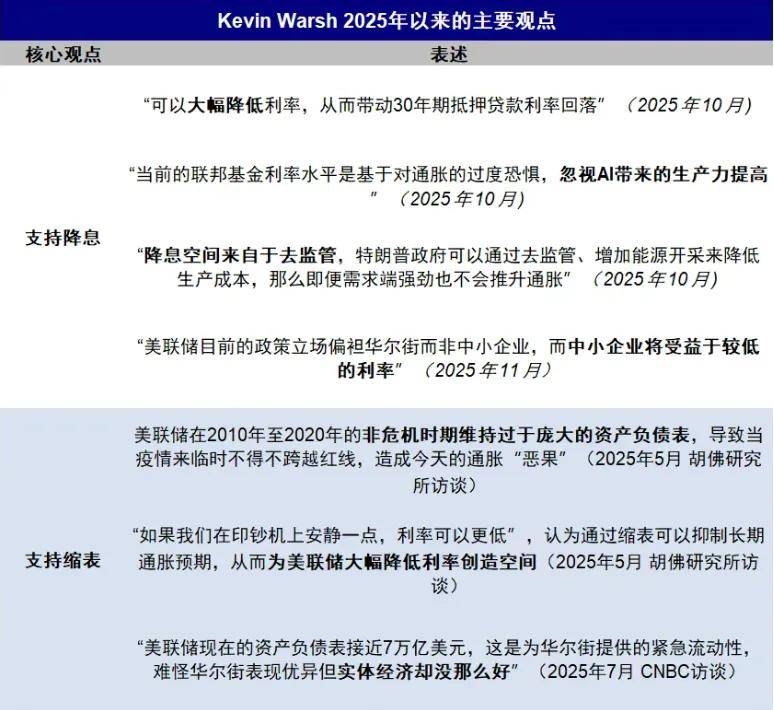
Group 1: Macro Policy Insights - The core policy proposition of Walsh is "rate cuts + balance sheet reduction," emphasizing the need for the Federal Reserve to take responsibility for inflation, attributing it to prolonged quantitative easing (QE) post-crisis, and advocating for quantitative tightening (QT) to control inflation [6] - Walsh criticizes the Federal Reserve's large balance sheet, arguing that QE distorts market incentives and leads to a decline in banks' willingness to lend to the real economy, thus promoting a transition from a "sufficient reserves" mechanism to a "scarce reserves" mechanism [6] - The policy approach aims to balance the independence of the Federal Reserve with the administration's desire for rate cuts, reflecting a commitment to controlling inflation while addressing the administration's economic goals [6] Group 2: Economic Implications - QT is viewed as "responsible balance sheet management," correcting the idea of unlimited support for demand, while rate cuts are intended to enhance supply capacity from an industrial policy perspective [6] - The implementation of QT has shown effectiveness in controlling inflation, as evidenced by the Consumer Price Index (CPI) dropping from 9% to around 3% following the announcement of passive balance sheet reduction in 2022 [6] - However, the use of QT has limitations, as recent liquidity tensions in the repurchase market have led to a halt in QT, necessitating the initiation of Reserve Management Purchases (RMP) [6] Group 3: Market Dynamics - The transition to a "scarce reserves" mechanism is expected to be challenging, with liquidity issues remaining a constraint on QT implementation until bank reserves return to a relatively sufficient level [6] - Policies aimed at revitalizing manufacturing and the real estate sector under the Trump administration require credit expansion from banks, which is dependent on adequate reserve levels [6] - The shift in policy focus from Wall Street to Main Street is seen as beneficial for addressing the "K"-shaped economic divergence in the U.S., but balancing the conflicts between the upper end (stock market) and lower end (inflation) remains a challenge for Walsh [6]

国泰海通|“联储换帅”总量联合解读
国泰海通证券研究· 2026-02-01 14:04
Group 1 - The core viewpoint of the article is that Kevin Warsh advocates for a policy of "rate cuts + balance sheet reduction" to control inflation and restore the Federal Reserve's independence while addressing President Trump's demands for lower interest rates [8][14]. - Warsh's approach is termed "pragmatic monetarism," emphasizing the need for the Federal Reserve to take responsibility for inflation, which he attributes to the prolonged quantitative easing (QE) following the financial crisis [8][6]. - The article discusses the historical context of Federal Reserve chair transitions, noting that such changes typically lead to increased volatility in bond markets, structural adjustments in yield curves, and a re-evaluation of risk premiums [12][14]. Group 2 - Warsh criticizes the Federal Reserve's large balance sheet, arguing that QE has distorted market incentives and reduced banks' willingness to lend to the real economy [8][13]. - The article highlights that Warsh's policy proposals aim to transition from a "sufficient reserves" framework to a "scarce reserves" framework, which would encourage banks to increase lending [8][14]. - The potential implications of Warsh's nomination include a heightened sensitivity in the bond market to the new chair's policy stance, particularly given the complex economic environment characterized by persistent inflation and geopolitical risks [14][12]. Group 3 - The article suggests that under Warsh's leadership, the Federal Reserve may exhibit three key characteristics: increased policy uncertainty due to independence paradoxes, a gradual convergence of rate cut paths, and a reduction in bond market support due to aggressive balance sheet reduction [14][15]. - It is noted that the current economic landscape requires a balance between managing inflation and supporting credit expansion, particularly in light of the Trump administration's policies aimed at revitalizing manufacturing and real estate sectors [17][14]. - The article concludes that regardless of who becomes the new chair, the short-term outlook for the Federal Reserve's monetary policy is likely to remain accommodative, with a focus on maintaining liquidity in the markets [21][14].

缩表式降息:如何理解沃什的政策主张
GUOTAI HAITONG SECURITIES· 2026-01-31 14:48
Group 1: Policy Proposals - Warsh's notable policy proposal is "rate cuts + balance sheet reduction," emphasizing the Fed's responsibility for inflation control and the need to correct market distortions caused by prolonged QE[8] - He argues that QT (Quantitative Tightening) is essential for controlling inflation, as evidenced by the CPI dropping from 9% to around 3% after the Fed announced passive balance sheet reduction in 2022[15] - Warsh criticizes the Fed's large balance sheet, claiming that QE has distorted market incentives and reduced banks' willingness to lend to the real economy[8] Group 2: Economic Implications - The transition from a "sufficient reserves mechanism" to a "scarce reserves mechanism" is crucial for enhancing banks' lending willingness and correcting post-crisis monetary policy[8] - The policy aims to avoid excessive capital flowing away from the real economy and instead provide low-cost funding to the real sector, aligning with Trump's supply-side reform agenda[14] - The balance between managing the upper end of the "K" economy (stock market) and the lower end (inflation) requires a delicate balancing act from Warsh[15] Group 3: Risks and Challenges - QT's implementation faces constraints due to liquidity issues in the repo market, which may hinder the transition to a "scarce reserves mechanism" in the short term[15] - The need for credit expansion in sectors like manufacturing and real estate under the Trump administration relies on maintaining sufficient reserve levels in banks[15] - Risks include significant fluctuations in the stock market damaging consumer confidence and the potential for the recovery of the real economy to fall short of expectations[22]