茶咖融合

Search documents
茶咖共舞 黔滇联动——贵州省茶产业专家服务团共话特色产业融合赋能乡村振兴新路径
Xin Lang Cai Jing· 2026-01-12 04:33
Group 1 - The core idea of the event is to explore the integration of tea and coffee industries in Yunnan and Guizhou, aiming to empower rural revitalization through collaboration and innovation [1][5][10] - Over 150 participants from academia and industry gathered to discuss the fusion of tea and coffee cultures, brand building, and market expansion strategies [3][4] - The event highlighted the historical significance of tea and the introduction of coffee to China, emphasizing the potential for mutual growth and shared consumer spaces [4][12] Group 2 - Experts discussed various innovative approaches, such as combining red tea with local fruits and expanding coffee into snack offerings, to meet consumer needs [4][9] - The importance of continuous innovation and appealing to younger consumers was emphasized, with suggestions for the tea industry to learn from the coffee sector's quality and experience [4][10] - The event underscored the need for a dual focus on product functionality and emotional value, aiming to create a cultural connection with consumers [4][10] Group 3 - The integration of tea and coffee is seen as a transformative process, shifting from a one-way output to a value co-creation model between production and consumption [5][10] - Successful case studies, such as the popularity of matcha products in coffee shops, were presented to illustrate the potential for cross-industry collaboration [9][10] - The need for talent cultivation in the coffee industry was highlighted, with recommendations for educational institutions to develop relevant programs [9][10] Group 4 - The event concluded with a call to deepen the integration of tea and coffee, leveraging unique regional advantages to foster innovation and new business models [14][15] - Participants expressed optimism about the future of tea and coffee collaboration, aiming to create products that appeal to diverse age groups and enhance market opportunities [12][14]


中老铁路推动普洱产业升级 “茶咖融合”焕发新活力
Yang Shi Wang· 2025-12-03 12:13
Core Insights - The China-Laos Railway has been operational for four years, significantly enhancing connectivity between China and ASEAN, and providing unprecedented development opportunities for the regions along the route [1][5]. Group 1: Economic Impact - The railway has revitalized the local economy in Pu'er, a historical hub of the "Tea Horse Road," by increasing passenger flow and creating new opportunities for local industries [1][5]. - The number of coffee shops in Pu'er has surged from 29 to over 300 in four years, indicating a substantial growth in the coffee and tea tourism sector, which is becoming a new economic engine for the region [5]. Group 2: Industry Transformation - The development of the "tea-coffee integration" industry in Pu'er reflects a shift from a single agricultural focus to a more diversified "sixth industry" model, combining agriculture with tourism and leisure [5]. - The influx of tourists and investment, as seen in a newly opened coffee estate, highlights the potential for further growth driven by the railway [3].

茶颜悦色上市再提速?从港股转战看新茶饮巨头的资本突围战
Sou Hu Cai Jing· 2025-11-21 01:27
Core Viewpoint - The tea brand Cha Yan Yue Se is transitioning from the consumer market to the capital stage, preparing for a Hong Kong IPO, which reflects not only its growth but also the future of the new tea beverage industry [2][3] Group 1: IPO Strategy - Cha Yan Yue Se's parent company, Hunan Cha Yue Cultural Industry Development Group, is accelerating its Hong Kong IPO plans, aiming to raise between $500 million and $800 million for supply chain upgrades and national expansion [3] - The estimated valuation for Cha Yan Yue Se is between $4.8 billion and $5.5 billion, with a stronger cultural recognition in the Hong Kong market compared to the U.S. [3] - Recent regulatory changes in China have simplified the process for companies to raise funds overseas, providing support for Cha Yan Yue Se's IPO [3][8] Group 2: Shareholder Structure and Brand Development - In 2024, significant changes in shareholder structure occurred, with early investors exiting and new Hong Kong-based shareholders entering, indicating a move towards a VIE structure for overseas listing [4] - The launch of the sub-brand "Cha Yan Coffee" in over 1,200 self-operated stores reflects the brand's strategy to deepen its "tea-coffee fusion" approach, enhancing growth potential [4] Group 3: Business Model and Market Position - Cha Yan Yue Se maintains a direct sales model, with 1,312 self-operated stores as of September 2025, focusing on quality and profitability despite a smaller scale compared to franchise brands [5] - The company reported a revenue of approximately 3.12 billion yuan and a net profit of 460 million yuan in 2024, with a net profit margin of 14.7%, significantly higher than the industry average [5] - The brand's direct sales model has led to high customer loyalty and a strong ecosystem of products and culture, with 30% of revenue coming from peripheral products [5] Group 4: Competitive Landscape and Growth Strategy - Competition in Hunan has intensified, with rival brands increasing their presence, prompting Cha Yan Yue Se to adopt a strategy of "regional densification and sub-brand penetration" to enhance market share [6] - The introduction of new sub-brands aims to cater to diverse consumer needs while maintaining brand integrity, although balancing expansion and profitability remains a challenge [6] Group 5: Market Environment and Challenges - The new tea beverage market is experiencing a slowdown, with growth rates declining to 5.1% in 2025, which poses challenges for new entrants and existing players [7] - Cha Yan Yue Se's unique cultural branding has helped it maintain competitive strength, but it must continue to demonstrate its differentiation and innovation to sustain investor confidence [7][8] - The choice of Hong Kong for the IPO is influenced by regulatory environments and market expectations, with a focus on profitability and cost control in the direct sales model [8]

华创证券:首予古茗“推荐”评级 目标价27.84港元
Zhi Tong Cai Jing· 2025-11-13 06:19
Core Viewpoint - The report from Huachuang Securities indicates that Guming (01364) is a leading player in the domestic mid-range tea beverage market, with potential for stable performance growth driven by new product categories, store expansion, and cost reduction in raw materials [1] Group 1: Company Performance and Projections - The company is expected to achieve revenue of 111.59 billion, 134.19 billion, and 158.18 billion yuan for the years 2025-2027, with year-on-year growth rates of 26.9%, 20.3%, and 17.9% respectively [1] - The projected net profit attributable to shareholders is 24.87 billion, 26.25 billion, and 31.55 billion yuan for the same period, with year-on-year growth rates of 68.2%, 5.5%, and 20.2% respectively [1] - The target price for the stock is set at 27.84 HKD, with a "recommended" rating reflecting confidence in its growth potential as a leader in the fresh tea beverage industry [1] Group 2: Market Position and Strategy - As of the end of 2023, the company ranks second in the national ready-to-drink tea market and first in the mid-range segment, having expanded to 11,179 stores through franchising [2] - The company offers a diverse range of fresh tea products priced between 10-18 yuan, successfully penetrating lower-tier markets with a strategy of "fresh and accessible" offerings [2] - Key competitive advantages include a robust supply chain that supports rapid store expansion and a strong cold chain logistics system, enabling the company to deliver fresh fruits and milk to stores within two days [2] Group 3: Industry Trends and Insights - The ready-to-drink beverage industry is characterized by price differentiation, operational efficiency, and the integration of tea and coffee products [3] - The market size for ready-to-drink tea is projected to exceed 600 billion yuan by 2035, driven by expanding consumer demographics and increasing frequency of consumption [3] - The competitive landscape is shifting, with weaker brands exiting the market, creating structural expansion opportunities for leading brands like Guming [3] Group 4: Growth Drivers - The coffee business is expected to become a new growth engine, with over 8,000 stores covered by mid-2025 and significant potential in lower-tier cities [4] - Store expansion is anticipated to continue, with many domestic provinces and overseas markets still underdeveloped, allowing for replicable success based on supply chain advantages [4] - There is considerable room for cost reduction in key agricultural raw materials, which will enhance profit margins as scale effects and supply chain efficiencies improve [4]
华创证券:首予古茗(01364)“推荐”评级 目标价27.84港元
智通财经网· 2025-11-13 06:17
Core Viewpoint - The report from Huachuang Securities indicates that Guming (01364) is a leading player in the domestic mid-range tea beverage market, with potential for stable growth driven by new product categories, store expansion, and cost reduction in raw materials [1] Company Overview - Guming ranks second in the ready-to-drink tea market nationwide and first in the mid-range segment as of the end of 2023, with 11,179 stores opened through franchising by the first half of 2025 [2] - The company offers a diverse range of ready-to-drink tea products priced between 10-18 yuan, along with newly launched fresh coffee products, successfully penetrating lower-tier markets [2] Competitive Advantages - Guming employs a robust expansion strategy, opening stores in regions where supply chain coverage exists, achieving over 500 stores in nine provinces, with 41% of stores located in towns away from city centers [2] - The company has one of the strongest cold chain systems among leading tea brands, capable of delivering fresh fruits and milk to lower-tier city stores every two days, covering 97% of its stores [2] Industry Trends - The ready-to-drink beverage industry is characterized by price differentiation, operational efficiency, and the integration of tea and coffee [3] - The market size for ready-to-drink tea is projected to exceed 600 billion yuan by 2035, driven by consumer demand for healthier and fresher products [3] Growth Prospects - The coffee business is expected to become a new growth engine, with over 8,000 stores covered by June 30, 2025, and low penetration in lower-tier cities [4] - Store expansion opportunities exist both in existing markets and untapped domestic and overseas markets, leveraging supply chain advantages [4] - There is significant potential for cost reduction in key agricultural raw materials, which may enhance profit margins as scale effects deepen [4]
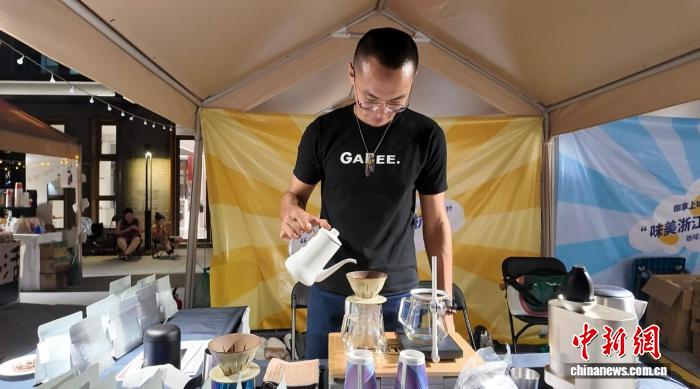
台湾咖啡师和他的“茶与咖”
Zhong Guo Xin Wen Wang· 2025-10-02 13:01
Core Insights - The article highlights the growing acceptance and appreciation of specialty coffee in mainland China, particularly through the experiences of Taiwanese barista Li Yi at a coffee culture festival in Hangzhou [1][2]. Group 1: Coffee Culture and Trends - The "Coffee Culture Carnival" in Hangzhou features 60 coffee brands, showcasing a variety of specialty coffees that attract large crowds [1]. - Li Yi emphasizes the connection between coffee and tea, explaining that both beverages can reflect their origins and unique characteristics, thus enhancing consumer experience [2]. - There is a noticeable shift among consumers from drinking coffee solely for caffeine to seeking flavor experiences, with many now engaging in hand-brewing techniques [2]. Group 2: Innovative Coffee Blends - Li Yi and his team have experimented with unique coffee blends, such as combining Taiwanese oolong tea and guava juice, as well as integrating local Zhejiang white wine into coffee [4]. - A collaboration with a traditional Chinese medicine brand resulted in six coffee blends using herbal ingredients, which surprised consumers with their unique flavors [4]. Group 3: Regional Coffee Culture - Different cities in China exhibit distinct coffee cultures, with Shanghai being a "testing ground" for new flavors, while Hangzhou serves as a "tasting room" for consumers to find their preferred tastes [4]. - The article notes that the pursuit of quality and local flavors remains a common thread in both tea and coffee cultures across regions [4].