
蓝碳

Search documents
一所学校,这样融入城市发展
Ren Min Ri Bao· 2026-02-13 20:24
Group 1 - The core focus of the news is the successful development and commercialization of marine biotechnology and aquaculture in Qingdao, led by the Ocean University of China, which has resulted in significant economic contributions and advancements in marine drug research [1][2] Group 2 - The "Deep Blue No. 1" deep-sea aquaculture net cage in the Yellow Sea has achieved mass production of domestically sourced salmon, contributing to an annual output value exceeding 100 million yuan [1] - The Qingdao Marine Biomedical Research Institute, established by the Ocean University of China, aims to bridge the gap between academic research and practical application in marine biomedicine, facilitating the transformation of scientific achievements into marketable products [1] - The research institute has developed new drugs targeting immune anti-tumor therapies, hepatitis B, and chronic obstructive pulmonary disease, with several candidates entering clinical trial phases between 2022 and 2025 [2] - The "Blue Seed Industry" innovation team has cultivated over 20 nationally approved aquatic species, leading to a cumulative promotion area of over 6 million mu and driving industry output value beyond 100 billion yuan [2] - The collaboration between the Ocean University of China and Qingdao is fostering a modern industrial system that integrates breeding, reproduction, and promotion, contributing to high-quality development and marine ecological protection [2]

广东湛江:加快打造现代化沿海经济带
Zhong Guo Jing Ji Wang· 2026-01-16 08:13
Core Viewpoint - The "14th Five-Year Plan" period is a significant phase for Zhanjiang, focusing on high-quality development and modernization as a key coastal economic zone and provincial sub-center city [1] Economic Development - Zhanjiang's GDP is expected to reach 400 billion yuan by 2025, with industrial added value surpassing 100 billion yuan and a double-digit growth rate for industrial added value [1] - A total of 2,367 major provincial and municipal projects have been implemented over five years, with a cumulative investment of 440 billion yuan, ranking first in the eastern and northwestern regions of Guangdong [1] - The total output value of agriculture, forestry, animal husbandry, and fishery has exceeded 100 billion yuan for five consecutive years, with annual R&D expenditure growing by 24.9% [1] Industrial Development - Zhanjiang has established a preliminary "Four Greens and One Blue" industrial system, with green petrochemicals and modern agriculture both achieving annual output values exceeding 100 billion yuan [2] - Key projects such as BASF's integrated base and Baosteel's hydrogen-based steel plant have been completed, while the region leads the province in onshore wind and solar power grid connection [2] - The Zhanjiang Lingang Economic Zone has been recognized as a national zero-carbon park, and the Zhanjiang Economic Development Zone has been designated as a national hydrogen energy pilot area, with industrial added value growing at an annual rate of 33.5% [2] Transportation and Infrastructure - Zhanjiang has enhanced its role as a national logistics hub, with its port becoming the first deep-water port in South China capable of accommodating 400,000-ton vessels [3] - The completion of the Zhanjiang Wuchuan International Airport has led to an annual passenger throughput exceeding 3.1 million, and the Guangzhan high-speed railway has improved connectivity with the Guangdong-Hong Kong-Macao Greater Bay Area [3] - A series of road and bridge projects have been completed, making Zhanjiang's total road mileage the highest in the province [3] Environmental and Ecological Initiatives - Zhanjiang maintains excellent air quality and water quality in coastal areas, with over 93% of nearshore waters rated as good [3] - The city has launched the first national "blue carbon" trading project and has been recognized for its ecological initiatives, including the promotion of zero-carbon islands [3] - Zhanjiang's ecological assets, such as mangroves and the Chinese white dolphin, have become key ecological symbols for the city [3] Trade and Tourism - The Zhanjiang Comprehensive Bonded Zone has commenced operations, with international trade covering 182 countries and regions [4] - The "Fresh Zhanjiang" tourism brand has driven total tourism revenue to exceed 110 billion yuan, attracting over 100 million visitors [4] - Zhanjiang has been recognized as a high-quality outdoor sports destination, successfully hosting major sports events [4] Future Outlook - Looking ahead to the "15th Five-Year Plan," Zhanjiang aims to accelerate its development as a key coastal economic zone and provincial sub-center city, striving for new advantages and breakthroughs [4]
“十四五”时期湛江崛起两个年产值千亿产业集群 去年GDP有望冲刺四千亿
Nan Fang Ri Bao Wang Luo Ban· 2026-01-16 07:53
Economic Growth and Industrial Development - By 2025, Zhanjiang's GDP is expected to reach 400 billion yuan, with industrial added value exceeding 100 billion yuan and a double-digit growth rate for industrial added value above designated size [1] - Zhanjiang has established a "four greens and one blue" industrial system, focusing on green steel, green petrochemicals, green energy, green food, and blue ocean economy, with both green petrochemicals and modern agriculture achieving annual output values exceeding 100 billion yuan [1] - The Zhanjiang Lingang Economic Zone has been recognized as a national zero-carbon park, and the Zhanjiang Economic Development Zone has been designated as a national hydrogen energy pilot area, with an average annual growth of 33.5% in industrial added value above designated size [1] Urban and Rural Integration and Transportation - Zhanjiang is advancing the "Hundred Counties, Thousand Towns, and Ten Thousand Villages High-Quality Development Project," with eight counties (cities, districts) crossing the new 10 billion yuan economic threshold [2] - The city has enhanced its role as a national comprehensive transportation hub, with Zhanjiang Port becoming the first deep-water port in South China capable of accommodating 400,000-ton vessels and the completion of the Zhanjiang Wuchuan International Airport, which has a passenger throughput exceeding 3.1 million annually [2] - The opening of the Guangzhan High-Speed Railway allows for a 90-minute rapid connection between Zhanjiang and the Guangdong-Hong Kong-Macao Greater Bay Area [2] Ecological and Social Development - Zhanjiang has launched the country's first "blue carbon" trading project and has been recognized as a pilot for the ecological product value realization mechanism [3] - Over 80% of the general public budget expenditure is allocated to livelihood-related spending, with over 310,000 new urban jobs created and 142 "Elderly Canteens" established [3] - The "Fresh Zhanjiang" tourism brand has driven total tourism revenue to exceed 110 billion yuan, attracting over 100 million visitors [3]
汇聚蓝碳力量 共绘海洋蓝图
Zhong Guo Zi Ran Zi Yuan Bao· 2025-12-17 05:54
Core Insights - The recent 2025 Blue Carbon International Symposium and West Pacific Blue Carbon Ecosystem Restoration Workshop highlighted the importance of blue carbon ecosystems, particularly mangroves, in climate change mitigation and ecological restoration efforts [1] Group 1: Marine Carbon Sequestration - The ocean is identified as the largest active carbon sink with significant negative emission potential. A new negative emission strategy, BCMS, integrates four carbon pumps to maximize ocean carbon storage [3] - The "International Grand Science Plan for Marine Negative Emissions," initiated by Chinese scientists, has gained international recognition with participation from over 80 research teams across 35 countries [3] Group 2: Importance of Mangrove Restoration - Tropical tidal wetland forests, such as mangroves, are crucial for carbon storage and biodiversity. Their degradation transforms them from carbon sinks to significant emission sources, necessitating restoration efforts [5] - Scientific approaches to mangrove restoration should prioritize ecosystem-based methods, focusing on ecological characteristics, restoration goals, and suitable species configurations [5] Group 3: Global Research and Monitoring Initiatives - Research on blue carbon ecosystems has rapidly developed since 2010, with a focus on coastal wetland carbon sinks and greenhouse gas emissions. However, Southeast Asia's research on mangroves remains limited [6] - International cooperation has been initiated for mangrove monitoring, utilizing remote sensing data to support policy-making and enhance data comparability [6] Group 4: National and Regional Case Studies - Malaysia emphasizes the protection of existing mangroves over post-damage restoration, implementing various protective measures and community involvement in restoration efforts [11][13] - Thailand has integrated mangrove carbon sinks into climate policy, allowing community and corporate partnerships to develop carbon credit projects, with 90% of the revenue benefiting the participants [17] Group 5: Funding and Investment Strategies - Sustainable funding is essential for large-scale mangrove restoration, with blue finance tools like blue bonds and carbon credits being explored to support ecological restoration efforts [19] - The establishment of a long-term financing system for mangrove and coastal wetland restoration is crucial, requiring collaboration among government, financial, and social institutions [19] Group 6: Challenges and Future Directions - Indonesia faces challenges in achieving its mangrove restoration goals due to ecological pressures and the need for reliable scientific assessments to guide restoration efforts [21] - Cambodia's mangrove restoration efforts are hindered by illegal logging and land use changes, necessitating enhanced cooperation and community engagement [39][41]
创新金融供给 完善交易机制——与会专家热议蓝碳助力海洋经济高质量发展
Xin Hua Cai Jing· 2025-12-11 06:53
Core Viewpoint - The 2025 Pearl Bay Climate Investment and Financing Conference highlighted the importance of blue carbon in promoting high-quality development of the marine economy, emphasizing the need for financial innovation, improved trading mechanisms, and the green and intelligent transformation of the marine economy [1][2]. Financial Support for Marine Economy - China's marine economy has shown significant development, with a marine production value of 10.54 trillion yuan in 2024, accounting for 7.8% of GDP [2]. - Financial institutions have begun to innovate blue financial products, such as blue bonds from the Bank of China and PPP projects from the National Development Bank [2]. - Challenges in blue financial product innovation include the lack of a value conversion channel for blue carbon, high upfront investment costs, and difficulties in project identification and risk pricing [2]. Development of Blue Carbon Financial System - The potential of marine resources suggests that blue finance can play a significant role, with recommendations to develop blue financial products, establish a national blue financial directory, and utilize technology for monitoring marine ecological risks [3]. Improvement of Blue Carbon Trading Mechanism - Activating the economic value of blue carbon requires a robust trading mechanism and diversified trading channels [4]. - The blue carbon trading market has seen rapid development since 2020, but issues such as insufficient market liquidity and a lack of pricing mechanisms remain [4]. - Local governments are exploring the integration of blue economy with renewable energy, enhancing traditional fisheries and providing broader applications for the renewable energy sector [4]. Opportunities in Nansha for Blue Economy - Nansha has a solid foundation for developing the blue economy, with Guangdong's marine economy ranking first nationally for 30 consecutive years [5]. - The "Nansha Financial 30 Measures" aims to support international shipping hub construction, with significant initiatives like the launch of a shipping insurance trading platform [5]. - Nansha is leveraging its unique port resources and policy advantages to attract investment in marine infrastructure and technology [6].
四中全会精神在基层 | 陆海统筹做大做强向海经济
Guang Xi Ri Bao· 2025-11-23 02:50
Core Insights - The development of the marine economy in Fangchenggang City is highlighted as a key strategy for rural revitalization and economic growth, with successful examples in aquaculture and infrastructure development [1][2][3] Group 1: Aquaculture Development - The establishment of a 24.1-hectare aquaculture base in Meili Village, which is the first village-level base with both sea area usage rights and aquaculture permits, has enabled local farmers to expand production [1] - The cooperative model involving 45 farmers has led to innovations in packaging technology, allowing "Meili bass" to enter high-end markets, with annual production exceeding 600,000 kilograms and generating over 15 million yuan in revenue [1] - The collective economy of the village has seen an increase of 137,500 yuan due to the successful aquaculture operations [1] Group 2: Port and Trade Development - Fangchenggang City, as a key node in the Belt and Road Initiative, boasts the largest port in the western region with significant infrastructure, including 57 berths for vessels over 10,000 tons and ongoing construction of larger terminals [2] - The city's annual throughput has surpassed 200 million tons, with foreign trade import and export volumes ranking second in the region, showing a 30.3% increase in imports and an 87.3% increase in exports [2] - The local economy has diversified into traditional and emerging industries, with a combined annual output exceeding 200 billion yuan from sectors like steel and aluminum [2] Group 3: Ecological and Sustainable Development - The city is implementing "blue carbon" pilot projects to explore carbon trading from mangrove forests, aiming to transform ecological assets into economic benefits [3] - There is a strong emphasis on green transformation of industries, requiring environmental facilities to be built alongside new projects and promoting a circular economy [3] - The development of an ecological tourism belt is underway, leveraging the region's natural beauty to attract investment and talent, positioning Fangchenggang as a "blue pearl" in the Beibu Gulf [3]


海南生态文明实践成果亮相COP30“中国角”首场边会
Hai Nan Ri Bao· 2025-11-14 03:04
Core Insights - The "Ecological Civilization and Beautiful China Practice" side event at COP30 highlighted Hainan's achievements in ecological civilization and climate action [1][2] - Hainan has maintained a forest coverage rate above 62%, with air quality good days ratio consistently over 98%, and nearshore water quality excellent rate at 99.8% [1] - The province is conducting systematic blue carbon ecosystem surveys and has completed its first blue carbon credit transaction, injecting market dynamics into marine ecological protection [1] Environmental Protection Efforts - Hainan is focusing on becoming a "clean energy island" and "smart transportation" hub to accelerate its transition to a low-carbon future [1] - The province has approximately 25 million kilowatts of installed power capacity, with over 60% of new installations coming from renewable sources like wind and solar energy [1] - Nuclear power development is being advanced to provide stable and clean baseload power for the grid [1] Electric Vehicle Adoption - Hainan has achieved a penetration rate of over 60% for new energy vehicles, ranking first in China [1]
毛东利:海南加速建设“清洁能源岛”,驶向低碳未来
Zhong Guo Xin Wen Wang· 2025-11-12 12:07
Core Viewpoint - Hainan is accelerating its transition to a low-carbon future by building a "clean energy island" as a key driver in response to global climate change [1][5]. Group 1: Ecological Protection and Legislation - Hainan faces climate challenges such as rising sea levels and coral bleaching, and is implementing strict laws and regulations to protect its ecological environment [4]. - The province has established pioneering legislation, including China's first tropical rainforest national park regulations and local laws on ecological protection red lines, ensuring the preservation of its ecosystems [4]. - Hainan maintains a forest coverage rate of over 62%, with air quality good days consistently above 98%, and nearshore water quality rated at 99.8% [4]. Group 2: Energy Transition - Hainan is focusing on renewable energy sources, with over 60% of new power installations coming from wind and solar energy, making renewables the largest power source in the province [5]. - The province is also advancing the safe and efficient development of nuclear power to provide stable and clean base-load electricity [5]. - Hainan has achieved a penetration rate of over 60% for new energy vehicles, ranking first in China [5]. Group 3: Marine Environment and Carbon Sequestration - Hainan's extensive marine ecosystems, such as mangroves and seagrass beds, are effective "blue carbon" capture systems, and the province is conducting systematic assessments of these ecosystems [7]. - The first blue carbon carbon credit transaction in Hainan has been completed, injecting market dynamics into marine ecological protection efforts [7]. - Restoration of mangroves is aimed not only at protecting coastlines and biodiversity but also at contributing directly to carbon reduction efforts [7]. Group 4: Community Transformation and Economic Development - Hainan is addressing ecological degradation and climate risks by restoring coral reefs, seagrass beds, and mangroves, while also engaging local communities in cultural heritage [8]. - The average annual income of fishermen in Lingshui Li Autonomous County increased by approximately 19% after transitioning to the cultural tourism industry [8]. - Initiatives in Beigang Island demonstrate how environmental challenges can be transformed into development opportunities, showcasing a model of "win-win" for protection and development [8].
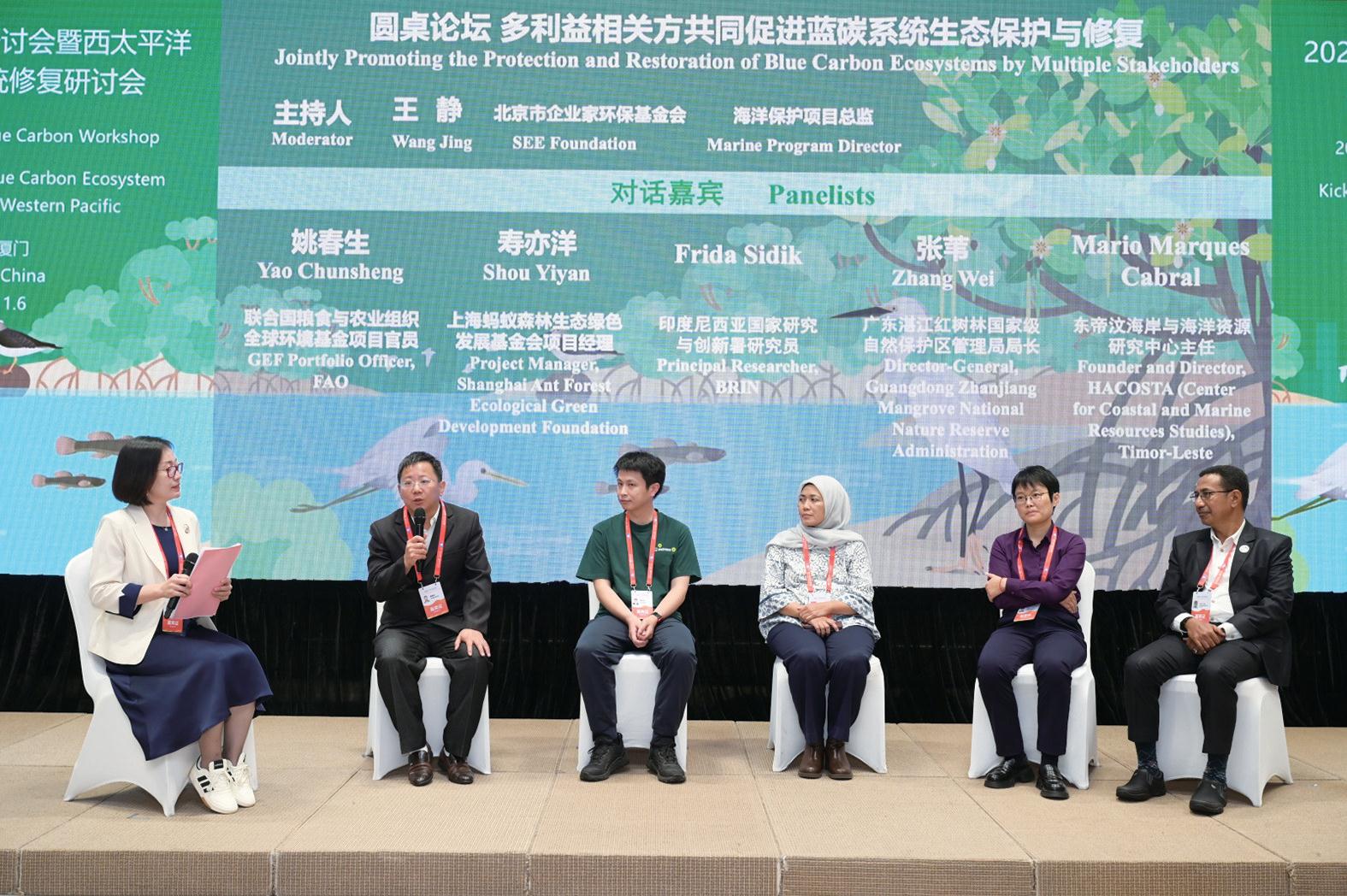
二○二五蓝碳国际研讨会暨西太平洋蓝碳生态系统修复研讨会成功举办
Zhong Guo Zi Ran Zi Yuan Bao· 2025-11-10 02:20
Core Insights - The 2025 International Blue Carbon Workshop and Western Pacific Blue Carbon Ecosystem Restoration Seminar was successfully held from November 6 to 8, 2025, in Xiamen, China, during the International Ocean Week [2] - The event was co-hosted by various organizations, including the Ministry of Natural Resources of China and UNESCO's Intergovernmental Oceanographic Commission, highlighting the importance of international collaboration in blue carbon management [2] - Over 100 representatives from 10 countries participated, sharing knowledge on blue carbon policies and ecosystem restoration techniques, emphasizing the need for multi-stakeholder cooperation to address global climate change [2][3] Event Highlights - The seminar featured discussions on the protection and restoration of blue carbon ecosystems such as mangroves and seagrass beds, with a focus on regional cooperation priorities [2] - Participants engaged in field visits to witness successful ecological restoration projects in China, receiving positive feedback on China's efforts in coastal wetland protection [3] - The event aimed to enhance global and regional blue carbon cooperation and provide technological support for policy makers and communities, contributing to climate change mitigation strategies [3]

全球滨海论坛聚焦蓝碳治理,多场景实践引领"蓝色希望"
Yang Zi Wan Bao Wang· 2025-09-25 05:42
Core Insights - The 2025 Global Coastal Forum focused on "Blue Carbon" as a significant topic, highlighting its potential as a carbon sink that is 20 times larger than terrestrial carbon sinks and 50 times larger than atmospheric carbon sinks [1] - The forum marked the transition of "Blue Carbon" from a scientific concept to practical implementation, with the release of China's first assessment of blue carbon ecosystem carbon storage [1] Group 1: Blue Carbon Ecosystem Assessment - The Ministry of Natural Resources conducted a nationwide survey from 2021 to 2024, establishing a carbon density parameter database for blue carbon ecosystems, with over 7,000 data sets collected [2] - The survey revealed that sediment is the primary carbon storage medium, with mangrove ecosystems accounting for over 60% of total carbon storage, while seagrass beds and coastal salt marshes contribute up to 90% [2] Group 2: Practical Applications and Innovations - Jiangsu Yancheng has emerged as a leader in blue carbon practices, with annual carbon sequestration from coastal salt marshes estimated at 16,000 tons of CO2 equivalent, comparable to the annual emissions of 35,000 cars [3] - The first blue carbon transaction in China occurred in September 2023, where Tencent purchased 1,926 tons of CO2 reduction for 208,000 yuan, marking a significant step in the marketization of blue carbon ecological value [3] - Future projects include a second phase of salt marsh restoration expected to yield 32,000 tons of carbon sequestration, covering an area of 18,975 acres [3] Group 3: Ecological Restoration and Collaborative Efforts - Ecological restoration is emphasized as a key pathway to enhance blue carbon effects, with a focus on reforesting damaged mangroves rather than simply afforesting mudflats [4] - Experts at the forum discussed the need for differentiated strategies for coastal protection based on various coastal types, aiming to synergize with blue carbon ecosystem protection [4] - The forum's outcomes are expected to promote the restoration and protection of coastal blue carbon ecosystems, enhance data sharing, and contribute to global climate governance [4]