
补充杠杆率(SLR)

Search documents
美国银行业 监管放松及其影响
Sou Hu Cai Jing· 2026-01-25 16:31
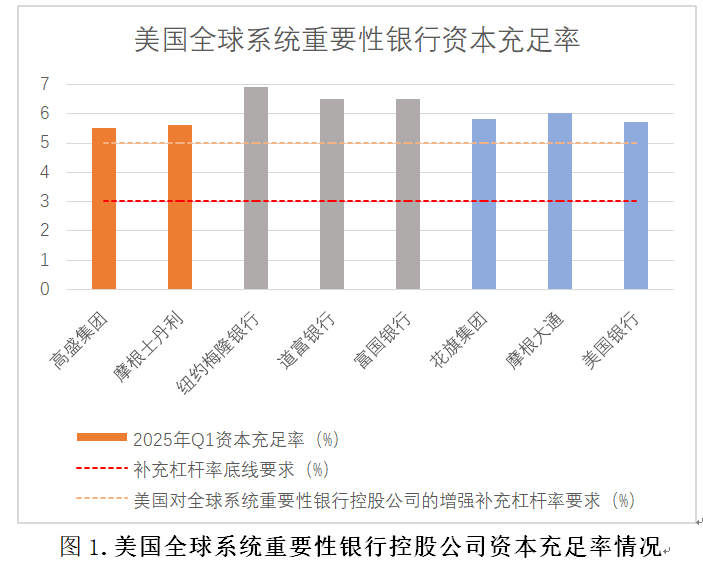
Group 1 - The core viewpoint is that the U.S. banking industry is experiencing a trend of regulatory relaxation, with significant changes expected in the Basel III final rules and supplementary leverage ratio (SLR) regulations, which may lead to improved liquidity in the U.S. Treasury market and expansion of large banks [1][8][10] Group 2 - The overall changes in the Basel III final rule proposal indicate that U.S. regulatory standards are stricter than international norms, with higher risk weights for specific loan categories and more stringent capital buffer requirements for large banks [2][4] - Large banks are expected to increase their capital by approximately 16%, with the largest eight global systemically important banks (GSIBs) needing to raise 19% [2][3] - The proposed changes to the supplementary leverage ratio (SLR) aim to balance safety and efficiency, with a baseline requirement of 3% and additional capital buffers for GSIBs [4][5] Group 3 - The relaxation of leverage ratio regulations is anticipated to marginally improve liquidity in the U.S. Treasury market, potentially lowering Treasury yields and reducing volatility [8][9] - The loosening of capital requirements will enhance the ability of large banks to hold and trade U.S. Treasuries, which may shift the ownership of Treasuries more domestically [8][10] - The expansion of large banks is expected as regulatory relaxations will free up over $5 trillion in balance sheet space, allowing them to compete more effectively against smaller banks and private credit institutions [10][12] Group 4 - The divergence between U.S. domestic regulations and international standards is increasing, with potential risks of regulatory competition arising from the U.S. relaxing its rules while Basel III aims to strengthen regulation [11][12] - The overall regulatory relaxation may lead to increased liquidity supply in the banking sector, contributing to rising stock market valuations and potentially delaying necessary economic adjustments [13]
美国银行业监管放松及其影响
Di Yi Cai Jing· 2026-01-25 12:48
Core Viewpoint - The U.S. banking industry's domestic regulation is trending towards relaxation since the Trump administration, with upcoming changes to the Basel III final rules expected to improve liquidity in the U.S. Treasury market and extend economic cycles [1][11]. Group 1: Basel III Final Rules Changes - The proposed Basel III final rules by U.S. regulators are stricter than international standards, with higher risk weights for specific loan categories and stricter capital buffer requirements [2]. - Large banks with assets over $100 billion will need to increase their capital by approximately 16%, while the largest eight Global Systemically Important Banks (GSIBs) will need to raise 19% [2]. - The definition of large banks has expanded, now including more institutions than the previous threshold of $250 billion [2]. Group 2: Capital Requirements and Lobbying - U.S. large banks have strongly opposed the proposed capital requirements and initiated lobbying efforts, leading to a compromise proposal that raises capital requirements by about 9% for the largest banks [3]. - The revised proposal from the Federal Reserve in 2025 significantly relaxes the capital requirements compared to the 2023 proposal, with increases of only 3% to 7% for most large banks [3]. Group 3: Supplementary Leverage Ratio (SLR) Regulation - The SLR, introduced post-2008 financial crisis, requires a minimum ratio of Tier 1 capital to adjusted total assets, with a baseline requirement of 3% [4]. - The enhanced SLR for GSIBs requires additional capital buffers, raising the minimum leverage ratio for parent companies to between 3.5% and 4.25% [6]. Group 4: Total Loss Absorption Capacity (TLAC) Regulation - The TLAC requirements for banks include a risk-weighted ratio of 18% and a leverage ratio of 7.5%, with GSIBs needing to hold an additional 2% TLAC leverage buffer [9]. - The final rules from November 2025 will reduce the TLAC requirements by approximately $90 billion, a decrease of about 5% [9]. Group 5: Other Relaxation Measures - The withdrawal of the 2013 guidance on leveraged loans will enhance banks' lending capabilities, with private credit balances nearing $1.3 trillion by the end of 2024 [10]. - The Federal Reserve's proposed reforms to stress testing will increase transparency and may lead to banks optimizing their reporting structures, potentially weakening the effectiveness of stress tests [10]. Group 6: Policy Impacts and Outlook - The relaxation of leverage regulations is expected to marginally improve liquidity in the U.S. Treasury market and enhance credit demand, although fundamental issues remain unresolved [11][12]. - Large U.S. banks are likely to expand their operations, releasing over $5 trillion in balance sheet capacity, which may alter competitive dynamics in the banking sector [13][14]. - The divergence between U.S. regulatory practices and international standards may increase, complicating regulatory coordination and raising the risk of regulatory competition [15]. - The relaxation of banking regulations may delay the adjustment cycle of the U.S. economy, with increased liquidity potentially masking underlying economic risks [16].

大行评级|大摩:下调高盛目标价至828美元 下调明后两年每股盈测
Ge Long Hui A P P· 2025-10-15 14:57
Core Viewpoint - Morgan Stanley's report indicates that market optimism for Goldman Sachs' earnings per share (EPS) exceeding expectations has been tempered by stricter Supplementary Leverage Ratio (SLR) regulations, leading to a 3% downward revision of Goldman Sachs' EPS forecast for 2027 [1] Financial Performance - Morgan Stanley has adjusted Goldman Sachs' EPS estimates for the next two years down by 3%, resulting in projections of $53.82 and $63.72 for the respective years, influenced by higher shares outstanding, elevated non-compensation and compensation expenses, and lower trading revenues [1] - The downward revisions were partially offset by increased revenues from asset and wealth management, as well as from currency, commodities, platform solutions, and investment banking [1] Target Price and Rating - Morgan Stanley has lowered Goldman Sachs' target price from $854 to $828, maintaining a price-to-earnings (P/E) ratio of 13x based on the revised EPS forecast for 2027, with a rating of "in line with the market" [1]

美债的历史演进与当下困局:美国系列深度研究之三
Guohai Securities· 2025-08-25 15:38
Debt Growth and Historical Context - The U.S. federal debt has increased significantly, from $10.6 trillion at the end of Obama's term to $36.2 trillion at the end of Biden's term, with an acceleration in growth rates[3][22] - The first $12 trillion took over 200 years to accumulate, the second $12 trillion took about 10 years, and the third $12 trillion took less than 5 years[22] - As of August 11, 2025, the U.S. debt surpassed $37 trillion[22] Interest Burden and Fiscal Impact - Net interest expenditure for FY 2024 is projected to reach approximately $881.1 billion, a year-on-year increase of 33.9%, accounting for over 13% of total expenditures[4][22] - Each percentage point increase in interest rates could result in an additional $360 billion in refinancing costs annually[4][22] Current Challenges Facing U.S. Debt - The federal debt for FY 2024 is $35.5 trillion, with a debt-to-GDP ratio of 123%, which is lower than Japan (220.8%) and Greece (181.6%), but higher than Germany (60.0%) and France (108.6%)[11][37] - The average annual debt growth from FY 2022 to FY 2024 exceeds $2.3 trillion, approximately $64.3 billion per day, doubling the growth rate from FY 2017 to FY 2019[12][43] - Mandatory spending, including Medicare and Social Security, constitutes 60.1% of total expenditures in FY 2024, making cuts difficult[12][44] Political and Economic Pressures - Political motivations favor fiscal stimulus to maximize voter support, with 90% of surveyed individuals indicating the importance of Social Security in voting decisions[12][46] - The recent "Big and Beautiful" tax and spending bill is expected to increase the debt ceiling by $5 trillion, potentially adding $3.4 trillion to the deficit over the next decade[13][22]
美联储就修改补充杠杆率(SLR)征询意见,将于8月26日截止。
news flash· 2025-06-27 15:04
Group 1 - The Federal Reserve is seeking comments on modifications to the Supplementary Leverage Ratio (SLR), with a deadline set for August 26 [1]
联储拟降低美国大行资本充足率要求,或为美债带来更多国内买盘
Sou Hu Cai Jing· 2025-06-27 00:36
Core Viewpoint - The Federal Reserve has proposed changes to the supplementary leverage ratio (SLR) for globally systemically important banks (GSIBs), aiming to reduce capital requirements and enhance liquidity in the U.S. Treasury market [1][2] Group 1: Regulatory Changes - The proposal is a 140-page discussion paper initiated by the Office of the Comptroller of the Currency (OCC), the Federal Reserve, and the Federal Deposit Insurance Corporation (FDIC) [1] - The changes are seen as a reversal of the strong regulatory trend established after the 2008 financial crisis [1] - The proposal aims to adjust capital requirements for banks to ensure the enhanced supplementary leverage ratio (eSLR) functions effectively without unnecessarily limiting banks' lending capabilities [1] Group 2: Support and Opposition - Among the seven Federal Reserve governors, two opposed the proposal, while five, including Chairman Jerome Powell, supported it [2] - The current Vice Chair for Supervision, Michael Barr, stated that the proposal is a crucial step in balancing financial system stability with the resilience of the Treasury market [2] Group 3: Implementation Timeline - The proposal has a 60-day comment period, with no set timeline for implementation [2] - Goldman Sachs anticipates that the new regulations could be finalized 4-6 months after the comment period, potentially taking effect within 6-8 months [2]
投资者对特朗普批评鲍威尔担忧加剧 美债收益率周四盘前下跌
Sou Hu Cai Jing· 2025-06-26 12:57
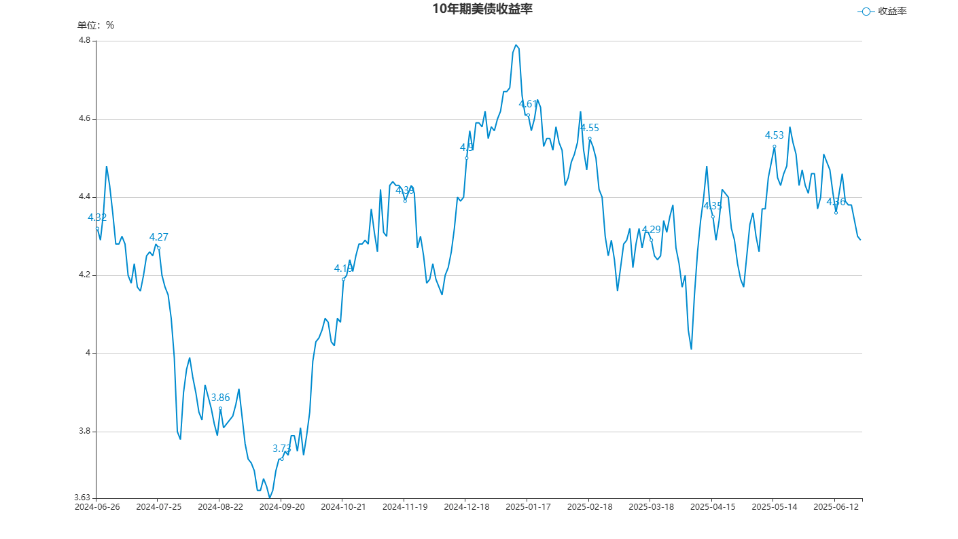
Group 1 - US Treasury yields declined as investors expressed concerns over President Trump's consideration to replace Federal Reserve Chairman Jerome Powell, with the 10-year Treasury yield dropping over 2 basis points [1] - On the same day, the 2-year Treasury yield fell by 1.1 basis points to 3.768%, the 10-year yield decreased by 1 basis point to 4.285%, and the 30-year yield dropped by 0.3 basis points to 4.839% [1] - Powell reiterated the Fed's primary goal of controlling inflation amidst unclear impacts from Trump's tariffs, facing criticism from Trump who is reportedly considering Powell's successor [3] Group 2 - The Federal Reserve Board voted 5-2 to lower the Supplementary Leverage Ratio (SLR), allowing major banks to release some of their capital to support market stability, which could enable banks to purchase more US Treasuries [4] - Investors are awaiting the weekly initial jobless claims data and the May Personal Consumption Expenditures index to be released [4] - European bond yields fell across the board, with the 10-year German yield down by 1.7 basis points to 2.544% and the 10-year Italian yield down by 4.5 basis points to 3.4464% [4] Group 3 - In the Asia-Pacific market, Japanese bond yields rose, with the 10-year yield increasing by 3.8 basis points to 1.436% [6] - Japanese investors increased their holdings of overseas medium- to long-term bonds by 615.5 billion yen, while foreign investors reduced their holdings of Japanese medium- to long-term bonds by 368.8 billion yen [6] - The US Treasury Department reissued 77-day cash management bills for the first time in 16 years, issuing a total of $214 billion in four bond types [6]
美联储重磅发声!
证券时报· 2025-06-25 15:26
Group 1: NATO Defense Spending - NATO has agreed to increase its defense spending target from 2% to 5% of GDP by 2035, marking the most decisive move in over a decade [4][6] - The commitment includes a minimum of 3.5% of GDP dedicated to "pure" defense, with the remainder allocated to security and related infrastructure [6] - European defense stocks have performed exceptionally well, with Rheinmetall's stock rising 248% and Exail Technologies SA increasing by 444% over the past year [6] Group 2: US Defense Stocks - US defense stocks have also shown strong performance, with Raytheon Technologies up 23% and Palantir soaring 90% year-to-date [7] - Despite the positive market sentiment, Goldman Sachs noted significant net selling in European defense stocks ahead of the NATO meeting [7] Group 3: Stablecoin Developments - The European Commission plans to introduce new regulations for the rapidly growing stablecoin market, despite warnings from the European Central Bank about potential risks to banking stability [9] - Mastercard is deepening its collaboration with fintech company Fiserv to integrate its new FIUSD token into its products, aiming to enhance the adoption and practicality of stablecoins [9] - Circle Internet, the first public stablecoin company, has seen its stock decline over 5% recently, following a significant increase of over 700% since its listing [9] Group 4: Federal Reserve Insights - Federal Reserve Chairman Jerome Powell is set to testify in the Senate, with investors keen on any hints regarding the Fed's monetary policy direction [11] - Powell indicated a cautious stance on interest rates, suggesting that lower-than-expected inflation or a weak job market could lead to earlier rate cuts [11] - The Fed is also considering a proposal to relax bank leverage rules, which could facilitate trading in the US Treasury market [12]

美联储主席鲍威尔:对近期推进巴塞尔协议III和补充杠杆率(SLR)措施充满信心。
news flash· 2025-06-25 14:33
Core Viewpoint - The Federal Reserve Chairman Jerome Powell expresses confidence in advancing Basel III and the Supplementary Leverage Ratio (SLR) measures [1] Group 1 - The implementation of Basel III is seen as a crucial step for enhancing the stability of the banking sector [1] - The Supplementary Leverage Ratio (SLR) measures are designed to ensure that banks maintain adequate capital buffers [1] - Powell's remarks indicate a proactive approach by the Federal Reserve in addressing potential risks in the financial system [1]
美联储主席鲍威尔:今天将披露关于补充杠杆率(SLR)反馈意见的某些信息。
news flash· 2025-06-25 14:24
Core Viewpoint - The Federal Reserve Chairman Jerome Powell will disclose certain information regarding feedback on the Supplementary Leverage Ratio (SLR) today [1] Group 1 - The announcement indicates a focus on regulatory measures related to leverage in the banking sector [1]