
谣言治理

Search documents
特斯拉将终止FSD免费转移|首席资讯日报
首席商业评论· 2026-01-22 04:52
Group 1 - Tesla has announced the termination of its free FSD transfer plan, effective March 31, 2026, aiming to increase the usage rate of FSD features [2] - The minimum down payment ratio for commercial housing loans in 20 cities in Guangdong Province will be adjusted to no less than 30%, effective January 21, 2026 [3] - The 2026 Spring Festival travel period is expected to see record-high inter-regional mobility and passenger volumes in rail and civil aviation, with self-driving remaining the primary mode of travel [4] Group 2 - The State Administration for Market Regulation reported that 1.3977 million problematic power banks were recalled in 2025, with ongoing efforts to strengthen product recall supervision [5] - In 2025, real estate development investment in Henan Province is projected to decline by 8.6%, with residential investment down by 9.6% [6] - Pinduoduo was fined 100,000 yuan for failing to report tax information as required, highlighting the importance of compliance in business operations [7] Group 3 - Great Wall Motors' new vehicle sales reached 1.3237 million in 2025, with over 500,000 units sold in overseas markets, reflecting a year-on-year growth of 11.68% [8] - Xibei Catering Group has secured Series A financing, increasing its registered capital by approximately 13.1% [9] - Douyin reported a 90% decrease in rumor exposure in 2025, thanks to improved rumor detection and management systems [10] Group 4 - Douyin's e-commerce division denied the development of a product called "Dou Sheng Sheng," clarifying that it is part of a local service exploration [11] - New Media Co., Ltd. announced that its co-invested dramas are being released as planned, with revenues to be recognized according to the broadcasting schedule [12] - Taobao and Tmall are upgrading their real experience score system and launching a "Good Service" leaderboard for over 1,000 stores [12]



抖音:与2025年年初相比谣言曝光量下降90%
Bei Ke Cai Jing· 2026-01-21 11:33
Group 1 - The core viewpoint of the article highlights Douyin's commitment to enhancing platform governance and user trust through transparency and advanced technology [1][2] - In 2025, Douyin launched a safety and trust center website that publicly discloses algorithm principles, achieving over 1.5 million visits to date [1] - Douyin has significantly reduced rumor exposure by 90% and rumor reporting by 74% through the introduction of large model technology in rumor governance [1] - The "AI Douyin Truth Seeking" feature has been introduced to help users identify and refute misinformation, with a daily exposure of 300 million for the "Truth Prompt" [1] Group 2 - Douyin has implemented seven governance rules, including the "Community Hot Information and Account Governance Rules (Trial)," to address emerging issues such as controversial information dissemination, AI-generated content, and malicious marketing accounts [2]
十年谣言治理之路:从信息净化到信任重构2015-2025|腾讯新闻较真十周年谣言治理白皮书
腾讯研究院· 2025-12-18 12:21
Research Background and Significance - The rapid flow of information has led to unprecedented speed and influence of rumor dissemination, necessitating a stable and professional fact-checking capability to maintain a healthy information ecosystem and protect user rights [7][9]. Methodology and Data Sources - The report employs quantitative statistics, trend comparisons, questionnaire surveys, and case studies to analyze the evolution of rumors from 2015 to 2025, focusing on total volume, type distribution, and dissemination patterns [10][11]. Ten Core Findings 1. The rumor ecosystem has evolved through three phases: 2015-2019 focused on health and food safety rumors; 2020-2022 centered on major public events; and 2023-2025 characterized by AI integration and content diversification [13]. 2. The dissemination of rumors has undergone a "channel revolution," transitioning from text-based to video and algorithm-driven platforms, significantly altering the spread and impact of misinformation [13]. 3. AI technology has lowered the barriers for producing false information, leading to a "probability truth" challenge where the focus shifts from content authenticity to source credibility [13]. 4. Public trust and recognition have deteriorated as highly realistic content blurs the lines of truth, increasing anxiety and apathy towards the concept of "truth" [13]. 5. A significant portion of the public exhibits cognitive closure, with 93% of respondents preferring clear answers, making them susceptible to emotionally driven misinformation [14]. 6. The public's ability to identify health-related rumors is notably weak, with 55.63% of respondents scoring low due to the complexity and misleading nature of health misinformation [14]. 7. Fact-checking methods have evolved through three stages: manual verification, algorithmic identification, and AI-driven real-time verification, enhancing efficiency by up to 90% [14]. 8. The governance model has shifted from independent platform efforts to a collaborative ecosystem involving multiple stakeholders, including authoritative institutions [14]. 9. The effectiveness of fact-checking has been quantitatively assessed, showing a 36.5% reduction in public panic during the pandemic due to effective rumor management [14]. 10. "Pre-fact-checking" strategies have proven effective, particularly for policy-related rumors, with 92% of respondents showing a habit of verifying through official channels [15]. Evolution of Rumors Over the Past Decade - The chapter outlines the significant changes in the forms, media, and social impacts of rumors over the past decade, reflecting technological advancements and societal developments [19]. Phases of Rumor Evolution - The rumor landscape is divided into three phases: - 2015-2019 saw a rise in everyday life rumors amid a lack of scientific literacy [22]. - 2020-2022 shifted focus to major public health events, with video content becoming the dominant form of rumor [26]. - 2023-2025 is marked by AI's role in content creation, complicating the identification of misinformation [28]. Lifecycle of Rumors - The lifecycle of rumors includes four stages: emergence, diffusion, peak, and decline, with some rumors re-emerging periodically [37]. Types of Rumors - "Evergreen" rumors maintain relevance due to their broad applicability, while "flash-in-the-pan" rumors arise from specific events and have shorter lifespans [39][40]. Upgrading of Rumor Dissemination Methods and Public Perception Changes - The evolution of media technology has restructured rumor dissemination, transitioning from text-based platforms to visual and algorithm-driven short video platforms, significantly altering public attitudes and behaviors towards misinformation [45]. Channels of Rumor Dissemination - The transition from traditional text-based platforms to visual content and algorithm-driven platforms has redefined the mechanisms of rumor spread [46]. Public Attitudes and Behavioral Changes - Public attitudes towards rumors have shifted significantly over the past decade, influenced by life anxieties and the trust dynamics within social networks [58].


“免费采摘”闹剧不断,必须全链条整治
Ren Min Ri Bao· 2025-12-01 01:15
Core Viewpoint - The spread of false information regarding "free picking" events, such as the recent cases in Shaanxi and Inner Mongolia, has led to significant economic losses for farmers and disrupted social order, highlighting the need for accountability and preventive measures against such rumors [1][5][6] Group 1: Impact on Farmers - The dissemination of false claims about free harvesting has resulted in farmers suffering economic losses and having their hard work undermined [1][5] - The phenomenon of "free picking" rumors appears to be on the rise, with multiple instances occurring in a short period, indicating a troubling trend [1][5] Group 2: Role of Media and Social Platforms - Some self-media accounts prioritize traffic over truth, spreading exaggerated or fabricated claims about "free picking" to attract attention [5][6] - Official media have also contributed to the problem by failing to verify information before sharing, inadvertently endorsing the rumors [5][6] Group 3: Need for Systematic Solutions - Addressing the issue of "free picking" rumors requires a comprehensive approach, including strengthening platform responsibilities and improving content verification mechanisms [6] - There is a call for enhanced public awareness and education to encourage skepticism and verification of sensational claims [6]

抖音:某电商平台在操控舆论
Zheng Quan Shi Bao· 2025-11-11 12:50
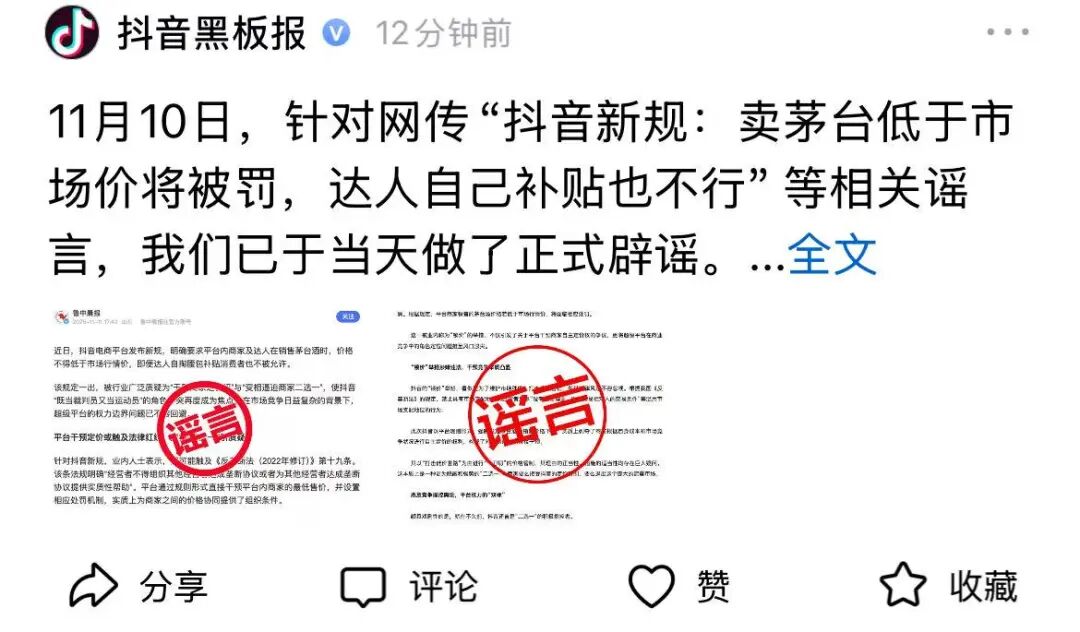
Group 1 - Douyin has refuted rumors regarding penalties for selling Moutai below market prices, stating that the reports are misinterpretations [1][3] - The platform has initiated a special action to address complaints about merchants and influencers using "fake low-price Moutai" for misleading promotions [1] - Douyin emphasized that the spread of these rumors is harmful to consumer choices and the platform's rights, urging all parties to respect the truth and maintain a healthy market environment [3] Group 2 - Douyin accused certain media outlets of deliberately continuing to spread the rumors even after official clarification, suggesting manipulation by a competing e-commerce platform [3] - The company highlighted the importance of combating misinformation in the digital space, indicating potential legal actions against those who intentionally distort facts [3]
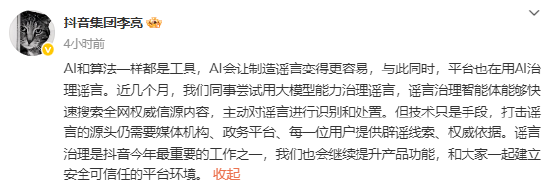
李亮:AI让制造谣言变得更容易,谣言治理是抖音今年最重要的工作之一
Xin Lang Ke Ji· 2025-10-29 06:12
Core Insights - The Vice President of Douyin Group, Li Liang, emphasized that AI, like algorithms, is merely a tool that can facilitate the spread of rumors while also being utilized to combat them [1] - Douyin has been actively employing large model capabilities to manage rumors, with intelligent agents capable of quickly searching authoritative sources online to identify and address false information [1] - The company recognizes that technology is just a means, and effective rumor control requires contributions from media organizations, government platforms, and individual users to provide debunking clues and authoritative evidence [1] - Rumor management is highlighted as one of Douyin's most important tasks for the year, with ongoing efforts to enhance product features to create a safer and more trustworthy platform environment [1]
骑手集体关机半小时配送费翻倍?美团回应:系谣言
2 1 Shi Ji Jing Ji Bao Dao· 2025-10-24 08:33
Core Viewpoint - The rumors regarding delivery riders collectively shutting down their services to increase delivery fees have been confirmed as false by Meituan [2][4]. Group 1: Rumor Details - Various social media posts claimed that delivery riders collectively shutting down their services led to a spike in delivery fees, with specific examples stating fees increased from 3.5 to 6 yuan in half an hour [3]. - The rumors began circulating on October 3, with initial claims originating from cities like Chongqing and Changsha, and later evolving to include Guangzhou and Hangzhou [3]. Group 2: Company Response - Meituan stated that no collective shutdown of riders occurred in Chongqing, Guangzhou, or Hangzhou, labeling the information as rumors [4]. - The company noted that many accounts spreading the rumors are linked to MCN organizations and exhibit signs of AI-generated content, prompting Meituan to report these accounts to relevant authorities for accountability [4]. Group 3: Rider Income Information - Meituan provided insights into rider income, stating that the average monthly income for high-frequency riders is between 6,949 to 10,201 yuan, with skilled riders in major cities like Beijing, Shanghai, Guangzhou, and Shenzhen potentially earning up to 12,826 yuan [4].

大模型“眼睛雪亮” 谣言减少三分之二
Ke Ji Ri Bao· 2025-09-21 23:50
Core Insights - Douyin has implemented AI large model technology for rumor governance, resulting in a 67% reduction in rumor exposure over the past quarter [1][2] - The AI model actively reviews trending information, analyzes content, and determines its authenticity, significantly reducing the processing time from days to hours [1] - The "AI Douyin Truth-Seeking" feature has been upgraded to provide users with links to comprehensive information on potentially misleading content [1][2] Group 1: AI Implementation and Effectiveness - Douyin's AI model can identify the credibility of information sources, including authoritative media and historical rumor databases [1] - The accuracy rate of the AI model in identifying rumors is currently at 85% and is expected to improve further [1] - The "AI Douyin Truth-Seeking" feature is estimated to achieve nearly 100 million exposures per day [2] Group 2: Rumor Management Strategies - Douyin has established a rumor governance ecosystem through various initiatives, including hot topic operations and collaboration with media [2] - The rumor operation team actively verifies the authenticity of information related to rumors, collaborating with local authorities to address specific cases [2] - Despite advancements, challenges remain in completely eliminating rumors due to subjective fabrication and the dynamic nature of information [3]

对“碰瓷式维权”不能姑息
Jing Ji Ri Bao· 2025-05-13 21:48
Core Insights - The article emphasizes the importance of building a solid foundation of integrity in businesses, using the example of Pang Donglai, which prioritizes transparency and customer trust over high profits [1][3] - It highlights the role of regulatory bodies in swiftly addressing misinformation and protecting both consumer rights and legitimate businesses [2][3] - The narrative illustrates the challenges faced by well-known companies in the age of social media, where they can easily become targets for unfounded allegations [3] Group 1: Company Practices - Pang Donglai's approach of clearly labeling prices and offering free returns has resonated with consumers, enhancing their trust despite the low profit margins [1][3] - The company’s commitment to transparency contrasts sharply with industry practices that often rely on vague marketing terms to justify high prices [1][3] Group 2: Regulatory Environment - The timely intervention of market regulators played a crucial role in clarifying the situation, ensuring that the investigation was fair and thorough without being overly punitive [2][3] - Regulatory bodies are encouraged to maintain a balance between protecting consumers and supporting compliant businesses to foster innovation and consumer confidence [2][3] Group 3: Industry Challenges - The article discusses the broader implications of social media scrutiny, where companies face significant risks from unverified claims made by influencers [2][3] - It calls for improved mechanisms among platforms to identify and address misinformation swiftly, preventing the spread of harmful rumors that can damage businesses [3]