价格锚定

Search documents
行情在消息情绪,看清机构行为不踩坑
Sou Hu Cai Jing· 2026-02-27 07:52
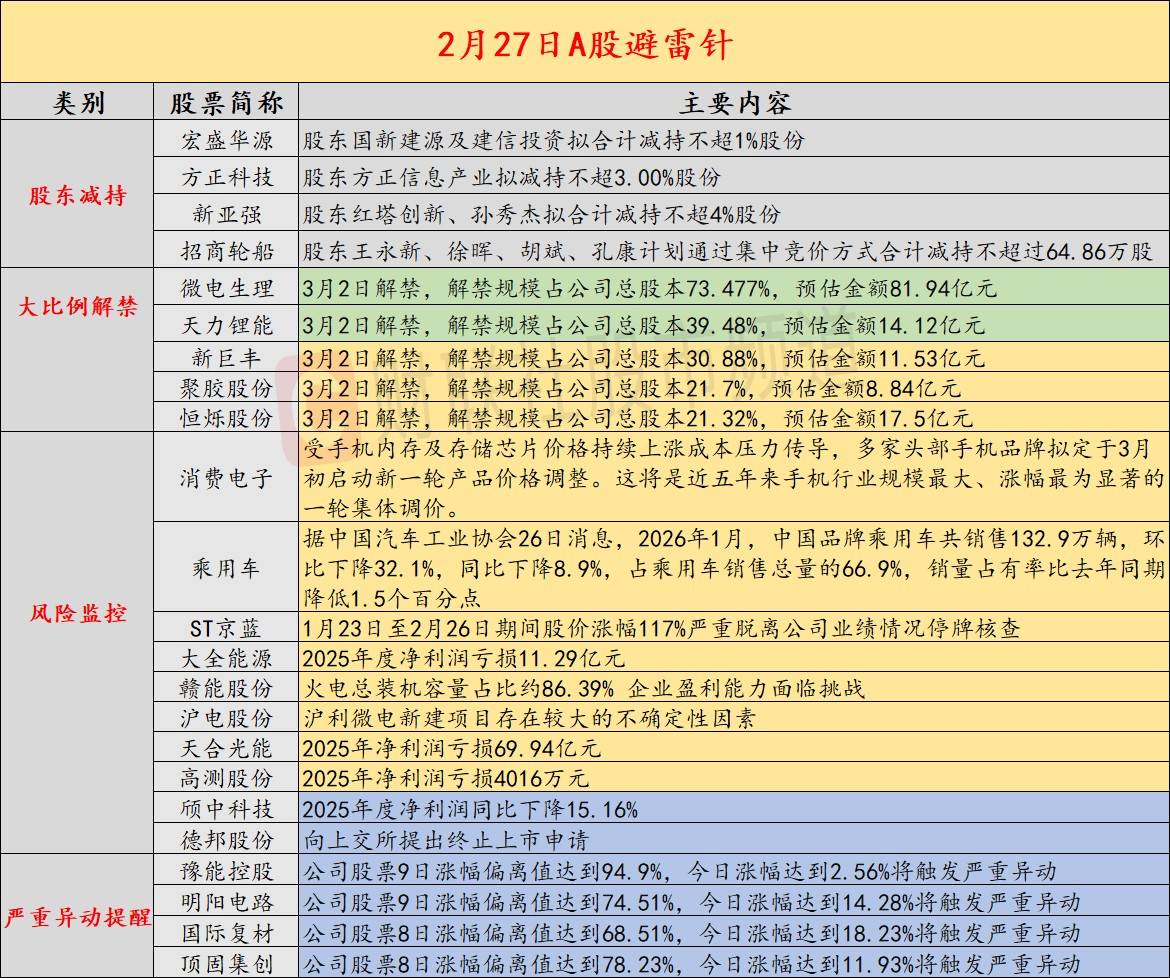
Core Viewpoint - The article emphasizes that market movements are influenced more by underlying trading behaviors rather than just news events, suggesting that a quantitative data approach can help investors understand the true market dynamics [1]. Group 1: Market Dynamics - Various smartphone brands are planning to adjust product prices due to rising costs from memory and storage chips, marking the largest price increase in the smartphone industry in five years [2]. - In the automotive sector, Chinese brand passenger car sales in January 2026 reached 1.329 million units, a decrease of 32.1% month-on-month and 8.9% year-on-year, with a market share drop of 1.5 percentage points [2]. Group 2: Shareholder Actions - Shareholders of Hongsheng Huayuan and Fangzheng Technology plan to reduce their stakes by up to 1% and 3% respectively [2]. - A significant share unlock is expected for several companies on March 2, including: - China Merchants Shipping with a 64.86% unlock, estimated at 81.94 billion [2]. - Weidian Physiotherapy with a 73.477% unlock, estimated at 14.12 billion [2]. - New Giant Hand with a 30.88% unlock, estimated at 11.53 billion [2]. - JuJiao Co. and HengLian Co. with unlocks of 21.7% and 21.32%, estimated at 8.84 billion and 17.5 billion respectively [2]. Group 3: Trading Behavior Insights - The article introduces four core trading behaviors identified through quantitative data: - "Bullish Dominance" indicates active buying [4]. - "Profit Taking" shows that previous investors are cashing out [4]. - "Bearish Dominance" reflects a tendency for investors to sell [4]. - "Short Covering" indicates that previously exited investors are re-entering the market [4]. Group 4: Behavioral Analysis - The article discusses how "Profit Taking" can mislead investors into thinking a stock is still on an upward trend when in fact, funds are exiting [6]. - Conversely, "Short Covering" can lead to price increases despite negative news, as funds may be entering the market during panic selling [10]. - Quantitative data can reveal these hidden behaviors, allowing investors to make more informed decisions and avoid emotional reactions to market fluctuations [13].

45亿砸出7000万新用户,但留下多少人才是胜负关键
3 6 Ke· 2026-02-05 11:44
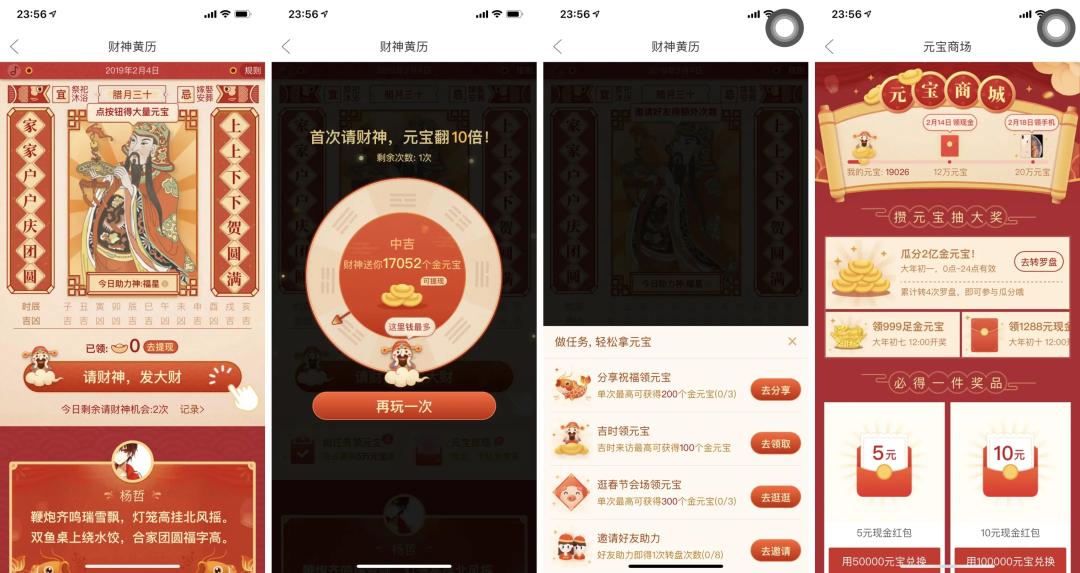
Core Insights - Major AI applications like Tencent's Yuanbao, Baidu's Wenxin, and Alibaba's Qianwen launched a marketing campaign with over 4.5 billion yuan in cash incentives to attract users and cultivate AI usage habits, reminiscent of past Spring Festival red envelope wars [1][2] - The campaign faced immediate backlash as WeChat's security center announced restrictions on sharing red envelope links due to user complaints about disruptive behaviors, highlighting the importance of maintaining a non-intrusive user experience [1][5] Group 1: Marketing Strategy and User Engagement - The AI red envelope activity is fundamentally a combination of cash incentives and task completion, where users must engage with AI to earn rewards, effectively paying users' "education costs" [2] - The event underscores WeChat's dominance as a traffic pool in the mobile internet era, with its core value being a high signal-to-noise ratio social environment, which was compromised by the high-frequency sharing of red envelope links [3][6] - Despite the initial success in user acquisition, with Yuanbao topping the App Store charts and significant increases in downloads, the long-term effectiveness of such strategies remains questionable [7][8] Group 2: User Retention and Long-term Viability - The critical factor for success lies not in short-term user acquisition but in fostering user habits and retention through meaningful engagement with AI functionalities [8][10] - The current AI red envelope strategies risk reducing AI to mere tools for short-term engagement rather than fostering deeper user interactions and problem-solving capabilities [9][10] - Companies are attempting to integrate AI into practical use cases, such as food delivery and social interactions, to enhance user retention and relevance in daily life [11][13] Group 3: Competitive Landscape and Future Directions - The competition among AI applications is expected to evolve from short-term promotional tactics to a focus on functional strength and integration into user scenarios [14] - The ongoing struggle for user attention and engagement will likely require a shift from traditional internet marketing strategies to technology-driven growth [14][15] - The current red envelope campaigns serve as defensive measures in a saturated market, with the true competition for AI applications yet to unfold as they seek to establish lasting user relationships [13][14]



45亿春节红包,能买来多少留存?
Hua Er Jie Jian Wen· 2026-02-03 11:18
Core Viewpoint - The 2026 Spring Festival is set to become the most expensive AI battleground in history, with major companies like Alibaba, ByteDance, Tencent, and Baidu investing a total of at least 4.5 billion RMB in marketing efforts to capture user attention and establish AI products as essential tools in daily life [1][2][4]. Group 1: Investment and Strategy - Alibaba is investing 3 billion RMB to integrate its ecosystem into the Spring Festival, aiming to create a comprehensive entry point for users [1]. - ByteDance has secured a partnership with the Spring Festival Gala, embedding its AI product Doubao into the event to leverage national traffic for AI penetration [1]. - Tencent is spending 1 billion RMB, with a focus on replicating the success of WeChat Pay by utilizing its social ecosystem to drive AI product adoption [1][2]. Group 2: User Acquisition and Retention Challenges - The total investment of 4.5 billion RMB is not merely a festive marketing strategy; it reflects a strategic move to capture the AI market's "super entry point" [2][4]. - The average user acquisition cost (CAC) during peak periods like the Spring Festival can rise to 30 RMB per user, but the real challenge lies in retaining these users beyond initial downloads [4][11]. - Historical data shows that past promotional efforts, such as Baidu's 9 billion RMB investment in 2019, resulted in a mere 2% retention rate after one week, raising concerns about the effectiveness of such spending [9][10]. Group 3: User Behavior and Value Proposition - Users attracted by cash incentives may not develop a genuine interest in AI products, leading to high churn rates post-promotion [21][22]. - The distinction between "cash-grab" users and "AI-native" users is critical; the latter are driven by genuine needs and are more likely to continue using AI tools [19][20]. - The long-term success of AI products will depend on their ability to integrate into users' daily lives and provide real value beyond initial promotions [44]. Group 4: Competitive Landscape and Future Outlook - Companies like Kimi, Zhizhu AI, and Baichuan Intelligence are opting out of the cash-heavy competition, focusing instead on building sustainable user bases through high-value applications [30][32]. - The current investment strategies of major players reflect a defensive posture, aiming to secure market share and prevent disruption from emerging competitors [36][39]. - The outcome of this massive investment will be evaluated in the first quarter of 2026, as companies will need to demonstrate whether they can convert promotional spending into lasting user engagement and loyalty [42][46].
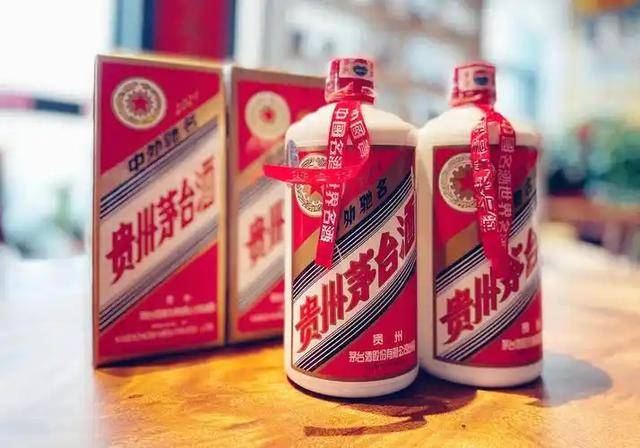
1499元飞天遭疯抢,茅台降价潮下的抢购悖论
Sou Hu Cai Jing· 2026-01-09 07:32
Core Insights - The article discusses the contrasting perceptions of Moutai's sales performance, highlighting the ongoing demand for its official product despite claims of poor sales in the market [2][17]. Group 1: Consumer Behavior - Moutai has established itself as a status symbol, making it more than just a beverage; it is perceived as a gift that conveys respect and importance during social gatherings [4]. - The official price of 1499 yuan serves as a psychological anchor for consumers, making them feel they are getting a good deal compared to previous inflated market prices [6][8]. - Consumers are increasingly cautious about counterfeit products, leading them to prefer official channels like the iMoutai app for purchasing genuine products [10][13]. Group 2: Market Dynamics - The perception of Moutai being "hard to sell" primarily applies to high-priced products held by middlemen, while the official channel's reasonably priced genuine products continue to sell well [19]. - The demand for Moutai is particularly strong during festive seasons, such as the New Year and Spring Festival, when consumers are more willing to purchase for family gatherings [16]. - The article suggests that Moutai's strategy of maintaining stable pricing and ensuring product authenticity has resonated with consumers, contrasting with other brands that rely on price increases and stockpiling [21].