风控措施

Search documents
芝商所再出手!历史大顶时发生了啥?
Qi Huo Ri Bao· 2026-02-01 09:00
Core Viewpoint - CME Group has announced an increase in margin requirements for precious metals trading, aiming to mitigate extreme market volatility following significant price fluctuations in gold and silver [1][2][3] Group 1: Margin Requirement Adjustments - CME Group will raise the margin requirements for gold, silver, platinum, and palladium futures, effective after the market closes on February 2 [1] - The margin for non-high-risk accounts for gold futures will increase from 6% to 8%, while high-risk accounts will rise from 6.6% to 8.8% [1] - For silver futures, the non-high-risk margin will go from 11% to 15%, and high-risk accounts from 12.1% to 16.5% [1] Group 2: Market Reactions and Implications - The increase in margin requirements is a response to the extreme volatility in precious metal prices, with gold reaching a historical high of $5,500 per ounce and silver peaking at $121 per ounce, followed by significant drops of 15% and 31% respectively [2][3] - The adjustments are expected to raise trading costs by over 30%, impacting investors' leverage and potentially leading to reduced positions if returns do not cover increased costs [3][4] Group 3: Historical Context and Comparisons - Historical adjustments by CME Group have often coincided with extreme market conditions, such as the 1980 Hunt brothers incident and the 2011 silver flash crash, where margin requirements were significantly increased to curb speculation [5][6] - Current adjustments differ in that they utilize a dynamic margin mechanism, allowing for more responsive changes based on market conditions, contrasting with past fixed standards [6] Group 4: Global Regulatory Actions - CME Group's actions are part of a broader trend among global regulatory bodies to implement risk control measures, including Thailand's restrictions on gold futures trading and India's increase in gold import taxes [7] - These measures aim to prevent systemic risks and encourage rational investment behavior, with the expectation that while volatility may persist, the long-term upward trend in precious metal prices remains intact [7][8]



再出手!18名客户被限制开仓和出金!交易所精准亮剑 守护市场“安全感”
Qi Huo Ri Bao· 2026-01-27 13:36
Core Viewpoint - The Shanghai Futures Exchange (SHFE) has implemented regulatory measures in response to significant market volatility in precious and non-ferrous metals, aiming to maintain trading order and protect investors' rights [4][6]. Group 1: Regulatory Actions - On January 27, SHFE announced that nine groups of accounts exceeded trading limits, leading to restrictions on opening new positions for these accounts and withdrawal limitations for 18 clients suspected of failing to declare actual control relationships [1]. - Between January 26 and 27, SHFE issued four regulatory announcements and two notifications regarding upgraded risk control measures due to increased trading risks influenced by fluctuating U.S. tariff policies and geopolitical conflicts [4]. - SHFE has publicly released ten regulatory announcements as of January 27, with a focus on monitoring trading behaviors and verifying actual control relationships to combat market manipulation [6]. Group 2: Market Conditions - From December 2022 to January 2023, prices for gold, silver, copper, and tin reached historical highs, with gold futures surpassing 1,100 yuan per gram and silver futures exceeding 30,000 yuan per kilogram [4]. - Market analysts attribute the surge in precious and non-ferrous metal prices to a combination of macroeconomic and fundamental factors, although the rapid price increases have raised concerns about potential risks, particularly from high-leverage funds and irrational buying behavior [4]. Group 3: Risk Control Measures - SHFE has upgraded its risk control measures, including adjustments to trading margins and fees to increase trading thresholds and curb high-leverage and short-term speculative behaviors [5]. - The exchange has modified the price fluctuation limits for various metals, with silver's limit set at 16% and tin's at 11%, to mitigate extreme market conditions [5]. - Daily opening limits have been established, such as an 800-hand limit for silver and a 200-hand limit for tin, to prevent concentrated capital inflows that could lead to abnormal price fluctuations [5].
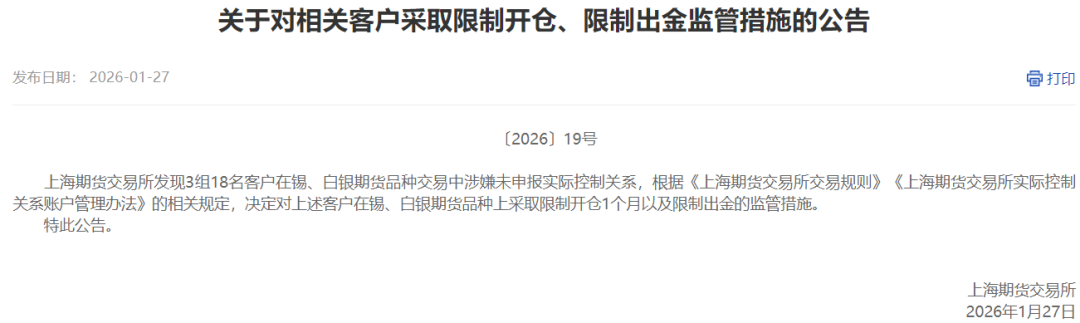
再出手!18名客户被限制开仓和出金!交易所精准亮剑,守护市场“安全感”
Qi Huo Ri Bao· 2026-01-27 13:28
Core Viewpoint - The Shanghai Futures Exchange (SHFE) has implemented regulatory measures in response to significant volatility in precious and non-ferrous metal markets, aiming to maintain market order and protect investors amid rising prices and trading risks [4][5]. Group 1: Regulatory Actions - On January 27, SHFE announced that nine groups of accounts exceeded trading limits, leading to restrictions on opening new positions for these accounts and withdrawal limitations for 18 clients suspected of failing to declare actual control relationships [1]. - Between January 26 and 27, SHFE issued four regulatory announcements and two notifications regarding upgraded risk control measures due to increased market volatility influenced by U.S. tariff policies and geopolitical conflicts [4]. - As of January 27, SHFE had publicly released ten regulatory announcements, including measures to manage abnormal trading behaviors and verify actual control relationships among accounts [6]. Group 2: Market Conditions - From December 2022 to January 2023, prices for gold, silver, copper, and tin reached historical highs, with gold futures surpassing 1,100 yuan per gram and silver futures exceeding 30,000 yuan per kilogram [4]. - Market analysts attribute the surge in precious and non-ferrous metal prices to a combination of macroeconomic and fundamental factors, although the rapid price increases have raised concerns about potential risks, particularly from high-leverage funds and irrational buying behavior [4]. Group 3: Risk Control Measures - SHFE has upgraded its risk control measures, including adjustments to trading margins and fees to increase trading thresholds and curb high-leverage and short-term speculative behaviors [5]. - The exchange has modified the price fluctuation limits for various metals, with silver's limit set at 16% and tin's at 11%, to mitigate extreme market conditions and reduce price volatility [5]. - Daily opening limits have been established, such as 800 contracts for silver and 200 contracts for tin, to prevent concentrated capital inflows that could lead to abnormal price fluctuations [5].
日度策略参考-20260109
Guo Mao Qi Huo· 2026-01-09 05:51
Report Industry Investment Rating No relevant content provided. Core View of the Report - The market sentiment cooled slightly yesterday, with the commodity market weakening significantly and the stock index showing a volatile trend. The trading volume also contracted. After a rapid rise, the stock index has entered a stage of shock consolidation. There are no obvious macro-level negatives at present, and the short-term outlook for the stock index remains bullish. The bond futures are favored by the asset shortage and weak economy, but the central bank has recently warned of interest rate risks. Attention should be paid to the Bank of Japan's interest rate decision. [1] - The prices of various commodities are affected by different factors, such as supply and demand, policy changes, and macro sentiment. The report provides trend judgments and trading suggestions for each commodity, including metals, energy, chemicals, and agricultural products. [1] Summary by Related Catalogs Macro Finance - Stock Index: After a rapid rise, the stock index has entered a stage of shock consolidation. There are no obvious macro-level negatives at present, and the short-term outlook for the stock index remains bullish. Attention should be paid to capital flows and market sentiment changes. [1] - Treasury Bonds: The bond futures are favored by the asset shortage and weak economy, but the central bank has recently warned of interest rate risks. Attention should be paid to the Bank of Japan's interest rate decision. [1] Non-Ferrous Metals - Copper: The copper price has fallen from its recent high, but there are still disruptions in the mining end. The downside space for the copper price is expected to be limited. [1] - Aluminum: There has been an accumulation of domestic electrolytic aluminum stocks recently, and the industrial driving force is limited. The macro anti-involution sentiment has ebbed, and the aluminum price has fallen from its high. [1] - Alumina: The supply side of alumina still has a large release space, and the industrial side exerts downward pressure on the price. However, the current price is basically near the cost line, and the price is expected to fluctuate. [1] - Zinc: The fundamentals of zinc have improved, and the cost center has shifted upward. The recent macro sentiment has been good, and the zinc price has risen. However, considering the still existing pressure on the fundamentals, caution is advised regarding the upside space. [1] - Nickel: The market's concerns about nickel supply have significantly cooled, and the LME nickel inventory has increased significantly recently. The nickel price has corrected from its high. Since Indonesia has not disclosed the specific amount and said that it is still in the process of accounting, there is still uncertainty about the implementation of the subsequent policy. The short-term volatility risk of the nickel price has increased. Attention should be paid to the implementation of Indonesia's policy, changes in macro sentiment, and changes in futures positions, and risk control should be done well. [1] Precious Metals and New Energy - Gold and Silver: The annual weight adjustment of the BCOM index has officially started, and the exchange has introduced multiple risk control measures for silver to suppress speculative enthusiasm. The prices of precious metals have fallen across the board, with a significant decline in silver. In the short term, gold and silver are expected to continue to be weak and volatile. In the medium and long term, attention can be paid to the opportunity to buy on dips after this round of risk release. [1] - Platinum and Palladium: Platinum and palladium have followed the weakening of precious metals. In the short term, they are expected to be in a wide-range volatile pattern. In the medium and long term, with the still existing supply-demand gap for platinum and the tendency of palladium to have a loose supply, platinum can still be bought on dips or a [long platinum, short palladium] arbitrage strategy can be adopted. [1] Industrial Products - Industrial Silicon: There is an increase in production in the northwest and a decrease in production in the southwest. The production schedules for polysilicon and organic silicon in December have decreased. [1] - Polysilicon: It is the traditional peak season for new energy vehicles. The demand for energy storage is strong. The supply side has increased production resumption. There is a short-term rapid increase. [1] - Rebar and Hot Rolled Coil: In the short term, sentiment and capital have a greater influence than industrial contradictions. One can try to follow long positions with a stop-loss; for futures-spot trading, participate in positive spread positions. [1] - Iron Ore: There is sector rotation, but the upside pressure on iron ore is obvious. It is not recommended to chase long positions at this level. [1] - Non-Ferrous Metals: There is a combination of weak reality and strong expectations. The current supply and demand situation remains weak, but in terms of expectations, energy consumption double control and anti-involution may have an impact on supply. [1] - Soda Ash: Soda ash follows the trend of glass. In the medium term, the supply and demand situation will be more relaxed, and the price will be under pressure. [1] - Coking Coal and Coke: If the "capacity reduction" expectation continues to ferment and there is pre-holiday restocking of spot goods, coking coal may still have room to rise. However, since the current market's "capacity reduction" expectation mainly comes from online rumors, it is difficult to judge the actual upside space. After a significant increase, the volatility will intensify, and caution should be exercised. The logic for coke is the same as that for coking coal. [1] Agricultural Products - Palm Oil: The MPOB December data is expected to be bearish for palm oil, but palm oil will reverse under the themes of seasonal production reduction, the B50 policy, and US biodiesel in the future. Short-term rebounds due to macro sentiment should be watched out for. [1] - Soybean Oil: The fundamentals of soybean oil are relatively strong. It is recommended to allocate more in the oil sector and consider a long Y, short P spread. Wait for the January USDA report. [1] - Rapeseed Oil: The trade relationship between China and Canada may improve, and Australian rapeseed will be imported smoothly. After the rapeseed trade flow is opened up, the trading logic of rapeseed oil will gradually shift from the domestic tight supply situation to the global rapeseed production increase expectation. There is still room for the price to fall. Short-term rebounds due to macro sentiment should be watched out for. [1] - Cotton: There is a strong expectation of a good harvest for domestic new crops, and the purchase price of seed cotton supports the cost of lint cotton. The downstream operating rate remains low, but the inventory of yarn mills is not high, and there is a rigid demand for restocking. Considering the growth of spinning capacity, the demand for cotton in the new crop market year is relatively resilient. Currently, the cotton market is in a situation of "having support but no driving force." Future attention should be paid to the tone of the No. 1 Central Document in the first quarter of next year regarding the direct subsidy price and cotton planting area, the intention of cotton planting area next year, the weather during the planting period, and the demand during the "Golden Three and Silver Four" peak season. [1] - Sugar: Currently, there is a global surplus of sugar, and the supply of domestic new crops has increased. The short-selling consensus is relatively strong. If the futures price continues to fall, there will be strong cost support below. However, there is a lack of continuous driving force in the short-term fundamentals. Attention should be paid to changes in the capital side. [1] - Corn: The fundamentals of corn have not changed significantly. The spot price remains firm, and the progress of grain sales at the grassroots level is relatively fast. Most traders have not yet strategically built inventories, and feed enterprises maintain a safe inventory. There is a certain restocking demand before the holiday. The short-term outlook for CO3 is expected to be oscillating and slightly bullish. Attention should be paid to the dynamics of policy grain auctions. [1] - Soybean Meal: The domestic market may restart the auction of imported soybeans; the relationship between China and Canada is expected to ease, and China is expected to suspend the tax on Canadian rapeseed meal; the macro sentiment has cooled, and the domestic market has returned to the fundamentals and shown a significant decline. Recently, it has been greatly affected by policy news. The soybean meal futures price is expected to be mainly oscillating in the short term. Attention should be paid to the adjustment of the January USDA supply and demand report and the trend of the Brazilian premium. [1] - Pulp: Pulp has fallen today due to the decline in the commodity macro market. The overall price has not broken through the oscillating range. The short-term commodity sentiment fluctuates greatly, and it is recommended to observe cautiously. [1] - Logs: The spot price of logs has shown a certain sign of bottoming out and rebounding recently. The further downside space for the futures price is expected to be limited. However, the January overseas quotation has still slightly declined, and the log futures and spot markets lack upward driving factors. It is expected to oscillate in the range of 760 - 790 yuan/m³. [1] - Hogs: Recently, the spot price has gradually stabilized. Supported by demand and with the出栏体重 not yet fully cleared, the production capacity still needs to be further released. [1] Energy and Chemicals - Crude Oil: OPEC+ has suspended production increases until the end of 2026. There is uncertainty about the Russia-Ukraine peace agreement. The United States has imposed sanctions on Venezuela's crude oil exports. [1] - Fuel Oil: In the short term, the supply-demand contradiction is not prominent, and it follows the trend of crude oil. The probability of the 14th Five-Year Plan's rush demand being falsified is high, and the supply of Ma Rui crude oil is not short. The profit of asphalt is relatively high. [1] - BR Rubber: The futures position has declined, and the number of new warehouse receipts has increased. The increase in BR has slowed down temporarily. The spot price has led the rise to repair the basis, and BR continues to focus on the upward momentum above the 12,000 yuan line. The listed prices of BD/BR have been continuously raised, and the processing profit of butadiene rubber has narrowed. The overseas cracking device capacity has been cleared, which is beneficial to the long-term export expectation of domestic butadiene. The tax on naphtha also has a positive impact on the butadiene price. Fundamentally, butadiene rubber maintains high production and high inventory operation, and the trading center is generally average. Styrene-butadiene rubber is relatively better than butadiene rubber. [1] - PX and PTA: The PX market has experienced a rapid rise, but this round of rise is not due to a fundamental change. The fundamentals of PX do have support, and the market is expected to continue to tighten in 2026, driven by the new PTA production capacity in India and the organic growth of demand. Domestic PTA maintains high production. The gasoline spread is still at a high level, which supports aromatics. [1] - Ethylene Glycol: There is news that two sets of MEG plants in Taiwan, China, with a total annual capacity of 720,000 tons, plan to stop production next month due to efficiency reasons. Ethylene glycol has rebounded rapidly during the continuous decline, stimulated by supply-side news. The current operating rate of the polyester downstream remains above 90%, and the demand performance is slightly better than expected. [1] - Short Fiber: The PX market has experienced a rapid rise, but this round of rise is not due to a fundamental change. Domestic PTA maintains high production, and the domestic polyester load has declined. The short fiber price continues to closely follow the cost fluctuations. [1] - Styrene: The Asian styrene market is generally stable. Suppliers are reluctant to lower prices due to continuous losses, while buyers insist on pressing prices due to weak downstream polymer demand and compressed profits. Although the downstream demand is weak, the domestic market has a strong bullish sentiment due to export support. The market is in a weak balance state, and the short-term upward momentum needs to be driven by the overseas market. [1] - Urea: The export sentiment has slightly eased, and there is limited upside space due to insufficient domestic demand. There is support from anti-involution and the cost side below. [1] - PF: Geopolitical conflicts have intensified, and there is a risk of an increase in crude oil prices. There are fewer maintenance activities, the operating load is at a high level, and there are overseas arrivals, so the supply has increased. The downstream demand operating rate has weakened. In 2026, there will be more new production capacity, and the supply-demand surplus will further intensify, and the market expectation is weak. [1] - Propylene: There are fewer maintenance activities, the operating load is relatively high, and the supply pressure is relatively large. The improvement in the downstream is less than expected. The propylene monomer price is at a high level, the crude oil price has risen, and the cost support is strong. Geopolitical conflicts have intensified, and there is a risk of an increase in crude oil prices. [1] - PVC: In 2026, there will be less global new production capacity, and the future expectation is relatively optimistic. Currently, there are fewer maintenance activities, new production capacity is being released, and the supply pressure is increasing. The demand has weakened, and the orders are not good. The differential electricity price in the northwest region is expected to be implemented, which will force the clearance of PVC production capacity. [1] - LPG: The January CP has risen more than expected, and the cost support for imported gas is relatively strong. The geopolitical conflicts between the United States, Venezuela, and the Middle East have escalated, and the short-term risk premium has increased. The trend of inventory accumulation in the EIA weekly C3 inventory has slowed down, and it is expected to gradually turn to inventory reduction. The domestic port inventory has also decreased. Domestic PDH maintains high production and deep losses. There is a rigid demand for global civil combustion, and the demand for MTBE from overseas olefin blending for gasoline has declined temporarily. Since January 1, 2026, naphtha has been re-taxed, and the long-term demand expectation for light cracking raw materials such as LPG has increased, and the performance of downstream olefin products is relatively strong. [1] Shipping - Container Shipping - European Line: It is expected to peak in mid-January. Airlines are still relatively cautious in their trial reflights. The pre-holiday restocking demand still exists. [1]
日度策略参考-20260108
Guo Mao Qi Huo· 2026-01-08 02:26
Report Industry Investment Rating No specific industry investment ratings were provided in the report. Core Viewpoints of the Report - A-share market is expected to continue its upward trend in the short term and may rise further in 2026 compared to 2025, supported by macro policies, inflation, capital market reforms, and the role of Central Huijin [1]. - The bond market is favored by asset shortages and weak economic conditions, but the central bank has recently warned of interest rate risks [1]. - Metal prices are influenced by factors such as supply disruptions, macro sentiment, and cost changes. Some metals are expected to have upward trends, while others may experience volatility or are subject to supply concerns [1]. - Energy and chemical product prices are affected by factors such as geopolitical conflicts, supply and demand, and cost support. Some products are expected to have upward trends, while others may experience volatility [1]. - Agricultural product prices are influenced by factors such as seasonal changes, policy support, and supply and demand. Some products are expected to have upward trends, while others may experience volatility [1]. Summary by Category A-shares - A-share market has continuous trading volume increase. Short-term, the index is expected to remain strong. In 2026, the index may continue to rise on the basis of 2025, supported by macro policies, inflation, capital market reforms, and Central Huijin [1]. Bonds - Asset shortages and weak economic conditions are favorable for bond futures, but the central bank has recently warned of interest rate risks. Attention should be paid to the Bank of Japan's interest rate decision [1]. Metals - Copper: Supply disruptions and improved macro sentiment have led to a rise in copper prices, and the upward trend is expected to continue [1]. - Aluminum: Domestic electrolytic aluminum has accumulated inventory, but macro sentiment is positive, and global aluminum ingot supply is expected to tighten, leading to a strong aluminum price [1]. - Alumina: Supply has significant release potential, putting pressure on prices. However, the current price is close to the cost line, and the price is expected to oscillate [1]. - Zinc: Fundamentals have improved, and the cost center has shifted upward. With positive macro sentiment, zinc prices have risen, but the upside space is limited due to fundamental pressure [1]. - Nickel: Supply concerns have led to a significant increase in nickel prices and an increase in positions. The short-term price may be strongly oscillating, but high risks and volatility are present at high price levels. Attention should be paid to Indonesian policies and macro sentiment [1]. Industrial and Energy Chemicals - Polycrystalline silicon: Northwest production has increased, while southwest production has decreased. December production schedules for polycrystalline silicon and organic silicon have declined [1]. - Carbonate lithium: It is the traditional peak season for new energy vehicles, with strong energy storage demand and increased supply from restarts. Prices have risen rapidly in the short term [1]. - Rebar and hot-rolled coil: Futures-spot arbitrage positions can be rolled for profit-taking. The price valuation is not high, and short-selling is not recommended [1]. - Iron ore: Near-term contracts are restricted by production cuts, but the commodity sentiment is positive, and there is still an upward opportunity for far-term contracts [1]. - Silicone and ferrosilicon: There is a combination of weak reality and strong expectations. In the short term, expectations dominate, and energy consumption control and anti-involution may disrupt supply [1]. - Soda ash: The market sentiment has improved, and the supply and demand are supportive. The price is low and expected to be strong in the short term [1]. - Coking coal and coke: If the "capacity reduction" expectation continues to ferment and there is pre-holiday restocking of spot goods, there may still be room for price increases, but the actual increase is difficult to judge, and volatility increases after a significant rise [1]. Agricultural Products - Palm oil: The December MPOB data is expected to be bearish, but the price is expected to reverse under themes such as seasonal production cuts, the B50 policy, and US biofuels. Short-term rebounds due to macro sentiment should be watched out for [1]. - Soybean oil: The fundamentals are strong, and it is recommended to be overweight in the oil market. Consider the spread between soybean oil and palm oil [1]. - Cotton: There is support but no driving force in the short term. Future attention should be paid to the central government's No. 1 document in the first quarter of next year, planting area intentions, weather during the planting period, and peak season demand [1]. - Sugar: There is a global surplus and increased domestic supply. The short side consensus is strong. If the price continues to fall, there is strong cost support, but there is a lack of continuous driving force in the short term [1]. - Corn: With the release of reserve and imported grains, the supply has increased. The spot price is expected to be firm in the short term, and the futures price will oscillate within a range [1]. - Pulp: The 05 contract is expected to oscillate between 5400 - 5700 yuan/ton due to the tug-of-war between "strong supply" and "weak demand" [1]. - Logs: The spot price has shown signs of bottoming out and rebounding, and the downward space for the futures price is limited. However, the January overseas quotation has slightly declined, and there is a lack of upward driving factors. The price is expected to oscillate between 760 - 790 yuan/m³ [1]. Energy and Chemicals - Crude oil: OPEC+ has suspended production increases until the end of 2026. The uncertainty of the Russia-Ukraine peace agreement and US sanctions on Venezuelan oil exports have an impact [1]. - Fuel oil: Follows the trend of crude oil in the short term, with no prominent supply-demand contradictions [1]. - Asphalt: The "14th Five-Year Plan" rush demand is likely to be disproven, and the supply of Ma Rui crude oil is sufficient. The profit margin is high [1]. - Natural rubber: The raw material cost provides strong support, the futures-spot price difference has rebounded significantly, and the midstream inventory has increased substantially [1]. - BR rubber: The upward momentum has slowed down, the spot price has led the recovery of the basis, and the processing profit has narrowed. There are positive factors for future domestic butadiene exports [1]. - PTA: The PX market has experienced a sharp rise, and the PTA market is expected to remain tight in 2026. Domestic PTA maintains high production, and the gasoline spread provides support for aromatics [1]. - Ethylene glycol: Two MEG plants in Taiwan, China, plan to shut down next month. The price has rebounded rapidly due to supply-side news, and the downstream demand is slightly better than expected [1]. - Styrene: The Asian market is stable, with suppliers reluctant to cut prices due to losses and buyers pressing for lower prices due to weak downstream demand. The market is in a weak balance, and the upward momentum depends on overseas markets [1]. - Urea: The export sentiment has eased, and the upside space is limited due to insufficient domestic demand. There is support from anti-involution and the cost side [1]. - PE: There is a risk of rising crude oil prices due to geopolitical conflicts. The supply pressure is high, and the market expectation is weak due to planned production increases in 2026 [1]. - PP: The supply pressure is high, and the downstream improvement is less than expected. The cost is supported by high propylene monomer and crude oil prices [1]. - PVC: The global production is expected to be low in 2026, but the current supply pressure is rising. The demand is weak, and the implementation of differential electricity prices in the northwest may force the clearance of PVC production capacity [1]. - LPG: The January CP has risen unexpectedly, and the import cost provides strong support. Geopolitical conflicts have increased the risk premium. The inventory accumulation trend has slowed down, and the domestic port inventory is decreasing. The long-term demand for LPG is expected to increase [1]. Aviation - It is expected to peak in mid-January. Airlines are still cautious about trial resumptions [1].
刚刚!2000亿“绞肉机”突袭!“牛市”缘何突然变脸?
券商中国· 2025-12-29 11:03
Core Viewpoint - The commodity market experienced a sudden downturn after a period of rapid growth, with significant declines in platinum, palladium, and lithium carbonate prices, indicating a potential market correction due to high speculation and regulatory measures [2][3][4]. Group 1: Market Performance - On December 29, the commodity market saw a drastic shift, with platinum and palladium futures contracts hitting their daily limit down, while lithium carbonate also faced a significant drop, reaching a trading volume exceeding 200 billion yuan [2]. - Platinum futures closed at 634.35 yuan per gram, down 10%, while palladium futures also fell by 10%. The Shanghai silver contract peaked at 19,998 yuan per kilogram before dropping to 18,205 yuan, reflecting a nearly 10% decline from its intraday high [3]. - Lithium carbonate futures hit a limit down at 117,400 yuan per ton, closing with a drop of 7.89% [3]. Group 2: Market Sentiment and Speculation - The rapid price increases in silver, platinum, and palladium have led to overheating in the market, with the gold-silver ratio dropping below the historical average, indicating accumulated risks and reduced future potential [4]. - High speculation levels in nickel and palladium have been noted, with over 65% indicating extreme market sensitivity, where minor changes could trigger significant reactions [5]. Group 3: Regulatory Measures - In response to the market volatility, regulatory bodies have implemented stricter risk control measures, including increasing the price fluctuation limits for gold and silver to 15% and raising margin requirements to 17% [6]. - The National Investment Silver LOF announced a temporary suspension of trading to protect investors, highlighting the need for caution in the current market environment [6]. Group 4: Analyst Recommendations - Analysts suggest maintaining a cautious approach, particularly for volatile commodities like silver and platinum, and recommend strict stop-loss measures to manage risk exposure effectively [6].