
市场过热风险

Search documents
贵金属遭遇“巨震星期一”!黄金、白银史诗级大跌背后:交易所出手降温
Sou Hu Cai Jing· 2025-12-30 08:36
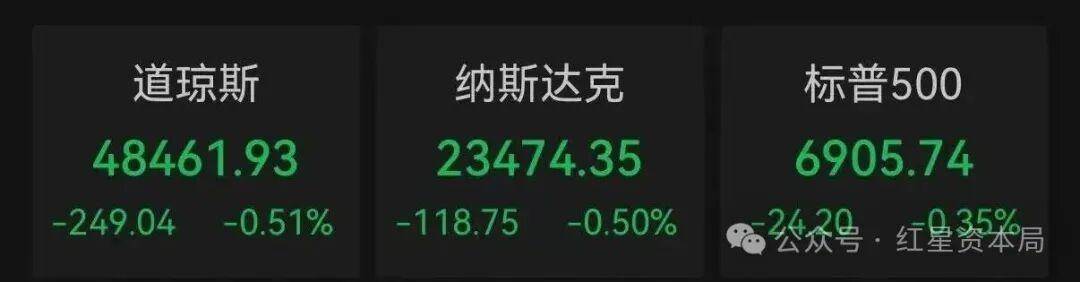
Core Viewpoint - The precious metals and stock markets experienced a significant pullback, with major U.S. stock indices closing lower on December 29, 2025, marking the last trading week of the year [1]. Group 1: Market Performance - The three major U.S. stock indices all closed down, with the S&P 500 index falling by 0.35%, the Nasdaq down by 0.5%, and the Dow Jones down by 0.51% [1]. - Precious metals, particularly silver, saw a sharp decline, with spot silver dropping over 9%, marking its largest single-day drop since September 2020 [3]. - Spot gold fell more than 4%, the largest single-day drop since October 21, and COMEX gold futures dropped 4.45% to $4,350.2 per ounce [3]. Group 2: Factors Influencing Price Movements - The decline in precious metals was influenced by a rebound in the U.S. dollar, an increase in margin requirements by the CME Group, and technical overbought conditions [3][5]. - The CME Group announced an increase in margin requirements for various metal contracts, which took effect after the market closed on December 29, contributing to the downward pressure on prices [5][8]. Group 3: Market Sentiment and Future Outlook - Analysts expressed concerns about the rapid pace of the recent price increases in precious metals, indicating that the market may be overheated [5]. - Despite the current downturn, there remains a generally optimistic outlook for precious metals, with silver prices having increased by over 185% year-to-date [8]. - Analysts from Heraeus warned that silver and other precious metals prices may decline in the first half of 2026 due to high prices weakening demand across various industries [9].

涨6%→跌6%!白银,大跳水
Sou Hu Cai Jing· 2025-12-29 13:01
Group 1 - Silver experienced a significant drop, falling over 6% after reaching a historical high earlier in the day, with London silver currently down 5.67% [1] - COMEX silver decreased by approximately 4%, while other precious metals like gold and platinum also saw declines of nearly 2% and 6% respectively [1] - The World Silver Association forecasts a supply-demand gap exceeding 100 million ounces in the global silver market by 2025, marking the fifth consecutive year of supply shortages [1] Group 2 - Huolong Futures noted that silver's performance is currently stronger than gold, with high volatility and a "frenzy phase" in the market, advising caution for ordinary investors [2] - The rapid price increases in silver, platinum, and palladium have led to overheating in the market, with the gold-silver ratio dropping below the historical average, indicating accumulating risks [2] - The industrial attributes of silver, platinum, and palladium mean that irrational price surges could suppress actual demand, highlighting the need to guard against potential market corrections [2] Group 3 - Current speculative levels in nickel and palladium have exceeded 65%, indicating that market sentiment is in a highly sensitive zone, where minor changes could trigger significant reactions [3]
白银“蹦极” 盘中振幅超过12%
2 1 Shi Ji Jing Ji Bao Dao· 2025-12-29 11:22
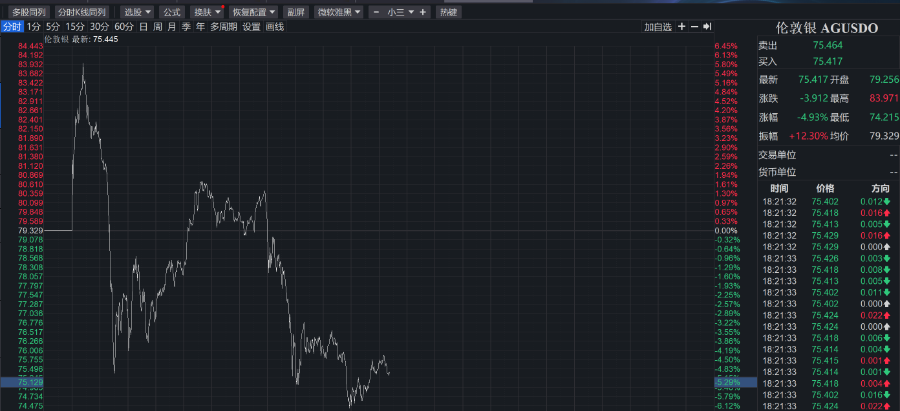
Core Viewpoint - Silver prices experienced significant volatility, with a peak increase of 5.3% to $83.971 per ounce before dropping sharply to a low of $74.215, resulting in a daily fluctuation of nearly $10 per ounce and a total intraday volatility of 12.3% [1][3] Group 1: Price Movements and Trends - In the last two trading days, silver prices have shown increased volatility, with a notable single-day increase of approximately 10% on December 26, marking the largest single-day gain since 2008 [3] - Year-to-date, silver prices have risen over 185%, maintaining a growth rate of around 160% even after the recent pullback, positioning it for the best annual performance since 1979 [3] - The silver-gold ratio has significantly decreased from around 104 in April to below 60, with a peak of approximately 55 on December 29 [3] Group 2: Market Sentiment and Predictions - Despite a generally optimistic outlook for precious metals, there are concerns about short-term overheating risks in the silver market, with some investors suggesting that the current market dynamics are driven more by speculation than fundamentals [3] - Analysts from Heraeus and TD Securities have warned of potential price declines for silver and other precious metals in the first half of 2026, with predictions of silver prices stabilizing around $40 [4] - The Silver Institute forecasts a structural supply deficit of approximately 95 million ounces in the global silver market for 2025, indicating a continued supply-demand imbalance for the fifth consecutive year [5][6] Group 3: Regulatory Actions and Market Reactions - In response to heightened trading activity, the Shanghai Futures Exchange announced adjustments to margin requirements and price limits for gold and silver futures contracts, effective December 30 [4] - The CME Group also raised margin requirements for various metal futures, which is expected to increase trading costs and lead to profit-taking among investors, contributing to price declines on December 29 [5] Group 4: Retail Investor Behavior - Retail investor sentiment remains bullish, with 57% of retail traders expecting silver prices to exceed $100 per ounce in 2026, contrasting with only 27% of institutional analysts predicting prices between $80 and $100 [8] - The National Investment Silver LOF has experienced extreme price movements, including consecutive trading halts, with a significant price fluctuation of 19.61% on December 29 [8][9] - High premium rates for the National Investment Silver LOF have attracted many investors, leading to a chain reaction of arbitrage activities that have resulted in price disconnections from net asset values [9]
刚刚!2000亿“绞肉机”突袭!“牛市”缘何突然变脸?
券商中国· 2025-12-29 11:03
Core Viewpoint - The commodity market experienced a sudden downturn after a period of rapid growth, with significant declines in platinum, palladium, and lithium carbonate prices, indicating a potential market correction due to high speculation and regulatory measures [2][3][4]. Group 1: Market Performance - On December 29, the commodity market saw a drastic shift, with platinum and palladium futures contracts hitting their daily limit down, while lithium carbonate also faced a significant drop, reaching a trading volume exceeding 200 billion yuan [2]. - Platinum futures closed at 634.35 yuan per gram, down 10%, while palladium futures also fell by 10%. The Shanghai silver contract peaked at 19,998 yuan per kilogram before dropping to 18,205 yuan, reflecting a nearly 10% decline from its intraday high [3]. - Lithium carbonate futures hit a limit down at 117,400 yuan per ton, closing with a drop of 7.89% [3]. Group 2: Market Sentiment and Speculation - The rapid price increases in silver, platinum, and palladium have led to overheating in the market, with the gold-silver ratio dropping below the historical average, indicating accumulated risks and reduced future potential [4]. - High speculation levels in nickel and palladium have been noted, with over 65% indicating extreme market sensitivity, where minor changes could trigger significant reactions [5]. Group 3: Regulatory Measures - In response to the market volatility, regulatory bodies have implemented stricter risk control measures, including increasing the price fluctuation limits for gold and silver to 15% and raising margin requirements to 17% [6]. - The National Investment Silver LOF announced a temporary suspension of trading to protect investors, highlighting the need for caution in the current market environment [6]. Group 4: Analyst Recommendations - Analysts suggest maintaining a cautious approach, particularly for volatile commodities like silver and platinum, and recommend strict stop-loss measures to manage risk exposure effectively [6].

硅谷扛不住了、撬动华尔街,“AI军备竞赛”开始扩散,风险也是!
美股IPO· 2025-09-07 00:17
Core Viewpoint - The article discusses how major tech companies are adopting innovative financial strategies to externalize risks and liabilities in response to unprecedented financial pressures from massive capital expenditures, particularly in AI infrastructure [2][3][4]. Group 1: Financial Strategies - Three innovative financial strategies have emerged among tech giants to externalize risks and costs: joint ventures, syndicated debt, and backstop agreements [4]. - These strategies aim to transfer part of the costs and risks off their balance sheets while maintaining financial health during aggressive expansion [3][4]. Group 2: Meta's Joint Venture - Meta initiated a financing of up to $29 billion for its "Hyperion" data center project in Louisiana, forming a joint venture with Blue Owl Capital, which invested $3 billion in equity, while $26 billion in debt was distributed through bond giant Pimco with Morgan Stanley's assistance [6]. - This structure allows Meta to repay the debt through lease payments, effectively moving the project off its balance sheet and controlling debt levels [6] Group 3: Oracle's Syndicated Debt - Oracle agreed to become a tenant for a 1.4GW data center complex being developed by Vantage Data Centers, which is one of the largest ongoing projects globally [7]. - Vantage is collaborating with a syndicate of six banks, led by JPMorgan and Mitsubishi UFJ Financial Group, to distribute $22 billion in debt for the project, thereby reducing individual risk exposure [7][8]. Group 4: Google's Backstop Agreement - Google's approach involves a complex backstop agreement, providing up to $3.2 billion in backup guarantees for a lease contract between cloud startup Fluidstack and data center owner TeraWulf, while acquiring a 14% stake in TeraWulf [9][10]. - This design allows Google to avoid counting the guarantee as a current liability, as it only triggers if Fluidstack defaults [10]. Group 5: Market Dynamics and Risks - The significant financing needs of tech giants coincide with a cash-rich credit market, with lenders willing to cover 80% to 90% of data center project costs, compared to the historical range of 65% to 80% [12]. - However, this influx of capital raises concerns about market overheating, high concentration risk due to reliance on a few creditworthy tech giants, and leverage risks, particularly highlighted by Oracle's high leverage ratio of 4.3 times [12][13][14].

硅谷扛不住了、撬动华尔街 “AI军备竞赛”开始扩散 风险也是!
智通财经网· 2025-09-06 06:02
Group 1 - The core viewpoint of the articles highlights that the AI arms race among tech giants is evolving into a complex financial game, with companies like Amazon, Google, Meta, Microsoft, and Oracle feeling unprecedented financial pressure due to massive capital expenditures [1][2] - Tech giants are shifting from relying solely on internal cash flows for infrastructure development to seeking external capital, leading to innovative financing strategies to manage costs and risks while maintaining healthy financial statements [2][3] Group 2 - Three innovative financial strategies have emerged to externalize risks and costs: joint ventures, syndicated loans, and backstop agreements [3] - Meta's strategy involves a joint venture for its Hyperion data center project, raising $29 billion, with a significant portion of the debt structured to be off its balance sheet [4] - Oracle is utilizing syndicated loans for a $22 billion data center project, distributing risk among multiple lenders to facilitate large-scale financing [5] Group 3 - Google's approach is characterized by a backstop agreement, providing a $3.2 billion guarantee for a lease contract, which is contingent on a default, thus potentially avoiding immediate liability on its balance sheet [6][7] - The influx of capital into data center projects is significant, with lenders willing to cover 80% to 90% of total project costs, indicating a robust funding environment [8][9] Group 4 - However, this capital frenzy raises concerns about market overheating, high concentration risk among a few tech giants, and the potential for increased leverage risks, particularly highlighted by Oracle's high leverage ratio [9][10]



硅谷扛不住了、撬动华尔街,“AI军备竞赛”开始扩散,风险也是!
Hua Er Jie Jian Wen· 2025-09-06 05:27
Group 1 - The core viewpoint is that the AI arms race among tech giants is evolving into a complex financial game, with companies feeling unprecedented financial pressure despite having substantial cash reserves [1][2] - Tech giants are shifting from relying solely on internal cash flow for infrastructure development to seeking external capital, leading to innovative financing strategies [2][3] - The need for external financing is driven by the rapid pace and scale of AI development, prompting companies to collaborate with banks to design complex financial solutions [2][3] Group 2 - Three innovative financial strategies have emerged to externalize risk and costs: joint ventures, syndicated loans, and backstop agreements [3] - Meta's strategy involves a joint venture for its Hyperion data center project, raising $29 billion, with a significant portion of the debt being managed off its balance sheet [4][5] - Oracle is utilizing syndicated loans for a $22 billion data center project, distributing risk among multiple lenders to facilitate large-scale financing [5] - Google's approach includes a backstop agreement, providing a $3.2 billion guarantee for a lease, which is contingent on a startup's default, thus minimizing immediate liabilities [6] Group 3 - The influx of capital into data center projects is significant, with lenders covering 80% to 90% of total project costs, indicating a robust funding environment [7] - However, this capital influx raises concerns about market overheating, high concentration risk among a few tech giants, and elevated leverage risks for some companies [7][8] - Moody's and S&P have issued warnings regarding Oracle's high leverage ratio, which is currently at 4.3 times, indicating potential credit rating risks if not managed [8]