AI与机器人技术

Search documents
拐点已现,未来所有公司都可能成为机器人公司
虎嗅APP· 2026-03-14 13:37
Core Viewpoint - The intersection of AI and robotics is driving a transformation in the manufacturing industry, evolving from specialized machinery to general-purpose robots, sparking significant discussion [2]. Group 1: Methodology of Robot Development - A central question in the robotics revolution is whether to pursue specialized or general-purpose robots, and how automotive manufacturers entering the space will impact traditional robotics companies [3]. - The development of robotics is seen as a gradual transition from specialized applications to general-purpose capabilities, driven by technological advancements and cost reductions [9]. - The maturity of technologies such as batteries, sensors, and AI is crucial for the evolution of robotics, with a timeline of 15-30 years anticipated for widespread adoption [12][10]. Group 2: Impact of Automotive Manufacturers - The entry of automotive manufacturers into the robotics sector is viewed positively, as it indicates industry growth and can accelerate technological advancements [15]. - The integration of automotive manufacturing advantages into robotics production is expected to lead to more affordable and reliable robots [15]. Group 3: International Expansion and Challenges - The robotics industry has seen a significant increase in China's global market share, rising from 30-35% in 2019 to approximately 55-60% today [23]. - Companies are advised to prioritize customer acquisition before expanding overseas, with a strategic approach to entering international markets [23]. Group 4: Future of Robotics in Households - The concept of household robots is evolving, with current products like vacuum and washing robots already in use, but the vision of a fully functional humanoid robot remains distant [28]. - The integration of robotics into home environments will require addressing complex issues such as safety and ethical considerations, particularly for elder care [29]. Group 5: Industry Outlook - The robotics industry is expected to grow significantly over the next decade, with advancements in technology potentially transforming healthcare access and elder care solutions [30]. - The future may see a shift in consumer choices regarding care for the elderly, with robots becoming a viable alternative to human caregivers [30].


CMF展望2026年经济 多维度向好可期
Sou Hu Cai Jing· 2026-01-11 09:33
Economic Outlook for 2026 - The report anticipates a "gradual warming" of the Chinese economy in 2026, with GDP growth expected to rebound seasonally, and actual GDP growth projected to be in the range of 4.5% to 5% for the year, approaching the upper limit [1] - Nominal GDP growth is expected to show a more significant rebound, with the macro and micro "temperature difference" gradually disappearing [1] Price Trends - Consumer Price Index (CPI) is expected to gradually rise to a moderate range, while the decline in Producer Price Index (PPI) is expected to narrow, alleviating negative effects related to prices [1] Consumption Sector - The consumption market is projected to operate steadily in 2026, with a recovery in dining consumption, emergence of new consumption formats driven by AI and robotics, and growth in service consumption being the main drivers of consumption growth, with total retail sales of consumer goods expected to return to a growth rate of around 4% [2] Investment Sector - Investment is expected to stabilize, with infrastructure investment recovering first and a significant reduction in the decline of real estate investment; a notable structural optimization combining "investment in physical assets" and "investment in people" (such as education and healthcare) is anticipated [2] Foreign Trade and Employment - Foreign trade is expected to remain at a high level, with a moderate appreciation of the RMB exchange rate, overall employment stability, synchronized growth in residents' income, a "soft landing" in the real estate market, and an estimated annual stock market increase of about 10% [2] Expert Insights - Experts emphasize the importance of stabilizing prices as a core policy for 2026, aiming to bring CPI closer to a target of 2%, while controlling real estate supply and stabilizing housing prices to avoid negative impacts on consumption and investment [2] - The real estate market is currently experiencing a "decline in both volume and price," and further price adjustments are needed to convert potential demand into effective demand [3] - The long-term trend of RMB appreciation is seen as a necessary step for China to transition to a high-income country, with policies needing to accommodate this trend [3] - Balancing "technological self-reliance" with "improving livelihoods" is crucial, focusing on breakthroughs in AI and advanced manufacturing while enhancing social security for vulnerable groups [3]
尾盘涨停,机器人概念股再度爆发
Zheng Quan Shi Bao· 2025-08-19 10:54
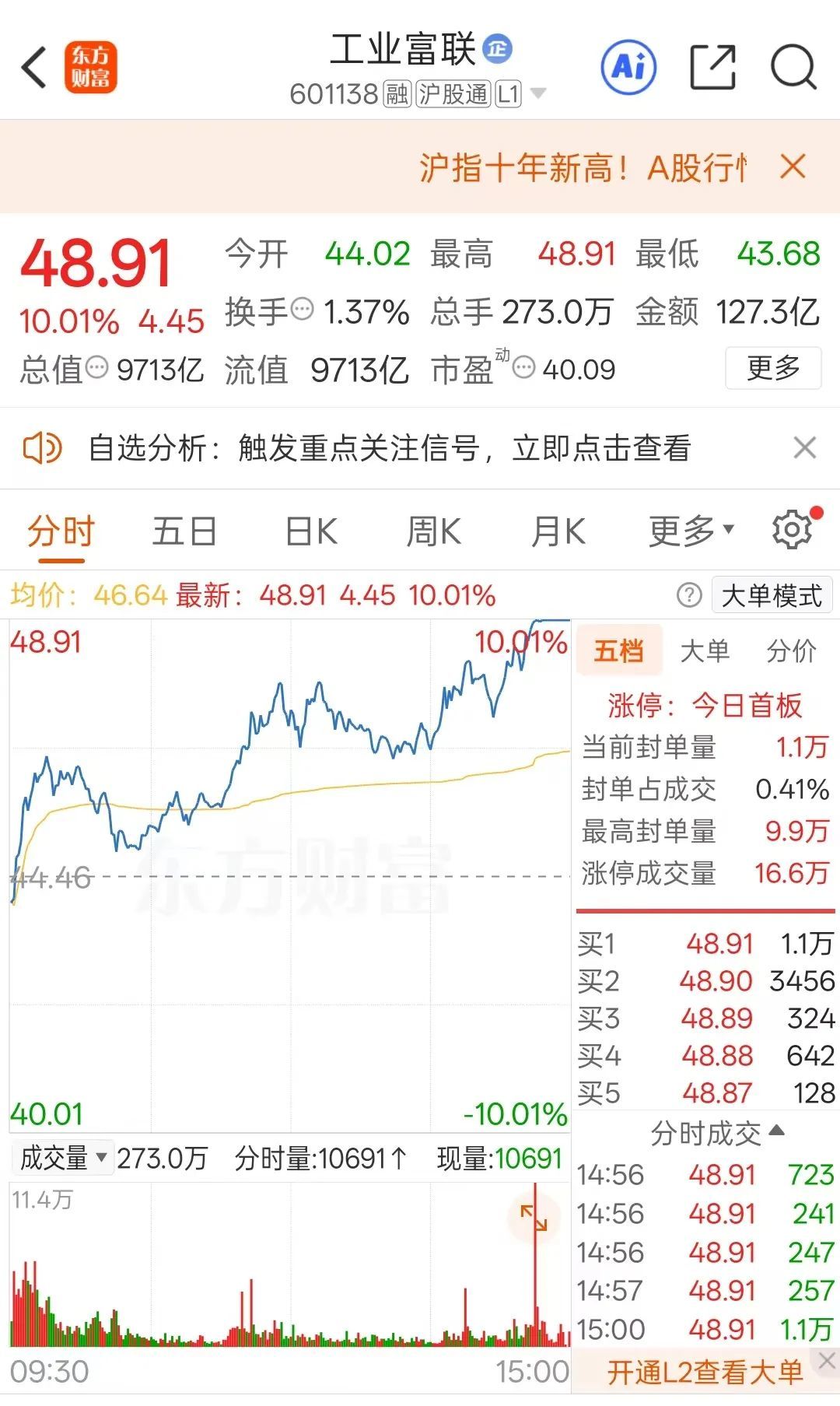
Market Performance - On August 19, A-shares experienced a slight decline, with the Shanghai Composite Index down 0.02%, Shenzhen Component Index down 0.12%, and ChiNext Index down 0.17% [1] - Nearly 3,000 stocks rose while over 2,200 stocks fell, indicating active stock performance in the market [1] Robotics Sector Surge - The robotics sector saw a collective surge in stock prices, with over 30 related stocks, including DiAo Micro, YiAn Technology, TianRun Industry, Top Group, and Lingyi ZhiZao, hitting the daily limit or rising over 10% [1][3] - Industrial Fulian also experienced a significant increase, closing at the daily limit with a total market value approaching 1 trillion yuan [1][3] Collaboration and Innovations - The rise in the robotics sector was primarily driven by news of a collaboration between Nvidia and Hon Hai, which will unveil a humanoid robot in November [1][6] - Hon Hai is also set to introduce humanoid robots in its new factory in Houston, expected to be operational in Q1 2024, focusing on AI server production [6] Policy Support for Robotics Industry - Shanghai has introduced a new policy to accelerate the deployment of humanoid robots in various industries, aiming to enhance production efficiency and safety [6][8] - Various cities, including Hangzhou and Beijing, have released supportive policies for the robotics industry, focusing on technological breakthroughs and the establishment of a robust industrial ecosystem [8][9] Future Outlook - The robotics industry is expected to maintain high momentum, with upcoming events such as the Zhiyuan Robotics Partner Conference and the release of the Optimus third-generation robot serving as potential catalysts for growth [10]



彩讯股份:暂未与智元机器人达成合作
Jin Rong Jie· 2025-08-15 01:32
Core Viewpoint - The company has not yet established a partnership with Zhiyuan Robotics, despite ongoing exploration of AI and robotics technology applications [1] Group 1 - The company received an inquiry from investors regarding a reported joint venture with Zhiyuan Robotics and a procurement order worth 15 million yuan focused on multi-modal interaction systems for entertainment and sports scenarios [1] - The company confirmed that it is continuously monitoring and exploring innovative applications of AI and robotics technology [1] - The company maintains an open attitude towards embracing intelligent ecosystems and does not rule out future collaborations in AI applications with industry partners [1]

“一个机器人能顶3名工人,充电两小时就能巡检两小时”
财联社· 2025-07-20 16:10
Core Viewpoint - The article highlights the digital transformation in manufacturing within Henan province, focusing on the adoption of robotics and digital technologies to enhance safety and operational efficiency in high-risk environments [2][12]. Group 1: Digital Transformation in Manufacturing - Companies like Liyuan Group, Mengdian Cement, and Sinian Food are implementing digital and intelligent technologies to improve safety and efficiency, particularly in hazardous operations [2][12]. - Liyuan Group has established a 5G dispatch center that integrates real-time production data and a digital twin system for better management and monitoring [3][5]. Group 2: Robotics and Automation - Liyuan Group has deployed inspection robots that can replace three workers, with a charging and inspection cycle of two hours each [6][13]. - Mengdian Cement has developed a digital control platform using digital twin technology to manage mining operations, including the use of unmanned excavators and transport systems [8][10]. Group 3: Safety and Efficiency Improvements - The implementation of smart technologies has led to a 15% increase in energy efficiency and a 20% improvement in labor productivity at Liyuan Group [5]. - Sinian Food has achieved a 30% increase in production efficiency and a 20% reduction in overall costs through automation in key food production processes [12]. Group 4: Employment Impact and Future Outlook - The rapid advancement of AI and robotics raises concerns about potential job displacement, with predictions that AI will create 11 million jobs while replacing 9 million by 2030 [12][14]. - Companies emphasize that current automation efforts are primarily focused on high-risk areas and are still in testing phases, indicating a cautious approach to widespread implementation [13][14].