CUDA生态

Search documents
AI芯片“淘金”热!燧原科技亏51亿拟募60亿
Xin Lang Cai Jing· 2026-01-28 09:27
Core Viewpoint - Baidu's Kunlun Chip has submitted an application for a Hong Kong IPO, while Alibaba is considering a spin-off IPO for Pingtouge [2][47]. Group 1: Company Overview - Shanghai Suiruan Technology Co., Ltd. (Suiruan Technology) has had its IPO application accepted on the Sci-Tech Innovation Board, aiming to raise 6 billion yuan [3][48]. - Suiruan Technology is the last of the "four domestic GPU leaders" to pursue an IPO, following the listings of Moer Thread, Muxi Co., and Biran Technology [3][48]. - The company focuses on cloud AI training and inference, with primary revenue derived from AI accelerator cards and modules, but faces challenges such as heavy R&D spending, ongoing losses, and reliance on a single major customer [3][48]. Group 2: Financial Performance - Over the past four years, Suiruan Technology has accumulated losses exceeding 5.1 billion yuan, with R&D expenditures consistently surpassing 160% of revenue [4][14]. - Revenue figures for Suiruan Technology from 2022 to the first three quarters of 2025 are 0.90 billion yuan, 3.01 billion yuan, 7.22 billion yuan, and 5.40 billion yuan, respectively, with net profits of -1.12 billion yuan, -1.67 billion yuan, -1.51 billion yuan, and -0.89 billion yuan [14][60]. - The company’s R&D investment totaled 4.42 billion yuan, accounting for nearly 270% of cumulative revenue of approximately 1.65 billion yuan [15][61]. Group 3: Market Position and Competition - The AI chip market is currently dominated by Nvidia, which holds a 70% market share, while Huawei's Ascend leads among domestic manufacturers with 64,000 units shipped [24][30]. - Domestic AI chip manufacturers are divided into two camps: the "revolutionary faction," which includes Suiruan Technology, and the "compatible faction," which aims to reduce customer migration costs by aligning with Nvidia's CUDA ecosystem [29][49]. - Suiruan Technology's main products include cloud AI chips, AI accelerator cards, and intelligent computing systems, which are designed to provide robust AI computing power [6][51]. Group 4: Customer Dependency - Suiruan Technology's revenue has significantly increased due to its relationship with Tencent, which has become its primary customer, accounting for 71.84% of revenue by the third quarter of 2025 [18][67]. - The company has seen its inventory grow year-on-year, with figures of 3.11 billion yuan, 2.61 billion yuan, 9.79 billion yuan, and 11.48 billion yuan at the end of each reporting period [22][68]. Group 5: Future Outlook - The company anticipates reaching a breakeven point by 2026, contingent on sales volume and product delivery progress [17][63]. - The ongoing IPO wave in the semiconductor industry includes 30 companies entering the A-share IPO process in 2025, with a total fundraising target of nearly 100 billion yuan [40][41].

从情绪迸发到价值审视 摩尔线程、沐曦股份已回调近40%
2 1 Shi Ji Jing Ji Bao Dao· 2026-01-05 05:42
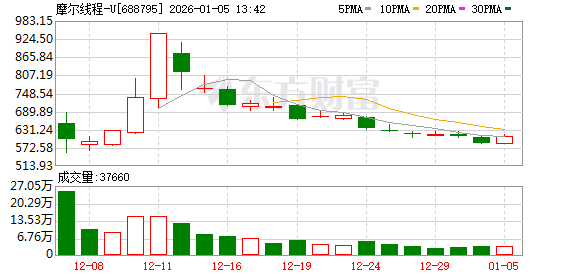
Group 1 - The core viewpoint of the article highlights the recent IPO frenzy among domestic GPU companies, with significant initial stock price surges followed by substantial market corrections, indicating a disconnect between high valuations and commercial realities [2][4][6] - The three notable companies, Moer Thread, Muxi Co., and Birran Technology, have all seen their stock prices soar upon listing, with Moer Thread's price increasing by over 468% on its debut, while Muxi Co. achieved a peak market value exceeding 300 billion yuan [4][5] - Despite the initial excitement, all three companies have experienced significant stock price declines, with Moer Thread and Muxi Co. seeing reductions of approximately 37% and 35% from their peak values, respectively [6][9] Group 2 - The article discusses the high capital expenditures associated with the GPU industry, noting that all three companies have reported substantial losses alongside significant R&D investments, with Moer Thread's cumulative losses reaching around 5 billion yuan from 2022 to 2024 [7][8] - The market share of domestic GPU companies remains low compared to international competitors, with Nvidia holding a dominant position in both domestic and global markets, capturing over 54.4% of the domestic AI chip market [9][10] - The article emphasizes the importance of ecosystem compatibility, with domestic companies striving to create alternatives to Nvidia's CUDA ecosystem, which poses a significant challenge for their long-term survival and growth [10]
摩尔线程、沐曦股份已回调近40%
21世纪经济报道· 2026-01-05 05:26
Core Viewpoint - The recent IPO frenzy among domestic GPU companies has led to significant initial stock price surges, but these stocks have since experienced substantial declines, highlighting the gap between high market expectations and the companies' current financial realities [1][2][4]. Group 1: IPO Performance - On January 2, 2025, Birran Technology (6082.HK) saw its stock price rise nearly 120% on its debut, becoming the "first domestic GPU stock" in Hong Kong [1]. - Moer Technology (688795.SH), dubbed the "first domestic GPU stock," experienced a stock price increase of over 400% on its first day, closing at over 900 CNY per share, significantly above its issue price of 114.28 CNY [1][4]. - Muxi Co., Ltd. (688802.SH) had a debut on December 17, 2025, with a maximum profit of nearly 400,000 CNY for investors on its first day, setting a record for A-share IPOs in the past decade [1]. Group 2: Market Valuation and Adjustments - Following their initial surges, Moer Technology and Muxi Co. have seen their stock prices decline by approximately 37% and 35%, respectively, from their peak values [1][5]. - Birran Technology's stock closed with a gain of less than 80% on its first day, with a total market capitalization of less than 100 billion HKD, only about one-third of Moer and Muxi's market values [1][8]. Group 3: Financial Performance and Challenges - All three companies have shown revenue growth over the past three years but have yet to achieve profitability, with high R&D expenditures continuing [1][10]. - Moer Technology reported cumulative losses of approximately 5 billion CNY from 2022 to 2024, with total R&D investments of 3.81 billion CNY and total revenue of only about 600 million CNY [10]. - Muxi Co. indicated cumulative losses of 3.29 billion CNY during the same period, with R&D investments totaling 2.466 billion CNY, far exceeding total revenue of 1.116 billion CNY [10]. Group 4: Market Position and Competition - The market share of domestic GPUs remains low compared to global competitors, with Nvidia holding a dominant position [12]. - In the domestic AI chip market, Nvidia, Huawei, and AMD hold 54.4%, 21.4%, and 15.3% market shares, respectively, indicating a significant competitive gap for domestic firms [12]. - The industry is characterized by a high concentration of market share among leading players, with the top two participants accounting for 94.4% of the market revenue in China [12]. Group 5: Ecosystem and Future Prospects - The success of GPU companies is heavily reliant on building a compatible ecosystem, with Nvidia's CUDA ecosystem being a significant barrier for domestic firms [13]. - Domestic companies are attempting to create their ecosystems, such as Moer Technology's MUSA architecture, but face challenges in breaking Nvidia's dominance [13]. - The market's initial enthusiasm for these companies reflects strong future demand expectations, but the companies must navigate the pressures of short-term speculation and long-term development potential [13].

从情绪到价值 5000亿国产GPU叙事转折
2 1 Shi Ji Jing Ji Bao Dao· 2026-01-04 11:21
Group 1 - The core viewpoint of the article highlights the recent IPO frenzy among domestic GPU companies, with significant initial stock price surges followed by substantial market corrections [2][6][12] - The first day of trading for domestic GPU companies saw remarkable gains, with Moer Thread's stock price increasing over four times its issue price, and Muxi's stock price reaching a peak of nearly 900 CNY per share [4][10] - Despite initial excitement, the market capitalization of these companies has significantly declined, with Moer Thread and Muxi experiencing a drop of nearly 40% from their peak prices [6][14] Group 2 - The article discusses the challenges faced by these GPU companies, including high R&D costs and the inability to achieve profitability despite revenue growth over the past three years [7][16] - The competitive landscape shows that domestic GPU companies have a low market share compared to international giants like NVIDIA and AMD, which dominate the market [18][19] - The article emphasizes the importance of building a robust ecosystem, as NVIDIA's CUDA ecosystem presents a significant barrier for domestic companies trying to establish their own competitive technologies [19]
深圳理工大学唐志敏:异构计算已成必然,软件决定芯片胜负丨GAIR 2025
雷峰网· 2025-12-24 03:19
Core Viewpoint - RISC-V has the potential to integrate the characteristics of CPU, GPU, and AI processors, breaking through the ecological barriers of CUDA [47] Group 1: AI and Computing Power - The eighth GAIR Global AI and Robotics Conference will be held in Shenzhen, focusing on the core of intelligent systems—computing power [2] - Computing power is not just a reflection of hardware performance but a capability system to complete tasks under resource and time constraints [3] - The rapid growth of generative AI's demand for computing power necessitates heterogeneous computing (CPU + XPU) as CPUs alone cannot meet real-world needs [11][16] Group 2: Software and Ecosystem - The true determinant of computing power release is the software and application ecosystem, rather than the hardware itself [20] - The ecosystem includes all software that runs on processors, and the productivity is generated by application software, not the chips [24] - The x86 ecosystem has a significant market share and inertia, making it challenging for new architectures to compete [26] Group 3: RISC-V and Market Challenges - RISC-V's openness presents new possibilities, but openness does not guarantee success; many open CPUs have failed commercially [27][28] - RISC-V faces commercialization difficulties, particularly in complex computing fields, due to an immature software ecosystem [29] - The need for a robust software ecosystem is critical for RISC-V to succeed in the competitive landscape [20][29] Group 4: Future Directions - The future of computing architecture may return to a CPU-centric model, with RISC-V having the potential to unify CPU, GPU, and AI processor characteristics [47] - The importance of building a domestic computing ecosystem is recognized at the national level to avoid dependency on foreign technologies [33] - Successful chip development hinges on the ability to create a comprehensive software ecosystem that adds significant value to products and services [34][45]

英伟达真正的对手是谁
Jing Ji Guan Cha Wang· 2025-12-22 07:48
Core Insights - AI computing power is the most critical infrastructure and development engine for artificial intelligence, with NVIDIA establishing a near-monopoly in the AI training and inference chip market, becoming the highest-valued public company globally, with a market capitalization of approximately $4.5 trillion by November 2025 and a year-on-year revenue growth of about 62% in Q3 2025 [2] Competitive Landscape - NVIDIA faces challengers from traditional chip giants like AMD and Intel in the U.S., as well as self-developed computing power from tech giants like Google and Amazon, and emerging players like Cerebras and Groq, but none have significantly threatened NVIDIA's leadership position yet [2] - The AI computing chip market has two main application scenarios: training and inference, with training being the core bottleneck that determines the model's capabilities [3] Training Power Dominance - NVIDIA holds a dominant position in training power due to advanced technology and a monopolistic ecosystem, as training large models requires massive data computation that single-chip power cannot provide [5] - The requirements for training chips can be broken down into single-chip performance, interconnect capabilities, and software ecosystem [6] Technical Advantages - NVIDIA excels in single-chip performance, with competitors like AMD catching up in key performance metrics, but this alone does not threaten NVIDIA's lead in AI training [7] - Interconnect capabilities are crucial for large model training, and NVIDIA's proprietary technologies like NVLink and NVSwitch enable efficient interconnectivity at a scale of tens of thousands of chips, while competitors are limited to smaller clusters [8] Ecosystem Strength - NVIDIA's ecosystem advantage is primarily software-based, with CUDA being a well-established platform that enhances developer engagement and retention [8] - The strong network effect of NVIDIA's ecosystem makes it difficult for competitors to challenge its dominance, as many AI researchers and developers are already familiar with CUDA [9][10] Inference Market Dynamics - Inference requires significantly fewer chips than training, leading to reduced interconnect demands, which diminishes NVIDIA's ecosystem advantage in this area [11] - Despite this, NVIDIA still holds over 70% of the inference market share due to its competitive performance, pricing, and overall value proposition [11] Challenges to NVIDIA - Competitors must overcome both technical and ecosystem barriers to challenge NVIDIA, with options including significant technological advancements or creating protective market conditions [13] - In the U.S., challengers are primarily focused on technological advancements, such as Google's TPU, while in China, the market has become "protected" due to U.S. export bans on advanced chips [16] Geopolitical Implications - The U.S. government's restrictions on NVIDIA's chip sales to China have created a challenging environment for Chinese AI firms, but also present significant opportunities for domestic chip manufacturers [17] - The recent shift in U.S. policy allowing NVIDIA to sell advanced H200 chips to China under specific conditions indicates a recognition of the need to maintain NVIDIA's competitive edge while managing geopolitical tensions [19] Strategic Considerations - The competition in AI technology should not solely focus on domestic replacement strategies, as this could lead to a cycle of technological isolation [20] - Huawei's decision to open-source its CANN and Mind toolchain reflects a strategic move to build a competitive ecosystem that can attract global developer participation [21]

全球芯片业巨震,谷歌TPU芯片横空杀出,与Meta“密谋”大事,英伟达市值蒸发4万亿元,“护城河”被攻破?黄仁勋坐不住了
3 6 Ke· 2025-12-01 01:37
Core Insights - In November 2025, Google's market value increased by approximately $530 billion, while Nvidia's market value decreased by $620 billion, indicating a significant shift in the AI chip market dynamics [1][3][6] - Meta is reportedly in discussions with Google to purchase TPU chips, which could threaten Nvidia's dominance in the GPU market, where it currently holds about 85% market share [1][6][30] - The competition between TPU and GPU represents a technological divergence, with TPUs offering 2-3 times the energy efficiency compared to GPUs, particularly in AI workloads [1][11][25] Market Reactions - Google's stock rose by 13.87% in November, extending its year-to-date gain to 69%, while Nvidia's stock fell by nearly 12.59%, reducing its year-to-date gain to 27.96% [3][6] - The market reacted strongly to the news of Meta's potential shift, causing stock prices of Google's TPU manufacturing partners, such as Broadcom, to rise over 16% [6][30] Technological Developments - Google's TPU has undergone significant advancements over seven generations, with the latest Ironwood model expected to deliver 4 times the performance of its predecessors [10][11] - The TPU's design is specifically optimized for AI workloads, making it particularly effective for large language models and complex deep learning tasks [11][25] Competitive Landscape - Analysts are divided into two camps: the "win-win" camp believes the AI infrastructure market can support multiple players, while the "threat" camp sees Google's vertical integration as a significant challenge to Nvidia's market position [26][29] - Nvidia's CUDA platform is viewed as a strong barrier to entry, but Google's advancements in TPU technology and potential partnerships may pose a long-term threat to Nvidia's dominance [30][31] Future Outlook - Predictions suggest that the AI data center market could grow from $242 billion to $1.2 trillion by the end of the decade, with Nvidia's market share potentially decreasing from 85% to 75% [27][29] - The potential collaboration between Google and Meta could mark a significant shift in the AI chip market, positioning TPU as a viable alternative to Nvidia's offerings [30][31]


沐曦股份IPO上会:高性能GPU光环下的三大隐忧
Sou Hu Cai Jing· 2025-10-23 09:22
Core Insights - Muxi Co., Ltd. is facing significant challenges as it prepares for its IPO on the STAR Market, highlighted by a cumulative loss of 3.29 billion yuan over three years and a reliance on a single product for over 97% of its revenue [1][2]. Financial Performance - The company has exhibited a "high investment, high loss" financial profile, with cumulative losses reaching 3.29 billion yuan from 2022 to Q1 2025, peaking at 1.409 billion yuan in 2024 [2]. - Revenue surged from 426,400 yuan in 2022 to 743 million yuan in 2024, yet this revenue only accounted for 53% of the losses incurred during the same period [2]. - Operating cash flow has been persistently negative, with a total outflow of 4.51 billion yuan from 2022 to Q1 2025, including a single-year outflow of 2.148 billion yuan in 2024 [2]. Product Dependency and Pricing Power - Muxi's revenue structure is heavily dependent on the Xiyun C500 series, which constituted 97.87% of total revenue in Q1 2025, a sharp increase from 30.09% in 2023 [3]. - The average selling price of the GPU boards has declined from 56,900 yuan to 38,900 yuan from 2023 to Q1 2025, representing a 31.6% drop, indicating a lack of pricing power in a competitive market [3]. - The company faces significant product iteration pressures, with new chip designs taking 2-3 years to develop, while AI model technologies evolve every 3-6 months [3]. Competitive Landscape - Muxi operates in a highly competitive environment dominated by NVIDIA, which held a 70% market share in China's AI chip market in 2024 [4]. - Despite U.S. export controls creating opportunities for domestic GPU manufacturers, NVIDIA's tailored H20 chip for the Chinese market poses a threat to local firms [4]. - Domestic competition is fierce, with Muxi competing against other local players like Haiguang Information and Moore Threads, all vying for a limited market share [4]. Customer Concentration and Technology Sources - The company has a high customer concentration, with the top five customers accounting for 88.35% of sales in Q1 2025, raising concerns about revenue independence [5]. - The core technology team includes members with backgrounds at AMD, a direct competitor, which could pose potential risks in terms of intellectual property disputes [5]. Industry Challenges and Muxi's Path Forward - Muxi's struggles reflect broader challenges faced by domestic GPU companies, including how to achieve a commercial breakthrough amid technological lag and weak ecosystems [6]. - The company plans to leverage CUDA compatibility to reduce user migration costs, but building a robust software ecosystem is a long-term endeavor [6]. - The upcoming IPO aims to raise 3.9 billion yuan primarily for new chip development, but the high failure rate in chip R&D raises questions about the effectiveness of these investments [6].