GLP - 1类药物

Search documents
速递|一个月打一针,石药冲进减重深水区:SYH2082中美双获批临床
GLP1减重宝典· 2026-03-22 15:16
Core Viewpoint - The article highlights the approval of SYH2082, a GLP-1/GIP receptor dual agonist developed by Shiyao Group, for clinical trials in China, marking a significant step in the competitive weight loss drug market, emphasizing a shift from a follow-up strategy to a focus on differentiated mechanisms and administration convenience [4]. Group 1 - SYH2082 is not just an ordinary dual agonist but a biased dual agonist that selectively activates the cAMP pathway while reducing β-arrestin recruitment, aiming to enhance efficacy and prolong action time [5]. - The design of SYH2082 allows for monthly administration, contrasting with the more common weekly formulations in the market, indicating a shift in competition towards better adherence and stability in weight management [5]. - The approved indication for SYH2082 in China targets obesity or overweight individuals with at least one weight-related comorbidity, and it also shows potential for improving blood glucose control in type 2 diabetes patients, expanding its market potential beyond just weight loss [7]. Group 2 - While the current data on SYH2082's efficacy and tolerability mainly comes from preclinical and toxicological studies, it is still seen as a potential candidate rather than a mature product ready for market [8]. - The simultaneous approval for clinical trials in both China and the U.S. signals a clear market trend where the focus is shifting towards next-generation products that offer longer-lasting effects, convenience, and better tolerability [8].

全球药王易主
21世纪经济报道· 2026-03-10 11:24
Core Viewpoint - The global pharmaceutical industry is experiencing a new competitive landscape as multinational companies release their 2025 performance reports, with Johnson & Johnson leading in total revenue at $94.193 billion, followed by Eli Lilly with a remarkable growth rate of 44% [1][2]. Group 1: Financial Performance of Major Pharmaceutical Companies - Johnson & Johnson achieved total revenue of $94.193 billion, with its innovative pharmaceuticals and medical technology segments generating $60.401 billion (+6%) and $33.792 billion (+6.1%) respectively [2]. - Eli Lilly reported a total revenue of $65.179 billion, marking a significant growth of 44% [2]. - Roche, Merck, Pfizer, AbbVie, AstraZeneca, and Novartis also showed upward revenue trends, contributing to the steady growth of the global pharmaceutical industry [1][2]. Group 2: Strategic Adjustments and Leadership Changes - Sanofi appointed Belén Garijo as the new CEO, focusing on enhancing the productivity and innovation capabilities of the R&D department [3]. - Merck announced a reorganization of its pharmaceutical business into two segments: oncology and specialty, aiming to maintain its leadership in cancer treatment [3]. - The global pharmaceutical industry is expected to see continued growth differentiation, with only Eli Lilly providing a double-digit revenue growth forecast for 2026 [3]. Group 3: Competition for the "King of Drugs" Title - In 2025, Eli Lilly's Tirzepatide secured the title of "King of Drugs" with a revenue contribution of $36.5 billion, while Merck's Keytruda generated $31.68 billion, marking a 7% increase [6][7]. - Novo Nordisk's Semaglutide followed closely with $36.1 billion in sales, reflecting over 10% growth [7]. - The GLP-1 drug market is becoming increasingly competitive, with both Eli Lilly and Novo Nordisk dominating the landscape [8]. Group 4: Performance in the Chinese Market - AstraZeneca maintained its leading position in the Chinese market with a revenue of $6.654 billion, representing a 4% increase [12]. - Roche and Novartis were among the top three companies in terms of revenue growth in China, with Roche achieving a 10% increase [13]. - Companies are increasingly focusing on local partnerships and innovations to enhance their market presence in China [14]. Group 5: Patent Expiration and New Growth Opportunities - Many multinational pharmaceutical companies are facing significant risks due to impending patent expirations, with some companies exposed to risks as high as 70% [16]. - The industry is witnessing a surge in business development activities, with 142 innovative drug transactions reported in 2025, marking a new high [17]. - Companies are increasingly seeking new growth avenues through mergers, acquisitions, and collaborations to mitigate the impact of patent cliffs [19].





医药行业周报:医药供给端变量增加-20260301
Huaxin Securities· 2026-03-01 14:04
Investment Rating - The report maintains a "Recommended" investment rating for the pharmaceutical industry as of March 1, 2026 [1] Core Insights - The supply-side variables in the pharmaceutical industry are increasing, leading to an expansion in price adjustments. The raw material drug industry is particularly sensitive to these changes, with the penicillin supply chain already experiencing price rebounds. For instance, the import price limit for 6-APA has been set at approximately 260 RMB/kg, prompting domestic companies to raise their prices [2] - The GLP-1 oral medication era is actively beginning, with Chinese companies continuing to explore international markets. Notably, Eli Lilly's sales of its GLP-1 drug reached 36.5 billion USD in 2025, and the oral version of semaglutide has been launched in the U.S. market, showing strong initial prescription numbers [3] - The small nucleic acid field is witnessing ongoing collaborations and authorizations, with significant mergers and acquisitions occurring in 2026. For example, China National Pharmaceutical Group is acquiring a domestic siRNA innovator for 1.2 billion RMB [4] - The retail pharmaceutical market showed positive trends in Q4 2025, with a retail scale of 58.8 billion RMB, although the annual growth rate remained slightly negative at -0.57% [5] - The report emphasizes the market value of oral autoimmune drugs, highlighting Takeda's new oral TYK2 inhibitor showing promising results in clinical trials for psoriasis [6] Summary by Sections 1. Pharmaceutical Market Tracking - The pharmaceutical industry index underperformed the CSI 300 index by 0.58 percentage points in the last week, ranking 25th among 31 sectors [19] - Over the past month, the pharmaceutical industry index fell by 2.67%, also underperforming the CSI 300 index by 2.77 percentage points, ranking 28th [22] 2. Pharmaceutical Sector Trends and Valuation - The current PE (TTM) for the pharmaceutical industry index is 37.20, which is below the five-year historical average of 30.78 [40] 3. Recent Research Achievements - The report includes various deep-dive studies on topics such as the growth of biological agents and oral medications, indicating a positive outlook for psoriasis treatment [42] 4. Important Industry Policies and News - Recent policies include the approval of 292 medical device products by the National Medical Products Administration, indicating regulatory support for the industry [44] - Significant news includes Eli Lilly's positive clinical trial results for its drug, which may enhance its market position [46]
医药风云录:减肥“药王”炼成记
3 6 Ke· 2026-02-26 07:59
Core Insights - In 2025, Tirzepatide from Eli Lilly became the global sales champion with a revenue of $36.507 billion, surpassing Novo Nordisk's Semaglutide, which achieved $36.1 billion in sales, marking a significant shift in the pharmaceutical landscape [1][2] - The rise of GLP-1 receptor agonists, particularly Tirzepatide and Semaglutide, signifies a new era in the treatment of metabolic diseases, especially type 2 diabetes and obesity, which affect millions globally [1][2] - Tirzepatide's rapid ascent to the top, from approval in 2022 to becoming the best-selling drug in less than four years, highlights an unprecedented acceleration in the pharmaceutical industry [1][2] GLP-1 Class Drug Evolution - The GLP-1 class of drugs has evolved from being a novel diabetes treatment to a key player in weight management, with significant market potential driven by the booming weight loss market [3][4] - GLP-1 drugs initially focused on glucose regulation but have been found to aid in weight loss, leading to a surge in research and development for dual-action medications [4][5] - The development of GLP-1 drugs has transitioned from single-target to multi-target approaches, with Tirzepatide exemplifying this trend as a dual agonist for GLP-1 and GIP [5][6] Competitive Landscape - Semaglutide, while a pioneer in the GLP-1 weight loss market, faced challenges in maintaining its position against Tirzepatide, which leverages a dual-target mechanism for enhanced efficacy [6][7] - The competition between Tirzepatide and Semaglutide illustrates the dynamic nature of the pharmaceutical market, where innovation and timing are crucial for success [6][7] - The historical context of previous "blockbuster" drugs, such as Humira and the COVID-19 vaccine Comirnaty, underscores the competitive landscape and the rapid changes in drug rankings [2][3] Scientific Breakthroughs - The unique mechanism of GLP-1, which operates in a glucose-dependent manner, minimizes the risk of hypoglycemia, making it a preferred choice for diabetes management [3][4] - The discovery of GIP's role in enhancing the effects of GLP-1 has led to the development of Tirzepatide, which combines the benefits of both hormones for improved patient outcomes [7][8] - The journey of Tirzepatide reflects the challenges and breakthroughs in drug development, emphasizing the importance of persistence and innovation in the pharmaceutical industry [9][10]

这家减重药公司股价大涨
Di Yi Cai Jing Zi Xun· 2026-02-25 07:53
Group 1 - Federal Pharmaceutical's stock price surged over 7% following the announcement of mid-term clinical trial data for its new weight loss drug UBT251, which showed an average weight loss of 19.7% in the treatment group compared to 2% in the placebo group after 24 weeks of treatment [2] - Novo Nordisk entered a licensing agreement with Federal Pharmaceutical for UBT251 in March last year, with an upfront payment of $200 million and a potential total deal value of up to $2 billion [2] - UBT251 targets GLP-1/GIP/GCG triple receptors and is expected to outperform Eli Lilly's dual-target GLP-1 weight loss drug [2] Group 2 - Novo Nordisk has initiated a global trial involving approximately 330 overweight or obese patients using different doses of UBT251, with results expected in 2027, and plans to start a trial for type 2 diabetes patients [3] - In a competitive landscape for weight loss drugs, multinational pharmaceutical companies are increasingly focusing on Chinese weight loss drug assets, as evidenced by recent strategic collaborations, including one between Senwa Bio and Pfizer China, with a total deal value of up to nearly $500 million [3] - Pfizer also secured a licensing agreement with a subsidiary of Fosun Pharma for a GLP-1 receptor agonist, with a total deal value exceeding $2 billion [3] Group 3 - In July last year, CSPC Pharmaceutical licensed an oral small molecule GLP-1 receptor agonist to Madrigal Pharmaceuticals for $2.075 billion, and earlier this year, it licensed another dual-target weight loss injection to AstraZeneca [4] - Domestic pharmaceutical companies, including HengRui Medicine, Hansoh Pharmaceutical, and Chengyi Biotechnology, have successfully expanded internationally through licensing their GLP-1 drugs [4] - The value of Chinese innovative drugs is being reassessed by multinational pharmaceutical companies, with next-generation weight loss drugs seen as a significant strategic focus due to their vast market potential [4] Group 4 - Goldman Sachs projected that the global market for GLP-1 drugs could reach $95 billion by 2030 and potentially expand to $120 billion by 2035 [4]

减重药公司联邦制药股价大涨,跨国巨头纷纷入局中国减重药资产
Di Yi Cai Jing· 2026-02-25 06:50
Core Viewpoint - The competition in the weight loss drug market is intensifying, prompting multinational pharmaceutical companies to focus on weight loss drug assets in China [1][5]. Group 1: UBT251 Clinical Trial Results - Federal Pharmaceuticals' stock surged over 7% following the announcement of mid-term clinical trial data for its new generation triple-target weight loss drug UBT251, which showed an average weight loss of 19.7% in the treatment group after 24 weeks, compared to only 2% in the placebo group [1][4]. - An endocrinology expert commented that the trial results are "very good," highlighting the potential of new generation weight loss drugs developed in China [4]. Group 2: Strategic Partnerships and Market Potential - In March of last year, Novo Nordisk entered into a licensing agreement with Federal Pharmaceuticals for UBT251, with an upfront payment of $200 million and a potential total deal value of up to $2 billion [4]. - The global market for GLP-1 drugs is projected to reach $95 billion by 2030 and could expand to $120 billion by 2035, according to a report from Goldman Sachs [5]. Group 3: Other Collaborations in the Market - On February 24, Chinese weight loss drug developer Xianweida Biotech announced a strategic partnership with Pfizer China, granting Pfizer exclusive commercialization rights for its core GLP-1 product, with a total deal value potentially reaching nearly $500 million [2][5]. - In December, Pfizer also secured a licensing agreement with a subsidiary of Fosun Pharma for a global exclusive right to an oral small molecule GLP-1 receptor agonist, with a deal value exceeding $2 billion [5].
减重药公司股价大涨,跨国巨头纷纷入局中国减重药资产
Di Yi Cai Jing· 2026-02-25 06:42
Core Viewpoint - The competition in the weight loss drug market is intensifying, prompting multinational pharmaceutical companies to focus on weight loss drug assets in China [1]. Group 1: Company Developments - On February 25, after the opening of the Asia-Pacific stock market, the stock price of United Pharmaceuticals (3933.HK) surged, with an increase of over 7% in the afternoon following the announcement of mid-term clinical trial data for its new generation triple-target weight loss drug UBT251, which showed an average weight loss of 19.7% in the treatment group after 24 weeks compared to only 2% in the placebo group [2]. - Novo Nordisk entered into a licensing agreement with United Pharmaceuticals for UBT251 in March last year, with an upfront payment of $200 million and a potential total deal value of up to $2 billion [2]. - Novo Nordisk recently initiated a global trial involving approximately 330 overweight or obese patients using different doses of UBT251, with results expected in 2027, and plans to start a trial for type 2 diabetes patients [2]. Group 2: Industry Trends - On February 24, Chinese weight loss drug developer Senwa Biopharma announced a strategic partnership with Pfizer China, granting Pfizer exclusive commercialization rights for its core GLP-1 product, Enoglutide injection, in mainland China, with a total deal value of up to nearly $500 million [3]. - In December last year, Pfizer also reached a licensing agreement with a subsidiary of Fosun Pharma for a global exclusive right to an oral small molecule GLP-1 receptor agonist, with a deal value exceeding $2 billion [3]. - The global market for GLP-1 drugs is projected to reach $95 billion by 2030 and potentially expand to $120 billion by 2035, according to a report from Goldman Sachs [3].
减肥药赛道再现天价合作:先为达4.95亿美元牵手辉瑞中国
Guan Cha Zhe Wang· 2026-02-24 12:00
Core Viewpoint - The collaboration between Xianweida Biopharmaceutical and Pfizer China for the exclusive commercialization rights of the GLP-1 product, Enoglutide, in mainland China is a strategic move to address Xianweida's cash flow issues while providing Pfizer with a necessary product in a competitive market [1][9]. Financial Situation - As of June 30, 2025, Xianweida's cash on hand is only 780 million RMB, while its redeemable ordinary shares liability stands at 2.923 billion RMB [6][9]. - The company has reported significant losses, with cumulative losses exceeding 1.4 billion RMB since its inception, and it has not generated revenue until the first half of 2025 [4][6]. - The financial costs are increasing, with 2023 financial costs at 179 million RMB, rising to 191 million RMB in 2024, and reaching 122 million RMB in the first half of 2025 [6]. Product and Market Dynamics - Enoglutide has shown promising clinical data, with an average weight reduction of 15.1% in participants and 92.8% achieving clinically significant weight loss [7][9]. - The GLP-1 market is expected to become increasingly competitive, with predictions of up to 16 new GLP-1 weight loss products entering the market by 2029, intensifying price competition [2][11]. - Pfizer's involvement is expected to leverage its established hospital networks and marketing resources to enhance market penetration for Enoglutide [10][11]. Strategic Implications - The collaboration is seen as a critical step for Xianweida to secure liquidity and potentially pave the way for its IPO, with the total deal amounting to up to 495 million USD [1][9]. - However, the reliance on a single product, Enoglutide, poses a structural risk for Xianweida, as the company lacks a diversified pipeline to support its revenue in the long term [7][11]. - The impending expiration of the patent for Semaglutide in March 2026 is expected to trigger a wave of generic competition, which will challenge the pricing strategy and market positioning of Enoglutide [2][10].

产业焦点 | 又一跨国巨头抢滩中国减肥药市场,辉瑞要来打“价格战”?
Sou Hu Cai Jing· 2026-02-24 10:33
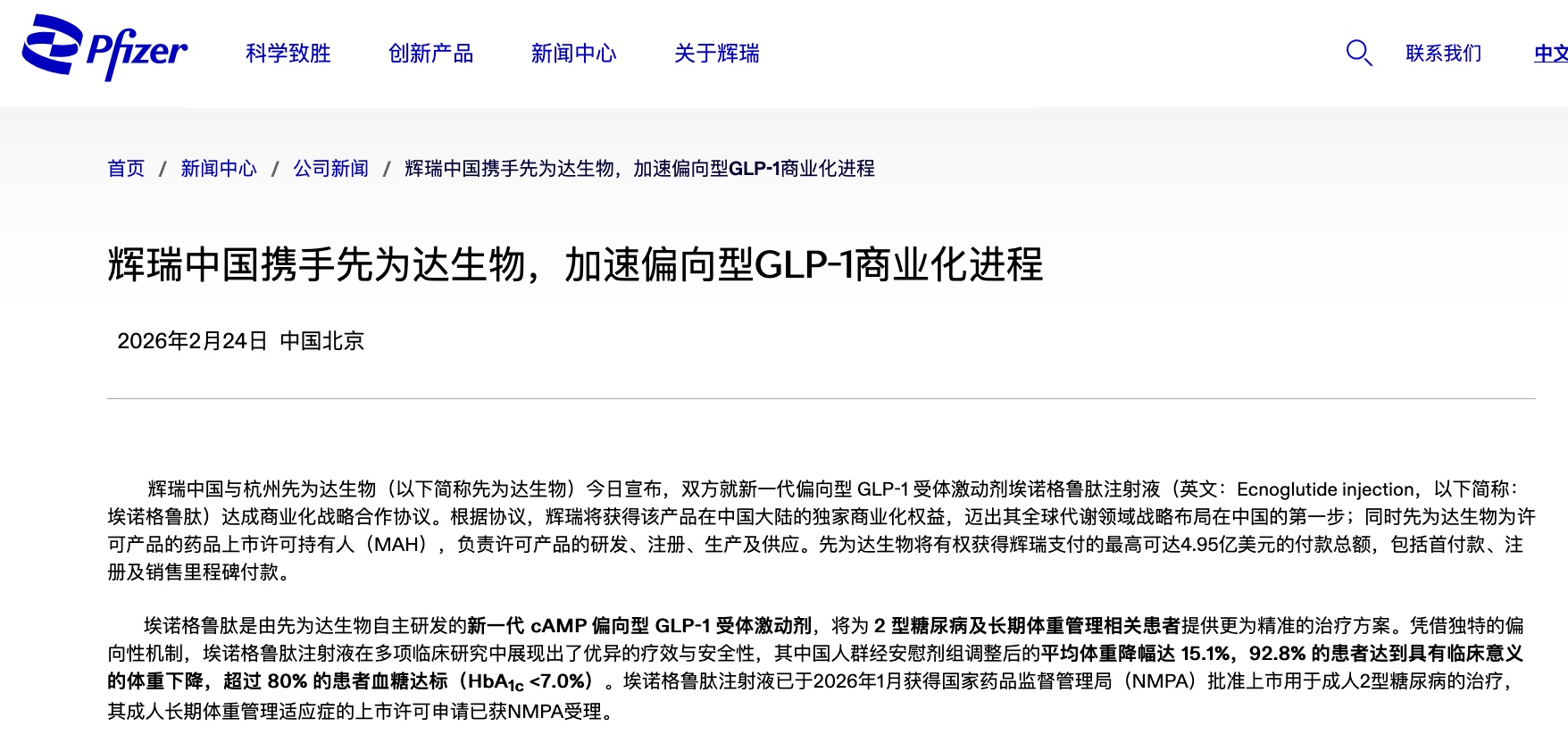
Core Insights - Pfizer China has secured exclusive commercialization rights for the GLP-1 receptor agonist, Enoglutide, in mainland China through a strategic partnership with Innovent Biologics, which will retain the drug's development, registration, production, and supply responsibilities [2][4] - The partnership is part of Pfizer's response to the rising obesity rates in China, which currently stands at 14.1% among adults, and aligns with the "Healthy China Action" initiative [4] - The GLP-1 drug market in China is becoming increasingly competitive, with multiple companies engaging in price wars, as seen with Novo Nordisk and Eli Lilly significantly reducing prices for their GLP-1 medications [4][5] Company and Industry Summary - Innovent Biologics will receive up to $495 million from Pfizer, which includes upfront payments and milestone payments related to registration and sales [2] - The approval of Enoglutide for diabetes management was granted in January, and its application for long-term weight management is currently under review by the Chinese regulatory authority [2] - The GLP-1 drug class is gaining traction in China, with only a penetration rate of less than 1%, compared to over 10% in the U.S. and 5% in the U.K., indicating significant growth potential in the market [5] - Pfizer's strategy includes diversifying its portfolio beyond COVID-19 products, as evidenced by its recent acquisitions and partnerships aimed at enhancing its presence in the obesity and oncology sectors [6]

中国减肥药市场增加新跨国巨头玩家,辉瑞也要加入“价格战”?
Di Yi Cai Jing· 2026-02-24 07:21
Core Insights - Pfizer has secured exclusive commercialization rights for the GLP-1 receptor agonist, Enogratide, in mainland China through a strategic partnership with Innovent Biologics [1][3] - The agreement allows Pfizer to pay up to $495 million, which includes upfront payments and milestone payments related to registration and sales [1] - The obesity rate among adults in China is currently 14.1%, highlighting the growing market potential for obesity treatments [3] Group 1: Market Dynamics - The Chinese obesity drug market is becoming increasingly competitive, with several multinational companies entering the space [1][3] - GLP-1 drugs are recognized as effective treatments for obesity, with six approved medications in China, five of which are GLP-1 based [3] - A price war has erupted among GLP-1 drugs, with significant price reductions from competitors like Novo Nordisk and Eli Lilly [3] Group 2: Strategic Moves - Innovent Biologics has opted to partner with Pfizer for the commercialization of Enogratide, leveraging Pfizer's strengths in market operations [5] - Pfizer is diversifying its business away from reliance on COVID-19 products, focusing on expanding its pipeline in obesity and oncology through external collaborations [5] - The penetration rate of GLP-1 drugs in China is currently below 1%, indicating substantial growth potential as market education efforts increase [5]