零售行业

Search documents
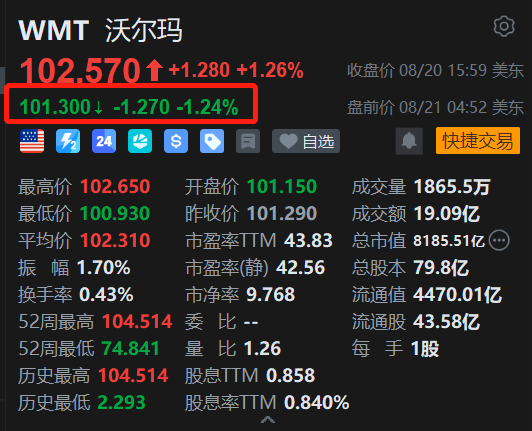
美股异动丨沃尔玛盘前跌1.25% 即将发布财报
Ge Long Hui· 2025-08-21 08:59
Group 1 - Walmart's stock fell 1.25% in pre-market trading ahead of its quarterly earnings report [1] - Analysts expect Walmart to report earnings per share of $0.74 and revenue of $176 billion [1] - The company previously indicated a projected net sales growth of 3.5% to 4.5% for the second fiscal quarter, but did not provide earnings guidance due to changing U.S. tariff policies [1] Group 2 - As of the last closing price, Walmart's stock was at $102.57, with a market capitalization of approximately $818.55 billion [1] - The stock's 52-week high and low are $104.514 and $74.841, respectively [1] - The price-to-earnings ratio is reported at 42.56, and the dividend yield is 0.840% [1]


这场会议将影响全球市场走向
Guo Ji Jin Rong Bao· 2025-08-20 09:52
Group 1 - The global financial community is focused on the Jackson Hole Economic Symposium, which will take place from August 21 to 23, with the theme "Labor Market Transformation: Demographics, Productivity, and Macroeconomic Policy" [1] - Federal Reserve Chairman Jerome Powell's speech on August 22 is highly anticipated, as it may provide insights into future monetary policy directions amid mixed economic signals [2][3] - The upcoming FOMC meeting on September 16-17 is expected to see an 85% probability of a 25 basis point rate cut, although recent data suggests a potential deterioration in the labor market [2][3] Group 2 - Analysts warn that Powell may not confirm a rate cut at the Jackson Hole meeting, and there are concerns he might adopt a more cautious tone, which could temper market expectations [3] - The Federal Reserve's framework for analyzing and responding to economic data is under review, with potential implications for how quickly it can respond to inflationary pressures [4][5] - The upcoming release of the July FOMC meeting minutes may provide further insights into internal policy discussions [7] Group 3 - Historical data indicates that the Jackson Hole meeting typically does not lead to significant market volatility, but recent market reactions suggest heightened sensitivity, particularly in the tech sector [8] - A hawkish stance from Powell could benefit financial institutions by widening net interest margins, while companies with strong balance sheets may also gain from higher interest income [8][9] - Conversely, a hawkish position could pose challenges for highly leveraged companies, particularly in capital-intensive sectors like real estate and utilities, which may face rising costs [9][10] Group 4 - A dovish stance from Powell could positively impact sectors such as real estate and consumer discretionary, as lower borrowing costs may stimulate market activity [9][10] - Utility stocks may become more attractive due to stable dividend yields compared to low-yield bonds, while highly leveraged companies could see improved cash flow from reduced interest expenses [10] - The broader economic outlook discussed at the symposium will also influence corporate performance, with a positive outlook supporting growth in cyclical sectors, while a negative outlook could lead to declines across various industries [11]
华润三九:8月14日召开董事会会议
Mei Ri Jing Ji Xin Wen· 2025-08-15 11:43
Group 1 - The core viewpoint of the article highlights that China Resources Sanjiu (华润三九) held its 10th board meeting for 2025 on August 14, where it reviewed the semi-annual report and related documents [1] - For the year 2024, the revenue composition of China Resources Sanjiu is as follows: 85.82% from the pharmaceutical industry, 12.21% from the retail industry, 1.92% from packaging and printing, and 0.04% from other sources [1] - As of the report, the market capitalization of China Resources Sanjiu is 52.1 billion yuan [1] Group 2 - The article also mentions Huakang Co., which is involved in an 11 billion yuan acquisition, raising concerns about the revenue contribution from a major client that has been in debt crisis for two years [1]

裕元集团(00551):制造业务收入和盈利均环比改善,零售业务受同店销售及费用影响仍承压
Changjiang Securities· 2025-08-15 02:16
Investment Rating - The investment rating for the company is "Buy" and it is maintained [6]. Core Views - The company achieved revenue of 4.06 billion USD in H1 2025, a year-on-year increase of 1.1%, with a net profit attributable to shareholders of 170 million USD, down 7.2% year-on-year [2][4]. - The manufacturing business reported revenue of 2.80 billion USD, up 6.2% year-on-year, and a net profit of 160 million USD, down 0.2% year-on-year. Conversely, the retail segment, represented by Bao Sheng International, saw revenue of 1.26 billion USD, down 8.6% year-on-year, and a net profit of 30 million USD, down 44.3% year-on-year [2][4]. - The company declared an interim dividend of 0.4 HKD per share, with a payout ratio of 48% [2][4]. Summary by Sections Manufacturing Business - The manufacturing segment showed robust growth with a Q2 revenue of 1.47 billion USD, up 6.5% year-on-year, and a net profit of 90 million USD, up 29.2% year-on-year. The output volume increased by 4.7% year-on-year, and the average selling price rose by 3.9% year-on-year [7]. - The capacity utilization rate improved to 95%, although there were regional disparities in capacity load and rising labor costs, leading to a slight decrease in gross margin [7]. Retail Business - The retail segment faced challenges with Bao Sheng International reporting a Q2 revenue decline of 11.1% year-on-year and a net profit drop of 69.2% year-on-year. The company closed 40 stores in H1 2025, with same-store sales declining significantly [7]. - Despite a slight improvement in discount rates, the increase in selling, general and administrative expenses led to a decrease in net profit margin [7]. Future Outlook - The manufacturing business is expected to benefit from the ramp-up of production capacity in Indonesia and new capacity in India, which may help address regional capacity imbalances [7]. - The retail business is under pressure in the short term, but a multi-channel operation and diversified brand strategy may drive future growth [7]. - The projected net profits for 2025-2027 are 360 million USD, 400 million USD, and 450 million USD, respectively, with corresponding P/E ratios of 8, 7, and 6 [9].
裕元集团(00551):2025H1业绩点评:Q2制造产能利用率环比进一步提升,零售业务承压
GUOTAI HAITONG SECURITIES· 2025-08-13 13:37
Investment Rating - The investment rating for the company is "Accumulate" [6] Core Views - The manufacturing business showed steady revenue growth in Q2, with an improved gross margin compared to Q1. However, visibility for orders in H2 is limited, although gross margins are expected to be better than H1. The retail business faced pressure in Q2 due to a competitive domestic promotional environment, and it is anticipated to continue facing challenges in H2 [2][10] Financial Summary - Total revenue for 2023 is projected at $7.89 billion, with a decrease of 12.0% year-on-year. Revenue is expected to grow by 3.7% in 2024, followed by a slight decline of 2.0% in 2025, and then recover with growth rates of 5.7% and 5.2% in 2026 and 2027 respectively [4] - Gross profit for 2023 is estimated at $1.93 billion, with a year-on-year decrease of 7.3%. The net profit attributable to the parent company is projected at $275 million for 2023, with a significant increase of 42.8% in 2024, followed by a decrease of 9.6% in 2025 [4] - The company maintains a PE ratio of 6.49 for 2023, which is expected to rise to 9.15 in 2024 before declining to 7.63 in 2025 [4] Manufacturing Business - In H1 2025, the manufacturing business generated revenue of $2.61 billion, reflecting an 8.3% year-on-year increase. The shipment volume reached 127 million pairs, up 5.0% year-on-year, with an average selling price (ASP) of $20.61, a 3.2% increase [10] - The gross margin for H1 2025 was 17.7%, down 1.4 percentage points year-on-year, primarily due to uneven capacity utilization across factories and rising costs from increased labor and wages [10] Retail Business - The retail business reported revenue of $1.26 billion in H1 2025, a decline of 8.6% year-on-year. The gross margin for H1 was 33.5%, down 0.7 percentage points year-on-year, mainly due to increased discounting in a competitive promotional environment [10] H2 Outlook - For H2, the manufacturing side's order visibility remains uncertain, but gross margins are expected to improve compared to H1. The retail side may continue to face pressure from domestic discount promotions, although the company remains confident in its leading brands and plans to expand its product offerings [10]
滚动更新丨沪指突破3674.4点,创2021年12月以来新高
Di Yi Cai Jing· 2025-08-13 01:42
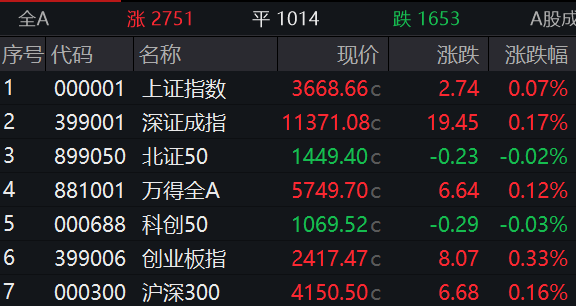
Market Performance - The Shanghai Composite Index (沪指) has surpassed 3674.4 points, reaching a new high since December 2021 [1] - The Hang Seng Index (恒生指数) has increased by 1%, with the Hang Seng Technology Index rising by 0.96% [1][4] - A-shares opened collectively higher, with the Shanghai Index up by 0.07%, Shenzhen Component Index up by 0.17%, and the ChiNext Index up by 0.33% [2] Sector Performance - The retail sector showed strong performance at the opening, with companies like HeBai Group and Guoguang Chain hitting the daily limit [1] - The sectors leading the gains include retail, duty-free shops, tourism, and real estate, while port shipping, coal, and energy metals are among the laggards [2] Currency and Monetary Policy - The People's Bank of China conducted a reverse repurchase operation of 118.5 billion yuan with a rate of 1.40% [5] - The central bank adjusted the RMB to USD middle rate up by 68 basis points to 7.1350 [6] International Market Trends - The Nikkei 225 index in Japan opened with a rise of over 1%, breaking the 43000 points mark for the first time, with significant gains in companies like Toyota and Sony [7] - The Korean Composite Index opened up by 1.11%, with notable increases in major companies such as HD Korea Shipbuilding & Offshore and SK Hynix [7]
特朗普关税伤害了谁?商品价格成本飙升 消费者买单还是企业求豁免?
Di Yi Cai Jing· 2025-08-11 14:04
Core Viewpoint - The implementation of "reciprocal tariffs" by the Trump administration is expected to lead to price increases, prompting American businesses to seek exemptions [1][2]. Group 1: Impact on Businesses - American businesses are adjusting their short-term strategies, such as early procurement and limiting imports to essentials, while also reevaluating long-term strategies due to the new normal of tariff fluctuations [2][3]. - The National Retail Federation (NRF) and the National Restaurant Association (NRA) indicate that the clarity of the tariff landscape presents both short-term and long-term challenges for various industries [2][3]. - Manufacturers, like Stanley Black & Decker, have already raised prices due to cost pressures from tariffs, and retailers, including Walmart, have warned of impending price increases [2][3]. Group 2: Consumer Impact - Higher tariffs are expected to be passed on to consumers, leading to increased prices, reduced hiring, decreased capital expenditures, and slowed innovation [2][3]. - The World Trade Organization (WTO) predicts that the tariff adjustments will negatively impact global trade, with increasing pressure on U.S. imports expected by mid-2025 and into 2026 [3]. Group 3: Restaurant Industry Challenges - The restaurant industry is facing significant cost increases for essential menu items due to tariffs, which may force operators to raise menu prices despite their reluctance [4][5]. - A decline in customer visits to restaurants has been noted, particularly among low-income customers, leading to a decrease in sales for chains like McDonald's [5][6]. - The American Restaurant Association has warned that tariffs on food and beverage products from Mexico and Canada could result in a loss of $15.16 billion for the domestic restaurant industry [5][6]. Group 4: Trade Negotiations - Current tariffs on Canadian and Mexican imports are set at 35% and 25%, respectively, while products meeting USMCA standards are exempt from tariffs [6]. - The coffee industry is particularly affected, with tariffs on Brazilian coffee beans rising to 50%, significantly increasing procurement costs for U.S. coffee shops [6]. - The American Restaurant Association advocates for the exclusion of food and beverage products from tariff negotiations and for maintaining exemptions for USMCA-compliant goods [6].
特朗普关税伤害了谁?商品价格成本飙升,消费者买单还是企业求豁免?
Di Yi Cai Jing· 2025-08-11 10:21
Group 1 - The implementation of higher tariffs has become an unavoidable reality for American businesses, leading to price increases that will ultimately be passed on to consumers [1][3][4] - Companies are adjusting their short-term strategies, such as early procurement and limiting imports to essentials, while also reevaluating long-term strategies due to the new tariff landscape [3][4] - The National Retail Federation (NRF) and the National Restaurant Association (NRA) indicate that the clarity of the tariff situation presents both short-term and long-term challenges for various industries [3][4] Group 2 - Manufacturers are increasingly recognizing the necessity of raising prices due to cost pressures from tariffs, with some, like Stanley Black & Decker, already implementing price hikes [3][4] - The World Trade Organization (WTO) predicts that the recent tariff adjustments will have a negative impact on global trade, with increasing pressure on U.S. imports expected by mid-2025 and 2026 [4] - The restaurant industry is particularly affected, with operators facing tight profit margins and being forced to raise menu prices, which could lead to reduced dining out frequency among consumers [5][6] Group 3 - The American Restaurant Association estimates that imposing a 30% tariff on food and beverage products from Mexico and Canada could result in a loss of $15.16 billion for the domestic restaurant industry [6] - Tariffs on coffee beans from Brazil, which are crucial for the U.S. coffee industry, have increased to 50%, significantly raising import costs [6] - There are ongoing negotiations regarding tariff exemptions for products that meet the USMCA standards, with a strong push from the restaurant industry to exclude food and beverage products from tariff discussions [6]
宝胜国际发布中期业绩 股东应占溢利1.88亿元 同比减少44.1%
Zhi Tong Cai Jing· 2025-08-11 09:49
Group 1 - The company reported a revenue of RMB 9.159 billion for the six months ending June 30, 2025, representing a year-on-year decrease of 8.3% [1] - The profit attributable to the company's owners was RMB 188 million, down 44.1% year-on-year, with basic earnings per share of 3.62 cents [1] - The company declared an interim dividend and special dividend of HKD 0.0115 per share [1] Group 2 - The gross profit for the period was RMB 3.069 billion, with a gross margin decline of 0.7 percentage points to 33.5% due to increased discounting in the retail sector [1] - The company experienced a relatively stable performance across all channels, but the increasingly volatile retail environment and fluctuating store foot traffic negatively impacted overall sales [1] - The performance of the franchise channel deteriorated on a quarterly basis, contributing to the overall revenue decline of 8.3% to RMB 9.159 billion [1]
上海"我店"模式:消费生态创新的:双刃剑
Sou Hu Cai Jing· 2025-08-09 08:16
Core Insights - The "WoDian" model in Shanghai has rapidly become a benchmark for digital transformation in the retail industry, driven by the dual forces of digital economy and consumer upgrade, creating a value symbiosis system among merchants, consumers, and platforms [1] Group 1: Model Innovation - The "WoDian" model innovatively transforms consumer behavior into valuable digital assets, allowing users to earn points equivalent to their spending, which can be converted into vouchers or cash through a smart algorithm [3] - The platform charges a transaction commission of 15%-20%, establishing a win-win fund for merchants, enhancing their participation through a cross-store rebate mechanism [5] - The model emphasizes localized operations using LBS technology to drive traffic to nearby merchants, resulting in a 30% increase in foot traffic and a 20% increase in the survival rate of small businesses in pilot areas [6] Group 2: Potential Risks - The reliance on merchant commissions for rebate funds poses systemic risks, as a slowdown in platform expansion or increased merchant withdrawal rates could lead to a funding chain rupture [9] - The lack of transparency in point redemption rules raises trust issues among consumers, with 30% of complaints related to rebate issues and sudden rule changes [10] - Some merchants engage in deceptive practices to gain more rebates, undermining consumer rights and eroding the trust ecosystem built by the platform [11] Group 3: Sustainable Development Path - To address these challenges, the platform should establish a three-dimensional protective system of "technology empowerment + institutional innovation + ecological governance," including blockchain for traceable point circulation and a dynamic risk control model [12] - The transition from "traffic competition" to "value symbiosis" is crucial for the sustainable development of the "WoDian" model, emphasizing the need for a compliant and sustainable ecosystem for mutual benefits among consumers, merchants, and platforms [12]