
建筑装饰

Search documents
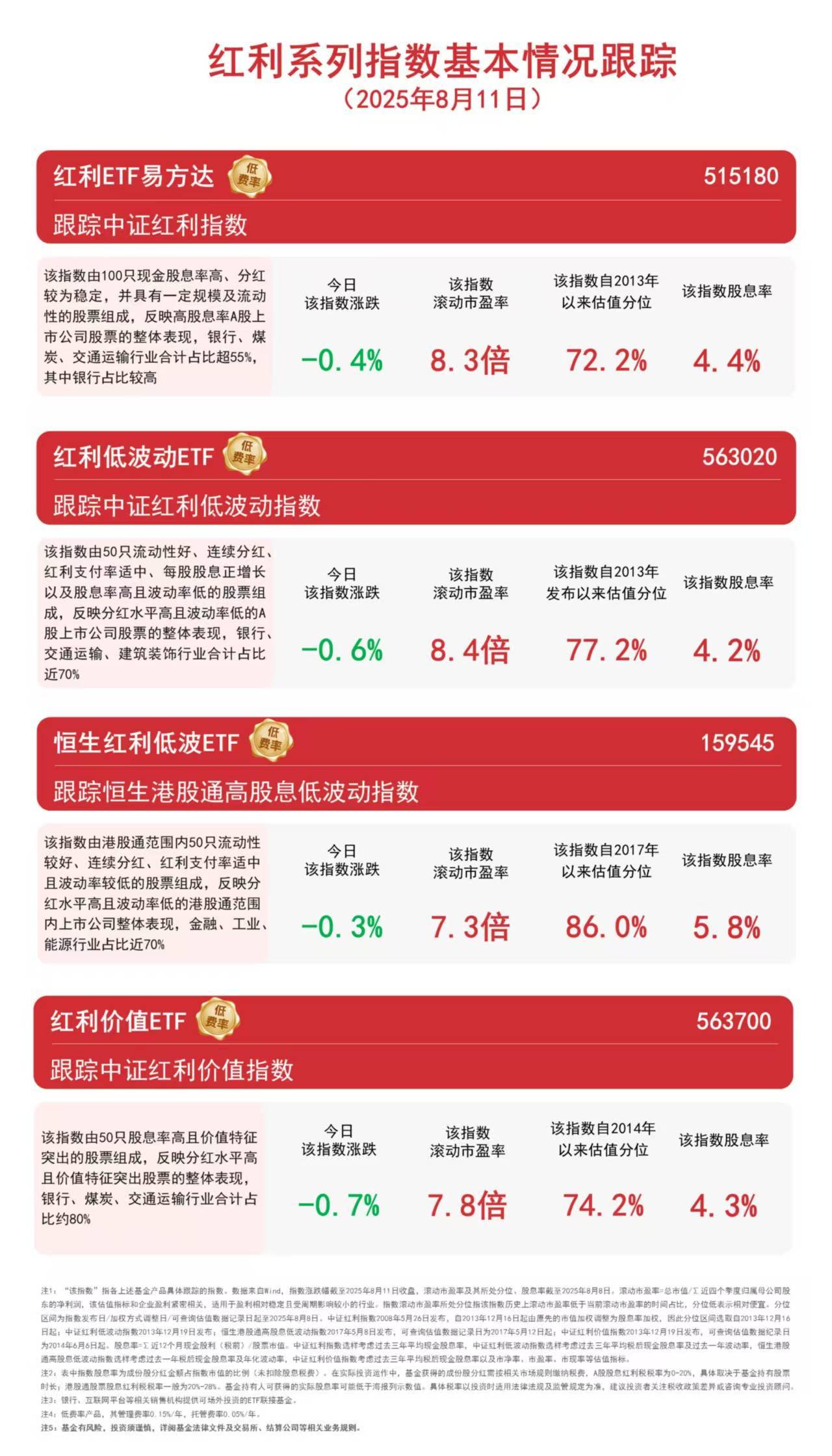
红利板块震荡调整,恒生红利低波ETF(159545)今日获超6700万份净申购
Sou Hu Cai Jing· 2025-08-11 11:28
Core Viewpoint - The article discusses various dividend-focused ETFs, highlighting their composition, performance, and sector allocations, indicating a trend towards stable, high-dividend yielding stocks in the A-share and Hong Kong markets [2]. Group 1: Dividend ETFs Overview - The E Fund Dividend ETF tracks the China Securities Dividend Index, composed of 100 stocks with high cash dividend yields, reflecting the overall performance of high-dividend A-share companies [2]. - The E Fund Low Volatility Dividend ETF tracks the China Securities Low Volatility Dividend Index, consisting of 50 stocks with good liquidity, continuous dividends, and low volatility, indicating a focus on stable dividend-paying stocks [2]. - The Hang Seng Low Volatility Dividend ETF tracks the Hang Seng High Dividend Low Volatility Index, made up of 50 stocks within the Hong Kong Stock Connect that have good liquidity and moderate dividend payout ratios [2]. Group 2: Performance Metrics - The E Fund Dividend ETF has a rolling price-to-earnings ratio of 8.3 times, with a valuation percentile of 72.2% since its inception in 2013, and a recent decline of -0.4% [2]. - The E Fund Low Volatility Dividend ETF has a rolling price-to-earnings ratio of 8.41 times, with a valuation percentile of 77.2% since its inception in 2013, and a recent decline of -0.6% [2]. - The Hang Seng Low Volatility Dividend ETF has a rolling price-to-earnings ratio of 7.3 times, with a valuation percentile of 86.0% since its inception in 2017, and a recent decline of -0.3% [2]. Group 3: Sector Allocations - In the E Fund Dividend ETF, the banking, coal, and transportation sectors account for over 55% of the index, with a significant weight in banking stocks [2]. - In the E Fund Low Volatility Dividend ETF, the banking, transportation, and construction sectors make up nearly 70% of the index [2]. - In the Hang Seng Low Volatility Dividend ETF, the financial, industrial, and energy sectors represent nearly 70% of the index [2].

A股公司又现“炒股热”:有人巨赚,有人巨亏
第一财经· 2025-08-11 09:09
Core Viewpoint - The article discusses the increasing trend of listed companies in China engaging in stock market investments, with many companies announcing plans to use significant amounts of idle funds for securities investment amid a bullish market. [3][4] Group 1: Company Actions - Liou Co., Ltd. announced plans to invest up to 3 billion yuan in securities, while Heshun Petroleum plans to invest up to 200 million yuan. [3] - In July, Yiduoli and Delian Group also announced plans to invest 30 million and 60 million yuan, respectively, in securities. [3] - Nearly 60 listed companies have announced intentions to use idle funds for securities investment this year. [4] Group 2: Market Performance - The Shanghai Composite Index has risen from around 3,000 points in April to over 3,600 points, leading to increased enthusiasm for stock trading among listed companies. [4] - A total of 57 listed companies have announced plans to use idle funds for securities investment this year, with several companies planning to invest over 1 billion yuan. [4] Group 3: Financial Performance - Most companies engaging in stock trading are from traditional manufacturing sectors, with 52 out of 57 companies expected to be profitable in 2024. [5] - However, 29 companies are projected to see a year-on-year decline in net profit for 2024, including major investors like Fangda Carbon and Seven Wolves, which expect declines of 55.3% and 27.5%, respectively. [7] Group 4: Investment Outcomes - Liou Co., Ltd. gained significant returns from its investment in Li Auto, with a peak profit of over 10 billion yuan from its initial investment of 4.5 billion yuan. [8] - Seven Wolves reported non-operating gains from securities investments of 236 million yuan in 2024, which helped offset a decline in its main business revenue. [8] - Conversely, Fangda Carbon has faced substantial losses from its stock investments, with a total loss exceeding 70 million yuan over the past three years. [10][11]



A股公司又现“炒股热”:二级市场比主业更赚钱?
Di Yi Cai Jing· 2025-08-11 08:36
Core Viewpoint - The A-share market has seen a surge in activity, with nearly 60 listed companies announcing plans to use idle funds for securities investment this year, driven by significant market gains and a strong profit-making effect [1][2]. Group 1: Company Actions - Liou Co. plans to invest up to 3 billion yuan in securities, including new stock subscriptions, stock and bond investments, and entrusted financial management [1]. - He Shun Petroleum announced a plan to invest up to 200 million yuan in idle funds for securities investment [1]. - Other companies like Yiduoli and Delian Group also announced plans to invest 30 million and 60 million yuan, respectively, in securities [1]. Group 2: Market Performance - The Shanghai Composite Index has risen 8.45% this year, encouraging companies to invest idle funds in the securities market [1]. - A total of 57 listed companies have announced plans to use idle funds for securities investment this year, with several companies planning to invest over 1 billion yuan [2]. Group 3: Financial Performance - Among the 57 companies, 52 are expected to be profitable in 2024, while 5 companies, including Liou Co. and Baichang Pharmaceutical, are projected to incur losses [2][3]. - Liou Co. reported a loss in 2024 due to changes in the fair value of previously invested stocks, but it still expects to achieve a profit of 160 million yuan after excluding non-recurring losses [3]. Group 4: Investment Outcomes - Liou Co. previously gained significant profits from its investment in Li Auto, with a peak profit of 4.772 billion yuan in 2020, largely due to stock sales [4]. - Seven Wolves reported substantial non-recurring gains from securities investments, which helped offset declines in its main business revenue [5][6]. - Conversely, Fangda Carbon faced significant losses from its securities investments, with a total loss exceeding 70 million yuan over three years [7][8].
8月8日机械设备、通信、非银金融等行业融资净卖出额居前
Zheng Quan Shi Bao Wang· 2025-08-11 05:06
Core Insights - As of August 8, the latest market financing balance is 1,995.36 billion yuan, a decrease of 3.56 billion yuan compared to the previous trading day [1] Industry Summary - **Industries with Increased Financing Balance**: - Non-ferrous metals industry saw the largest increase, with a financing balance of 907.00 billion yuan, up by 0.36% (3.59 billion yuan) [1] - Other notable increases include: - Computer industry: 1,547.19 billion yuan, up by 0.22% (3.34 billion yuan) [1] - Automotive industry: 1,036.83 billion yuan, up by 0.12% (1.21 billion yuan) [1] - National defense and military industry: 728.16 billion yuan, up by 0.11% (0.81 billion yuan) [1] - **Industries with Decreased Financing Balance**: - 21 industries experienced a decrease, with the most significant reductions in: - Machinery and equipment: 1,072.29 billion yuan, down by 0.62% (6.71 billion yuan) [2] - Communication: 699.19 billion yuan, down by 0.92% (6.53 billion yuan) [2] - Non-bank financials: 1,629.95 billion yuan, down by 0.32% (5.26 billion yuan) [2] - **Overall Financing Balance Changes**: - The comprehensive industry financing balance increased by 0.74% to 36.00 billion yuan [1] - The social services, non-ferrous metals, and beauty care industries also saw increases, with respective growth rates of 0.68%, 0.40%, and 0.39% [1] - Conversely, the coal, communication, and construction decoration industries had the largest declines, with financing balances of 154.27 billion yuan, 699.19 billion yuan, and 358.57 billion yuan, reflecting decreases of 1.00%, 0.92%, and 0.88% respectively [1]
68只股上午收盘涨停(附股)
Zheng Quan Shi Bao Wang· 2025-08-11 03:58
Market Overview - The Shanghai Composite Index closed at 3653.50 points, up 0.51% [1] - The Shenzhen Component Index closed at 11293.25 points, up 1.48% [1] - The ChiNext Index rose by 1.99% and the Sci-Tech 50 Index increased by 0.88% [1] Stock Performance - Among the tradable A-shares, 4278 stocks rose, accounting for 79.44%, while 943 stocks fell [1] - There were 68 stocks that hit the daily limit up, and 8 stocks hit the limit down [1] - The leading sectors for limit-up stocks included electronics, power equipment, and machinery, with 9, 7, and 7 stocks respectively [1] Notable Stocks - *ST Tianmao and ST Yundong are among the 4 ST stocks that hit the limit up [1] - Stocks with the most consecutive limit-ups include Jishi Media, Shanghai Port Bay, and Sainuo Medical, each with 3 consecutive limit-ups [1] - The stock with the highest limit-up order volume was *ST Tianmao, with 73,470.74 thousand shares, followed by Xinjiang Jiaojian and Beixin Road Bridge [1] Limit-Up Stock Details - Xinjiang Jiaojian: Closing price 15.19, turnover rate 1.06%, limit-up order volume 10,564.58 thousand shares, order amount 1.60 billion [1] - *ST Tianmao: Closing price 1.52, turnover rate 1.18%, limit-up order volume 73,470.74 thousand shares, order amount 1.12 billion [1] - Guosheng Jinkong: Closing price 16.56, turnover rate 10.40%, limit-up order volume 4,496.38 thousand shares, order amount 744.60 million [1] Sector Analysis - The construction decoration sector had significant activity with multiple stocks hitting limit up [1] - The non-bank financial sector also showed strong performance with stocks like *ST Tianmao and Guosheng Jinkong [1] - The electronics and power equipment sectors are highlighted for their robust stock performance [1]




广田集团:2025年第二次临时股东大会决议公告
Zheng Quan Ri Bao· 2025-08-08 16:14
Group 1 - The core point of the article is that Guangtian Group announced the holding of its second extraordinary general meeting of shareholders in 2025 on August 8, 2025, where several proposals, including the "Proposal for Amendment," were approved [2]

策略日报:延续震荡调整-20250808
Tai Ping Yang Zheng Quan· 2025-08-08 13:14
Group 1: Major Asset Tracking - The bond market is experiencing narrow fluctuations, with a prevailing trend of rising stock prices and falling bond prices. The overall monetary policy remains accommodative, supporting the bond market fundamentals and liquidity [17] - The A-share market shows a slight decline with a trading volume of 1.73 trillion, indicating a decrease in market sentiment but still active trading. The index is expected to trend upward, potentially breaking last year's high [20] - The U.S. stock market shows mixed performance, with the Dow Jones down 0.51% and the Nasdaq up 0.35%. Long-term trends suggest that U.S. stocks may outperform non-U.S. markets [24][25] Group 2: Important Policies and News - In July, the national retail sales of passenger cars reached 1.826 million units, a year-on-year increase of 6.3%. The retail sales of new energy vehicles also grew by 12% [36] - Shanghai has introduced a social insurance subsidy policy for female employees during maternity leave, covering 50% of the costs for employers [38] - The U.S. has seen a significant policy shift allowing 401K accounts to invest in cryptocurrencies and private equity, marking a historic moment [41] Group 3: Trading Strategies - The bond market is expected to experience fluctuations followed by high-level oscillations, while the A-share market is recommended to adopt a bullish stance, focusing on holding positions [7][20] - The strategy for the U.S. stock market remains bullish in the medium to long term, indicating a continuation of the bull market [8] - In the foreign exchange market, a strategic long position on the U.S. dollar is advised, as shorting the dollar lacks cost-effectiveness [29] Group 4: Commodity Market - The Wenhua Commodity Index has decreased by 0.2%, but it shows signs of stabilization and recovery. The recommendation is to buy on dips, using the low point from July 10 as support [31]
基础建设业董秘群体观察:苏文电能张子健年薪锐减超56万节能铁汉连续两任董秘违规受罚
Xin Lang Cai Jing· 2025-08-08 10:41
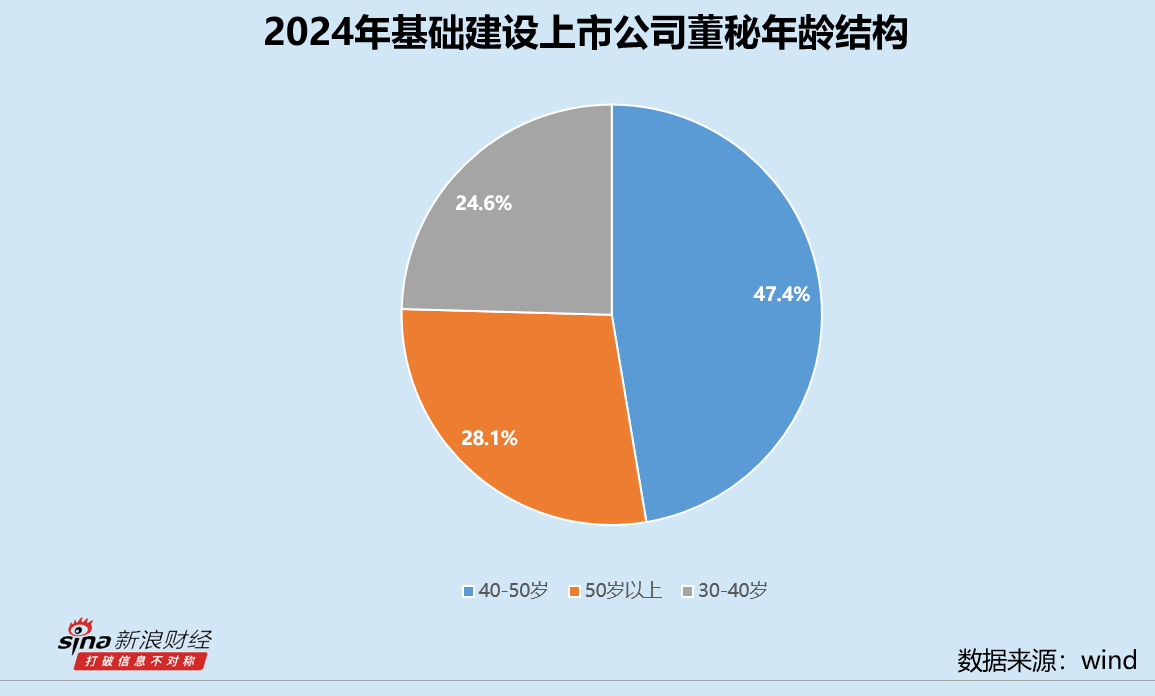
Core Insights - The report highlights that in 2024, the total salary for A-share listed company secretaries reached 4.086 billion yuan, with an average annual salary of 755,000 yuan [1][2] - Over 21% of company secretaries earned more than 1 million yuan annually, indicating a significant portion of high earners in this role [1] Group 1: Salary and Compensation - The average annual salary for secretaries in the infrastructure sector is 555,500 yuan, which is lower than the average salary of 634,900 yuan in the construction decoration industry, reflecting a year-on-year decrease of 17.7% [2] - The median annual salary for secretaries in 2024 is 471,600 yuan, with the highest salary recorded at 1.4312 million yuan [2] - Male secretaries earn an average salary of 590,200 yuan, which is nearly 100,000 yuan higher than their female counterparts [2] Group 2: Demographics and Tenure - The average age of secretaries in the infrastructure sector is 45.09 years, with 47.4% aged between 40-50 years and 28.1% over 50 years [1] - The majority of secretaries (33.3%) have a tenure of 1-3 years, while 24.6% have served for 5-10 years [2] - Among the 56 secretaries with disclosed educational backgrounds, 53.6% hold a master's degree, while 39.3% have a bachelor's degree [2] Group 3: Compliance and Conduct - In 2024, 12 secretaries in the infrastructure sector were reported to have compliance violations, with notable cases including two secretaries from Energy Iron Han receiving warnings for failing to manage insider information diligently [2]

基础建设业董秘群体观察:苏文电能张子健年薪锐减超56万 节能铁汉连续两任董秘违规受罚
Xin Lang Zheng Quan· 2025-08-08 10:34
专题:专题|2024年度A股董秘数据报告:1144位董秘年薪超百万 占比超21% 统计区间内,共有11位董秘离任,包括中国中铁何文、中国交建周长江、中国电建丁永泉等。其中,新疆交建林强担任董秘职务超9年,因个人原因离职。 成都路桥张婉和安徽建工徐亮在职仅一年,便因个人原因辞任。 董秘作为连接投资者与上市公司的"桥梁",在上市公司资本运作中发挥着关键作用。新浪财经《2024年度A股董秘数据报告》显示,2024年A股上市公司董 秘薪酬合计达40.86亿元,平均年薪75.43万元。 分行业来看,A股共有164家建筑装饰上市公司公开披露了董事会秘书信息,其中46家为基础建设上市公司。 就年龄结构而言,2024年基础建设上市公司董秘以中坚力量为主,剔除未披露具体信息的中国能建,平均年龄为45.09岁,40-50岁群体约占47.4%,50岁以 上群体约占28.1%,30-40岁群体约占24.6%。结合性别分析,男性董秘占据主导地位,整体约占64.9%,平均年龄为47.11岁;女性董秘约占35.1%,平均年龄 为41.45岁。 年龄最大的男性董秘为中国电建丁永泉,现已61岁。年龄最大的女性董秘为蒙草生态邓一新,目前52岁。 ...
粤开市场日报250808-20250808
Yuekai Securities· 2025-08-08 10:29
Market Overview - The A-share market showed a mixed performance today, with major indices mostly declining. The Shanghai Composite Index fell by 0.12% to close at 3635.13 points, the Shenzhen Component Index decreased by 0.26% to 11128.67 points, and the ChiNext Index dropped by 0.38% to 2333.96 points. The total trading volume in the Shanghai and Shenzhen markets was 17102 billion yuan, a decrease of 1153 billion yuan compared to the previous trading day [2][14]. Industry Performance - Among the Shenwan first-level industries, the sectors that gained the most included Comprehensive, Building Materials, Building Decoration, Steel, and Nonferrous Metals, with increases of 1.56%, 1.16%, 1.14%, 1.11%, and 1.06% respectively. Conversely, the sectors that experienced the largest declines were Computer, Electronics, Media, Non-Bank Financials, and National Defense Industry, with decreases of 2.38%, 1.15%, 0.96%, 0.80%, and 0.56% respectively [2][16]. Concept Sector Performance - The concept sectors that performed well today included Xinjiang Revitalization, Western Infrastructure, Excavators, Animal Vaccines, Tibet Revitalization, Rare Metals, Wind Power, High-Speed Rail, Lithium Mines, and Duty-Free Shops. These sectors showed significant gains, indicating potential investment opportunities [3].