服务业

Search documents
三大指数均有回升 我国经济景气水平总体保持扩张——透视6月份PMI数据
Xin Hua She· 2025-06-30 08:40
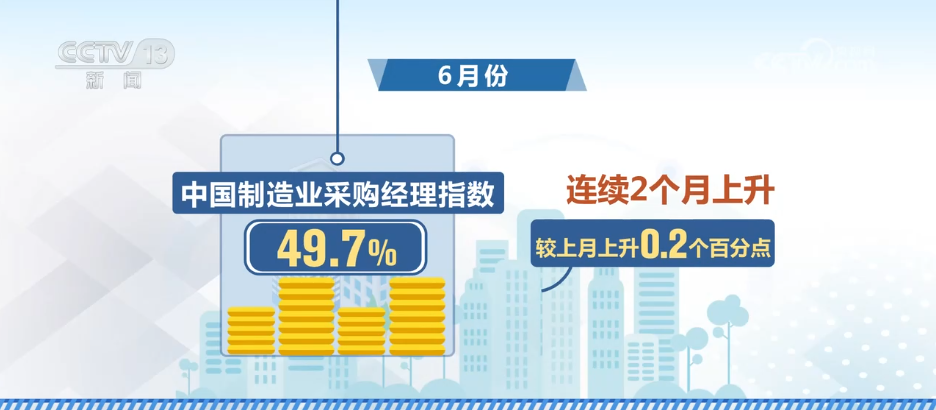
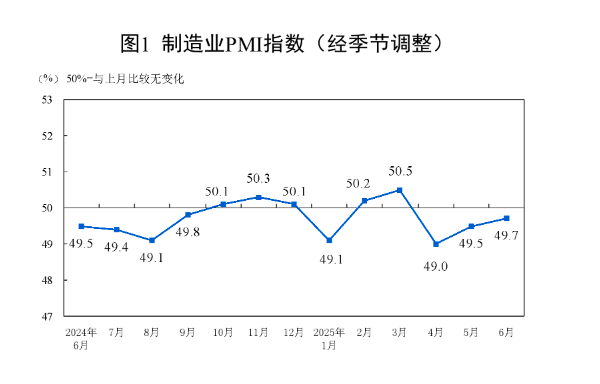
Group 1: Manufacturing Sector - The manufacturing PMI for June is reported at 49.7%, showing a 0.2 percentage point increase from the previous month, indicating a continued recovery in the manufacturing sector [1] - In June, the new orders index rose to 50.2%, up 0.4 percentage points, marking a return to the expansion zone after two months below 50% [2] - The production index for manufacturing increased to 51%, up 0.3 percentage points, reflecting stable expansion in production activities [2] - The purchasing volume index for raw materials also returned to the expansion zone at 50.2%, increasing by 2.6 percentage points [2] - The equipment manufacturing PMI is at 51.4%, high-tech manufacturing PMI at 50.9%, and consumer goods PMI at 50.4%, all indicating expansion [3] Group 2: Non-Manufacturing Sector - The non-manufacturing business activity index for June is reported at 50.5%, a 0.2 percentage point increase, indicating continued expansion in the non-manufacturing sector [5] - The construction sector shows significant growth with a business activity index of 52.8%, up 1.8 percentage points, and civil engineering at 56.7%, indicating strong activity [6] - The service sector's business activity index is at 50.1%, slightly down by 0.1 percentage point, but the business activity expectation index remains high at 56% [5][6] Group 3: Economic Outlook - The overall economic climate is showing resilience, with manufacturing PMI recovering for two consecutive months, suggesting a stable economic foundation [4] - The second quarter saw fluctuations due to external factors, but the manufacturing sector is expected to maintain steady growth in the second half of the year [4] - The non-manufacturing business activity index has consistently remained above 50%, indicating stable expansion in the sector [6]
6月PMI:现实强于预期(申万宏观·赵伟团队)
赵伟宏观探索· 2025-06-30 08:24
关注、加星,第一时间接收推送! 文 | 赵伟、屠强 联系人| 屠强、耿佩璇 摘要 事件: 6月30日,国家统计局公布6月PMI指数,制造业PMI为49.7%、前值49.5%;非制造业PMI为 50.5%、前值50.3%。 却下行至2023年来最低水平(52%)。展望后续,设备更新周期逐步退坡,出口链生产走弱,制造业景 气面临较大下行压力。但近期扩内需政策再加码,5000亿服务消费再贷款、准财政工具(政策性开发性 金融工具)已对服务业投资进行部署,服务消费、基建投资或加快修复,有望对企业和居民预期形成支 撑。 常规跟踪:制造业、非制造业景气均有改善。 制造业:制造业:制造业PMI有所回升,生产、新订单指数延续改善。 6月,制造业PMI边际上行0.2pct 至49.7%。生产、新订单指数边际分别上行0.3、0.3pct至51%、50.2%。 核心观点:制造业景气回升,但企业预期降至低位;政策加码下,需关注微观预期的变化。 6月制造业PMI表现好于市场预期,结构上依然是生产指数恢复更好。 6月制造业PMI延续回升,边际上 行0.2pct至49.7%,好于市场预期(WIND,49.3%)。主要分项中,生产、新订单指数 ...

6月PMI:现实强于预期(申万宏观·赵伟团队)
申万宏源宏观· 2025-06-30 08:22
Core Viewpoint - Manufacturing sector shows signs of recovery, but corporate expectations have dropped to a low level; increased policy support is needed to monitor changes in micro expectations [3][6][100] Manufacturing Sector - June manufacturing PMI improved to 49.7%, up 0.2 percentage points from May, exceeding market expectations of 49.3% [2][10] - The production and new orders indices both rose, reaching 51% and 50.2% respectively, indicating expansion [3][10] - The new orders index showed slight improvement, with domestic demand orders recovering more than new export orders [22][98] - High-frequency indicators reveal a year-on-year decline in foreign trade cargo volume, indicating reduced export strength [22][98] Industry Analysis - High-energy-consuming industries saw a significant PMI increase, rising 0.8 percentage points to 47.8%, driven by investment and ongoing infrastructure projects [4][28] - Equipment manufacturing and consumer goods sectors also benefited from domestic demand, with PMIs rising to 51.4% and 50.4% respectively [4][28] - Food and beverage, as well as specialized equipment sectors, have maintained production and new order indices in the expansion zone for two consecutive months [4][28] Non-Manufacturing Sector - The construction sector's PMI rose significantly by 1.8 percentage points to 52.8%, indicating rapid progress in infrastructure projects [31][99] - The civil engineering PMI reached 56.7%, remaining in a high prosperity range for three consecutive months [31][99] - In contrast, the real estate sector's construction progress appears slower, with weak performance in cement and rebar consumption [31][99] Service Sector - The service sector PMI slightly declined by 0.1 percentage points to 50.1%, primarily due to the fading effects of holiday consumption [5][42] - Business activity indices in retail, transportation, and hospitality sectors showed varying degrees of decline, reflecting reduced market activity [5][42] - Conversely, sectors such as telecommunications and financial services maintained high business activity indices above 60% [5][42] Future Outlook - There are risks of weakening manufacturing sentiment, necessitating close attention to the impact of incremental policies on domestic demand and changes in corporate expectations [6][100] - Despite the recovery in production and new orders, the corporate expectation index has fallen to its lowest level in 2023 at 52% [6][100] - Recent policies aimed at boosting domestic demand, including a 500 billion yuan service consumption relending initiative, may support corporate and consumer expectations [6][100]
制造业PMI连续两月回升 上半年我国经济运行稳中向好
Yang Shi Xin Wen Ke Hu Duan· 2025-06-30 08:11
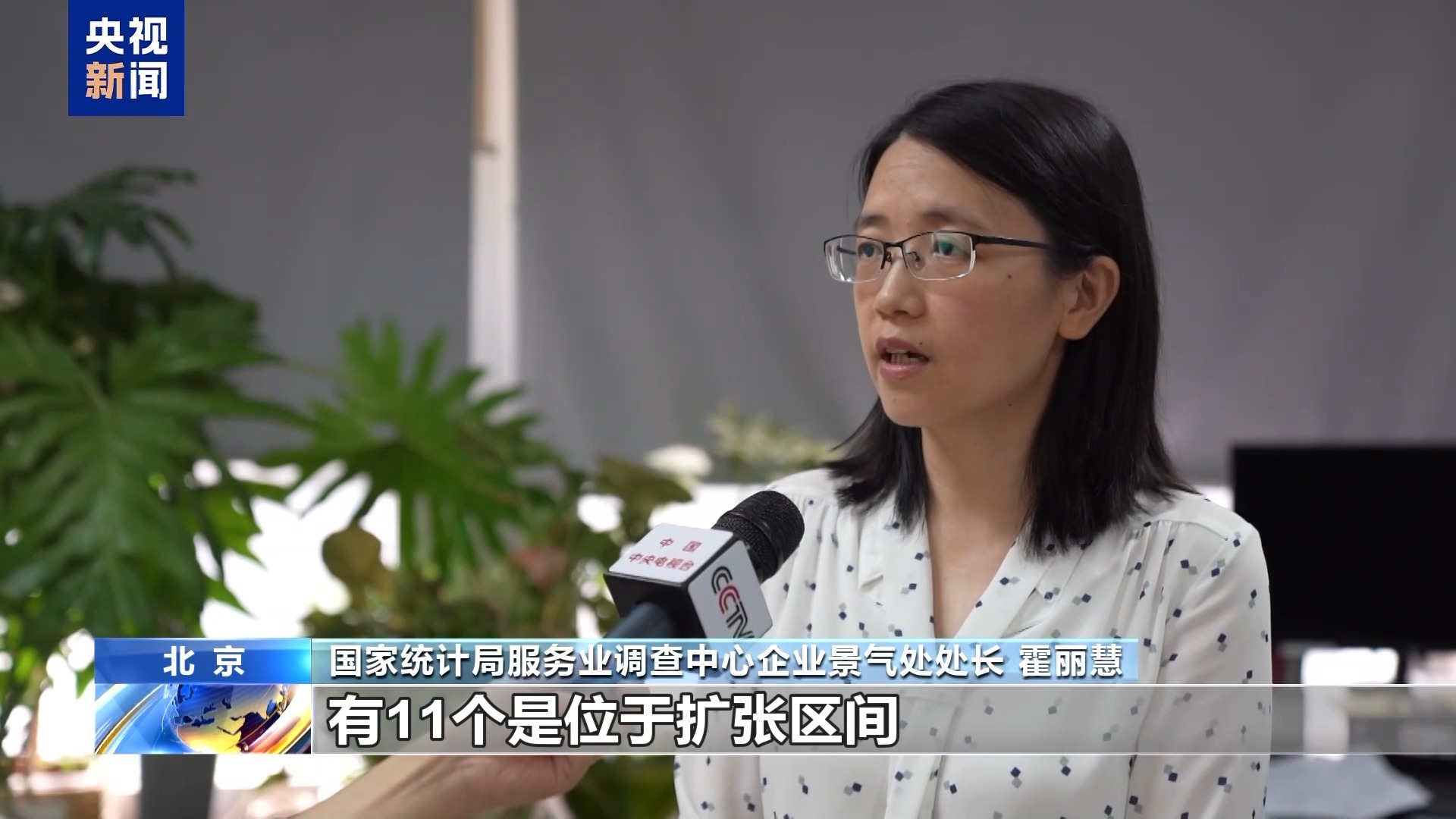
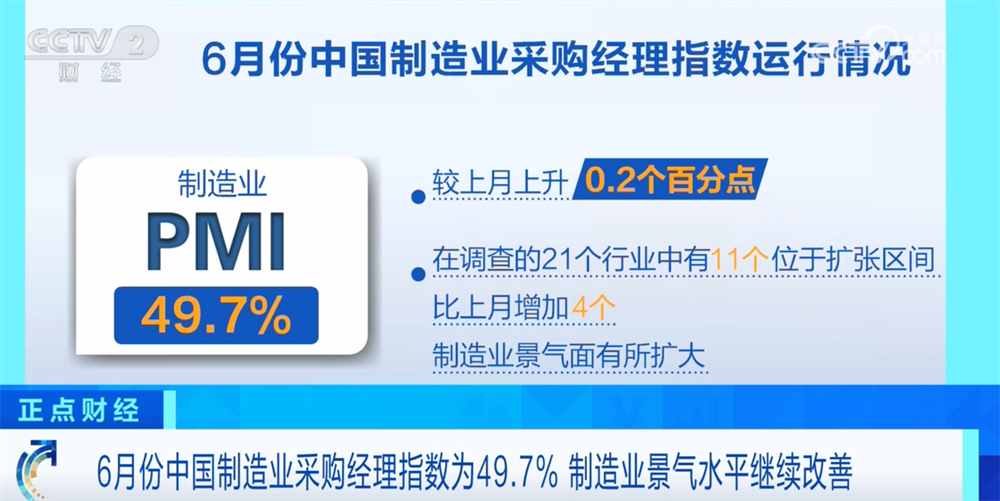
Group 1 - The core viewpoint of the article indicates that China's manufacturing purchasing managers' index (PMI) has shown continuous improvement, with a reading of 49.7% in June, up 0.2 percentage points from the previous month, marking two consecutive months of increase [1][25] - In June, 11 out of 21 surveyed industries were in the expansion zone, an increase of 4 from the previous month, indicating an overall improvement in manufacturing sentiment [2][25] - The new orders index returned to the expansion zone at 50.2%, after being below 50% for two months, reflecting a recovery in market demand [4][25] Group 2 - The equipment manufacturing PMI was 51.4%, up 0.2 percentage points, with both production and new orders indices above 53%, indicating strong performance in this sector [9] - The consumer goods manufacturing PMI rose to 50.4%, up 0.2 percentage points, showing stable growth in this area [13] - Large enterprises continued to expand, with their PMI at 51.2%, up 0.5 percentage points, while medium-sized enterprises also saw a recovery, with their PMI increasing by 1.1 percentage points [15][13] Group 3 - The non-manufacturing business activity index rose to 50.5%, up 0.2 percentage points, indicating continued expansion in the non-manufacturing sector [18] - The construction industry business activity index increased to 52.8%, up 1.8 percentage points, reflecting a recovery in construction activities, particularly in infrastructure projects [22][24] - Overall, the purchasing managers' index serves as an important leading indicator of macroeconomic trends, showing a resilient economic performance in the first half of the year despite fluctuations [25][29]
【数据发布】2025年6月中国采购经理指数运行情况
中汽协会数据· 2025-06-30 07:19
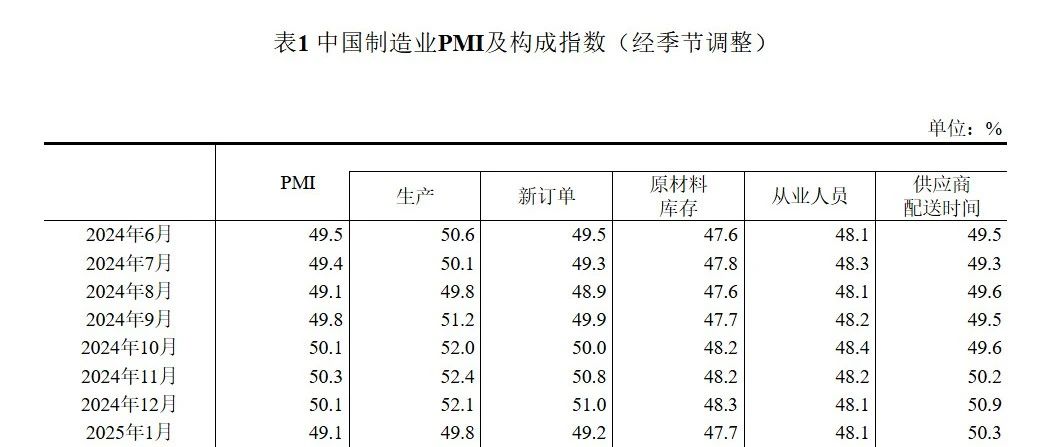
Group 1: Manufacturing PMI Overview - In June, the Manufacturing Purchasing Managers' Index (PMI) was 49.7%, an increase of 0.2 percentage points from the previous month, indicating continued improvement in manufacturing sentiment [1] - Large enterprises had a PMI of 51.2%, up 0.5 percentage points, while medium and small enterprises had PMIs of 48.6% and 47.3%, respectively, indicating a decline for smaller firms [1] - The production index was 51.0%, up 0.3 percentage points, suggesting accelerated production activities in the manufacturing sector [2] Group 2: Manufacturing Sub-Indices - The new orders index was 50.2%, an increase of 0.4 percentage points, indicating improved market demand in manufacturing [3] - The raw materials inventory index was 48.0%, up 0.6 percentage points, indicating a continued narrowing of the decline in major raw material inventories [3] - The employment index was 47.9%, down 0.2 percentage points, reflecting a slight decrease in employment sentiment within manufacturing [3] Group 3: Non-Manufacturing PMI Overview - In June, the Non-Manufacturing Business Activity Index was 50.5%, an increase of 0.2 percentage points, indicating continued expansion in the non-manufacturing sector [6] - The construction industry business activity index was 52.8%, up 1.8 percentage points, while the services sector index was 50.1%, down 0.1 percentage points [8] Group 4: Non-Manufacturing Sub-Indices - The new orders index for non-manufacturing was 46.6%, up 0.5 percentage points, indicating a slight recovery in market demand [10] - The input prices index was 49.9%, up 1.7 percentage points, suggesting stable input prices for non-manufacturing activities [10] - The business activity expectation index was 55.6%, down 0.3 percentage points, indicating a generally optimistic outlook among non-manufacturing enterprises [11] Group 5: Comprehensive PMI Overview - The Comprehensive PMI Output Index was 50.7%, an increase of 0.3 percentage points, indicating an overall acceleration in production and business activities across sectors [14]
透过6月份经济数据看亮点:49.7%,连升两月!制造业景气水平持续改善
Yang Shi Wang· 2025-06-30 06:21
Core Viewpoint - The manufacturing sector in China shows signs of improvement, with the Purchasing Managers' Index (PMI) for June rising to 49.7%, marking a 0.2 percentage point increase from the previous month, indicating a continuous upward trend for two consecutive months [1] Manufacturing Sector Summary - The PMI for the equipment manufacturing industry reached 51.4%, up 0.2 percentage points from last month, with both production and new orders indices above 53% [5] - The high-tech manufacturing PMI stood at 50.9%, remaining stable compared to last month, with production and new orders indices around 52% [5] - The consumer goods manufacturing PMI increased to 50.4%, a rise of 0.2 percentage points, reflecting steady growth [7] - The basic raw materials industry PMI rose by 0.8 percentage points, ending a three-month decline [7] Enterprise Type Analysis - Large enterprises continued to expand, with their PMI at 51.2%, an increase of 0.5 percentage points from last month, indicating significant support for the overall manufacturing sector [9] - The PMI for medium-sized enterprises increased by 1.1 percentage points, ending a two-month downward trend, with new orders index rising over 4 percentage points, showing a notable recovery in demand [11] Non-Manufacturing Sector Summary - The non-manufacturing business activity index for June was 50.5%, a slight increase of 0.2 percentage points, indicating continued expansion [11] - The service industry business activity index was 50.1%, showing stability in the sector [11] - The construction industry business activity index rose to 52.8%, up 1.8 percentage points, indicating a recovery in activity levels [11] - The civil engineering construction index was at 56.7%, remaining above 55% for three consecutive months, suggesting rapid progress in infrastructure projects [11] - Investment-related activities in the construction sector have shown significant recovery, supported by the expansion of special bond investments [11]
制造业PMI连续2月回升,下半年走势如何?
第一财经· 2025-06-30 03:52
本文字数:2337,阅读时长大约4分钟 作者 | 第一财经 祝嫣然 今年二季度,受到美国关税政策变化的影响,制造业运行短期有所波动,但我国经济展现出了较强的 韧性,在短期放缓后迅速回稳。 国家统计局6月30日发布的6月份制造业采购经理指数(PMI)为49.7%,比上月上升0.2个百分点, 连续两个月回升,制造业景气水平继续改善。非制造业商务活动指数为50.5%,比上月上升0.2个百 分点。 中国物流与采购联合会特约分析师张立群表示,6月份PMI指数小幅回升,表明一系列增量政策的效 果继续显现。订单类指数回升反映扩大内需政策效果有所显现;生产指数、采购量指数上升反映企业 生产经营活动有回暖趋势。同时应注意到PMI指数仍处荣枯线下,生产经营活动预期指数仍在下降, 反映需求不足的企业占比仍在扩大,市场引导的需求收缩对制造业生产投资的制约仍然突出。 2025.06. 30 张立群强调,当前宏观经济政策逆周期调节与市场引导的需求收缩正处相互角力的关键阶段,必须坚 持不懈持续加大扩内需各项政策力度,特别要显著加强政府公共产品投资力度,扩大投资规模,有效 有力带动制造业企业订单显著增加,带动制造业生产投资持续活跃。 产需指 ...
49.7%、50.5%,改善、扩张!从6月份“指数”透视中国经济发展亮点
Yang Shi Wang· 2025-06-30 03:51
Group 1 - The manufacturing Purchasing Managers' Index (PMI) in China for June is reported at 49.7%, indicating a 0.2 percentage point increase from the previous month, suggesting continued improvement in manufacturing sentiment [1] - Among the 21 surveyed industries, 11 are in the expansion zone, an increase of 4 from the previous month, reflecting a broader improvement in manufacturing conditions [3] - The production index and new orders index stand at 51% and 50.2%, respectively, both showing increases of 0.3 and 0.4 percentage points from last month, indicating a recovery in production activities and market demand [3] Group 2 - Key sectors such as equipment manufacturing, high-tech manufacturing, and consumer goods have maintained PMIs in the expansion zone for two consecutive months, with production and new orders indices above 53% [5] - The PMI for high-energy-consuming industries, while still below the critical point, has shown signs of recovery this month [5] - The overall manufacturing PMI and its sub-indices reflect a rebound trend, indicating that internal economic momentum is gradually being released and resilience in economic growth is strengthening [7] Group 3 - The non-manufacturing business activity index for June is reported at 50.5%, a 0.2 percentage point increase from the previous month, indicating continued expansion in the non-manufacturing sector [8] - The service sector's performance remains stable, with financial services, capital market services, and insurance industries showing business activity indices above 60%, indicating rapid growth in these areas [8] - The construction sector, particularly civil engineering, has seen a significant rebound, with business activity indices remaining above 55% for three consecutive months, reflecting robust progress in infrastructure projects [8][10]
制造业PMI连续2月回升,下半年走势如何
Di Yi Cai Jing· 2025-06-30 02:41
Core Viewpoint - The manufacturing PMI index in June shows a slight recovery, indicating the effectiveness of a series of incremental policies, despite ongoing challenges in demand and production activities [1][4][11]. Manufacturing Sector - The manufacturing PMI for June is reported at 49.7%, up 0.2 percentage points from the previous month, marking two consecutive months of improvement [1]. - The new orders index has returned to the expansion zone at 50.2%, increasing by 0.4 percentage points after two months below 50% [4]. - The production index stands at 51%, reflecting stable expansion in production activities, with a 0.3 percentage point increase from last month [5]. - The procurement volume index has also returned to the expansion zone at 50.2%, up 2.6 percentage points [5]. - Large enterprises show a PMI of 51.2%, indicating accelerated expansion, while medium and small enterprises remain below the critical point at 48.6% and 47.3%, respectively [7]. Price Trends - In June, both the purchasing price index and the factory price index have stabilized, with the purchasing price index at 48.4% and the factory price index at 46.2%, both up 1.5 percentage points from the previous month [6]. Non-Manufacturing Sector - The non-manufacturing business activity index is at 50.5%, reflecting continued expansion, with a 0.2 percentage point increase [11]. - The construction industry shows a business activity index of 52.8%, up 1.8 percentage points, indicating a recovery in construction activities [12]. Future Outlook - The manufacturing sector is expected to maintain a steady growth trend in the second half of the year, supported by ongoing policy measures aimed at boosting domestic demand and stabilizing external trade [8].
刚刚发布,49.7%!
中国基金报· 2025-06-30 02:16
Group 1: Manufacturing PMI Overview - In June, the Manufacturing Purchasing Managers' Index (PMI) was 49.7%, an increase of 0.2 percentage points from the previous month, indicating continued improvement in manufacturing sentiment [2][22]. - The production index was 51.0%, up 0.3 percentage points, suggesting accelerated production activities in the manufacturing sector [6][23]. - The new orders index reached 50.2%, rising by 0.4 percentage points, reflecting an improvement in market demand for manufactured goods [7][23]. Group 2: Enterprise Size Analysis - Large enterprises reported a PMI of 51.2%, up 0.5 percentage points, remaining above the critical point, indicating robust performance [4][24]. - Medium-sized enterprises had a PMI of 48.6%, an increase of 1.1 percentage points, but still below the critical threshold [4][24]. - Small enterprises saw a decline in PMI to 47.3%, down 2.0 percentage points, indicating weaker performance [4][24]. Group 3: Non-Manufacturing PMI Overview - The Non-Manufacturing Business Activity Index was 50.5%, an increase of 0.2 percentage points, indicating continued expansion in the non-manufacturing sector [11][26]. - The construction sector's business activity index rose to 52.8%, up 1.8 percentage points, reflecting a recovery in construction activities [13][26]. - The service sector's business activity index was 50.1%, slightly down by 0.1 percentage points, indicating stability but with some sectors experiencing reduced activity [13][26]. Group 4: Comprehensive PMI Insights - The Comprehensive PMI Output Index was 50.7%, an increase of 0.3 percentage points, indicating an overall acceleration in production and business activities across sectors [21][27]. - The manufacturing production index and non-manufacturing business activity index contributed to this comprehensive index, standing at 51.0% and 50.5% respectively [27].