微短剧

Search documents
设立省级微短剧发展资金 单项奖励最高300万元 河南真金白银打造微短剧产业高地
He Nan Ri Bao· 2025-12-22 14:12
Core Viewpoint - The micro-short drama industry is experiencing optimistic market expectations and has become a new growth point in the digital cultural industry, with Henan province emerging as a significant player by accounting for approximately 40% of the national production capacity over the past two years [1] Group 1: Policy Measures - The Henan provincial government has issued a set of policies aimed at promoting the high-quality development of the micro-short drama industry, which includes 15 specific measures to support content creation, enhance the industry chain, and strengthen service guarantees [1][2] - The policies include financial incentives such as a one-time reward of up to 300,000 yuan for outstanding scripts and a maximum of 100,000 yuan for companies establishing overseas distribution channels [2][3] Group 2: Industry Development - Henan's unique transportation hub status and rich cultural heritage have led to the establishment of several micro-short drama creation and filming bases, which are contributing to local economic development [3] - The policies encourage the revitalization of idle properties and the creation of shared equipment and service areas to enhance the micro-short drama production ecosystem [3][4] Group 3: Support for Talent and Resources - The measures aim to address key issues in the industry, such as funding, talent, and technology, by providing a comprehensive support system for micro-short drama enterprises [4] - The policies also include provisions for free or low-cost access to state-owned cultural resources for filming, as well as support for talent recruitment and evaluation [4]
短剧精品化时代:运营策略三大变化
3 6 Ke· 2025-12-22 09:09
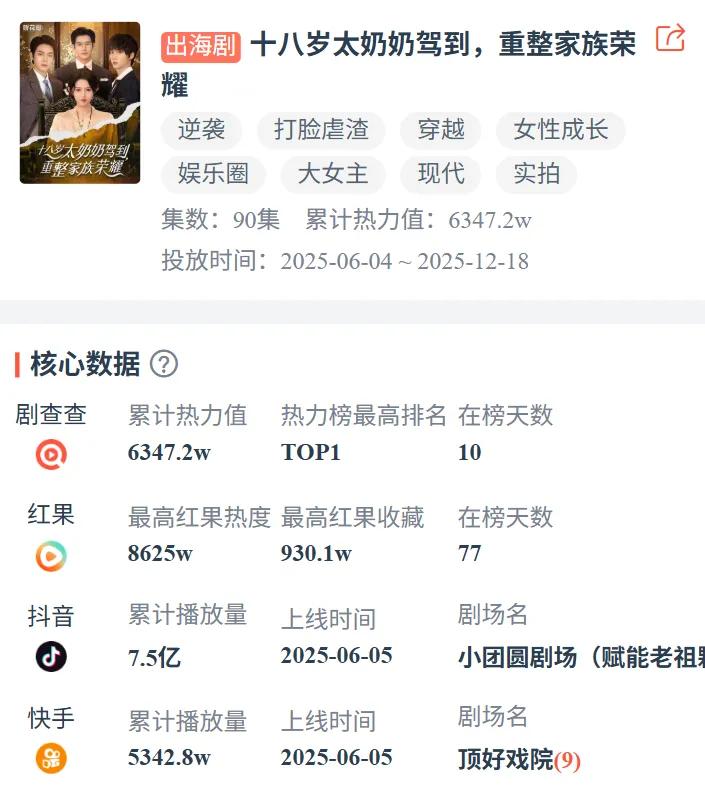
Group 1: Industry Trends - The short drama industry is entering a period of refinement, with micro-short dramas becoming a mainstream entertainment choice by the end of 2025, leading to intensified competition and a shift in focus towards scale, quality, and copyright competition [1] - Popular short dramas such as "Good Girl" and "Eighteen-Year-Old Grandma" have broken viewership records, with "Good Girl" being the first short drama on the Hongguo platform to exceed 10 million collections [1][3] - The phenomenon of top-tier resources concentrating among leading players is evident, creating a closed loop of "high traffic - high revenue sharing - top works," which exacerbates the Matthew effect in the industry [4] Group 2: Operational Strategy Changes - In response to the concentration of resources, mid-tier production companies are adopting differentiated strategies to survive, as exemplified by the Heima Theater under Dianzhong, which saw a 99.4% year-on-year increase in monthly active users, exceeding 50 million by September 2025 [5] - Heima Theater's new partner plan 3.0 emphasizes differentiation through three major upgrades: a quantifiable revenue-sharing model, an incentive category upgrade, and a guaranteed minimum revenue for completed dramas [7][9] Group 3: Differentiation Strategy Implications - The differentiation strategy allows mid-tier players to focus on content quality rather than chasing popular genres, thus meeting diverse user needs and avoiding the pitfalls of homogenization [11] - By implementing a quantifiable revenue-sharing model and a tiered minimum revenue guarantee, mid-tier production companies can reduce trial and error costs and focus on niche topics, creating opportunities for high-quality works [13] - The differentiation strategy contributes to industry upgrades by promoting diverse themes and addressing the issues of content homogenization, leading to a virtuous cycle of "differentiated competition - quality content - revenue reinvestment in creation" [14]

河南:对排名靠前微短剧播出平台建设运营单位一次性给予最高不超过300万元奖励
Zheng Quan Shi Bao Wang· 2025-12-19 10:17
Core Viewpoint - The Henan Provincial Government has released a set of policies aimed at promoting the high-quality development of the micro-short drama industry, with 15 specific measures to enhance content creation and improve the industry chain [1] Group 1: Support for Content Creation and Distribution - The policies encourage the establishment of micro-short drama broadcasting platforms and support companies in building online audio-visual platforms to strengthen their broadcasting business [1] - Local media and platforms with micro-short drama broadcasting qualifications are encouraged to create special columns for high-quality micro-short dramas, with financial rewards of up to 3 million yuan for top-ranking platforms based on content quality, user ratings, and industry influence [1] Group 2: Industry Collaboration and Development - The measures aim to attract micro-short drama platform companies to set up headquarters or functional headquarters in Henan Province, fostering collaboration among local media platforms to create a complementary and competitive micro-short drama promotion matrix [1]
河南:对符合条件的优秀剧本,一次性给予版权方最高不超30万元奖励
Zheng Quan Shi Bao Wang· 2025-12-19 10:16
Core Viewpoint - The Henan Provincial Government has released a set of policies aimed at promoting the high-quality development of the micro-short drama industry, with 15 specific measures to enhance content creation and improve the industry chain, positioning Henan as a competitive hub for micro-short dramas nationally [1] Group 1: Policy Measures - The policies include rewards for outstanding script creation, encouraging writers to participate actively in micro-short drama production [1] - Establishment of a high-quality micro-short drama script database to support ongoing and upcoming projects with financial assistance [1] - Creation of a reserve library for excellent online novels and a platform for the incubation of IP rights and adaptations in the Central Plains region [1] Group 2: Financial Incentives - A one-time reward of up to 300,000 yuan will be given to the copyright holders of excellent scripts selected for various national programs, with each script eligible for only one application [1]
2025年中国数字文娱大会在广州举办
Zhong Guo Jing Ji Wang· 2025-12-19 05:34
Group 1 - The 2025 China Digital Entertainment Conference opened in Guangzhou, focusing on "new technologies, new models, and new business formats" [1] - The conference aims to create a platform for the digital entertainment industry to promote high-quality development in China, with a permanent location in Guangzhou starting in 2024 [1] - Guangzhou's government has approved a policy to support the gaming and esports industry, which will soon be announced to the public [1] Group 2 - The Vice President of Pop Mart International Group emphasized that IP is the core driving force for the company's development and connects global consumers emotionally [2] - The micro-short drama industry is transitioning from "traffic-driven" to "value cultivation," with high-quality content being essential for sustainable industry growth [2] - The "China Entertainment Industry AI Application Development Report" indicates that the digital entertainment market in China will reach 1.75 trillion yuan in 2024, with short video users making up 93.6% of the audience [2]
第一创业晨会纪要-20251219
First Capital Securities· 2025-12-19 03:49
Macro Economic Group - The November CPI in the US was reported at 2.7% year-on-year, lower than the expected 3.1%, indicating a reduction in inflation pressure [4] - The core CPI for November was 2.6%, also below the expected 3.0%, marking the lowest level since early 2021 [4] - The market reacted positively, with the Nasdaq rising by 1.38%, while the S&P 500 and Dow Jones experienced slight declines [4] Industry Comprehensive Group - OpenAI plans to raise $100 billion at an $830 billion valuation by Q1 2026, with sovereign wealth funds expected to participate [7] - The price of electrolytic manganese in China has risen for 13 consecutive days, with a cumulative increase of nearly 15%, reaching an average price of 17,820 yuan/ton, the highest since May 2022 [7] - The average price of electrolytic manganese for the first 11 months of the year was around 15,000 yuan, indicating a more than 7% increase compared to the average price in 2024 [7] - The central economic work conference emphasized stabilizing prices and reducing internal competition, supporting a positive outlook for non-ferrous metals [7] Advanced Manufacturing Group - The price difference between peak and valley electricity rates in 25 provinces has narrowed, with Zhejiang's average price difference dropping from 0.83 yuan/kWh to 0.52 yuan/kWh, leading to a nearly 40% decrease in project returns [9] - The payback period for projects has extended from 5.4 years to 9.1 years due to these changes [9] - The storage industry is experiencing short-term cooling but maintains a long-term positive outlook as demand for storage is expected to rise with increased new energy installations [9] Consumer Group - The micro-short drama sector is entering a golden development phase, with a projected market size of 67.79 billion yuan by 2025, reflecting a year-on-year growth of 34.4% [11] - The industry is transitioning from a single genre to diversified innovation, with IP and branding becoming core growth drivers [11] - Brand collaborations are increasing, with 233 brand cooperation micro-short dramas launched from January to August 2025, indicating a mature monetization path [11]
AI突围战,盯上数字文娱风口
2 1 Shi Ji Jing Ji Bao Dao· 2025-12-18 15:34
Core Insights - The article highlights the rapid growth and transformation of the digital entertainment industry in China, driven by AI technology and changing consumer demands [2][4][9] Industry Overview - The digital entertainment market in China is projected to reach a scale of 1.75 trillion yuan by 2024, indicating continuous market expansion [4] - The "14th Five-Year Plan" emphasizes the importance of cultural and technological integration, guiding the development of new cultural formats [2][4] Emerging Trends - New formats such as micro-short dramas are gaining popularity, with user numbers nearing 700 million and a market size expected to reach 50.4 billion yuan in 2024, reflecting a year-on-year growth of 34.9% [4] - Traditional sectors like gaming and trendy toys are revitalizing through IP innovation and technological empowerment, showcasing a competitive landscape with significant growth potential [4][5] AI Integration - AI is significantly enhancing production efficiency across various entertainment sectors, with game development time reduced from 10 days to just 1 hour for certain tasks [7] - Over 87.2% of companies in the gaming sector believe that AI-generated content (AIGC) technologies will be crucial for reducing development costs and improving creative processes [7] Consumer Engagement - The integration of AI is reshaping content production and business models, transitioning from selling assets to providing tools for unique content generation [8] - The demand for immersive and personalized experiences is driving innovation in content delivery, with AI facilitating tailored recommendations for consumers [9] Future Outlook - The convergence of AI and digital entertainment is expected to create new supply models and business opportunities, enhancing the industry's dynamism and creativity [9] - The future of top IPs may involve a complex ecosystem where AI generates content based on a defined worldview, shifting the focus from content control to ecosystem management [9]

微短剧,如何撑起点众科技的亿元分红?
2 1 Shi Ji Jing Ji Bao Dao· 2025-12-17 12:25
Core Insights - The announcement highlights that Zhangyue Technology (掌阅科技) received a cash dividend of 4.99 million yuan from its stake in Beijing Dianzhong Technology Co., Ltd. (点众科技), which represents 10.12% of the company's audited net profit for 2024 [1] Group 1: Financial Performance - Zhangyue Technology holds a 4.99% stake in Dianzhong Technology, which declared a total cash dividend of 100 million yuan for 2024 [1] - The cash dividend received by Zhangyue Technology amounts to 4.99 million yuan, contributing significantly to its financial performance [1] Group 2: Industry Growth - The micro-short drama industry in China is experiencing rapid growth, with its market size projected to increase from 3.68 billion yuan in 2021 to 50.44 billion yuan in 2024 [4] - Dianzhong Technology has successfully transitioned from mobile reading to micro-short dramas, leveraging its IP advantages for integrated production [4] Group 3: Content Strategy - Content quality is crucial for user engagement, with average daily usage time for micro-short drama apps reaching 120.5 minutes in the first eight months of 2025, a 25.9% increase from January [6] - Dianzhong Technology focuses on enhancing popular genres and addressing potential market gaps, targeting both young audiences and older demographics with tailored content [7] Group 4: Global Expansion - The overseas micro-short drama market generated 1.088 billion USD in revenue in the first half of the year, marking a 249% year-on-year growth [8] - Cultural adaptation is essential for the success of Chinese content in international markets, with Dianzhong Technology emphasizing the need to consider cultural differences in storytelling [8][9] Group 5: Future Outlook - Dianzhong Technology anticipates three major transformations in the short drama industry: consolidation towards leading players, a shift towards localized content, and advancements in technology such as AIGC [9] - The company is exploring AI technologies to enhance content creation and operational efficiency, viewing AI as a significant growth opportunity [9]

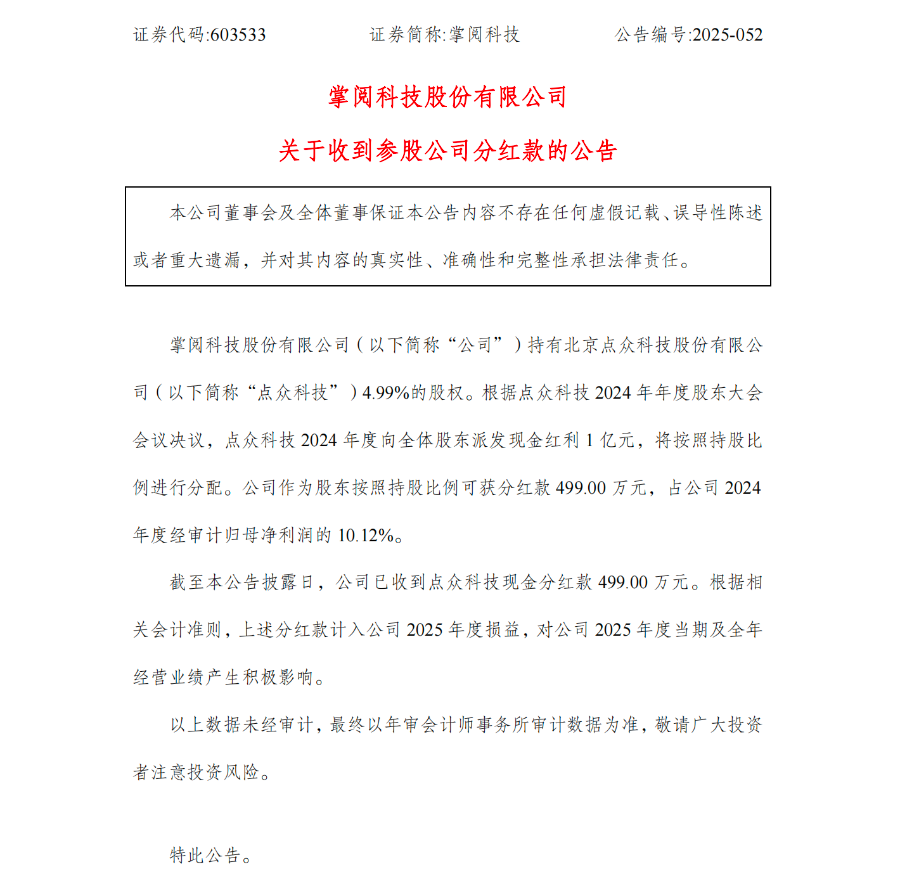
微短剧,如何撑起点众科技的亿元分红?丨出海观察
2 1 Shi Ji Jing Ji Bao Dao· 2025-12-17 12:21
(原标题:微短剧,如何撑起点众科技的亿元分红?丨出海观察) 21世纪经济报道记者 董静怡 日前,掌阅科技发布公告,公司收到参股公司北京点众科技股份有限公司(以下简称"点众科技")派发的 2024年度现金分红款499万元。 公告显示,公司持有点众科技4.99%的股权。根据点众科技2024年年度股东会会议决议,点众科技2024 年度向全体股东派发现金红利1亿元,按照持股比例进行分配。公司作为点众科技股东按照持股比例可 获分红款499万元,占公司2024年度经审计归母净利润的10.12%。 这已是点众科技连续第二年实施亿元级别的现金分红。其能持续大额分红,离不开微短剧业务的迅速发 展。《中国微短剧行业发展白皮书(2025)》显示,中国微短剧行业规模从2021年的36.8亿元跃升至 2024年的504.4亿元。 公开信息显示,点众科技成立于2011年,最初从手机阅读业务起家,2022年9月,公司正式开展网络短 剧业务试运营,发挥自有版权网络文学IP优势,实现了剧本改编、影片拍摄、内容宣发一体化制作。其 短剧业态也在逐渐向海外市场拓展,并逐步深入本土。 在微短剧行业从爆发增长迈向精耕细作的拐点上,如何持续平衡规模与品质 ...
2025微短剧基地报告:产能分化、AI渗透与政策驱动
Sou Hu Cai Jing· 2025-12-16 15:27
主编温静导读:2025年,微短剧基地已完成从产业配角到核心枢纽的身份蜕变,成为推动行业从"野蛮生长"向"高质量发展"转型的关键力量。 在政策引导、技术赋能与市场驱动下,基地形成了多元发展格局,但也面临同质化、人才短缺等挑战。 来源:传媒内参—视听快评 2025年,中国微短剧行业完成了从"流量红利驱动"向"产业生态驱动"的关键转型,作为产业核心生产载体的微短剧基地,也实现了从单一拍摄场地到"创 作孵化-人才培养-技术应用-商业变现"全链条中枢的升级。在全产业链市场产值迈向千亿级的背景下,微短剧基地已成为文化产业布局的战略支点,其发 展格局直接映射行业发展水平。 政策引导下的区域集群化竞争 2025年微短剧基地呈现"传统影视重镇坚守、新兴城市突围"的格局,政策扶持与成本优势成为区域竞争的核心变量,形成了多极发展的产业版图。 (一)区域分布:从单点突破到集群成型 根据艾媒咨询《2025年中国微短剧产业综合实力城市榜》,北京凭借文化资源优势仍居首位,但西安、郑州异军突起跻身第二梯队,广州、深圳紧随其 后,打破了传统影视产业的地理格局。这种格局重构背后,是不同城市基于资源禀赋的差异化布局: • 北方核心区以北京、郑州为 ...