
消费品制造业

Search documents
重要数据公布!同比增长20.4%
Zhong Guo Zheng Quan Bao· 2025-09-27 02:58
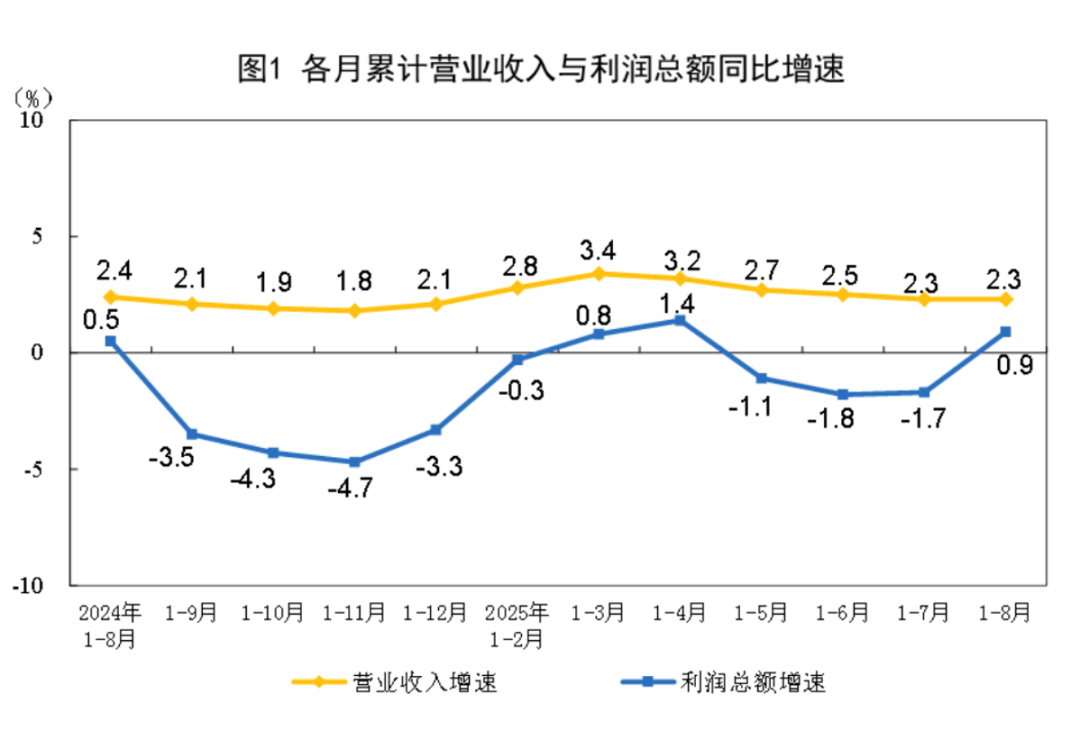
Core Insights - The total profit of industrial enterprises above designated size in China reached 46,929.7 billion yuan from January to August, marking a year-on-year increase of 0.9% [1][4] - In August, profits for these enterprises saw a significant turnaround, growing by 20.4% year-on-year, compared to a decline of 1.5% in July [1][4] - The recovery in profits is attributed to effective macro policies, the deepening of a unified national market, and a low base from the previous year [1][4] Profit Trends - From January to August, the profit decline of industrial enterprises was reversed, with a shift from a 1.7% decrease in the first seven months to a 0.9% increase [4] - Revenue for these enterprises also showed stable growth, with a 2.3% year-on-year increase from January to August, and a 1.9% increase in August alone [4] - Different scales of enterprises saw profit improvements, with private enterprises experiencing a notable profit growth of 3.3%, surpassing the average growth of all industrial enterprises [4][6] Cost and Profitability - In August, the cost per hundred yuan of revenue for industrial enterprises decreased by 0.20 yuan, marking the first year-on-year decline since July 2024 [5] - The profit margin for these enterprises improved to 5.83%, reflecting a year-on-year increase of 0.90 percentage points [5] Sector Performance - The equipment manufacturing sector played a crucial role, with profits growing by 7.2% from January to August, contributing 2.5 percentage points to the overall profit growth of industrial enterprises [6] - Among the eight industries within equipment manufacturing, seven reported profit increases, with notable growth in the railway, shipping, aerospace, and electrical machinery sectors [6][7] - The raw materials manufacturing sector also saw significant profit growth of 22.1%, while the consumer goods manufacturing sector turned from a 2.2% decline to a 1.4% increase in profits [6][7] Future Outlook - The government emphasizes the need to expand domestic demand and further develop a unified national market to support the continuous recovery of industrial enterprise profits [7]

刚刚,利好来了!国家统计局公布重磅经济数据
天天基金网· 2025-09-27 02:44
Core Viewpoint - In the first eight months of 2025, the profits of large-scale industrial enterprises in China increased by 0.9% year-on-year, driven by macroeconomic policies, the deepening of a unified national market, and a low base from the previous year [2][6]. Group 1: Profit Growth - From January to August 2025, the total profit of large-scale industrial enterprises reached 46,929.7 billion yuan, marking a year-on-year increase of 0.9% [6]. - The manufacturing sector saw a profit increase of 7.4%, while the electricity, heat, gas, and water production and supply sector grew by 9.4%. The mining sector, however, experienced a decline of 30.6% [6][7]. - In August alone, profits for large-scale industrial enterprises surged by 20.4%, reversing a 1.5% decline in July [10]. Group 2: Revenue Stability - The operating revenue of large-scale industrial enterprises grew by 2.3% year-on-year from January to August, remaining stable compared to the previous month [3][6]. - In August, the operating revenue increased by 1.9%, which was an acceleration of 1.0 percentage point compared to July [3]. Group 3: Sector Performance - The equipment manufacturing sector played a significant role, with profits increasing by 7.2%, contributing 2.5 percentage points to the overall profit growth of large-scale industrial enterprises [3][4]. - The raw materials manufacturing sector saw a profit increase of 22.1%, while the consumer goods manufacturing sector turned from a 2.2% decline in July to a 1.4% growth in August [4][5]. Group 4: Enterprise Size and Type - Profits improved across different enterprise sizes, with medium and small enterprises seeing increases of 2.7% and 1.5%, respectively. Private enterprises outperformed with a profit growth of 3.3% [5][6]. - State-owned enterprises experienced a profit decline of 1.7%, while joint-stock enterprises saw a profit increase of 1.1% [6]. Group 5: Cost and Profitability - In August, the cost per 100 yuan of operating revenue decreased by 0.20 yuan, marking the first year-on-year decline since July 2024 [5]. - The operating profit margin for large-scale industrial enterprises was 5.83% in August, reflecting a year-on-year increase of 0.90 percentage points [5][9].

宏观政策发力叠加低基数效应,前8个月工业利润同比由负转正
Xin Lang Cai Jing· 2025-09-27 02:27
Core Viewpoint - In August, profits of industrial enterprises above designated size turned from a decline of 1.5% in the previous month to a growth of 20.4% year-on-year, indicating a recovery in the industrial sector driven by macro policies and a low base from the previous year [1] Group 1: Industrial Profit Trends - From January to August, profits of industrial enterprises increased by 0.9% year-on-year, compared to a decline of 1.7% in the previous month [1] - The manufacturing sector saw a profit growth of 7.4%, accelerating by 2.6 percentage points compared to January-July [1] - The electricity, heat, gas, and water production and supply sector experienced a profit growth of 9.4%, accelerating by 5.5 percentage points [1] - The mining sector faced a decline of 30.6%, but the rate of decline narrowed by 1.0 percentage points [1] Group 2: Sector-Specific Performance - In the equipment manufacturing sector, profits grew by 7.2%, contributing 2.5 percentage points to the overall profit growth of industrial enterprises, marking it as one of the strongest sectors [1] - Among the eight industries in the equipment manufacturing sector, seven reported profit growth, with the railway, shipbuilding, and aerospace industries seeing significant increases of 37.3% and 11.5% respectively [3] - The raw materials manufacturing sector saw a profit increase of 22.1%, accelerating by 10.0 percentage points, contributing 2.5 percentage points to overall industrial profit growth [3] - The steel industry turned from loss to profit, achieving a total profit of 83.7 billion yuan, while the non-ferrous industry profits grew by 12.7%, accelerating by 5.8 percentage points [3] Group 3: Consumer Goods Sector - The consumer goods manufacturing sector turned from a decline of 2.2% in January-July to a growth of 1.4% in January-August, with the beverage and agricultural products industries showing rapid profit growth of 19.9% and 11.8% respectively [4] - These sectors collectively contributed 1.0 percentage point to the overall profit growth of industrial enterprises [4] Group 4: Economic Outlook - Analysts expect a continued moderate recovery in industrial profits, supported by improved market conditions and policy measures aimed at sustaining demand [4] - The emphasis on "sustained efforts and timely reinforcement" in policy is expected to support profit quality through improved market competition and cost distribution mechanisms [4] - However, the sustainability of profit growth remains contingent on effective demand and reasonable recovery of industrial product prices [4]
1—8月份规模以上工业企业利润同比实现增长
Guo Jia Tong Ji Ju· 2025-09-27 02:19
国家统计局工业司首席统计师于卫宁解读2025年1—8月份工业企业利润数据 1—8月份,在宏观政策发力显效、全国统一大市场纵深推进,叠加去年同期低基数等多重因素作用下, 规模以上工业企业利润同比增长0.9%,装备制造业支撑有力,不同规模企业利润均有所改善。 工业企业利润明显改善。1—8月份,规模以上工业企业利润由1—7月份同比下降1.7%转为增长0.9%, 扭转了自今年5月份以来企业累计利润持续下降态势。从三大门类看,1—8月份,制造业增长7.4%,较 1—7月份加快2.6个百分点;电力、热力、燃气及水生产和供应业增长9.4%,加快5.5个百分点;采矿业 下降30.6%,降幅收窄1.0个百分点。从月度看,8月份规模以上工业企业利润两位数增长,由7月份下降 1.5%转为增长20.4%,工业企业当月利润改善明显。 下阶段,在外部环境严峻复杂、国内市场需求仍显不足的背景下,要全面贯彻落实党中央决策部署,进 一步扩大国内需求,纵深推进全国统一大市场建设,规范企业竞争秩序,为工业企业利润持续恢复创造 更多有利条件。 资讯编辑:费斐 021-26093397 资讯监督:乐卫扬 021-26093827 资讯投诉:陈跃进 0 ...
国家统计局工业司首席统计师于卫宁解读2025年1—8月份工业企业利润数据
Xin Hua Wang· 2025-09-27 01:43
1—8月份规模以上工业企业利润同比实现增长 ——国家统计局工业司首席统计师于卫宁解读2025年1—8月份工业企业利润数据 1—8月份,在宏观政策发力显效、全国统一大市场纵深推进,叠加去年同期低基数等多重因素作用 下,规模以上工业企业利润同比增长0.9%,装备制造业支撑有力,不同规模企业利润均有所改善。 工业企业利润明显改善。1—8月份,规模以上工业企业利润由1—7月份同比下降1.7%转为增长 0.9%,扭转了自今年5月份以来企业累计利润持续下降态势。从三大门类看,1—8月份,制造业增长 7.4%,较1—7月份加快2.6个百分点;电力、热力、燃气及水生产和供应业增长9.4%,加快5.5个百分 点;采矿业下降30.6%,降幅收窄1.0个百分点。从月度看,8月份规模以上工业企业利润两位数增长, 由7月份下降1.5%转为增长20.4%,工业企业当月利润改善明显。 8月企业单位成本下降,营收利润率回升。8月份,规模以上工业企业成本状况有所改善,每百元营 业收入中的成本同比减少0.20元,为2024年7月份以来首次当月同比减少。8月份,规模以上工业企业营 业收入利润率为5.83%,同比提高0.90个百分点。 下阶段,在外 ...
前八月固定资产投资稳定增长,高技术制造业带动作用明显
2 1 Shi Ji Jing Ji Bao Dao· 2025-09-15 14:05
Economic Overview - In the first eight months of the year, national fixed asset investment (excluding rural households) reached 326.111 billion yuan, with a year-on-year growth of 0.5%. Excluding real estate development investment, fixed asset investment grew by 4.2% [1] - Infrastructure investment increased by 2.0% year-on-year, while manufacturing investment rose by 5.1%. Real estate development investment saw a decline of 12.9% [1] Manufacturing Sector - Manufacturing investment grew by 5.1%, outpacing overall investment growth by 4.6 percentage points, contributing 1.3 percentage points to total investment growth [1] - Investment in consumer goods manufacturing increased by 9.0%, and equipment manufacturing investment grew by 3.2%. High-tech manufacturing sectors, such as aerospace and computer equipment, saw significant investment growth of 28.0% and 12.6%, respectively [1] Investment Trends - The data indicates a structural shift in investment, with a notable increase in investments related to downstream and consumer-related industries, reflecting a trend towards demand-driven investment [1] - The real estate sector is transitioning from a focus on new growth to managing existing stock, indicating a shift in investment strategy [1] Private Investment - Private investment decreased by 2.3% year-on-year, but when excluding real estate development, it grew by 3.0% [2] - The government is implementing measures to stimulate private investment, focusing on removing barriers and enhancing support for private enterprises [3][4] Consumer Demand - The third batch of consumer goods replacement policies has been implemented, contributing to the release of consumer demand and driving sales growth in related goods [2] - In August, retail sales of household appliances and cultural office supplies continued to show double-digit growth, indicating strong consumer demand [2] Future Outlook - The government aims to maintain a stable economic environment while promoting high-quality development through various macroeconomic policies [3] - The focus will be on enhancing the investment environment for private enterprises, particularly in green industries and future technologies [3][4]
活力中国调研行|持续上“新”,各地多维发力点燃消费“引擎”
Yang Shi Wang· 2025-09-15 13:42
Group 1: Economic Growth and Consumer Demand - The core focus of this year's economic work is to boost consumption, expand domestic demand, and improve people's livelihoods [1][23] - In the first half of this year, Sichuan's retail sales of consumer goods increased by 5.6%, surpassing the national average by 0.6 percentage points [3][10] - Hubei's GDP grew by 6.2% in the first half of the year, ranking third in the country, with major economic indicators performing better than the national average [10][15] Group 2: Regional Initiatives and Strategies - Sichuan is implementing various policies to stimulate consumption, including the introduction of 21 measures to stabilize growth and hosting events like the China (Sichuan) International Panda Consumption Festival [3][5] - Hubei is focusing on building a modern logistics system to enhance consumption, with significant developments in transportation infrastructure such as the Huahu International Airport and the Wuhan Yangluo Port [13][15] - Fujian is prioritizing the expansion of domestic demand as a key driver for economic growth, achieving a GDP growth of 5.7% in the first half of the year, the highest since 2022 [17][19] Group 3: Tourism and Cultural Integration - Sichuan's tourism sector saw an 8.4% increase in ticket revenue and a 23.3% rise in overall tourism income from January to July [5][6] - Fujian is enhancing its tourism offerings, with a 12.5% increase in total visitors and a 15.7% rise in tourism spending in the first half of the year [21][23] - The integration of culture and tourism is emphasized across all three regions, with initiatives aimed at creating immersive experiences and enhancing consumer engagement [6][21] Group 4: Employment and Income Generation - Hubei is focusing on creating jobs and increasing income to form a virtuous cycle of employment, income, consumption, and domestic demand [15][11] - The province has implemented five major actions to tap into consumption potential and promote supply upgrades [15][10] - Fujian is also working on improving the living standards of its citizens through various reforms in employment, education, and social welfare [23][19]

政策助力制造业加速转型
Jing Ji Ri Bao· 2025-09-13 22:10
Core Insights - The manufacturing industry in China is accelerating its transformation towards high-end, intelligent, and green development, with significant growth in high-tech and digital product manufacturing [1][6] - The "Two New" and "Two Heavy" policies have effectively supported industrial structure adjustment and high-end industry development, contributing to overall industrial growth [2][3] Group 1: Industry Growth and Transformation - The added value of high-tech manufacturing increased by 9.5% year-on-year, contributing 23.3% to the overall industrial growth [2] - The equipment manufacturing sector's added value drove a 3.4 percentage point increase in total industrial growth, accounting for 35.5% of the total [2] - The value of green factories has surpassed 20% of total manufacturing output, indicating a shift towards sustainable practices [1][6] Group 2: Policy Impact - The "Two New" policies have stimulated traditional industries' equipment upgrades and technology transformations, leading to a 17.3% increase in investment in equipment and tools [3] - The special government bonds for equipment updates have increased to 200 billion yuan, supporting various sectors including environmental infrastructure [3] - The consumption upgrade initiative has driven sales exceeding 1.6 trillion yuan across five major consumer categories [3] Group 3: Digitalization and Innovation - Digital transformation is enhancing production efficiency, with examples such as a 15% increase in production efficiency and a 10% reduction in delivery times in traditional manufacturing [4] - The integration of AI and digital technologies is reshaping traditional industries, leading to new product developments and improved supply chain collaboration [5] - The number of 5G base stations reached 4.55 million, with over 1.11 billion mobile users, facilitating the growth of digital applications in various sectors [6][7] Group 4: Future Directions - The industry is expected to continue its high-quality transformation, with a focus on technological innovation and the integration of AI in key manufacturing sectors [7] - The establishment of a green low-carbon standard system is underway, aiming to enhance sustainable development in the manufacturing sector [7]
活力中国调研行丨智能制造加力消费潜能释放
Jing Ji Ri Bao· 2025-09-08 00:34
Group 1: Manufacturing and Economic Contribution - Fujian is a major manufacturing province, producing 1 in 5 pairs of sports shoes and 1 in 3 automotive glass globally, with the new energy vehicle battery market share being the largest in the world [1] - In 2024, the revenue of Fujian's consumer goods industry is expected to reach nearly 2.5 trillion yuan, accounting for 42% of the province's industrial revenue, laying a solid foundation for boosting consumption [1] Group 2: Technological Integration and Innovation - The establishment of the global fashion industry brain in Fujian integrates data from 1.27 million designers, covering popular styles, global trade trends, and consumer preferences in the sportswear sector [1][2] - The innovation center combines 12 different spaces, including trend libraries and AI design centers, to merge fashion with technology, aiming to explore consumer growth and accelerate traditional industry transformation [2] Group 3: Food Industry Development - Fujian's food industry is undergoing smart upgrades, with companies like Panpan Food utilizing 5G and AI to monitor production and reduce energy consumption by approximately 28% [3] - The promotion of traditional dishes like Buddha Jumps Over the Wall is being scaled up through modern techniques and national patents, making it more accessible to the public [4] Group 4: Consumer Market Performance - In the first seven months of the year, Fujian's total retail sales of consumer goods reached 1.456 trillion yuan, showing a year-on-year growth of 5.8%, indicating a vibrant consumer market [5]
7月工业企业利润降幅收窄,高技术制造业利润大幅回升
Ge Lin Qi Huo· 2025-08-28 08:58
Group 1: Investment Rating - Not provided Group 2: Core Viewpoints - In July, the decline in profits of large-scale industrial enterprises narrowed, and the profits of the manufacturing industry, especially high-tech manufacturing, rebounded significantly year-on-year. Whether this trend can continue is worthy of attention. The implementation of anti-involution policies and the narrowing of the year-on-year decline in PPI are beneficial to the year-on-year recovery of industrial enterprise profits [3][14] Group 3: Summary by Relevant Content Operating Income and Profit - From January to July, large-scale industrial enterprises achieved operating income of 78.07 trillion yuan, a year-on-year increase of 2.3%. In July, the operating income of large-scale industrial enterprises increased by 0.9% year-on-year. The total profit was 402.035 billion yuan, a year-on-year decrease of 1.7%. In July, the profit of large-scale industrial enterprises decreased by 1.5% year-on-year [1][4] - From January to July, private industrial enterprises' total profit increased by 1.8% year-on-year, and in July, their profit increased by 2.6% year-on-year [4] - From January to July, large-scale manufacturing enterprises achieved a total profit of 3.02 trillion yuan, a year-on-year increase of 4.8%. In July, manufacturing profits increased by 6.8% year-on-year, 5.4 percentage points faster than in June [2][7] - In July, the profit of raw material manufacturing turned from a 5.0% decline in June to a 36.9% increase. The consumer goods manufacturing industry decreased by 4.7%, with the decline narrowing by 3.0 percentage points compared to June. The profit of high-tech manufacturing turned from a 0.9% decline in June to an 18.9% increase [2][7] - Industries with relatively fast year-on-year profit growth from January to July include the ferrous metal smelting and rolling processing industry (5175.9%), non-ferrous metal mining and dressing industry (39.1%), etc. Industries with relatively large year-on-year profit declines include the coal mining and washing industry (-55.2%), ferrous metal mining and dressing industry (-33.7%), etc. [8] Operating Income Profit Margin - From January to July, the operating income profit margin of large-scale industrial enterprises was 5.15%, a year-on-year decrease of 0.25 percentage points. The manufacturing industry was 4.46%, slightly higher than the same period last year but about one percentage point lower than the same period in 2019. The mining industry was 16.75%, still higher than the same period in 2019. The production and supply of electricity, heat, gas, and water was 6.92%, better than the same period last year and higher than the same period in 2019 [2][9] Asset - Liability Ratio - At the end of July, the asset - liability ratio of large-scale industrial enterprises was 57.9%, a year-on-year increase of 0.3 percentage points. The asset - liability ratio of large-scale manufacturing enterprises was 57.2%, a year-on-year increase of 0.1 percentage point. Both are at the highest levels for the same period in the past decade [3][10] Accounts Receivable and Inventory - At the end of July, the average collection period of accounts receivable of large-scale industrial enterprises was 69.8 days, a year-on-year increase of 3.4 days, and that of large-scale manufacturing enterprises was 70.8 days, a year-on-year increase of 2.9 days, both at the highest levels for the same period since 2015, putting pressure on corporate cash flow [3][13] - From January to July, the cumulative year-on-year growth of finished product inventory of large-scale industrial enterprises was 2.4%. Industrial enterprises controlled a small year-on-year increase in finished product inventory under the circumstances of falling ex-factory prices, negative year-on-year net profit growth, longer accounts receivable periods, and rising debt ratios [3][13]