电信服务

Search documents
2025年度A股大数据排行榜
Wind万得· 2025-12-31 22:50
Market Overview - In 2025, the A-share market exhibited a comprehensive upward trend, with major indices showing an average increase of over 10%. The growth was particularly pronounced in growth sectors, with the ChiNext Index, North Exchange 50, and Sci-Tech 50 indices each rising by over 30% [1][3]. - The structural characteristics of the market were evident, with technology and resource sectors leading the performance. The optical module (CPO) index surged by over 180%, while indices for optical chips, copper-clad laminates, optical communications, and optical circuit switches all exceeded 100% growth [1][3]. A-share Index Performance - The ChiNext Index led the gains in 2025 with a cumulative increase of 49.57%. The North Exchange 50 and Sci-Tech 50 indices followed with increases of 38.80% and 35.92%, respectively. Other indices such as the Shenzhen Component Index, Wind All A, and CSI 1000 also saw gains exceeding 20% [3]. A-share Industry Performance - Among the 35 industries classified by Wind, 31 recorded increases in 2025. The non-ferrous metals industry topped the list with a cumulative increase of 92.20%. Hardware equipment and industrial trade sectors also performed well, with increases of 62.39% and 54.65%, respectively. Conversely, the daily consumer retail sector saw a decline of 6.42% [5]. A-share Hot Concepts - The optical module (CPO) index was the strongest performer in 2025, with a cumulative increase of 181.28%. Other notable performers included optical chips (130.78%), copper-clad laminates (129.58%), optical communications (125.58%), and optical circuit switches (112.55%). The rare metals, copper industry, and rare earth indices also showed significant growth, with increases of 119.85%, 103.64%, and 98.97%, respectively [9]. A-share Market Capitalization - By the end of 2025, the total market capitalization of the A-share market reached approximately 118.91 trillion yuan, marking a 26.6% increase from the end of 2024 [15]. - The Shanghai main board had the highest number of listed companies at 1,699, accounting for 31.06% of the total. The Shenzhen main board followed with 1,490 companies (27.24%), while the ChiNext and Sci-Tech boards had 1,393 and 600 companies, representing 25.47% and 10.97%, respectively [13]. Financing and Investment Trends - As of the end of 2025, the A-share margin trading balance was reported at 25.553 billion yuan, reflecting a 5.21% increase from the third quarter and a year-on-year increase of 35.91% [22]. - The top gainers in terms of stock price included Weiwei New Materials, which saw a cumulative increase of 1,820%, followed by Tianpu Co., with a 1,645% increase. Conversely, Shijin Technology led the decline with a 51% drop [24]. IPO Activity - In 2025, the A-share market saw a total of 112 IPOs, representing a 9.8% increase year-on-year. The fourth quarter alone accounted for 36 IPOs, up 9.1% from the previous year [49]. - The total fundraising from IPOs in 2025 reached 130.83 billion yuan, a significant increase of 97.4% year-on-year, with the fourth quarter alone raising 54.86 billion yuan, up 165.0% [51].


中国联通取得物联网数据高效推送专利
Sou Hu Cai Jing· 2025-12-30 12:31
Group 1 - China United Network Communications Group Co., Ltd. has obtained a patent for "Method, Device, Cloud Platform, Medium, and Product for Pushing IoT Data," with authorization announcement number CN119996506B, and the application date is February 2025 [1] - China United Network Communications Group Co., Ltd. was established in 1994, located in Beijing, and primarily engages in telecommunications, broadcasting, television, and satellite transmission services, with a registered capital of approximately 10.48 billion RMB [1] - The company has invested in 35 enterprises, participated in 3,332 bidding projects, and holds 3,734 trademark records and 5,000 patent records, along with 11 administrative licenses [1] Group 2 - Unicom Digital Technology Co., Ltd., established in 2006 and located in Beijing, focuses on software and information technology services, with a registered capital of approximately 988.98 million RMB [2] - The company has invested in 54 enterprises, participated in 5,000 bidding projects, and holds 24 trademark records and 1,959 patent records, along with 42 administrative licenses [2] Group 3 - Unicom Internet of Things Co., Ltd., established in 2018 and located in Nanjing, primarily engages in software and information technology services, with a registered capital of 100 million RMB [2] - The company has participated in 1,694 bidding projects, holds 47 trademark records and 222 patent records, along with 6 administrative licenses [2]

中国联通取得登录安全控制方法专利
Sou Hu Cai Jing· 2025-12-26 06:02
Group 1 - The core point of the article is that China United Network Communications Group Co., Ltd. has obtained a patent for a security control method related to login, with the patent number CN118432931B and an application date of May 2024 [1] - China United Network Communications Group Co., Ltd. was established in 1994 and is based in Beijing, primarily engaged in telecommunications, broadcasting, television, and satellite transmission services. The registered capital of the company is approximately 10.48 billion RMB [1] - The company has invested in 35 enterprises, participated in 3,324 bidding projects, and holds 3,738 trademark records and 5,000 patent records, along with 11 administrative licenses [1] Group 2 - Unicom Online Information Technology Co., Ltd., established in 2006 and also based in Beijing, focuses on software and information technology services, with a registered capital of 400 million RMB [1] - This subsidiary has invested in 10 enterprises, participated in 2,041 bidding projects, and has 57 trademark records and 658 patent records, in addition to 6 administrative licenses [1]
鼓励外商投资目录迎扩容,先进制造、现代服务业是重点
Xin Lang Cai Jing· 2025-12-24 07:56
Core Viewpoint - The release of the "Encouragement Directory for Foreign Investment Industries (2025 Edition)" aims to attract and utilize foreign investment more effectively, with new regulations set to take effect on February 1, 2026 [1][5]. Summary by Categories Changes in the Encouragement Directory - The new directory includes a total of 1,679 entries, with a net increase of 205 entries and 303 modifications compared to the 2022 version [1][5]. - The national directory for encouraging foreign investment now has 619 entries, an increase of 100, while the directory for advantageous industries in central and western regions has 1,060 entries, with an increase of 105 [1][5]. Focus Areas for Foreign Investment - The directory emphasizes three main areas for foreign investment: 1. **Advanced Manufacturing**: New or expanded entries in terminal products, components, and raw materials to enhance the development of industrial and supply chains [2][6]. 2. **Modern Services**: New or expanded entries in business services, technical services, scientific research, and service consumption to promote high-quality development in the service sector [2][6]. 3. **Regional Investment**: Encouragement for foreign investment in central and western regions, northeastern regions, and Hainan Province, tailored to local resources and industrial development [3][7]. Foreign Investment Trends - From January to November 2025, China utilized 693.18 billion RMB in foreign investment, a year-on-year decrease of 7.5%, but with a significant monthly increase of 26.1% in November [3][7]. - The number of newly established foreign-invested enterprises reached 61,207, marking a growth of 16.9% [3][7]. Future Strategies for Attracting Foreign Investment - The National Development and Reform Commission (NDRC) plans to enhance foreign investment through three strategies: 1. **Expanding Foreign Capital Inflow**: Utilizing major foreign investment projects to create a green channel for project construction and addressing national-level issues related to land, sea use, environmental assessments, and energy consumption [3][7]. 2. **Improving Satisfaction of Foreign Enterprises**: Conducting special actions to understand and resolve issues faced by foreign enterprises in investment and operations, while enhancing communication with foreign investors [3][7]. 3. **Building Investment Cooperation Platforms**: Organizing international investment cooperation activities to facilitate project negotiations and signings [4][8].
“十五五”数据资源开发利用系列解读四 健全数据付费机制 激活“十五五”时期“人工智能+”发展新动能
Ren Min Wang· 2025-12-23 08:09
Core Viewpoint - The articles emphasize the importance of establishing a data payment mechanism to activate the value of high-quality data, which is crucial for the development of artificial intelligence and the overall digital economy in China [1][2][3]. Group 1: Data Payment Mechanism - The establishment of a data payment mechanism is essential for addressing the core bottlenecks in the marketization of data elements and ensuring a continuous supply of high-quality data [2][3]. - A clear and reasonable payment mechanism serves as a "market benchmark" for data value, guiding efficient resource allocation by reflecting the true demand and value of data across different industries and applications [3][4]. - The payment mechanism is vital for solidifying the foundation of the artificial intelligence industry and mitigating security risks by incentivizing the production of high-quality data [3][4]. Group 2: Building a New Data Payment Ecosystem - A new data payment ecosystem should be constructed around three core aspects: quantifying value, ensuring circulation, and incentivizing application [4][5]. - A dynamic pricing mechanism based on scientific assessment and contribution recognition should be established, including a quality certification system and innovative pricing models [4][5]. - A secure circulation system supported by trustworthy data infrastructure is necessary to facilitate data transactions, including the establishment of a national-level secure circulation platform [5]. - The cultivation of application scenarios that demonstrate the tangible benefits of data is crucial for realizing data value, which includes creating benchmark projects and encouraging enterprises to manage data as core assets [5].

咪咕文化取得音频处理方法专利
Sou Hu Cai Jing· 2025-12-23 04:13
Group 1 - The State Intellectual Property Office of China has granted a patent titled "Audio Processing Method, Device, Equipment, and Computer-Readable Storage Medium" to Migu Culture Technology Co., Ltd. and China Mobile Communications Group Co., Ltd. The patent was applied for on November 2022 [1] - Migu Culture Technology Co., Ltd. was established in 2014 and is based in Beijing, primarily engaged in software and information technology services. The company has a registered capital of 1,040 million RMB and has invested in 9 companies, participated in 2,574 bidding projects, and holds 982 trademark records and 2,773 patent records [1] - China Mobile Communications Group Co., Ltd. was founded in 1999 and is also located in Beijing, focusing on telecommunications, broadcasting, television, and satellite transmission services. The company has a registered capital of 30,000 million RMB, has invested in 54 companies, participated in 5,000 bidding projects, and holds 2,219 trademark records and 5,000 patent records [1]

中国联通取得数据溯源方法和装置专利
Sou Hu Cai Jing· 2025-12-23 03:56
Group 1 - The State Intellectual Property Office of China has granted a patent titled "A Data Traceability Method and Device" to China United Network Communications Group Co., Ltd. and Unicom Group Financial Co., Ltd., with the patent announcement number CN116088874B and an application date of December 2022 [1] - China United Network Communications Group Co., Ltd. was established in 1994 and is based in Beijing, primarily engaged in telecommunications, broadcasting, television, and satellite transmission services. The company has a registered capital of 10,481,551,957.532 RMB [1] - The company has invested in 35 enterprises, participated in 3,322 bidding projects, and holds 3,738 trademark records and 5,000 patent records, along with 11 administrative licenses [1] Group 2 - Unicom Group Financial Co., Ltd. was established in 2016 and is also based in Beijing, focusing on monetary financial services. The company has a registered capital of 300,000,000 RMB [1] - The financial company has participated in 297 bidding projects, holds 6 patent records, and possesses 4 administrative licenses [1]
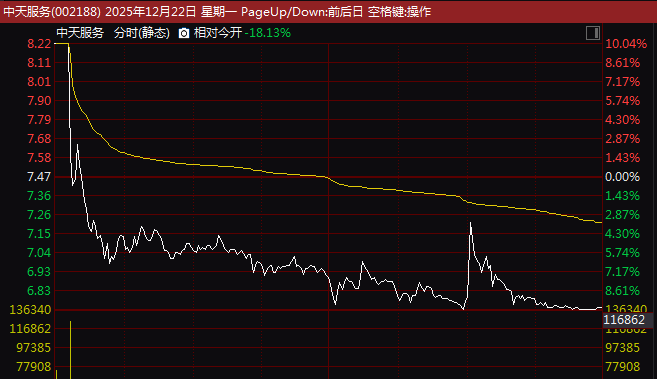
牛股突变!002188、603679,准“天地板”!
Zheng Quan Shi Bao Wang· 2025-12-22 08:27
Market Overview - The A-share market showed strong performance today, with the Shanghai Composite Index recovering above 3900 points, and both the ChiNext Index and the STAR Market Index rising over 2% [1] - The total market turnover increased to 1.88 trillion yuan, indicating a moderate rise in trading activity [1] Sector Performance - Leading sectors included Hainan local stocks, communication equipment, precious metals, and electrical machinery, all showing significant gains [1] - Conversely, sectors such as film and theater, real estate, telecommunications services, and pharmaceutical commerce experienced declines [1] Stock Movements - Some previously popular stocks experienced volatility, with Zhongtian Service (002188) opening at the daily limit but quickly falling, even touching the limit down during trading [1] - Huati Technology (603679) also opened at the daily limit but faced a sharp decline, closing just above the limit down price [3] - Other stocks like Bona Film Group (001330), Luokai Co. (603829), and Nanjing Commercial Travel (600250) closed at the limit down [3] Fund Flows - The electronics sector saw a net inflow of over 25.4 billion yuan, while the communication sector received over 11.9 billion yuan [5] - Other sectors with significant net inflows included power equipment (over 9.7 billion yuan), basic chemicals, and non-ferrous metals (each over 6 billion yuan) [5] - The banking sector experienced a net outflow of over 2.2 billion yuan, with media and public utilities also seeing outflows exceeding 1 billion yuan [6] Precious Metals Market - Precious metals stocks surged, with the sector index rising over 4%, reaching a two-month high, and all stocks in the sector recording gains [6] - As of the report, spot gold prices in London surpassed $4420 per ounce, setting a historical high, while silver approached $70 per ounce, also a record [6] - Domestic gold futures contracts broke through 1000 yuan, nearing historical highs, with silver futures rising over 6% to set new records [6] Global Gold Market Trends - According to the World Gold Council, global physical gold ETF inflows reached $5.2 billion in November, marking six consecutive months of inflows [7] - By the end of November, total assets under management increased to $530 billion, a 5.4% month-over-month growth, with total holdings rising 1% to 3932 tons, both reaching new highs [7] - Long-term projections suggest that if real interest rates decline by 100 basis points and central bank gold purchases remain around 1000 tons, gold prices could stabilize between $5400 and $5600 per ounce by 2026 [7]
光环新网:12月18日召开董事会会议
Mei Ri Jing Ji Xin Wen· 2025-12-18 08:00
Group 1 - The core viewpoint of the article is that Guanghuan Xinnet (SZ 300383) announced its fourth board meeting for 2025, where it reviewed a proposal for bank credit application [1] - For the first half of 2025, Guanghuan Xinnet's revenue composition shows that the telecommunications service industry accounts for 98.6%, while other services account for 1.4% [1] - As of the report date, Guanghuan Xinnet has a market capitalization of 22.5 billion yuan [1]

摩根大通减持中国铁塔约401.97万股 每股作价约12.25港元
Zhi Tong Cai Jing· 2025-12-17 12:08
Core Viewpoint - Morgan Stanley has reduced its stake in China Tower Corporation (00788) by selling 4,019,718 shares at a price of HKD 12.2516 per share, totaling approximately HKD 49.248 million, resulting in a new holding of about 278 million shares, representing 5.96% ownership [1] Group 1 - Morgan Stanley sold 4,019,718 shares of China Tower Corporation on December 12 [1] - The sale price per share was HKD 12.2516, leading to a total transaction value of approximately HKD 49.248 million [1] - After the reduction, Morgan Stanley's remaining shares in China Tower Corporation are approximately 278 million, equating to a 5.96% ownership stake [1]