
高技术制造业

Search documents
9.5% 创新动能加快积聚
Jing Ji Ri Bao· 2025-07-21 22:04
Group 1: Economic Growth and Innovation - The added value of high-tech manufacturing in China increased by 9.5% year-on-year in the first half of the year, contributing 23.3% to the overall industrial growth [1] - R&D expenditure as a percentage of GDP in China has approached 2.7%, surpassing the EU average and nearing the OECD average [2] - The number of effective invention patent applications in China reached nearly 5 million in the first five months, growing by 12.8% [2] Group 2: Technological Advancements - Significant technological achievements include the launch of DeepSeek model, amphibious firefighting aircraft AG600 receiving certification, and advancements in quantum computing and nuclear fusion [2][3] - The number of national-level manufacturing innovation centers has reached 33, supporting the industrialization of technological achievements [2] Group 3: Industry Transformation - The structure of the economy is steadily adjusting, with high-tech manufacturing and high-tech service investments growing by 9.5% and 8.6% respectively [4] - The production of industrial robots increased by 32% year-on-year, and the added value of smart vehicle equipment manufacturing grew by 26.8% [4] Group 4: Green Development - The production of new energy vehicles, lithium-ion batteries for vehicles, and solar batteries increased by 36.2%, 53.3%, and 18.2% respectively in the first half of the year [4] Group 5: Financial Support for Innovation - The total amount of loans for technological innovation and technological transformation reached 1.7 trillion yuan, 1.9 times that of the end of last year [7] - A new "technology board" in the bond market has been established to promote the construction of a technology finance system [6][7]
2025年6月宏观数据点评:上半年宏观经济增长动能偏强,下半年稳增长政策有望进一步加力
Dong Fang Jin Cheng· 2025-07-21 08:58
Economic Growth - In the first half of 2025, GDP grew by 5.3% year-on-year, with Q1 growth at 5.4% and Q2 at 5.2%[3] - The industrial added value in June increased by 6.8% year-on-year, up from 5.8% in the previous month[3] - Cumulative industrial added value for the first half of 2025 was 6.4%, compared to 5.8% for the entire year of 2024[3] Consumption Trends - Retail sales of consumer goods in June grew by 4.8% year-on-year, down from 6.4% in May[3] - Cumulative retail sales growth for the first half of 2025 was 5.0%, significantly higher than the 3.5% for the entire year of 2024[3] - The "old-for-new" consumption policy significantly boosted retail sales, with related products seeing over 20% growth in sales[14] Investment Insights - Fixed asset investment in the first half of 2025 grew by 2.8%, down from 3.7% previously, with a full-year growth target of around 4.2%[3] - Infrastructure investment showed stable growth, while real estate investment continued to decline, with a cumulative drop of 11.2% in the first half[21] Future Outlook - The external environment is expected to negatively impact exports in the second half of 2025, potentially leading to a shift from positive to negative growth in exports[5] - The government is likely to implement more proactive fiscal policies, including increased spending and interest rate cuts, to counteract external pressures[7] - GDP growth is projected to stabilize around 4.7% in the second half, ensuring an annual target of approximately 5.0% is met[7]
6.4% 工业生产增势良好
Jing Ji Ri Bao· 2025-07-20 22:15
Core Viewpoint - The industrial economy in China has shown strong resilience and growth in the first half of the year, with significant contributions from high-tech and equipment manufacturing sectors, alongside a focus on digital transformation and green development initiatives [1][2][3]. Group 1: Industrial Growth and Contribution - The industrial added value for enterprises above designated size increased by 6.4% year-on-year, reflecting a 0.4 percentage point acceleration compared to the same period last year [2]. - The contribution rate of the industrial sector to GDP growth reached 36.3%, an increase of 1.6 percentage points from the previous year [2]. - The added value of high-tech manufacturing and equipment manufacturing grew by 9.5% and 10.2% respectively, becoming key drivers of industrial economic growth [2]. Group 2: Digital Transformation - The digital transformation of industries has accelerated, with the added value of the digital product manufacturing sector increasing by 9.9% year-on-year [4]. - Significant growth was observed in smart equipment manufacturing and electronic components, with increases of 14.9% and 11.7% respectively [4]. - The Ministry of Industry and Information Technology is promoting a selection of replicable digital transformation solutions to address enterprise challenges [5]. Group 3: Green Development Initiatives - The green manufacturing sector has maintained rapid growth, with the production of new energy vehicles, lithium-ion batteries for vehicles, and solar cells increasing by 36.2%, 53.3%, and 18.2% respectively [7]. - The national-level green factory output now accounts for over 20% of total manufacturing output, with a continuous decline in energy consumption per unit of industrial added value [7]. - The government is focusing on deep green transformation in traditional industries, particularly in steel, non-ferrous metals, petrochemicals, and building materials [8].
上半年全省GDP同比增长5.7%
He Nan Ri Bao· 2025-07-18 23:35
Economic Overview - The province achieved a GDP of 31,683.80 billion yuan in the first half of the year, with a year-on-year growth of 5.7%, surpassing the national average by 0.4 percentage points [1] - The primary industry added value was 2,252.14 billion yuan, growing by 2.7%; the secondary industry added value was 12,189.39 billion yuan, growing by 6.0%; and the tertiary industry added value was 17,242.27 billion yuan, also growing by 6.0% [1] Industrial Performance - The province's industrial output value above designated size grew by 8.4% year-on-year, exceeding the national growth rate by 2.0 percentage points [2] - The manufacturing sector's output value increased by 9.8%, contributing 90.7% to the overall industrial growth [2] - Key industrial chains showed significant support, with a 9.5% increase in output value for these chains [2] - The automotive manufacturing sector saw a remarkable growth of 24.5%, while electrical machinery and equipment manufacturing grew by 21.2% [2] Service Sector Growth - The service sector's added value increased by 6.0%, with a notable acceleration from the first quarter [2] - The film and television production industry experienced a substantial growth of 89.0% in revenue from January to May [2] Investment Trends - Fixed asset investment in the province grew by 5.1%, outpacing the national growth rate by 2.3 percentage points [3] - Investment in key industrial chains surged by 25.2%, significantly contributing to overall investment growth [3] - Private investment rose by 8.3%, further boosting the province's investment landscape [3] Consumer Market Dynamics - The total retail sales of consumer goods reached 14,201.55 billion yuan, with a year-on-year growth of 7.2%, higher than the national average by 2.2 percentage points [3] - Online retail sales increased by 16.3%, significantly outpacing the national growth rate by 7.8 percentage points [3] Emerging Industries - High-tech manufacturing output value grew by 14.9%, indicating strong momentum in emerging sectors [3] - The new energy vehicle industry saw a remarkable growth of 30.5% in output value [3]
南方网评:广东“半年报”何以向上向好?
Nan Fang Du Shi Bao· 2025-07-18 15:58
Economic Overview - Guangdong's GDP reached 68,725.40 billion yuan in the first half of the year, with a year-on-year growth of 4.2%, showing a slight increase of 0.1 percentage points from the first quarter [1] - The primary industry added value was 2,258.86 billion yuan (growth of 4.2%), the secondary industry added value was 25,978.86 billion yuan (growth of 3.4%), and the tertiary industry added value was 40,487.69 billion yuan (growth of 4.6%) [1] High-Quality Development Indicators - The industrial added value above designated size grew by 4.0%, service industry added value increased by 4.6%, and retail sales of consumer goods rose by 3.5% [2] - Industrial technological transformation investment accounted for 34.1% of total industrial investment, indicating a solid foundation for economic stability and growth [2] Policy Support and Economic Growth - Guangdong has implemented various policies to promote high-quality development, including measures to support the private economy and enhance domestic circulation [3] - The province has initiated "old-for-new" replacement actions, with financial subsidies and promotional policies driving upgrades in durable consumer goods like home appliances and automobiles [3] Service Optimization and Market Vitality - The province aims to enhance government service levels to improve the business environment, which is crucial for market confidence and development [4] - Efforts include streamlining resource flows, enhancing trade facilitation, and encouraging enterprises to explore diversified markets [4] Innovation and Economic Dynamics - Guangdong is focusing on cultivating new productive forces, integrating technology, industry, and talent to accelerate the application of technological achievements [5] - Key industries such as advanced manufacturing and high-tech manufacturing saw added value growth of 5.9% and 6.0%, respectively, with high-tech products like electric vehicles and industrial robots experiencing significant production increases [5]
湖北2025“年中答卷”:GDP增6.2%,外贸首破4千亿元
2 1 Shi Ji Jing Ji Bao Dao· 2025-07-18 12:10
Economic Overview - Hubei Province achieved a GDP of 29,642.61 billion yuan in the first half of 2025, with a year-on-year growth of 6.2%, accelerating by 0.4 percentage points compared to the previous year and exceeding the national average by 0.9 percentage points [1][2] Sector Performance - The first industry added value was 1,914.07 billion yuan, growing by 3.3%; the second industry added value was 11,544.28 billion yuan, growing by 6.4%; and the third industry added value was 16,184.26 billion yuan, also growing by 6.4% [2] - Key industrial metrics showed significant growth: industrial added value increased by 7.9%, service industry revenue rose by 12.2%, fixed asset investment grew by 6.5%, retail sales of consumer goods increased by 6.9%, and total import and export volume surged by 28.4% [2] Innovation and Investment - High-tech manufacturing added value grew by 14.4%, contributing 27.5% to the industrial sector; production of computers, smartphones, optical fibers, and lithium-ion batteries saw increases of 31.5%, 19.9%, 25.7%, and 62.1% respectively [2] - Investment in high-tech industries rose by 8.8%, with high-tech service industry investment increasing by 24.6% [3] Consumption and Trade - Total investment in Hubei increased, with 19,250 construction projects, a growth of 7.1%; project investment (excluding real estate) grew by 9.8%, surpassing the national average by 3.2 percentage points [4] - Retail sales in wholesale and retail sectors grew by 5.9% and 8.7% respectively, with significant increases in consumer spending on durable goods and services [5][6] - Hubei's foreign trade reached a new high, with total imports and exports exceeding 400 billion yuan, reaching 402.31 billion yuan, with exports growing by 38.5% and imports by 7.4% [6][7] Agricultural and Income Growth - Agricultural output increased by 3.6%, with summer grain production reaching 9.901 billion jin, a year-on-year growth of 0.9% [8] - Per capita disposable income in Hubei reached 18,930 yuan, growing by 5.3%, with urban and rural income disparities narrowing [8]
2025年上半年湖北省GDP同比增长6.2%
Zhong Guo Xin Wen Wang· 2025-07-18 08:37
Economic Performance - Hubei Province achieved a GDP of 29,642.61 billion yuan in the first half of 2025, representing a year-on-year growth of 6.2% at constant prices [1] - The primary industry added value was 1,914.07 billion yuan, growing by 3.3%; the secondary industry added value was 11,544.28 billion yuan, growing by 6.4%; and the tertiary industry added value was 16,184.26 billion yuan, also growing by 6.4% [1] Industrial Upgrades - Continuous increase in innovation investment with high-tech industry investment growing by 8.8% [1] - The conversion of scientific and technological achievements accelerated, with the transaction value of technology contracts increasing by 10.6% [1] - High-tech manufacturing added value grew by 14.4%, contributing 27.5% to the industrial output of large-scale enterprises [1] - Production of key products such as complete computers, smartphones, optical fibers, and lithium-ion batteries increased by 31.5%, 19.9%, 25.7%, and 62.1% respectively [1] Foreign Trade - Hubei's foreign trade reached a record high, with total imports and exports exceeding 400 billion yuan for the first time, totaling 402.31 billion yuan [2] - Exports and imports grew by 38.5% and 7.4% respectively, with the export structure continuously optimizing [2] - The export of electromechanical products increased by 26.8%, accounting for 50.7% of total exports [2] - Trade with countries involved in the Belt and Road Initiative grew by 32.6%, making up 54.9% of total trade, an increase of 1.8 percentage points from the previous year [2] - Trade with ASEAN and EU increased by 56.3% and 48.2% respectively, while trade with the Middle East and least developed countries grew by 45.2% and 40% [2] Employment and Income - The employment situation in Hubei remained stable, with 565,100 new urban jobs created in the first half of the year [2] - The per capita disposable income of residents reached 18,930 yuan, a year-on-year increase of 5.3%, with urban and rural incomes growing by 4.7% and 5.7% respectively, indicating a continued narrowing of the income gap [2]
稳中有升 支撑有力 动能积聚 活力释放
Sou Hu Cai Jing· 2025-07-17 23:25
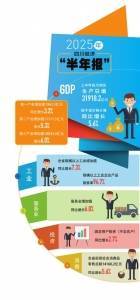
Economic Overview - In the first half of 2025, Sichuan's GDP reached 31,918.2 billion yuan, with a year-on-year growth of 5.6% [3][4] - The growth rate of GDP accelerated by 0.1 percentage points compared to the first quarter, indicating a steady economic recovery [4] Sector Performance - The primary industry added value was 1,963.3 billion yuan, growing by 3.2%; the secondary industry added value was 11,111.5 billion yuan, increasing by 5.3%; and the tertiary industry added value was 18,843.4 billion yuan, rising by 6.0% [4] - Agricultural output value reached 3,993.8 billion yuan, with a year-on-year increase of 3.3% [5][6] Industrial Growth - The industrial production maintained a strong start from the first quarter, with a 7.3% year-on-year increase in the added value of industrial enterprises above designated size [6][7] - The sales rate of products from industrial enterprises above designated size was 94.7% [6] New Growth Drivers - High-tech manufacturing saw a significant increase, with a 13.1% rise in added value, accounting for over 15% of the total industrial output [7] - The production of new energy vehicles, photovoltaic cells, and lithium-ion batteries for vehicles increased by 2.4 times, 1.9 times, and 53.2% respectively [7] Consumer and Investment Trends - The total retail sales of consumer goods reached 14,160.2 billion yuan, with a year-on-year growth of 5.6% [8] - Fixed asset investment (excluding rural households) grew by 2.7%, with a notable recovery in real estate development investment, which decreased by 6.5%, a reduction of 3.4 percentage points compared to the previous year [8]

供需改善推动制造业指标回升
Jing Ji Ri Bao· 2025-07-17 22:08
Group 1 - The manufacturing Purchasing Managers' Index (PMI) for June is reported at 49.7%, indicating a 0.2 percentage point increase from the previous month and a continuous rise for two months, suggesting an ongoing improvement in the manufacturing sector's economic climate [1] - Demand-side analysis shows that since the second quarter, the manufacturing sector experienced short-term fluctuations due to changes in U.S. tariff policies. However, by June, the impact of external disturbances diminished, leading to a recovery in market demand, with the new orders index rising to 50.2%, returning to the expansion zone after two months below 50% [1] - The manufacturing export sector is gradually recovering, with the new export orders index increasing for two consecutive months, reflecting a stabilization in production activities and procurement activities among enterprises [1] Group 2 - To enhance the competitiveness of the manufacturing sector, it is essential to strengthen innovation capabilities, particularly through the transformation of traditional industries by upgrading processes, technologies, and equipment, rather than dismissing them as "low-end industries" [2] - The Ministry of Human Resources and Social Security has announced plans to conduct pilot programs in around 30 cities to explore the integration of human resources services with manufacturing, aiming to promote industrial upgrades and employment [2] - Policies aimed at stabilizing investment, foreign trade, and consumption must be effectively implemented to facilitate the transition of the manufacturing sector towards high-end, intelligent, and green development [2]
我国投资潜力依然巨大
Jing Ji Ri Bao· 2025-07-17 22:06
Core Viewpoint - The balance between investment and consumption is crucial for economic development, with both elements complementing and promoting each other in the economic cycle [1][3] Investment Growth - In the first half of the year, China's fixed asset investment (excluding rural households) reached 24.8654 trillion yuan, a year-on-year increase of 2.8%, and a real growth of 5.3% after adjusting for price factors [1] - There is a significant differentiation in investment growth: manufacturing investment and high-tech service investment grew by 7.5% and 8.6% respectively, outpacing overall investment growth by 4.7 and 5.8 percentage points [1] - Infrastructure investment increased by 4.6%, exceeding the overall investment growth rate by 1.8 percentage points, while real estate investment faced pressure, declining by 11.2% year-on-year [1] Transition to High-Quality Development - The current investment slowdown reflects a structural and quality adjustment, indicating a shift from high-speed growth to high-quality development [2] - The focus of investment is shifting from traditional sectors like real estate and infrastructure to new growth areas, with manufacturing investment now accounting for 25.2% of total investment [2] - Investment in new energy and high-tech sectors is accelerating, showing a transition of funds from inefficient to efficient areas [2] Investment Potential - Despite the slowdown, China's investment potential remains significant, supported by factors such as low per capita infrastructure capital stock compared to developed countries and ongoing urbanization of nearly 300 million rural migrants [2] - There are still many weak links in public services like education, healthcare, and environmental protection that require effective investment [2] Policy Focus - Economic policies are increasingly aimed at improving livelihoods and promoting consumption, but investment remains a key component [3] - The "Two New" policy connects supply and demand, transforming development potential into tangible growth, with significant retail growth in household appliances and automobiles observed [3] Investment Structure Optimization - To promote sustainable investment growth, it is essential to balance supply and demand, new and old sectors, and the roles of government and market [4] - Funds should be directed towards advanced manufacturing and modern service industries, enhancing both short-term demand and long-term growth potential [4] - There is a need to prevent low-level repeated construction and improve investment efficiency while fostering private investment in more sectors [4]