渔业

Search documents
向海追“鲜”!看“海上新湛江”如何打造?
Nan Fang Nong Cun Bao· 2025-08-26 09:37
Core Viewpoint - The article highlights the revitalization of the seafood industry in Zhanjiang following the fishing season reopening, emphasizing its economic and cultural significance for the region [1][11][12]. Group 1: Economic Impact - Zhanjiang's total aquatic product output reached 1.316 million tons, with a total fishery output value of 29.44 billion yuan, maintaining the highest figures in the province for 30 consecutive years [8]. - The opening of the fishing season has led to bustling seafood markets and restaurants, attracting visitors from various regions to experience fresh seafood [5][6][19]. - The local economy benefits from the fishing season through increased activity in seafood trading, logistics, and related industries, strengthening the marine economic chain [18][19]. Group 2: Cultural Significance - The fishing season is not only a production restart but also a cultural event that connects the community through shared experiences and memories associated with seafood [12][25][28]. - The opening of the fishing season attracts tourists who come to witness the event and enjoy local seafood, enhancing the cultural tourism aspect of Zhanjiang [20][23]. Group 3: Modernization and Development - Zhanjiang is advancing its marine ranching capabilities with six modern deep-sea farming platforms and over 3,400 deep-sea farming cages, accounting for 38% and 54% of the province's total, respectively [49]. - The city is implementing a comprehensive plan for modern marine ranching from 2023 to 2035, aiming to establish a strong marine fishery city and achieve modernization in the industry [54][56]. - The local government is promoting the "media+" initiative to enhance brand building for marine products, integrating media resources into the agricultural supply chain [58][60][80].


全国人大代表、广东海洋大学副校长宁凌:建议将优质海产品纳入政府粮食储备计划
Nan Fang Nong Cun Bao· 2025-08-26 09:03
Core Viewpoint - The proposal to include high-quality marine products in the government's grain reserve plan aims to enhance the development of marine ranching and address industry challenges [1][17]. Group 1: Industry Development - The representative emphasizes the need to understand the industrial attributes of marine ranching to identify and solve development pain points [3][4]. - A comprehensive industry chain should be established focusing on fishery production, including seed breeding, aquaculture, feed, equipment, cold chain logistics, deep processing, and trading services [10][12]. Group 2: Key Challenges and Solutions - Initial considerations for marine ranching should include site selection, species, facility layout, and seedling assurance [13]. - Mid-term challenges involve addressing seed and feed supply, vessel maintenance, and extreme weather prevention [14]. - Long-term issues include managing market price fluctuations, processing value addition, cold chain logistics, market expansion, and brand building [15]. Group 3: Recommendations for Improvement - Financial support should be enhanced through subsidies, tax optimization, and the inclusion of quality marine products in government reserves [16][18]. - Credit support and low-interest loan products should be developed, along with expanding insurance coverage and improving standards [18]. - Technological advancements should focus on critical techniques and equipment development, while talent development should involve targeted training and incentive mechanisms [19][20].
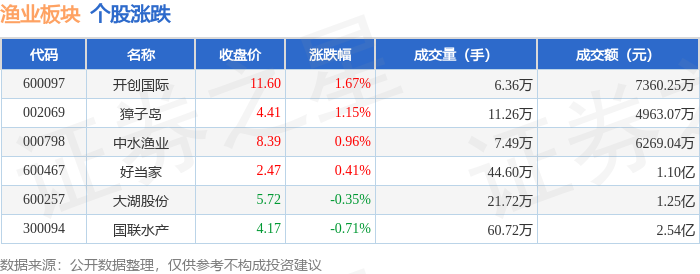
渔业板块8月26日涨0.41%,开创国际领涨,主力资金净流出5872.64万元
Zheng Xing Xing Ye Ri Bao· 2025-08-26 08:30
Group 1 - The fishing sector increased by 0.41% on August 26, with KaiChuang International leading the gains [1] - The Shanghai Composite Index closed at 3868.38, down 0.39%, while the Shenzhen Component Index closed at 12473.17, up 0.26% [1] - Key stocks in the fishing sector showed varied performance, with KaiChuang International rising by 1.67% to a closing price of 11.60, and DaHu Co. declining by 0.35% to 5.72 [1] Group 2 - The net capital flow in the fishing sector showed a net outflow of 58.73 million yuan from main funds, while retail investors contributed a net inflow of 40.17 million yuan [1] - The trading volume and turnover for key stocks varied, with HaoDangJia having a trading volume of 446,000 hands and a turnover of 110 million yuan [1] - The overall capital flow indicates a mixed sentiment among investors in the fishing sector [1]


中国科学院院士张偲:打造“广东海鲜”品牌,刻不容缓!
Nan Fang Nong Cun Bao· 2025-08-26 04:30
Core Viewpoint - The establishment of a "Guangdong Seafood" brand and the strengthening of marine ranching is urgent and necessary for the development of the industry [2][3]. Industry Overview - Guangdong is a strong marine economy province, holding the top position in marine GDP for 30 consecutive years [4][5]. - The province has the longest mainland coastline in China, measuring 4,114 kilometers [5]. Strategic Recommendations - It is suggested to upgrade the entire industrial chain and implement plans for billion-level industrial clusters, including triploid oysters, tuna, and other species [6][7]. - The development of new business models such as "fishing-tourism integration" and the establishment of a pre-prepared seafood product industry park are recommended [7][8]. Brand Development - Emphasis on brand cultivation to create a public brand for "Guangdong Seafood" and to nurture leading enterprises across the entire supply chain [9][10]. Market Expansion - Market expansion is crucial, with a focus on deep processing systems and market development [12]. - The market for high-quality fish species, such as Atlantic salmon and grouper, is currently around 200,000 to 300,000 tons, with potential growth to 500,000 tons [13][14]. Innovation and Standards - There is a need to prioritize the development of deep-sea leading species and high-quality seedlings, as well as to establish an innovation platform for deep cooperation among government, industry, academia, and research [15][16]. - A standardized system should be constructed for various aspects of aquaculture equipment design, manufacturing, installation, and inspection [16]. Top-Level Design - The proposal includes promoting "multi-regulation integration" to prioritize marine ranching construction needs in land spatial planning [17][18]. Competitive Advantages - Guangdong possesses first-mover advantages in climate, market, and industrial foundation [19]. - The establishment of marine ranching models based on examples from Guangzhou Ocean Laboratory and other national demonstration areas is suggested to provide a "Guangdong solution" for the country [20][21]. Talent and Investment - Strengthening talent cultivation and capital investment is essential, along with transitioning marine ranching from a "public welfare" nature to an "ecological economic composite" model [22][23].
“一条鱼”的价值蝶变 江西吉安农业转型金融实践
Jin Rong Shi Bao· 2025-08-26 02:45
Core Viewpoint - The article discusses the innovative "fish ticket" system in Wan'an County, Jiangxi Province, aimed at transforming ecological fish resources into economic assets, thereby enhancing the income of local fishermen and promoting sustainable development [1][4]. Group 1: Policy and Financial Innovations - The local government is implementing a "fish policy" to facilitate the transformation of the fishing industry, focusing on ecological fish value enhancement and shared prosperity for the community [2][3]. - A comprehensive ecological fish industry research institute has been established, along with a smart management platform to support the sustainable development of the fishing sector [2]. - The People's Bank of China in Ji'an is driving financial support for ecological products through policy guidance and credit empowerment, facilitating the transition to low-carbon fishing practices [3][7]. Group 2: "Fish Ticket" System - The "fish ticket" serves as an asset identification for ecological fish, quantifying their economic and ecological value, and enabling fishermen to access financing [4][5]. - The first "fish ticket" was issued with a value of 105,000 yuan, allowing the holder to improve fish farming practices and increase income through enhanced market prices [4][6]. - The "fish ticket" system includes a buyback guarantee from the local government to mitigate risks for financial institutions, ensuring the sustainability of the financing model [5][6]. Group 3: Financial Performance and Impact - As of June, the total ecological fish loans issued in Wan'an County reached 260 million yuan, marking a year-on-year increase of 24.6%, significantly boosting the local fishing industry's economic output [6][7]. - The establishment of a full ecological fish industry chain has led to an annual production of 6 million pounds of ecological fish, doubling the fishing industry's output value over three years [6][8]. - The local financial institutions have actively engaged in promoting tourism-related financial services, contributing to an increase in visitor numbers and generating 570 million yuan in ecological fish revenue [7][8].
中国银河证券:宠物食品出口量恢复增长 重点关注猪企产能变化节奏
智通财经网· 2025-08-26 01:56
Core Viewpoint - The report from China Galaxy Securities indicates that the pig prices in 2025 may show a downward trend year-on-year, while remaining relatively stable throughout the year. The pet food industry is in a growth phase, with leading domestic companies expected to maintain rapid growth due to increasing acceptance of domestic brands by pet owners [1][5]. Group 1: Pig Farming Industry - In July, the Consumer Price Index (CPI) remained flat year-on-year, with a 16% decrease in the cumulative trade deficit for agricultural products [1]. - The pig price fluctuated downwards in August, reaching a high of 21.06 yuan/kg in mid-August before falling to 14.25 yuan/kg by August 13, a 12% decrease compared to the end of 2024 [3]. - The number of breeding sows in China was 40.43 million at the end of Q2, with a slight increase of 0.1% [3]. - The report emphasizes the importance of monitoring cost changes and the financial health of quality pig farming companies, recommending companies such as Wens Foodstuff Group, Muyuan Foods, and others [5]. Group 2: Pet Food Industry - The export volume of pet food in July showed a recovery, with a year-on-year increase of 11.67%, although the export value decreased by 3.08% [4]. - The pet food market in China has a low concentration, but leading domestic companies are expected to grow rapidly as acceptance of domestic brands increases [4][5]. - Recommendations for the pet food sector include Zhongchong Co., Guibao Pet, and Petty Holdings, with a focus on companies that are likely to benefit from the growing market [5]. Group 3: Agricultural Index Performance - The agricultural index underperformed compared to the CSI 300 index from early August to August 22, with the agricultural index rising by 6.02% while the CSI 300 increased by 7.42% [2]. - Among sub-sectors, agricultural product processing and animal health showed relatively strong performance, while fisheries and planting sectors lagged behind [2].

果飘香、鱼满仓、特色作物收获忙 绿水青山间奏响“丰收乐章”
Yang Shi Wang· 2025-08-26 01:53
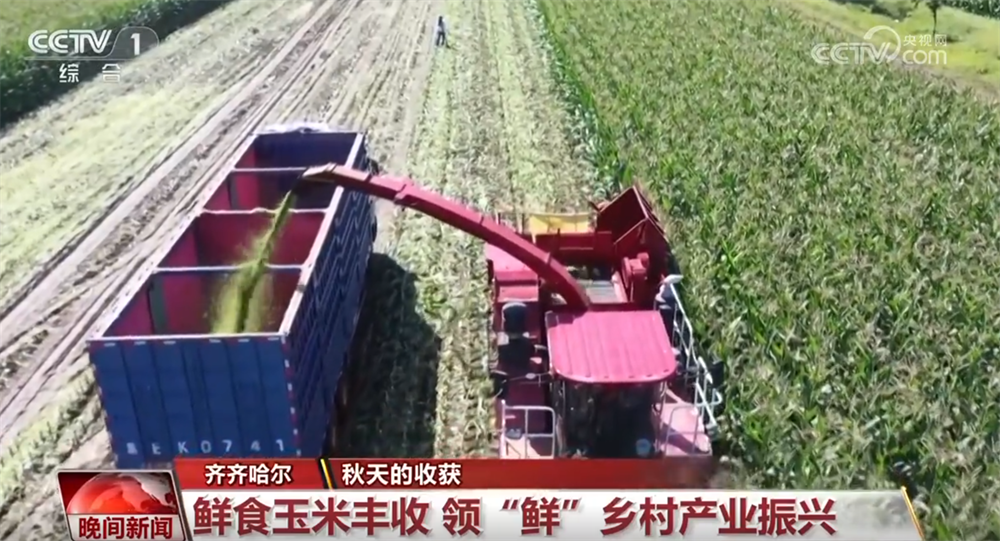
Group 1: Agricultural Harvests - In Heilongjiang, fresh corn is entering the harvest season with 24,000 acres expected to be fully harvested by mid-September, utilizing mechanized harvesting to accelerate the process [1] - The introduction of sweet and glutinous corn varieties in Yian County has led to an increase in yield to 1.5 tons per acre, providing a 60% increase in benefits compared to traditional planting methods [3] - In Hubei, peanut harvesting is also in full swing, with yields of 600-700 pounds per acre, generating over 2,000 yuan per acre in revenue [5] Group 2: Tomato Processing - In Xinjiang, 18,300 acres of processing tomatoes are being harvested, with machines efficiently completing multiple processes from picking to packaging [5] - The yield for processing tomatoes can reach 9 tons per acre, supported by a comprehensive service from processing factories throughout the planting and harvesting stages [7] Group 3: Fishing Industry - The fishing industry in Zhejiang is experiencing a resurgence as fishing boats return with full loads following the lifting of seasonal fishing restrictions [9] - The catch per net has significantly increased, stabilizing at over 3,000 pounds, indicating a substantial growth compared to the same period last year [13]
海南去年渔业产值近六百亿元
Zhong Guo Chan Ye Jing Ji Xin Xi Wang· 2025-08-25 23:39
Core Insights - Hainan Province is experiencing a transformation in its fishing industry, shifting from traditional fishing to diversified tourism and aquaculture, driven by improved marine ecological conditions and infrastructure development [1][2][4] Group 1: Industry Development - The total aquatic product output in Hainan Province reached 981,600 tons from January to July this year, with aquaculture contributing 486,800 tons [1] - The fishing industry in Hainan generated a total output value of 59.5 billion yuan last year, reflecting a year-on-year growth of 13.8% [1] - The province is implementing a "three zones and one park" development strategy to promote the transition of traditional fishing to deep processing, leisure fishing, and cold chain logistics [2][3] Group 2: Technological Advancements - Hainan's fishing industry is transitioning from traditional capture methods to deep-sea cage and factory farming, with significant investments in modern aquaculture facilities [4][5] - The province's factory aquaculture water volume reached 6.46 million cubic meters last year, a 171% increase compared to the beginning of the 14th Five-Year Plan, ranking third in the country [5] - The introduction of intelligent feeding and disease monitoring technologies in deep-sea farming projects is expected to shorten the growth cycle of fish, enhancing survival rates and product quality [4][5] Group 3: Community Impact - Local fishermen are diversifying their income sources by engaging in tourism-related activities, such as guiding and crafting, leading to improved livelihoods [2] - The development of coastal homestays and tourism experiences in traditional fishing villages is creating new economic opportunities for local communities [2][3]
首批80万尾鱼苗投产,清远进一步推动禾花鲤鱼产业发展
Nan Fang Nong Cun Bao· 2025-08-25 12:35
Core Viewpoint - The introduction of 800,000 fry of Hehua carp marks a significant step in promoting the Hehua carp industry in Qingyuan, enhancing local agricultural practices and economic benefits [1][2][3]. Group 1: Industry Development - Qingyuan Agricultural Technology Promotion Service Center has successfully delivered over 3,000 pounds of Hehua carp fry, each measuring 5 centimeters, to the Lian Nan Yao Autonomous County [2][3]. - The initiative is expected to promote integrated rice-fish farming across more than 300 acres, directly benefiting over 30 households [3][4]. - Hehua carp is a local specialty fish with high ecological adaptability and significant economic value, making it a strategic focus for local agricultural development [6][7]. Group 2: Breeding and Standards - Since 2019, the Qingyuan Agricultural Promotion Center has collected and preserved over 2,000 indigenous Hehua carp broodstock, establishing a modern breeding facility to support large-scale breeding [7][8]. - A local standard for Hehua carp was released in July 2024, covering the entire process from breeding to cultivation [10][11]. - The survival rate of the fry has exceeded 95% following scientific breeding practices [12]. Group 3: Economic Impact - The initiative aligns with the "Hundred Million Thousand Project" in Guangdong, which supports local specialty industries in minority areas [13][14]. - The Lian Nan demonstration area achieved a production value exceeding 10,000 yuan per acre in 2024, establishing itself as a benchmark for ecological agriculture in the province [14][15]. - In 2025, technical training will be conducted in Lian Shan, with an expected farmer participation rate of 80% [15]. Group 4: Ecological Benefits - The introduction of Hehua carp is expected to reduce pesticide usage by 30% and replace 10% of chemical fertilizers through natural processes [26][28]. - The integrated rice-fish farming model can increase per-acre output value to over three times that of traditional planting, reaching a level of 10,000 yuan [27][28]. - The system's carbon sequestration capability is enhanced by 15% compared to single-crop planting, promoting a balance of economic, ecological, and social benefits [28].
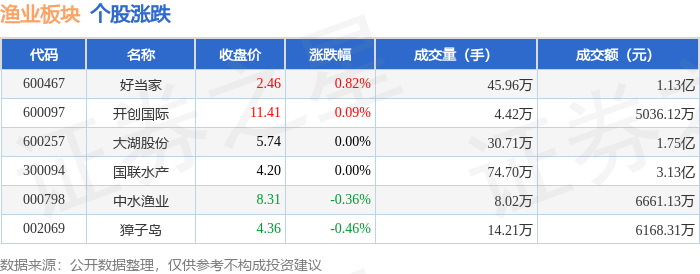
渔业板块8月25日涨0.03%,好当家领涨,主力资金净流出2996.04万元
Zheng Xing Xing Ye Ri Bao· 2025-08-25 08:47
Core Insights - The fishing sector experienced a slight increase of 0.03% on August 25, with "Hao Dang Jia" leading the gains [1] - The Shanghai Composite Index closed at 3883.56, up by 1.51%, while the Shenzhen Component Index closed at 12441.07, up by 2.26% [1] Sector Performance - "Hao Dang Jia" (600467) closed at 2.46, with a rise of 0.82%, and had a trading volume of 459,600 shares, amounting to a transaction value of 113 million yuan [1] - "Kai Chuang International" (600097) closed at 11.41, with a slight increase of 0.09%, and a trading volume of 44,200 shares, totaling 50.36 million yuan [1] - "Da Hu Co." (600257) remained unchanged at 5.74, with a trading volume of 307,100 shares, resulting in a transaction value of 175 million yuan [1] - "Guo Lian Aquatic Products" (300094) also remained unchanged at 4.20, with a trading volume of 747,000 shares, amounting to 313 million yuan [1] - "Zhong Shui Fishery" (000798) closed at 8.31, down by 0.36%, with a trading volume of 80,200 shares, totaling 6.66 million yuan [1] - "Yuan Zi Dao" (002069) closed at 4.36, down by 0.46%, with a trading volume of 142,100 shares, amounting to 6.17 million yuan [1] Capital Flow - The fishing sector saw a net outflow of 29.96 million yuan from institutional investors, while retail investors contributed a net inflow of 6.84 million yuan [1] - "Hao Dang Jia" had a net inflow of 7.55 million yuan from institutional investors, but a net outflow of 4.56 million yuan from speculative funds [2] - "Zhong Shui Fishery" experienced a net outflow of 1.76 million yuan from institutional investors, while speculative funds saw a net inflow of 534,000 yuan [2] - "Guo Lian Aquatic Products" had a net outflow of 3.10 million yuan from institutional investors, with a significant net inflow of 14.11 million yuan from speculative funds [2] - "Kai Chuang International" faced a net outflow of 3.29 million yuan from institutional investors, while speculative funds had a net inflow of 2.23 million yuan [2] - "Yuan Zi Dao" saw a substantial net outflow of 10.65 million yuan from institutional investors, but speculative funds had a net inflow of 9.12 million yuan [2] - "Da Hu Co." experienced a net outflow of 18.72 million yuan from institutional investors, while retail investors contributed a net inflow of 17.02 million yuan [2]