
保险业

Search documents
高质量完成“十四五”规划|综合实力更加雄厚 服务质效显著提升——国新办发布会聚焦“十四五”时期金融业发展成就
Sou Hu Cai Jing· 2025-09-22 14:30
Core Insights - The financial sector in China has significantly strengthened its comprehensive capabilities and improved service quality during the "14th Five-Year Plan" period, showcasing enhanced international competitiveness and influence [1][2]. Group 1: Industry Strength - As of June 2023, China's banking sector total assets reached nearly 470 trillion yuan, ranking first globally; the stock and bond market sizes are second in the world; and foreign exchange reserves have maintained the top position for 20 consecutive years [2]. - The financial system has undergone comprehensive reforms, with a modernized governance structure and improved regulatory capabilities, leading to a solidified position as the largest global credit market and the second-largest insurance market [2][5]. Group 2: Financial Services to the Real Economy - Over the past five years, the banking and insurance sectors have provided an additional 170 trillion yuan in funding to the real economy through various financing methods [3]. - The total financing from the exchange market for stocks and bonds reached 57.5 trillion yuan, with the direct financing ratio increasing by 2.8 percentage points to 31.6% compared to the end of the "13th Five-Year Plan" [3]. - The balance of inclusive loans to small and micro enterprises reached 36 trillion yuan, 2.3 times that of the end of the "13th Five-Year Plan," with interest rates decreasing by 2 percentage points [3]. Group 3: Risk Prevention and Resolution - The financial system remains generally stable, with significant reductions in the number of high-risk institutions and assets, making risks manageable [5]. - The A-share market has shown enhanced resilience and risk resistance, with the annualized volatility of the Shanghai Composite Index at 15.9%, down 2.8 percentage points from the "13th Five-Year Plan" period [5]. Group 4: Ongoing Financial Reform and Opening-up - Continuous promotion of supply-side structural reforms in finance, including the deepening of reforms in the Sci-Tech Innovation Board and the Growth Enterprise Market, has been emphasized [6]. - By the end of August 2023, various long-term funds held approximately 21.4 trillion yuan in A-share market value, a 32% increase from the end of the "13th Five-Year Plan" [6]. - The financial sector has seen significant foreign participation, with 43 of the world's top 50 banks establishing operations in China and over 10 trillion yuan held by foreign institutions and individuals in domestic stocks, bonds, and deposits [6].
货币市场日报:9月22日
Xin Hua Cai Jing· 2025-09-22 14:17
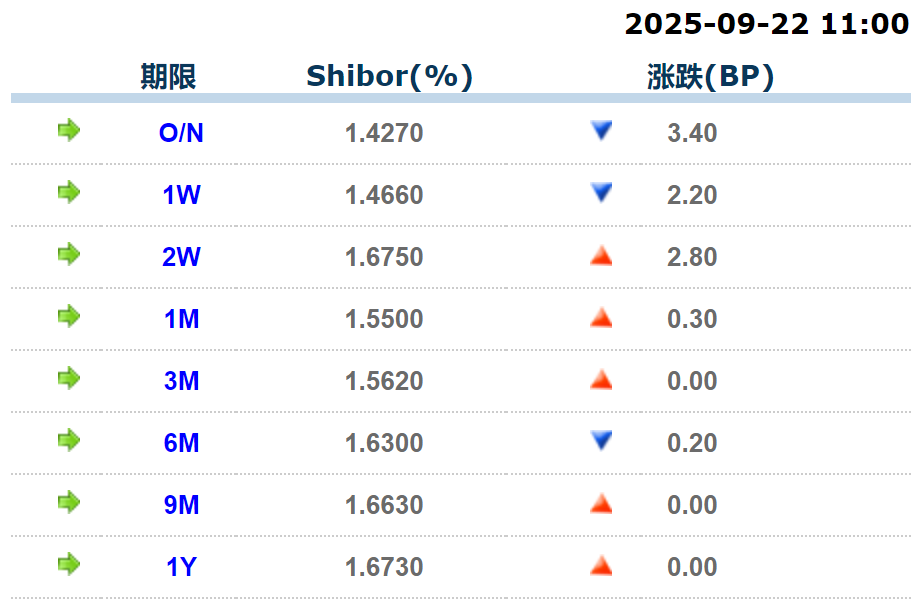
Group 1 - The People's Bank of China conducted a 240.5 billion yuan 7-day reverse repurchase operation at an interest rate of 1.40% and a 300 billion yuan 14-day reverse repurchase operation, resulting in a net injection of 260.5 billion yuan into the market [1] - The overnight and 7-day Shanghai Interbank Offered Rate (Shibor) continued to decline, while the 14-day Shibor increased. Specifically, the overnight Shibor fell by 3.40 basis points to 1.4270%, and the 7-day Shibor decreased by 2.20 basis points to 1.4660% [1][3] - In the interbank pledged repo market, the overnight rates decreased while the 14-day rates increased, with the R014 rate surpassing 1.7%. The weighted average rates for DR001 and R001 fell by 3.7 basis points and 2.4 basis points, respectively [5] Group 2 - The overall funding situation on September 22 was balanced and slightly loose, with overnight transactions primarily occurring in the range of 1.53%-1.55% and 7-day rates around 1.52% [7] - A total of 111 interbank certificates of deposit were issued on September 22, with an actual issuance amount of 231.87 billion yuan [7] - The financial regulatory authority reported that since the beginning of the "14th Five-Year Plan," insurance funds have invested over 5.4 trillion yuan in stocks and equity funds, marking an 85% increase compared to the end of the "13th Five-Year Plan" [11]

9月22日重要资讯一览
Zheng Quan Shi Bao Wang· 2025-09-22 13:53
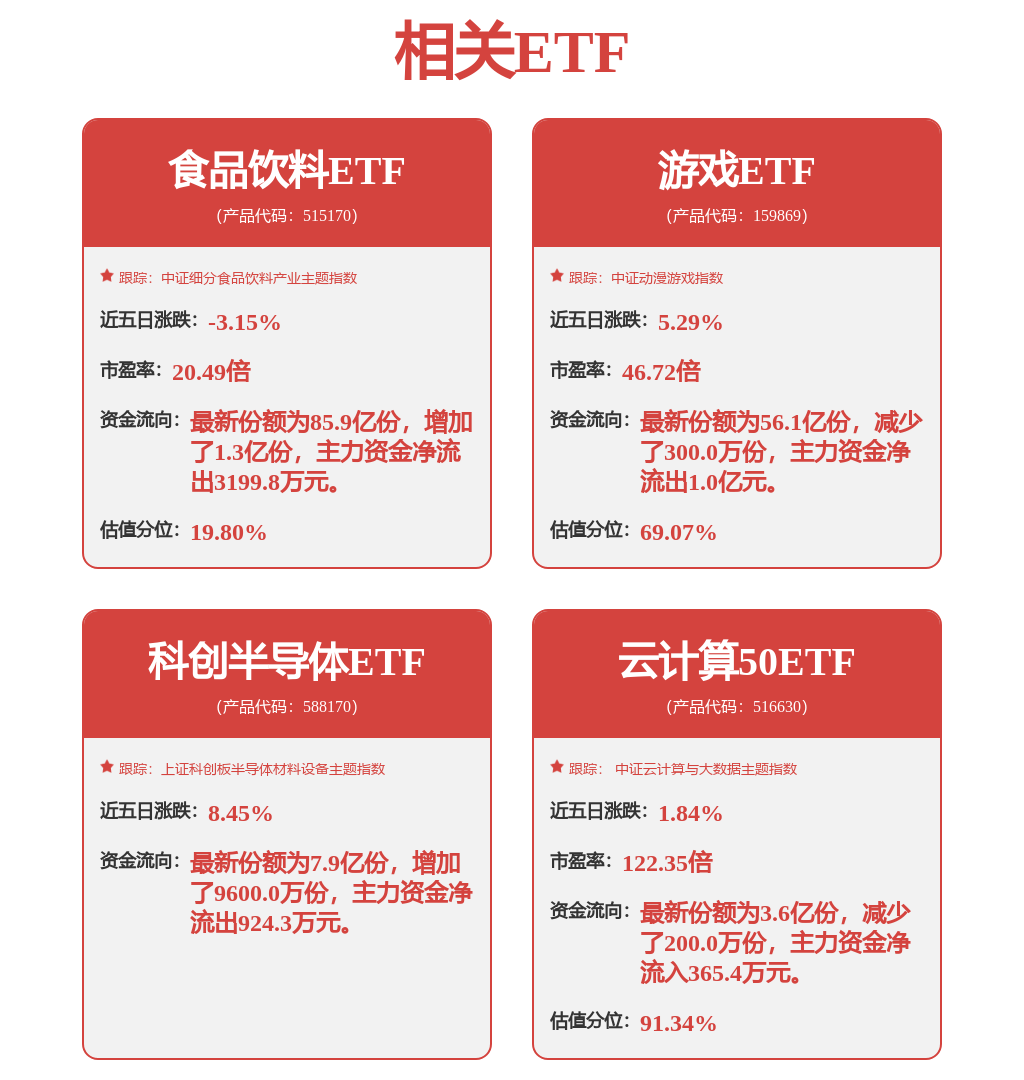
Group 1: Financial Sector Developments - The State Council held a press conference on September 22, 2025, focusing on the development of the financial sector during the 14th Five-Year Plan, emphasizing a mid-to-long-term perspective without discussing short-term policy adjustments [2] - The total assets of the banking and insurance sectors have exceeded 500 trillion yuan, with an average growth of nearly 9% over the past five years, solidifying China's position as the largest credit market and the second-largest insurance market globally [2] - The A-share market has shown enhanced resilience and risk resistance, with the Shanghai Composite Index's annualized volatility decreasing by 2.8 percentage points to 15.9% compared to the previous five-year period [2] Group 2: Capital Market Reforms - The China Securities Regulatory Commission (CSRC) announced plans to deepen capital market reforms, focusing on enhancing the service for new productive forces and improving the systems for the Sci-Tech Innovation Board and the Growth Enterprise Market [3] - The Shanghai Stock Exchange aims to promote long-term capital inflow into the market and enhance regulatory measures to support high-quality development [4] - The Shenzhen Stock Exchange is set to deepen comprehensive reforms in capital markets, particularly focusing on the Growth Enterprise Market to support the listing of quality tech innovation companies [5] Group 3: Energy and Industrial Developments - The National Energy Administration outlined goals for the energy equipment sector, aiming for a self-controlled, high-end, intelligent, and green development by 2030, with a focus on enhancing global competitiveness [6] - The Ministry of Industry and Information Technology has set a target for the steel industry to achieve an average annual growth of around 4% in value added over the next two years, emphasizing structural adjustments and capacity control [6] Group 4: Company News Highlights - He Yuan Bio has initiated its issuance, becoming the first new issuer in the Sci-Tech Innovation Growth sector [10] - Tianpu Co. has experienced a 14 consecutive trading limit increase, with no asset injection plans from the acquirer Zhonghao Xinying [10] - Longchuan Technology expects a year-on-year net profit increase of 131.39% to 145.38% for the first three quarters [11]
时报图说丨干货速览!潘功胜、李云泽、吴清、朱鹤新最新发声
Zheng Quan Shi Bao Wang· 2025-09-22 13:50
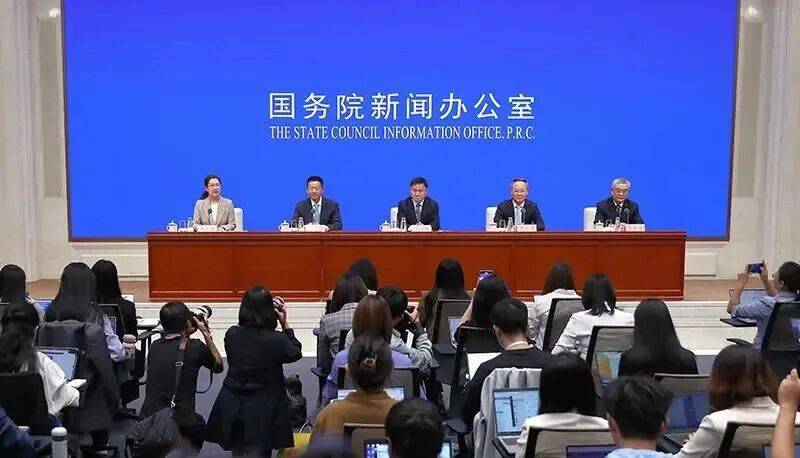
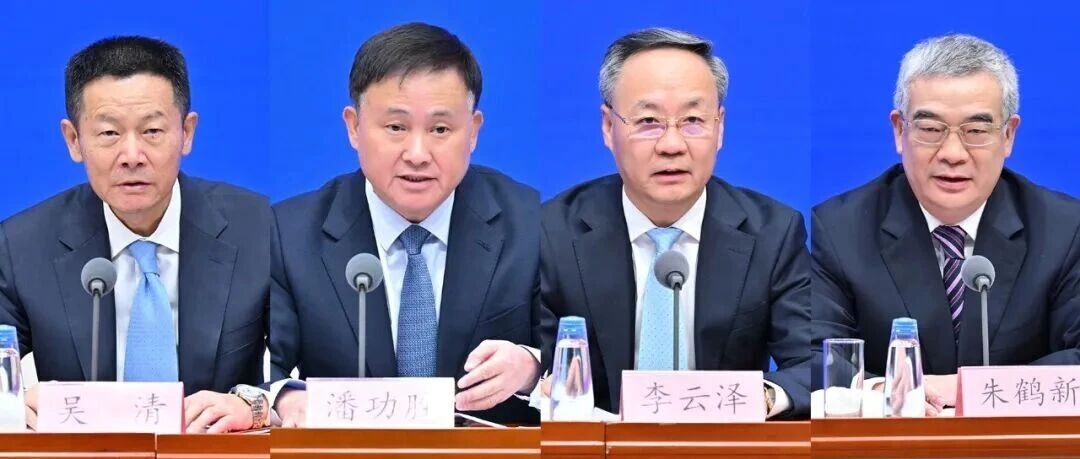
Core Viewpoint - The press conference highlighted the achievements of China's financial sector during the "14th Five-Year Plan" period, emphasizing the stability and growth of the financial system, as well as the advancements in various financial sectors such as green finance and digital finance [1][4]. Financial Sector Achievements - As of June 2023, China's banking sector total assets reached nearly 470 trillion yuan, ranking first in the world [3]. - The scale of China's stock and bond markets ranks second globally [4]. - The average annual growth rate of loans to technology-based SMEs, inclusive small micro loans, and green loans exceeded 20% during the "14th Five-Year Plan" [4]. Regulatory Developments - The financial regulatory environment has improved, with a total of 2,000 institutions penalized and 36,000 individuals held accountable since the beginning of the "14th Five-Year Plan" [6]. - The number of high-risk institutions and the scale of high-risk assets have significantly decreased, indicating that risks are under control [6]. - The regulatory framework has been enhanced, with 171 regulations issued over the past five years [7]. Capital Market Enhancements - The market capitalization of technology companies in the A-share market has increased, with the number of tech firms in the top 50 by market value rising from 18 to 24 [8]. - The total market value of the A-share market surpassed 100 trillion yuan for the first time in August 2023 [9]. - Direct financing's proportion has steadily increased, reaching 31.6%, up by 2.8 percentage points compared to the previous five-year period [8]. Future Outlook - The financial sector is expected to continue its supportive monetary policy stance, with a focus on enhancing the adaptability and inclusiveness of the financial system [11]. - The ongoing reforms aim to improve the quality and investment value of listed companies, fostering a more resilient capital market [11].

潘功胜、李云泽、吴清、朱鹤新重磅发声速览,事关股票、债券、银行业等
Sou Hu Cai Jing· 2025-09-22 13:42
Financial System Overview - The overall financial system in China is stable, with healthy financial institutions and smooth market operations [1] - As of June 2023, total assets of the banking sector reached nearly 470 trillion yuan, ranking first globally [1] - The banking and insurance sectors have total assets exceeding 500 trillion yuan, with an average annual growth of 9% over the past five years [2] Economic Support and Funding - Over the past five years, the banking and insurance sectors have provided an additional 170 trillion yuan in funding to the real economy, with significant growth in loans for research, manufacturing, and infrastructure [2] - The average annual growth rates for loans in key areas are 27.2% for research technology, 21.7% for manufacturing, and 10.1% for infrastructure [2] Capital Market Developments - In the last five years, total financing through stock and bond markets reached 57.5 trillion yuan, with the proportion of direct financing increasing to 31.6% [3] - The market capitalization of technology companies in A-shares has risen to over 25%, surpassing the combined market capitalization of banking, non-bank financial, and real estate sectors [3] - Companies listed on the stock market have significantly increased their return to investors, distributing a total of 10.6 trillion yuan through dividends and buybacks, an increase of over 80% compared to the previous five years [3] Market Resilience - The A-share market has shown improved resilience and risk resistance, with the annualized volatility of the Shanghai Composite Index decreasing by 2.8 percentage points to 15.9% [4] - By the end of August 2023, various long-term funds held approximately 21.4 trillion yuan of A-share market capitalization, a 32% increase from the end of the previous five-year plan [5] International Engagement - There has been active cross-border investment, with foreign institutions and individuals holding over 10 trillion yuan in domestic stocks, bonds, and deposits as of July [7] - The use of the renminbi in cross-border trade has increased from 16% to nearly 30%, indicating enhanced resilience in the foreign exchange market [7]
王信:以统一全面标准促进绿色金融高质量发展|绿色金融周报
2 1 Shi Ji Jing Ji Bao Dao· 2025-09-22 13:30
南方财经记者郭晓洁 21世纪经济报道记者李德尚玉 实习生李宜馨 广州报道 随着绿色金融市场的快速发展,相关的资讯和数据变得越来越丰富。绿色金融周报从宏观视角和机构绿 色金融实践等角度,关注绿色金融领域的最新前沿动态,追踪绿色金融市场的最新趋势,为绿色金融相 关参与方提供决策依据和参考。 21碳中和课题组快评:在"双碳"五周年关键节点,本次论坛汇聚多方智慧,既系统展现了中国绿色金融 从标准建设到转型金融、气候投融资试点的实践成果,也前瞻性探讨了绿色贸易、数智赋能等全球治理 新路径。 3、中诚信绿金发布《企业可持续发展/ESG工作实用手册》 中诚信绿金在北京举办《企业可持续发展/ESG工作实用手册》发布会。该手册结合国内外政策框架与 实践经验,系统梳理了企业在ESG战略制定、信息披露、绩效评价及投融资对接等方面的操作指南,旨 在为企业推动可持续发展提供标准化、可落地的参考。据悉,该手册涵盖ESG起源与发展、政策与准 则、评级与投资、报告编制、报告指标、信息披露与管理六大板块,兼具国际视野与本土实践。手册不 仅是企业认识ESG市场的工具书,更是助力其完成信息披露、实现管理提升的"案边指南",可服务于企 业内部从业者 ...
我国金融服务实体经济质效大幅提升
Xin Hua She· 2025-09-22 13:28
新华社北京9月22日电(记者 任军)"十四五"期间,我国金融服务实体经济质效大幅提升,推动经 济持续回升向好和高质量发展。这是记者从国新办9月22日举行的"高质量完成'十四五'规划"系列主题 新闻发布会上了解到的。 5年来,银行业保险业通过信贷、债券、股权等多种方式,为实体经济提供新增资金170万亿元;近 5年,交易所市场股债融资合计达到57.5万亿元,直接融资比重较"十三五"末提升2.8个百分点,达 31.6%…… 金融管理部门最新数据显示,"十四五"期间,金融部门扎实做好金融"五篇大文章",有力支持国家 重大战略、经济社会发展的重点领域和薄弱环节,有效稳定市场预期、提振信心。 "中国人民银行坚持支持性的货币政策立场,中国特色现代货币政策框架初步形成,实施和传导更 为有效,助力'十四五'经济社会发展主要目标顺利完成。"中国人民银行行长潘功胜表示。 金融监管总局局长李云泽表示,通过增供给、优结构、补短板,金融监管总局全力支持完成经济社 会发展目标。 发布会数据显示,"十四五"期间,科技型中小企业贷款、普惠小微贷款、绿色贷款年均增速均超过 20%。5年来,科研技术贷款、制造业中长期贷款、基础设施贷款年均增长27 ...
事关股票、债券、外汇、银行业等,四部门最新发声!
Sou Hu Cai Jing· 2025-09-22 13:23
Financial Market Developments - Over the past five years, China's financial system has undergone comprehensive reforms, enhancing the quality, efficiency, and inclusiveness of financial services [3] - As of June 2023, China's banking sector total assets reached nearly 470 trillion yuan, ranking first globally, with stock and bond market sizes also ranking second worldwide [3] - The banking and insurance sectors' total assets exceeded 500 trillion yuan, with an average annual growth rate of 9% over five years [3] Capital Market Insights - The A-share market's total market capitalization surpassed 100 trillion yuan for the first time in August 2023, with 157 futures and options products covering major industries [3] - More than 90% of newly listed companies in recent years are technology-related, with the technology sector's market capitalization exceeding 25% of the A-share market [3] - Listed companies have significantly increased their return to investors, distributing a total of 10.6 trillion yuan through dividends and buybacks over the past five years, an increase of over 80% compared to the previous five-year period [3] Risk Management in Financial Institutions - The focus on managing risks in small and medium-sized financial institutions has led to a significant reduction in the number of high-risk institutions and assets, with many provinces achieving "dynamic zero" for high-risk institutions [4] - Recent reports indicate a substantial decline in China's high-risk financial assets, with expectations for further reductions in the next two years [4] Real Estate and Local Debt Risk Mitigation - Financial support exceeding 1.6 trillion yuan has been provided for housing projects, with an average annual growth of 52% in loans for rental housing [5] - Financial institutions are guided to avoid new hidden debts while restructuring and replacing debts for local financing platforms [5] Monetary Policy and Global Financial Environment - The recent 25 basis point cut in the Federal Reserve's interest rate was anticipated by global financial markets, with stable reactions observed in major financial markets in China [7] - China's monetary policy remains supportive and moderately loose, aimed at fostering economic recovery and maintaining financial market stability [7] Foreign Exchange Management - Since the beginning of the "14th Five-Year Plan," China's foreign exchange reserves have remained stable above 3 trillion USD, consistently exceeding 3.2 trillion USD in recent years [8] - The country is actively promoting foreign exchange innovation policies in key regions such as free trade zones and the Guangdong-Hong Kong-Macao Greater Bay Area [8]
潘功胜、李云泽、吴清、朱鹤新同日发声
第一财经· 2025-09-22 13:16
Core Viewpoint - The article discusses the achievements of China's financial industry over the past five years, emphasizing the focus on long-term stability and development rather than short-term policy adjustments. The upcoming "Fifteen Five" plan is also hinted at, with expectations for continued financial reforms and support for economic growth [3][4][13]. Financial Development Achievements - The financial market has undergone significant changes, with the total assets of the banking and insurance sectors surpassing 500 trillion yuan, averaging a growth of 9% annually over the past five years [6][7]. - Financial support for the real economy has increased, with new funds injected into the economy reaching 170 trillion yuan, and specific sectors like technology and infrastructure receiving targeted loans [7][8]. - The insurance industry has paid out 9 trillion yuan in claims, a 61.7% increase compared to the previous five-year period [7]. Financial Risk Management - The financial regulatory framework has been reformed, with a focus on maintaining a high-pressure stance against illegal activities, resulting in significant penalties for financial misconduct [8]. - The number of high-risk small and medium-sized banks has decreased, and the cleanup of "zombie" private equity firms has been effective [8]. Financial Opening and International Cooperation - The financial sector has made strides in opening up, with significant reforms in capital markets and foreign exchange management, enhancing China's global financial integration [9][10]. - The removal of foreign ownership limits in the banking sector and the establishment of various cross-border investment mechanisms have expanded foreign participation in China's financial markets [11][12]. Future Financial Policy Outlook - The article outlines expectations for the upcoming "Fifteen Five" plan, with a focus on flexible and precise monetary policy to support economic recovery and stability [13][14]. - The emphasis will be on maintaining a balance between financial openness and risk prevention, with ongoing efforts to create a favorable environment for foreign exchange and investment [15].
图说高质量丨我国金融事业取得新的重大成就
Zhong Yang Ji Wei Guo Jia Jian Wei Wang Zhan· 2025-09-22 13:11
Core Insights - China's financial sector has achieved significant milestones under the strong leadership of the Central Committee, with total banking assets reaching nearly 470 trillion yuan, ranking first globally [2] - The financial system has been restructured to enhance governance and regulatory effectiveness, aligning with the strategic goal of building a financial powerhouse [2] - The banking and insurance sectors have provided 170 trillion yuan in new funds to the real economy over the past five years, with notable growth in loans for scientific research, manufacturing, and infrastructure [3] Group 1: Financial Achievements - As of mid-2023, China's banking sector holds total assets of approximately 470 trillion yuan, leading the world [2] - The stock and bond markets rank second globally in terms of size, while foreign exchange reserves have maintained the top position for 20 consecutive years [2] - The banking and insurance industries have contributed significantly to the real economy, with annual growth rates of 27.2% for scientific research loans, 21.7% for manufacturing loans, and 10.1% for infrastructure loans [3] Group 2: Risk Management - The China Securities Regulatory Commission (CSRC) has enhanced its regulatory framework, resulting in a 58% increase in administrative penalties for financial misconduct during the 14th Five-Year Plan period [4] - The A-share market has shown improved resilience and risk management capabilities, with the annualized volatility of the Shanghai Composite Index decreasing by 2.8 percentage points compared to the previous five-year period [4] - China's foreign exchange reserves have remained stable above 3 trillion USD, providing a crucial stabilizing effect on the economy amid external pressures [4]