
十四五时期金融业发展

Search documents
数说“十四五”时期金融业发展成就
Jing Ji Wang· 2025-09-30 01:44
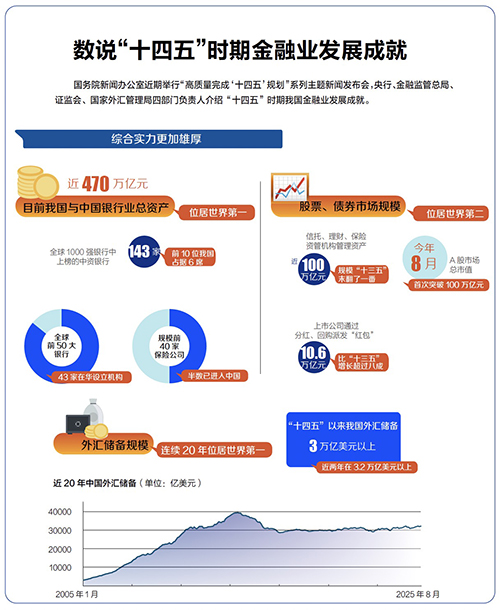
Core Insights - The financial industry in China has achieved significant growth during the "14th Five-Year Plan" period, with a total asset value of nearly 47 trillion yuan in the banking sector, ranking first globally in total banking assets and second in overall financial strength [1][2] - The stock and bond market sizes have also expanded, with the total market capitalization of listed companies surpassing 100 trillion yuan, indicating a robust financial market environment [1] Group 1: Financial Market Development - The banking and insurance sectors have provided an additional 9 trillion yuan in funding to the real economy over the past five years, demonstrating a strong commitment to supporting economic growth [2] - The insurance sector has seen a 61.7% increase in cumulative payouts during the "13th Five-Year Plan" period, highlighting its role in risk management for farmers and small enterprises [2] - The proportion of technology companies among newly listed firms has increased, with tech firms now representing over 25% of the A-share market capitalization [2] Group 2: Market Capitalization and Investment Trends - As of August this year, various long-term funds held approximately 32% of the A-share market capitalization, indicating a growing interest in stable investments [2] - The market capitalization distribution across different stock exchange segments shows a notable trend, with the main board and the Shenzhen main board holding 55.64% and 23.09% respectively in 2023 [2] - The growth rate of loans to small and micro enterprises, as well as green financing, has been significant, reflecting a shift towards more sustainable investment practices [2]

基差方向周度预测-20250926
Guo Tai Jun An Qi Huo· 2025-09-26 10:40
Group 1: Report Industry Investment Rating - No relevant content provided Group 2: Core Viewpoints of the Report - This week, the market showed a mild contraction in trading volume, with concentrated hotspots and weak performance of individual stocks. The press conference on the development of the financial industry during the "14th Five - Year Plan" reflected a prudent policy attitude, and there was some front - running trading for the "14th Five - Year Plan". The steel industry's growth target was set, and the A - share steel sector rebounded. Overseas, the US GDP growth in Q2 was revised up, which might affect the Fed's attitude towards monetary policy. Trading volume was concentrated in the technology sector, causing a siphon effect on the whole market. The Kechuang 50 index led the market with a nearly 6.5% increase, while other sectors and stocks declined severely. The weekly gains of the Shanghai 50, CSI 300, and CSI 500 were around 1%, and the CSI 1000 and 2000 recorded 0.5% and 1.8% declines respectively. The basis of each variety fluctuated little this week, with IH maintaining an annualized premium of 2% and the annualized discounts of the other three varieties narrowing slightly compared to last week. The term structure became flatter, and long - term hedging could be maintained [2] - The model predicts that the basis of IH, IF, IC, and IM will move in the directions of weakening, strengthening, strengthening, and strengthening respectively next week [4] Group 3: Summary According to the Directory This Week's Market Review - The market had a mild contraction in trading volume, with concentrated hotspots and weak individual stock performance. Relevant press conferences reflected a prudent policy attitude, and there was front - running trading for the "14th Five - Year Plan". The steel industry's growth target was set, and the A - share steel sector rebounded. Overseas, the US economic data might affect the Fed's monetary policy. Trading volume was concentrated in the technology sector, causing a siphon effect on the whole market. Different stock indices had different performance this week, and the basis of each variety had small fluctuations [2] Forecast Conclusion - The model predicts that the basis of IH will weaken next week, while the basis of IF, IC, and IM will strengthen [4]
宏观金融数据日报-20250924
Guo Mao Qi Huo· 2025-09-24 01:43
Group 1: Market Review and Policy Analysis - The central bank conducted 240.5 billion yuan of 7 - day reverse repurchase operations yesterday, with 280 billion yuan of reverse repurchases maturing, resulting in a net investment of 260.5 billion yuan [3] - This week, 1,826.8 billion yuan of reverse repurchases will mature in the central bank's open - market operations, and 30 billion yuan of MLF will mature on September 25. The central bank governor said that China's monetary policy will ensure sufficient liquidity [4] - The "14th Five - Year Plan" series of press conferences focused on summarizing the achievements of the financial industry in the medium - to - long - term, with limited short - term guidance for the capital market. Positive signals from Sino - US economic and trade talks and the Fed's first rate cut this year are positive for A - shares, while poor domestic economic data increases the need for policies [6] Group 2: Interest Rate and Bond Market - DRO01 closed at 1.43, down 3.67bp; DR007 closed at 1.49, down 2.08bp; GC001 closed at 1.60, up 19.50bp; GC007 closed at 1.62, up 7.00bp; SHBOR 3M was 1.56, unchanged; LPR 5 - year was 3.50, unchanged [3] - The 1 - year, 5 - year, and 10 - year Chinese treasury bonds decreased by 0.75bp, 0.50bp, and 0.75bp respectively, while the 10 - year US treasury bond increased by 3.00bp [3] Group 3: Stock Index and Futures Market - The CSI 300 rose 0.46% to 4523, the SSE 50 rose 0.43% to 2922, the CSI 500 rose 0.76% to 7225, and the CSI 1000 rose 0.69% to 7489. Industry sectors showed mixed performance. The trading volume of the two markets was 2.1215 trillion yuan, a decrease of 202.3 billion yuan [5] - The trading volumes of IF, IH, IC, and IM decreased by 32.5, 24.5, 38.9, and 33.1 respectively, and their positions changed by - 0.3%, 4.0%, - 3.0%, and - 2.8% respectively [5] - The IF, IH, IC, and IM contracts showed different levels of premium or discount rates in different periods [7] Group 4: Market Outlook - The stock index trend continues to be bullish, but the policy aims for a "slow - bull" pattern. It is recommended to adjust and go long, and control positions before the holiday [6]
数读中国 | 7图速览“十四五”时期金融业发展成就
Ren Min Wang· 2025-09-23 14:19
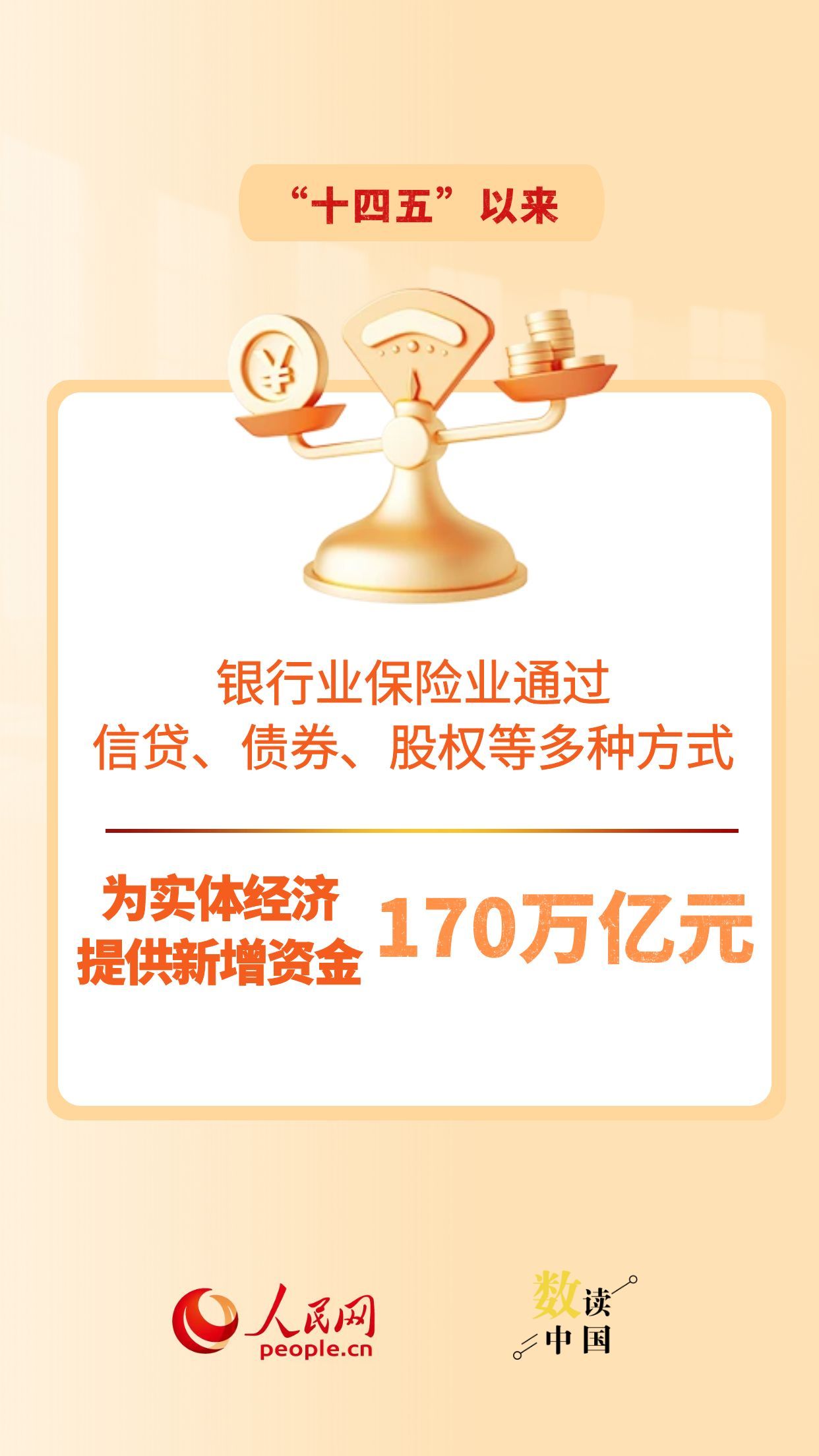
Core Insights - The press conference highlighted significant achievements in China's financial sector during the "14th Five-Year Plan" period, under the strong leadership of the Central Committee [1] Group 1: Financial Sector Achievements - The banking and insurance sectors have facilitated financing through various means, amounting to 170 trillion yuan [3] - The insurance industry has cumulatively paid out 9 trillion yuan, representing a 61.7% increase compared to the "13th Five-Year Plan" period [8] - Agricultural insurance has provided risk protection for 800 million farming households [8] Group 2: Direct Financing and Market Performance - The direct financing through the exchange market reached 57.5 trillion yuan, with a steady increase in its proportion [9] - The proportion of direct financing increased by 2.8 percentage points compared to the end of the "13th Five-Year Plan" [9] Group 3: Corporate Actions - Listed companies have distributed 10.6 trillion yuan through dividends and buybacks during the "14th Five-Year Plan" [12] - This represents an increase of over 80% compared to the "13th Five-Year Plan" [13]
锐财经|“十四五”期间金融体系稳健运行 中国银行业总资产位居世界第一
Ren Min Ri Bao Hai Wai Ban· 2025-09-23 04:00
Group 1 - As of June 2023, China's banking sector total assets reached nearly 470 trillion yuan, ranking first in the world, with stock and bond market sizes ranking second globally [1] - During the "14th Five-Year Plan" period, the average annual growth rate of loans to technology-based SMEs, inclusive finance for small and micro enterprises, and green loans exceeded 20% [2] - The banking and insurance sectors provided an additional 170 trillion yuan in funding to the real economy over the past five years, with the insurance industry paying out 9 trillion yuan, a 61.7% increase compared to the "13th Five-Year Plan" period [2] Group 2 - The banking and insurance sectors have shown improvement in key regulatory indicators such as non-performing loans, capital adequacy, and solvency, all remaining within a "healthy range" [3] - The total scale of capital and provisions to resist risks in the industry exceeded 50 trillion yuan, with a more than 40% increase in the disposal of non-performing assets compared to the "13th Five-Year Plan" [3] - The number of financing platforms decreased by over 60% and the scale of financial debt dropped by over 50% compared to the beginning of 2023 [3] Group 3 - Financial resources have been optimized to support high-quality economic development, with infrastructure loan balances reaching 54.5 trillion yuan, a 62% increase compared to the end of the "13th Five-Year Plan" [4] - The total financing through stock and bond markets reached 57.5 trillion yuan over the past five years, with the proportion of direct financing increasing by 2.8 percentage points to 31.6% [5] - The foreign exchange bureau has facilitated over 5.6 billion transactions related to cross-border e-commerce since the beginning of the "14th Five-Year Plan," enhancing the efficiency of trade foreign exchange receipts and payments [5]

数说“十四五”丨国新办举行新闻发布会介绍“十四五”时期金融业发展成就
Yang Guang Wang· 2025-09-23 01:25
Group 1 - The core viewpoint of the news is that during the "14th Five-Year Plan" period, China's financial sector has achieved significant accomplishments, with a stable financial system and improved financial services for the real economy [1] - As of June 2023, China's banking sector total assets reached nearly 470 trillion yuan, ranking first in the world; the stock and bond market sizes rank second globally; and foreign exchange reserves have maintained the world's largest position for 20 consecutive years [1] - The average annual growth rates for loans to technology-based SMEs, inclusive finance for small and micro enterprises, and green loans exceeded 20% during the "14th Five-Year Plan" period [1] Group 2 - Over the past five years, the banking and insurance sectors have provided an additional 170 trillion yuan in funding to the real economy through various means such as credit, bonds, and equity [1] - The average annual growth rates for loans in scientific research technology, medium to long-term loans for manufacturing, and infrastructure loans were 27.2%, 21.7%, and 10.1%, respectively [1] - The capital market is accelerating its service to technological innovation, with the market capitalization of the A-share technology sector exceeding 25% [2] - The number of technology companies among the top 50 by market capitalization in the A-share market increased from 18 at the end of the "13th Five-Year Plan" to 24 currently [2]
潘功胜、李云泽、吴清、朱鹤新重磅发声速览,事关股票、债券、银行业等
Sou Hu Cai Jing· 2025-09-22 13:42
Financial System Overview - The overall financial system in China is stable, with healthy financial institutions and smooth market operations [1] - As of June 2023, total assets of the banking sector reached nearly 470 trillion yuan, ranking first globally [1] - The banking and insurance sectors have total assets exceeding 500 trillion yuan, with an average annual growth of 9% over the past five years [2] Economic Support and Funding - Over the past five years, the banking and insurance sectors have provided an additional 170 trillion yuan in funding to the real economy, with significant growth in loans for research, manufacturing, and infrastructure [2] - The average annual growth rates for loans in key areas are 27.2% for research technology, 21.7% for manufacturing, and 10.1% for infrastructure [2] Capital Market Developments - In the last five years, total financing through stock and bond markets reached 57.5 trillion yuan, with the proportion of direct financing increasing to 31.6% [3] - The market capitalization of technology companies in A-shares has risen to over 25%, surpassing the combined market capitalization of banking, non-bank financial, and real estate sectors [3] - Companies listed on the stock market have significantly increased their return to investors, distributing a total of 10.6 trillion yuan through dividends and buybacks, an increase of over 80% compared to the previous five years [3] Market Resilience - The A-share market has shown improved resilience and risk resistance, with the annualized volatility of the Shanghai Composite Index decreasing by 2.8 percentage points to 15.9% [4] - By the end of August 2023, various long-term funds held approximately 21.4 trillion yuan of A-share market capitalization, a 32% increase from the end of the previous five-year plan [5] International Engagement - There has been active cross-border investment, with foreign institutions and individuals holding over 10 trillion yuan in domestic stocks, bonds, and deposits as of July [7] - The use of the renminbi in cross-border trade has increased from 16% to nearly 30%, indicating enhanced resilience in the foreign exchange market [7]
速览!“十四五”时期金融业发展成就
Xin Hua Wang· 2025-09-22 11:22
Group 1 - The market capitalization of the technology sector in A-shares exceeds 25% [2] - The number of technology companies among the top 50 by market capitalization has increased from 18 to 24 since the end of the 13th Five-Year Plan [2] - The average annual growth rate of loans to technology-based small and medium-sized enterprises during the 14th Five-Year Plan period exceeds 20% [3] Group 2 - China's foreign exchange reserves have remained stable above $3 trillion since the beginning of the 14th Five-Year Plan, with recent figures above $3.2 trillion [4] - The total market value of A-shares held by various types of medium- and long-term funds has increased by 32% compared to the end of the 13th Five-Year Plan, reaching approximately 21.4 trillion yuan [5] - The People's Bank of China maintains a supportive monetary policy stance, focusing on internal and external balance while promoting liquidity and reducing financing costs [6]
潘功胜、李云泽、吴清、朱鹤新发声,信息量很大→
Zheng Quan Shi Bao· 2025-09-22 09:06
Core Viewpoint - The press conference highlighted the achievements of China's financial sector during the "14th Five-Year Plan" period, emphasizing the stability and growth of the financial system, the effectiveness of monetary policy, and the ongoing reforms in financial governance and regulation. Group 1: Financial System Stability and Growth - The overall financial system in China is stable, with financial institutions remaining healthy and the market operating smoothly [3] - The total assets of the banking and insurance sectors have exceeded 500 trillion yuan, with an average growth of nearly 9% over the past five years [10] - The banking and insurance sectors have provided an additional 170 trillion yuan in funding to the real economy over the past five years, with significant growth in loans for key sectors such as technology and infrastructure [11] Group 2: Monetary Policy and Support for the Economy - The People's Bank of China has established a modern monetary policy framework that effectively supports the real economy, with annual growth rates for loans to technology SMEs, inclusive microloans, and green loans exceeding 20% [2][4] - The current monetary policy stance is supportive, implementing moderately loose monetary policies to stabilize market expectations and boost confidence [7][8] Group 3: Financial Regulation and Risk Management - Comprehensive financial regulation has been strengthened, with a focus on preventing financial risks and combating corruption within the financial sector [6] - The number of high-risk institutions and the scale of high-risk assets have been significantly reduced, ensuring that financial risks are fully controllable [14] - The financial regulatory authority has issued 171 regulations over the past five years, enhancing the regulatory framework across various financial sectors [22] Group 4: International Financial Cooperation and Currency Use - China's participation, influence, and voice in international financial governance have significantly increased, reflecting the country's commitment to structural reforms in the financial supply side [4] - The renminbi has become the third-largest currency for trade financing and payments globally, with its weight in the IMF's Special Drawing Rights basket ranking third [9] Group 5: Capital Market Developments - The capital market has seen a total financing of 57.5 trillion yuan through stock and bond markets over the past five years, with a steady increase in the proportion of direct financing [27] - The number of companies that have been smoothly delisted during the "14th Five-Year Plan" period reached 207, indicating a more robust exit mechanism for underperforming firms [35] - The A-share market's resilience and risk resistance have improved, with the annualized volatility of the Shanghai Composite Index decreasing by 2.8 percentage points compared to the previous five years [26]
信号巨大!潘功胜、李云泽、吴清、朱鹤新同日发声
Zheng Quan Shi Bao· 2025-09-22 08:59
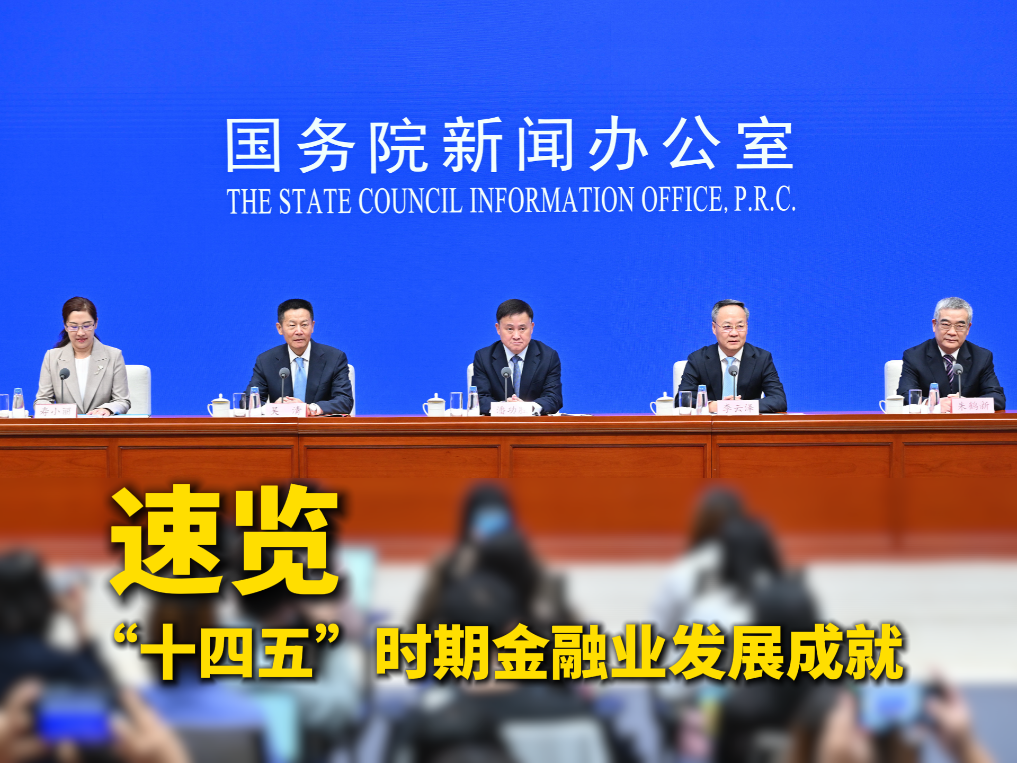
Core Viewpoint - The press conference focused on the achievements of the financial industry during the "14th Five-Year Plan" period, emphasizing long-term development rather than short-term policy adjustments [2]. Financial System Stability - The overall financial system in China is stable, with healthy financial institutions and smooth market operations [3]. - The average annual growth rate of loans to technology-based SMEs, inclusive small and micro loans, and green loans exceeded 20% during the "14th Five-Year Plan" [3]. Monetary Policy Framework - A modern monetary policy framework with Chinese characteristics has been gradually formed and is continuously improving, promoting reasonable growth in financial volume and optimizing credit structure [4]. International Financial Governance - China's participation, influence, and voice in international financial governance have significantly increased, driven by structural reforms in financial supply and market institutions [5]. Regulatory Health - Key regulatory indicators such as non-performing loans, capital adequacy, and solvency are all within a healthy range, with a 40% increase in the disposal of non-performing assets compared to the "13th Five-Year Plan" [7]. - The total assets of the banking and insurance sectors have surpassed 500 trillion yuan, with an average growth of nearly 9% over the past five years [8]. Funding for the Real Economy - The banking and insurance sectors provided an additional 170 trillion yuan in funding to the real economy over the past five years, with significant growth in loans for key areas such as scientific research and infrastructure [9]. Capital Market Developments - The basic system and regulatory logic of the capital market have been comprehensively restructured, laying a solid foundation for stable development [12]. - The market capitalization of the technology sector in A-shares has exceeded 25%, indicating a significant increase in the market's focus on technology [13]. - Total financing through stock and bond markets reached 57.5 trillion yuan over the past five years, with a direct financing ratio rising to 31.6% [14]. Corporate Actions - Listed companies distributed over 10.6 trillion yuan in dividends and buybacks, significantly higher than the amounts raised through IPOs and refinancing [15]. Regulatory Enforcement - The China Securities Regulatory Commission issued 2,214 administrative penalties during the "14th Five-Year Plan," with fines totaling 41.4 billion yuan, reflecting enhanced enforcement and market transparency [16]. Foreign Exchange Management - The foreign exchange reserves have remained stable above 3 trillion USD during the "14th Five-Year Plan," contributing to economic stability [19].