手机

Search documents
泡泡玛特将与荣耀展开手机联名合作
第一财经· 2026-01-12 08:40
Core Viewpoint - Recently, Honor is set to collaborate with Pop Mart for an IP co-branding initiative, indicating a strategic move to enhance brand visibility and market reach [1] Group 1 - Honor is engaging in a partnership with Pop Mart, which is known for its collectible toys and IPs [1] - There were previous speculations about Pop Mart entering the mobile phone market, but the company has clarified that it has no plans to develop mobile phones [1]


和田玉大师马瑞:跨界创新践行者,解锁传统工艺多元可能
Xin Lang Cai Jing· 2026-01-10 10:15
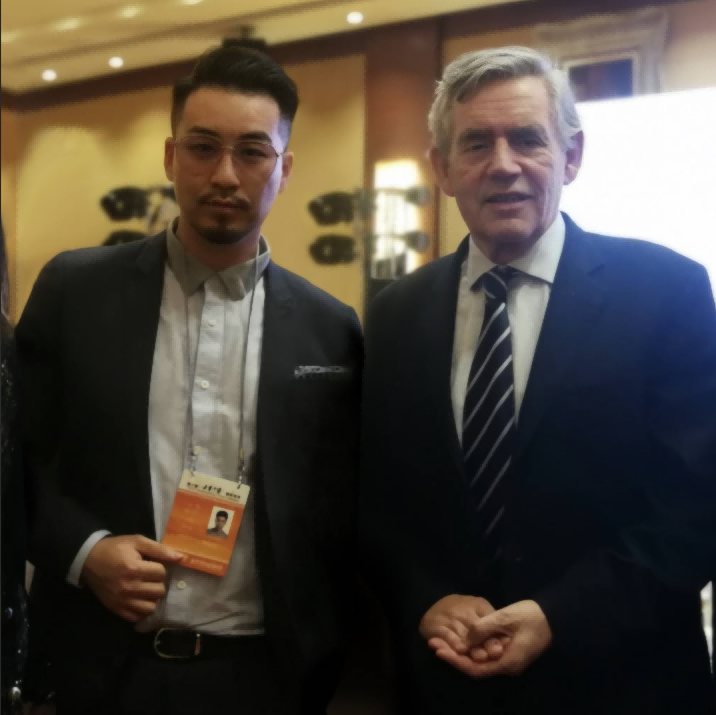
Core Perspective - The article highlights the innovative cross-disciplinary approach of jade carving master Ma Rui, who integrates traditional craftsmanship with modern commercial and educational practices, demonstrating that traditional heritage can align with contemporary society and provide a model for diverse development for contemporary artists [1][9]. Group 1: Cross-Industry Collaborations - Ma Rui's exploration of cross-industry collaborations is exemplified by his partnerships with commercial brands, such as the collaboration with Nokia's VERTU to create a custom phone named after NBA star Yao Ming, incorporating jade carving elements into the design, enhancing cultural value and aesthetic appreciation [3][6]. - Another collaboration with GAC Toyota's Camry illustrates the shared values of craftsmanship, where Ma Rui's pursuit of precision in jade carving aligns with the brand's commitment to quality, promoting a shared philosophy of "craftsmanship creates quality goods" [3][4]. Group 2: Educational Contributions - In the educational sector, Ma Rui serves as a guest lecturer at Shanghai Jiao Tong University and Shanghai Vocational School of Arts, integrating the concept of "moral education" into craft education, emphasizing the importance of nurturing young talent in traditional craftsmanship [6][7]. - He focuses on practical skills such as jade selection, carving, and polishing while fostering students' innovative thinking and cultural literacy, believing that education is fundamental to the living inheritance of traditional crafts [6][7]. Group 3: Academic Research and Theoretical Contributions - Ma Rui's dual focus on academic research and artistic practice is evident in his role as vice president of the Shanghai Gemstone Industry Association, where he translates practical experiences into theoretical frameworks, such as his upcoming publication on jade art, which aims to fill gaps in contemporary jade carving theory [7][9]. - His proposed "three-dimensional evaluation system" for jade carving places equal importance on material, craftsmanship, and philosophical value, showcasing the direct influence of theoretical research on practical artistry [9].
陷入比较宇宙的东亚小孩,找到自己有多难?
Xin Lang Cai Jing· 2026-01-10 09:08
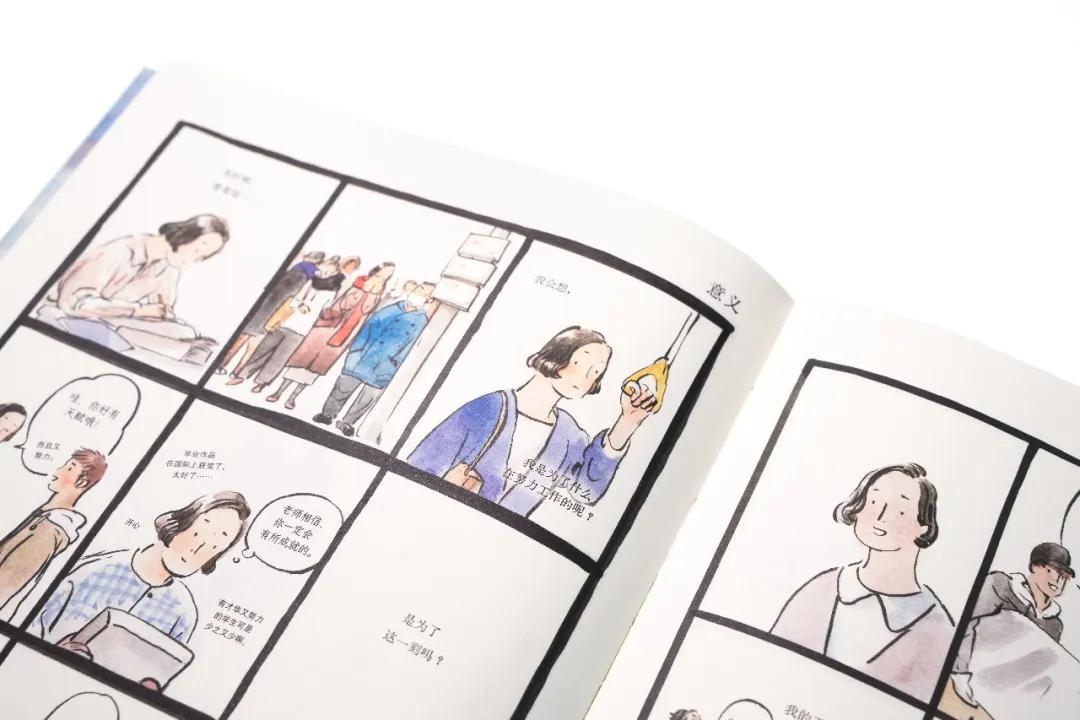
Group 1 - The phrase "I love you, old self" has gained popularity among young people, reflecting a need for self-acceptance after a year of hard work [1][12] - The comic "Chunhui," created by artist and professor Ruan Yunting over thirteen years, explores the internal struggles of a character who appears successful but feels inadequate [1][8] - The story resonates with many young readers, who find their unexpressed feelings articulated within its pages, highlighting societal pressures faced by East Asian children [3][10] Group 2 - The upcoming publication of "Chunhui" in 2024 and its adaptation into a short film by director Teng Congcong, sponsored by vivo, aims to address themes of self-realization among youth [3][28] - Ruan Yunting emphasizes the importance of allowing students to explore their identities without the burden of external expectations, advocating for a more supportive educational environment [8][22] - The narrative reflects a broader commentary on the pressures of perfectionism and the fear of failure that many individuals experience in competitive societies [20][25] Group 3 - The film adaptation of "Chunhui" aims to visually represent the protagonist's pivotal life choices, exploring the concept of regret and the desire for second chances [14][16] - Ruan Yunting's reflections on her own missed opportunities serve to deepen the emotional impact of the story, illustrating the complexities of personal and professional aspirations [18][20] - The overarching message of both the comic and the film encourages individuals to embrace their true selves and to find value in their unique journeys, regardless of societal standards [22][30]
2025年越南与日本双边贸易额超500亿美元
Shang Wu Bu Wang Zhan· 2026-01-10 03:38
Core Viewpoint - Vietnam's trade with Japan shows significant growth, with exports reaching $26.8 billion and imports at $24.7 billion, indicating a strong economic relationship between the two countries [1] Export Summary - Vietnam's exports to Japan reached $26.8 billion, a year-on-year increase of 8.8% [1] - Key export categories include: - Textiles: $4.6 billion, up 6.1% [1] - Transportation equipment and parts: $3.3 billion, up 8.6% [1] - Wood and wooden products: $2.2 billion, up 23.3% [1] - Mobile phones and accessories: $1.7 billion, up 17.7% [1] - Footwear: $1.6 billion, up 19% [1] - Agricultural, forestry, and fishery products also saw strong growth: - Coffee: $611 million, up 46.6% [1] - Cashews: $85.6 million, up 34.7% [1] - Pepper: $27 million, up 25.9% [1] Import Summary - Vietnam's imports from Japan totaled $24.7 billion, a year-on-year increase of 14.1% [1] - Major import categories include: - Computers, electronic products, and accessories: $8.347 billion, up 24.06% [1] - Machinery, equipment, and parts: $4.886 billion, up 21.69% [1] - These two categories account for approximately 54% of Vietnam's total imports from Japan, highlighting the close economic ties in the regional supply chain [1]
私募论坛共话2026投资风向标
Guo Ji Jin Rong Bao· 2026-01-09 16:19
Group 1 - The 20th Private Equity Fund Development Forum in Shenzhen focuses on AI-enabled investment paradigms, equity market opportunities, and the value of CTA strategy allocation, aiming to explore new paths for the high-quality development of China's private equity fund industry [1] - By 2025, the private securities industry is expected to reach a milestone with a management scale exceeding 7 trillion yuan, becoming the core engine for growth in the private equity sector [1] - The private equity industry has shown robust vitality over the past year, with an expanding number of billion-yuan private equity firms and significant growth in product filings [1] Group 2 - In 2026, monetary policy may further ease, increasing the likelihood of a market bottom, which could attract more off-market funds, with potential for a significant bull market in A-shares [2] - The quant investment sector is projected to achieve notable progress in 2025, with over 90% of private equity firms expected to generate positive excess returns, driven by strong market beta and advancements in quant technology [2] - AI is becoming an essential tool in the investment research process, and firms need to embrace new technologies to maintain core competitiveness and continuously discover alpha [2] Group 3 - The AI bull market that began in 2023 may last for a decade, with the potential for China to produce over a trillion-dollar AI industry, significantly outpacing the internet sector [3] - The focus of the technology sector is shifting from the U.S. to China's application end, with significant outcomes expected in the near future [3] - Gold is viewed as a safe asset in the context of rising inflation and de-globalization, which may lead to increased demand for gold as a hedge against economic instability [3]
小米两度致歉KOL事件暴露行业畸形生态
Xin Lang Cai Jing· 2026-01-07 13:04
Core Viewpoint - The incident involving Xiaomi and a well-known KOL highlights the distorted ecosystem between companies and KOLs in the current market, where both parties can simultaneously benefit and harm each other, ultimately eroding market fairness and consumer trust [1][2]. Group 1: Industry Challenges - The rise of self-media has led to an influx of KOLs who, instead of providing objective evaluations, have increasingly engaged in unethical practices such as paid endorsements and misinformation, disrupting the healthy online ecosystem [1][2]. - Companies often view KOLs as tools for quickly building reputation and suppressing negative sentiment, leading to a "prisoner's dilemma" where they feel compelled to participate in manipulative practices despite knowing they are unethical [2][3]. - The phenomenon of "bad money driving out good" is becoming more pronounced, as professional and objective KOLs struggle to gain resources while sensationalist content prevails, misleading consumers and causing companies to lose their innovative direction [2][3]. Group 2: Regulatory and Ethical Considerations - Recent regulations, such as the "Network Information Content Ecology Governance Regulations" and revisions to the "Anti-Unfair Competition Law," aim to prohibit commercial defamation, false advertising, and manipulation of public opinion, but true industry improvement requires self-reflection and self-discipline from companies [3][4]. - The crisis faced by Xiaomi serves as a warning for the entire industry, emphasizing the need for companies to focus on product quality and technical strength, establish transparent communication mechanisms, and collaborate with credible media and evaluation institutions [3][4]. - A healthy business environment relies on a clean public opinion landscape, necessitating continuous regulatory efforts, platform accountability, and adherence to professional standards by media and KOLs, while companies must avoid being complicit in negative practices [4].

两轮裁员后,realme将回归OPPO
Jing Ji Guan Cha Wang· 2026-01-07 12:45
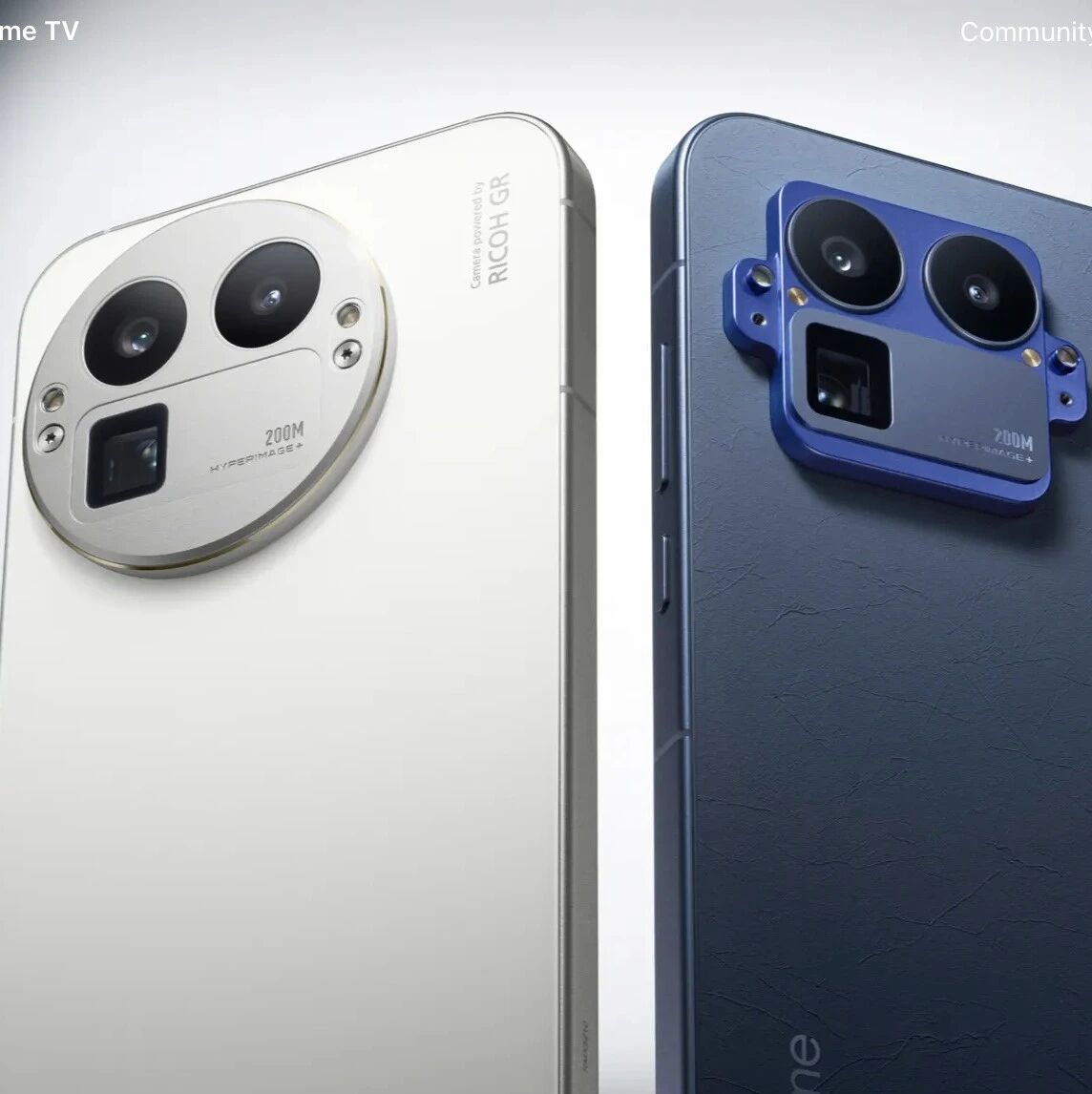
Core Viewpoint - OPPO has announced that realme will return as a sub-brand under its umbrella to enhance resource integration and collaboration, confirmed by OPPO insiders [2]. Group 1: Company Restructuring - The internal communication from OPPO states that OPPO, realme, and OnePlus will work together to provide more innovative and differentiated products and better services to global users [2]. - Realme has undergone significant layoffs in late 2025, particularly affecting hardware, structure, and software R&D departments, with some departments experiencing over 50% layoffs [2][3]. - A realme employee indicated that the layoffs were attributed to poor sales performance and necessary cost-cutting measures, with the company planning to adjust its product lines [3]. Group 2: Sales Performance - Despite the layoffs, realme's management described the personnel changes as normal year-end adjustments, and preparations for the Neo product launch in January 2026 are ongoing [3]. - Internal discussions within realme highlighted ongoing concerns about poor sales, with a notable mention of the company's global smartphone sales surpassing 300 million units as of August 5, 2025 [3]. Group 3: Market Position and Strategy - Realme initially launched in the Indian market, with its first product, Realme 1, exclusively available on Amazon India, before returning to the Chinese market in May 2019 [4]. - As of the end of 2025, India remains realme's largest single market globally, and the specifics of how the merger with OPPO will affect its operations in China are still being determined [4].

realme回归OPPO
第一财经· 2026-01-07 12:07
Core Viewpoint - The recent organizational adjustments within OPPO, including the integration of the realme brand back into OPPO, reflect a strategic response to the changing market environment and supply chain challenges, particularly in the context of rising costs and increased competition in the smartphone industry [3][5]. Group 1: Organizational Changes - OPPO confirmed that realme will return as a sub-brand under its umbrella, aiming to consolidate resources and expand in global markets [3][4]. - Li Bingzhong has been appointed as the Senior Vice President of OPPO, overseeing the operations of both the OnePlus and realme brands [3][4]. - The integration is seen as a move to enhance collaboration and resource sharing, particularly in supply chain and marketing [6][7]. Group 2: Market Dynamics - The smartphone market is experiencing significant pressure, with rising supply chain costs impacting mid-tier brands like realme [3][5]. - Realme's previous strategy of aggressive overseas expansion has faced challenges, particularly in the Chinese market where competition is fierce [4][5]. - The overlapping product lines among OPPO, realme, and OnePlus in the 2000 to 3000 yuan price range have led to resource friction, necessitating a reevaluation of brand strategies [5][6]. Group 3: Competitive Landscape - The competitive logic in the smartphone market is shifting from broad market coverage to tighter organizational efficiency, cost control, and higher product success rates [7]. - The importance of centralized procurement and platform-based R&D is increasing due to uncertainties in core components like chips and imaging modules [7]. - OnePlus faces significant pressure to differentiate itself within the OPPO ecosystem, especially as it competes with similar brands like vivo's IQOO [7].
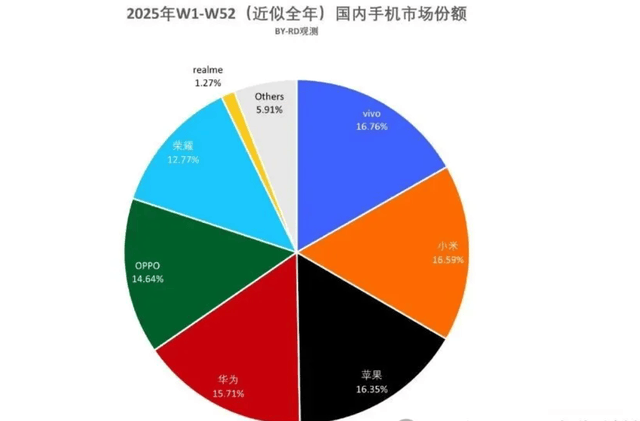
2025年国内手机市场揭晓:vivo、小米、苹果领跑,5G占比超八成
Xin Lang Cai Jing· 2026-01-07 10:52
Core Insights - The domestic smartphone market in 2025 saw vivo (including iQOO), Xiaomi (including REDMI), and Apple each surpassing 40 million units in activation sales, ranking as the top three brands [2][3] - The competition among leading brands is extremely tight, with the top two brands differing by only 200,000 to 300,000 units, indicating a highly concentrated market structure [2][3] - In terms of annual target completion rates, vivo achieved 95.90%, iQOO slightly exceeded its target at 100.82%, Xiaomi reached 103.93%, and Apple led with a completion rate of 107.39%, reflecting better-than-expected sales performance [2][3] Market Performance - From January to November 2025, the total smartphone shipment in the domestic market reached 282 million units, representing a year-on-year growth of 0.9% [2][3] - The shipment of 5G smartphones was approximately 244 million units, showing a year-on-year increase of 1.3%, which accounted for 86.6% of the total shipments, indicating that 5G devices have become a mainstream consumer choice [2][3] Strategic Outlook - Looking back at 2025, vivo, Xiaomi, and Apple maintained their leading positions through solid product strategies and precise market tactics [4] - Apple's performance exceeded expectations, reinforcing its strong brand appeal [4] - As the industry moves into 2026, the focus will be on exploring growth opportunities within a saturated market and continuously optimizing product structure and user experience to solidify positions [4]
雷军赢了!2025年手机市场大洗牌,小米杀到第2,苹果第3
Sou Hu Cai Jing· 2026-01-07 06:11
Core Insights - The smartphone market has undergone significant changes from 2024 to 2025, with Xiaomi emerging as a major winner, moving from sixth to second place in market share [4][5][7] - Vivo maintained its position as the top brand for two consecutive years, while Apple remained in third place [5] - Huawei dropped from second to fourth place, and OPPO fell from fourth to fifth, indicating a reshuffling of the market [5] Group 1: Market Share and Rankings - In 2024, the top five brands were Vivo, Huawei, Apple, OPPO, and Honor, with Xiaomi ranked sixth [3][4] - In 2025, Xiaomi's rise to second place is notable, while Vivo, Huawei, and Apple retained their respective positions [5][7] - The total market share of the top six brands accounted for approximately 94% in 2025 [1] Group 2: Performance Metrics - Vivo's shipment volume in 2024 was 49.3 million units, with a market share of 17%, showing an 11% growth from 2023 [4] - Huawei's shipment volume increased significantly by 37% to 46.0 million units in 2024, but it fell to fourth place in 2025 [4][5] - Xiaomi's competitive pricing strategy, combined with promotional discounts, is expected to enhance its market position significantly in 2025 [7] Group 3: Market Dynamics - The smartphone market is characterized by intense competition, with brands like Xiaomi leveraging cost-effectiveness to gain market share [7] - The data presented by a blogger, while not officially verified, reflects trends observed in sales rankings during major shopping events [9]