
装备制造业

Search documents
【权威解读】1—5月份规模以上工业企业实现利润总额2.7万亿元
中汽协会数据· 2025-06-27 06:18
Core Viewpoint - In the first five months of 2025, the total profit of industrial enterprises above designated size reached 2.72 trillion yuan, showing a year-on-year decline of 1.1% due to multiple factors including insufficient effective demand and declining industrial product prices [1] Group 1: Industrial Profit Trends - The total profit of industrial enterprises increased by 603.4 billion yuan compared to the first four months, but still experienced a year-on-year decline [1] - Gross profit margin for industrial enterprises grew by 1.1% year-on-year, contributing to a 3.0 percentage point increase in overall profits [1] - Revenue for industrial enterprises rose by 2.7% year-on-year, indicating a sustained growth trend that may support future profit recovery [1] Group 2: Equipment Manufacturing Sector - The equipment manufacturing sector demonstrated strong performance with a profit increase of 7.2% year-on-year, contributing 2.4 percentage points to the overall industrial profit growth [2] - Seven out of eight industries within equipment manufacturing reported profit growth, with notable increases in electronics, electrical machinery, and general equipment sectors, achieving growth rates of 11.9%, 11.6%, and 10.6% respectively [2] Group 3: High-Quality Development in Aerospace and Marine Industries - The aerospace, aviation, and marine industries experienced rapid growth, with profits increasing by 56.0% year-on-year [2] - Specific sectors such as aircraft manufacturing and spacecraft manufacturing saw profits rise by 120.7% and 28.6% respectively, driven by successful commercial operations and new achievements in commercial aerospace [2] - The shipbuilding and related equipment manufacturing sectors also thrived, with profits growing by 85.0%, including a 111.8% increase in metal ship manufacturing profits [2] Group 4: Impact of "Two New" Policies - The implementation of "Two New" policies has effectively stimulated domestic demand, with profits in general and specialized equipment sectors increasing by 10.6% and 7.1% respectively [3] - Rapid profit growth was observed in specific industries such as electronic and electrical machinery, with increases of 39.3% and 26.7% [3] - The effects of the consumer goods replacement policy were significant, with profits in smart consumer devices and kitchen appliances rising by 101.5% and 20.7% respectively [3] Group 5: Performance of Private and Foreign Enterprises - Profits for private enterprises and foreign-invested enterprises grew by 3.4% and 0.3% respectively, both exceeding the average growth rate of all industrial enterprises [4] - These sectors contributed 0.9 percentage points and 0.1 percentage points to the overall industrial profit growth [4] - Future strategies will focus on implementing proactive macro policies to strengthen domestic circulation and promote high-quality industrial development [4]


5月经济数据,最新解读!
Zheng Quan Shi Bao Wang· 2025-06-27 04:55
Group 1 - In May, the profits of industrial enterprises above designated size decreased by 9.1% year-on-year, marking a negative growth rate for the first time in five months [1][2] - From January to May, the total profit of industrial enterprises above designated size reached 27,204.3 billion yuan, a year-on-year decline of 1.1% [2] - Despite the profit decline, the operating income of these enterprises increased by 2.7% year-on-year, with gross profit rising by 1.1% [2] Group 2 - The mining industry saw a profit decrease of 29.0%, while the manufacturing sector experienced a profit increase of 5.4% [3] - The equipment manufacturing sector's profit grew by 7.2%, contributing significantly to the overall industrial profit growth [3] - Seven out of eight industries within equipment manufacturing reported profit growth, with notable increases in electronics, electrical machinery, and general equipment [3] Group 3 - The "Three Aviation" industries (aerospace, aviation, and maritime) significantly boosted related industries, with profits in these sectors rising by 56% [4] - The aircraft manufacturing sector saw a remarkable profit increase of 120.7%, driven by successful commercial operations and new achievements in space exploration [4] - The shipbuilding and related equipment manufacturing industries also experienced substantial profit growth, with metal ship manufacturing profits increasing by 111.8% [4] Group 4 - The smart consumer device manufacturing industry saw profits double, reflecting the impact of the "Two New" policy aimed at large-scale equipment updates and consumer product replacements [5][6] - The general and specialized equipment sectors reported profit increases of 10.6% and 7.1%, respectively, contributing to overall industrial profit growth [5] - The government has allocated significant funding to support equipment updates and consumer product replacements, with ongoing projects across various sectors [6]
国家统计局最新发布!这一数据转降,什么原因?
证券时报· 2025-06-27 04:45
6月27日,国家统计局公布的最新数据显示,按可比口径计算,5月份规模以上工业企业利润同比下降9.1%,前五个月同比下降1.1%。规模以上工业企业利 润同比增速再为负值。 分析认为,这主要受有效需求不足、工业品价格下降及短期因素波动等多重因素影响。其中,投资收益等短期因素的上年同期基数较高对利润增速形成拖 累。但也需要看到,工业企业毛利润、营收保持增长,为企业下阶段盈利恢复创造有利条件。 | 1 | 3 | | --- | --- | | 1 | | 多重因素影响工业企业利润下降 最新数据出炉。 数据显示,1—5月份,全国规模以上工业企业实现利润总额27204.3亿元,同比下降1.1%。 国家统计局工业司统计师于卫宁表示,前五个月规模以上工业企业实现利润总额比前四个月增加6034.1亿元,但是受有效需求不足、工业品价格下降及短期 因素波动等多重因素影响,同比为下降。 从利润构成看,投资收益等短期因素的上年同期基数较高,下拉1—5月份规上工业企业利润增速1.7个百分点。 虽然企业利润同比下降,但同期规模以上工业企业实现营业收入同比增长2.7%。于卫宁表示,从营业收入扣减营业成本计算的毛利润角度看,规模以上工业 企 ...

前5月规上工业利润总额2.7万亿元,装备制造业增7.2%
2 1 Shi Ji Jing Ji Bao Dao· 2025-06-27 03:59
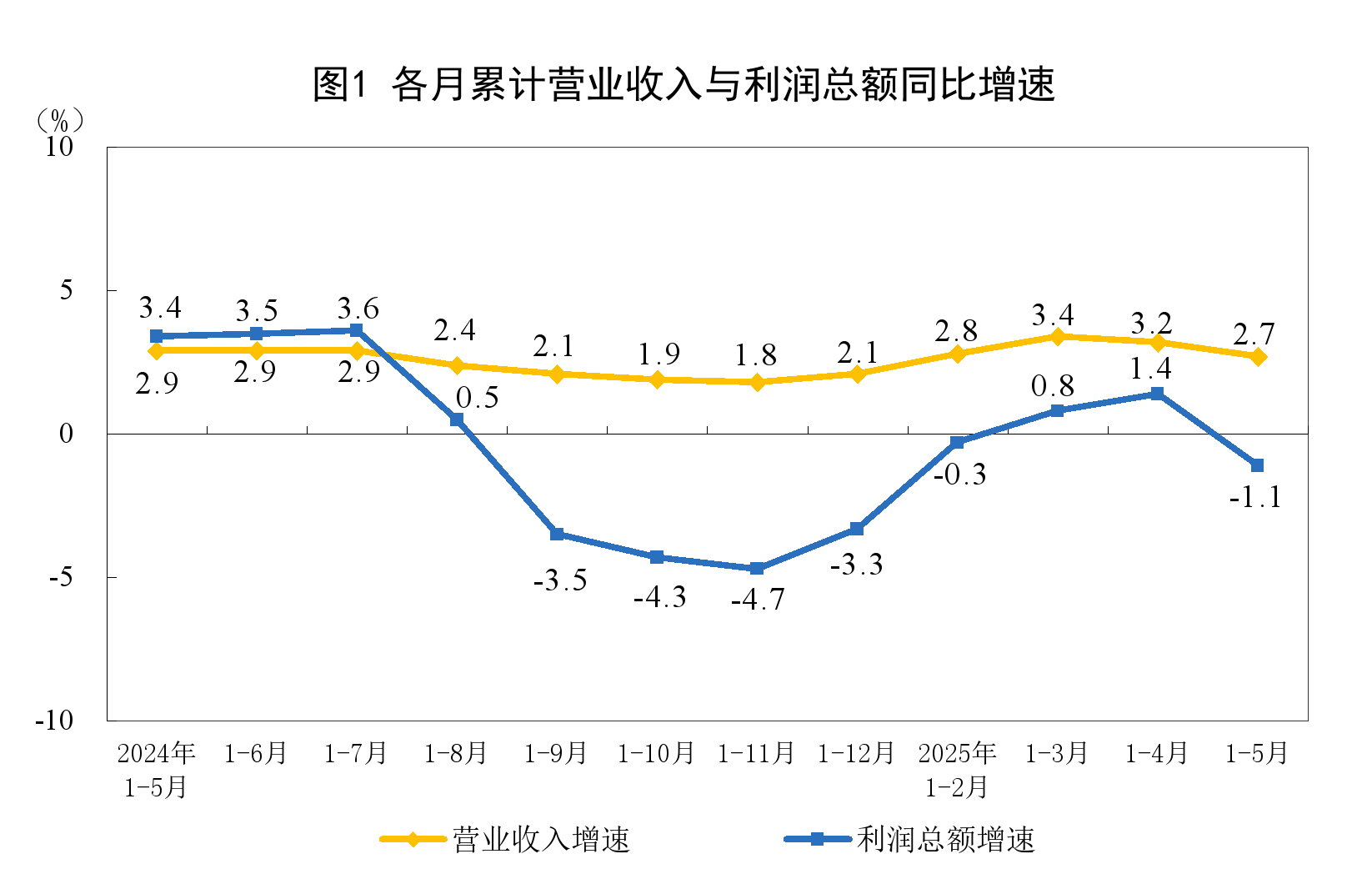
Core Insights - In the first five months of the year, profits of large-scale industrial enterprises increased by 603.4 billion yuan compared to the previous four months, but saw a year-on-year decline of 1.1% due to insufficient effective demand, falling industrial product prices, and short-term fluctuations [1][3] - The cumulative profit of large-scale industrial enterprises showed a recovery trend, with a year-on-year increase of 0.8% in January-March and 1.4% in April [3] - The overall revenue of large-scale industrial enterprises reached 54.76 trillion yuan, a year-on-year increase of 2.7%, while operating costs rose by 3% to 46.88 trillion yuan, resulting in a profit margin of 4.97%, down by 0.19 percentage points year-on-year [4] Profit Composition - The profit composition indicates that investment income and other short-term factors from the previous year had a high base, which dragged down the profit growth rate by 1.7 percentage points [1] - The gross profit of large-scale industrial enterprises increased by 1.1% year-on-year, contributing to a 3 percentage point increase in overall profits [4] Sector Performance - In terms of sector performance, the mining industry saw a profit decline of 29% to 358.04 billion yuan, while the manufacturing sector's profits increased by 5.4% to 20,201.4 billion yuan, and the electricity, heat, gas, and water production and supply sector grew by 3.7% to 3,422.5 billion yuan [3][5] - Notably, the agricultural and food processing industry experienced a profit increase of 38.2%, while the automotive manufacturing sector faced a significant decline of 11.9% [5] Equipment Manufacturing - The equipment manufacturing sector demonstrated strong performance, with profits increasing by 7.2%, contributing 2.4 percentage points to the overall profit growth of large-scale industries [5] - Among the eight industries within equipment manufacturing, seven reported profit growth, with electronics, electrical machinery, and general equipment showing double-digit growth rates [5] High-Quality Development - The aerospace, aviation, and maritime industries experienced a remarkable profit increase of 56% due to rapid development in the "three aviation" sectors [6] - Policies promoting equipment upgrades and consumer goods replacement have positively impacted profits in related sectors, with significant growth in smart consumer devices and kitchen appliances [6] Future Outlook - The focus for the next phase will be on implementing proactive macro policies to strengthen domestic circulation, enhance innovation, and promote high-quality industrial development, laying a solid foundation for the recovery of industrial enterprise profits [6]
工业利润由增转降,下阶段走势如何
Di Yi Cai Jing· 2025-06-27 02:55
Group 1 - The total profit of industrial enterprises above designated size in China for January to May was 2.72 trillion yuan, a year-on-year decrease of 1.1%, with May alone seeing a profit drop of 9.1% [1][3] - The decline in industrial profits is attributed to insufficient effective demand, falling industrial product prices, and fluctuations in short-term factors [1][3] - Despite the overall profit decline, the gross profit of industrial enterprises increased by 1.1% year-on-year, contributing to a 3.0 percentage point increase in total profits [1][3] Group 2 - Private enterprises and foreign-invested enterprises showed profit growth of 3.4% and 0.3% respectively, outperforming the average level of all industrial enterprises [3] - The equipment manufacturing sector demonstrated strong performance with a profit increase of 7.2%, contributing 2.4 percentage points to the overall industrial profit growth [3][4] - Several industries within equipment manufacturing, such as electronics and electrical machinery, reported profit growth exceeding 10% [3][4] Group 3 - The "Two New" policies have effectively stimulated domestic demand, leading to significant profit increases in general and specialized equipment manufacturing [4] - The consumer goods sector benefited from policies promoting the replacement of old products, with profit growth in smart consumer devices reaching 101.5% [4] - Future industrial profit growth is expected to improve due to supportive policies aimed at enhancing quality and efficiency in key industries [4]
新思想引领新征程丨做好节能减排工作 书写绿色低碳发展新答卷
Yang Guang Wang· 2025-06-27 02:28
Group 1 - China's ecological civilization construction is focusing on carbon reduction, with a shift towards a dual control system for carbon emissions and intensity [1] - The energy utilization efficiency has significantly improved, with a continuous decline in carbon dioxide emission intensity [1] - In Jiangxi's Jiujiang Chaisang District, an energy company processes around 2,000 tons of waste daily, generating approximately 1.1 million kWh of electricity for eight surrounding enterprises [1] Group 2 - By the end of May, the installed capacity of wind and solar power in China accounted for 45.7% of total installed capacity, surpassing that of coal-fired power [2] - The installed capacity of photovoltaic power has historically exceeded 1 billion kW, reflecting the optimization of China's energy structure [2] - A national-level green factory in Xi'an has reduced energy consumption per unit of output by over 30% in the past three years [2] Group 3 - The concept of green development is becoming more ingrained in society, as seen in Shenyang's metro system introducing a carbon points platform to encourage green commuting [3] - Since 2012, China's energy consumption intensity has decreased by over 26%, equivalent to saving 1.4 billion tons of standard coal and reducing carbon dioxide emissions by approximately 3 billion tons [3] - During the 14th Five-Year Plan period, energy consumption intensity and carbon emission intensity are projected to decrease by 3.8% and 3.4% respectively in 2024 [3]
受需求不足、工业品价格下降等影响,1-5月工业利润下降1.1%
Xin Lang Cai Jing· 2025-06-27 02:02
Core Viewpoint - In May, the profits of large-scale industrial enterprises in China decreased by 9.1% year-on-year, contrasting with a 3.0% increase in the previous month. For the period from January to May, profits fell by 1.1% compared to a 1.4% increase from January to April, indicating a significant decline in industrial profitability due to insufficient effective demand, falling industrial product prices, and short-term fluctuations [1]. Group 1: Industrial Profit Trends - The total profit of large-scale industrial enterprises increased by 603.4 billion yuan in the first five months compared to the previous four months, despite the year-on-year decline [1]. - The gross profit margin, calculated by deducting operating costs from operating income, showed a year-on-year increase of 1.1%, contributing to a 3.0 percentage point increase in overall profits for large-scale industrial enterprises [1]. Group 2: Sector Performance - The equipment manufacturing sector maintained a high level of profitability, with profits increasing by 7.2% year-on-year from January to May, contributing 2.4 percentage points to the overall industrial profit growth [2]. - Among the eight industries within equipment manufacturing, seven experienced profit growth, with notable increases in the electronics, electrical machinery, and general equipment sectors, achieving growth rates of 11.9%, 11.6%, and 10.6% respectively [2]. Group 3: Aerospace and Related Industries - The aerospace, aviation, and maritime industries saw rapid development, leading to a 56.0% year-on-year profit increase in the railway, shipping, and aerospace sectors. Profits in aircraft manufacturing and spacecraft and rocket manufacturing grew by 120.7% and 28.6%, respectively, while related equipment manufacturing profits rose by 68.1% [4]. - General and specialized equipment sectors also reported profit increases of 10.6% and 7.1%, respectively, contributing 0.6 percentage points to the overall industrial profit growth [4]. Group 4: Policy Support and Future Outlook - The Chinese government is implementing more proactive macro policies to strengthen domestic circulation and promote high-quality industrial development, which is expected to lay a solid foundation for the recovery of industrial enterprise profits [1]. - The National Development and Reform Commission announced that 200 billion yuan in special long-term bonds will support equipment upgrades, with the first batch of approximately 173 billion yuan allocated to 7,500 projects across 16 sectors [5]. - The continuation of the "old-for-new" consumption policy is expected to positively impact industrial profits, with significant profit growth observed in smart consumer devices and home appliances [4].
产能和库存周期有望触底回升,企业盈利修复动能增强
Haitong Securities International· 2025-06-26 11:05
Group 1 - The capacity and inventory cycles are expected to bottom out and recover, enhancing the momentum of enterprise profit recovery [1][6][53] - The current capacity cycle has been in a downward trend since the second half of 2021 and is nearing its end, while the inventory cycle is also expected to transition from a bottoming phase to a replenishment phase within the year [1][2][11] - The recovery of the capacity cycle is typically driven by strong fiscal support policies, as seen in previous cycles [8][14] Group 2 - The downstream capacity cycle is approaching a turning point, with upstream capacity utilization still declining and the mining industry requiring more time for capacity reduction [2][15] - The inventory cycle shows significant differentiation across upstream, midstream, and downstream sectors, primarily due to varying demand improvements [2][15] - Demand improvements are concentrated in sectors with strong policy support, emerging industries, and export-oriented industries, while traditional sectors like real estate remain weak [15][16] Group 3 - The manufacturing sector is currently in a dual bottom phase for both capacity and inventory cycles, with the manufacturing capital expenditure declining significantly since its peak in 2021 [14][40] - The industrial sector is experiencing a passive destocking phase, with inventory levels expected to gradually recover as revenue growth improves [14][17] - The midstream equipment manufacturing sector is showing signs of recovery, driven by policy support and increased consumer demand for electronics and vehicles [30][37] Group 4 - The downstream consumer manufacturing sector is also in a destocking phase, with revenue growth rebounding since the beginning of 2024 [40][48] - Specific industries within the downstream sector, such as agricultural and food processing, are entering active replenishment phases, indicating a positive outlook for inventory levels [48][49] - The overall economic recovery will depend on the strength of consumer and investment demand, which will gradually transmit to the production side [53]
解锁绿色发展新密码
Jing Ji Ri Bao· 2025-06-24 22:08
Core Viewpoint - Energy conservation and efficiency enhancement have become strategic choices for sustainable economic development and the future of humanity in the context of severe global climate change and accelerated energy structure transformation [1][2]. Group 1: Energy Consumption and Challenges - In 2024, China's primary energy consumption reached 5.96 billion tons of standard coal, with oil and natural gas import rates exceeding 70% and 40% respectively, indicating increasing energy security risks [2]. - Energy consumption intensity in China decreased by 3.8% year-on-year in 2024, with a cumulative reduction of 11.6% over the first four years of the 14th Five-Year Plan, meeting the planned target timeline [2]. Group 2: Policy Initiatives and Economic Impact - A new round of large-scale equipment updates and consumer product replacements was initiated in 2024, with the aim of enhancing technology, energy consumption, and emissions standards [3]. - By May 31, 2025, the old-for-new consumer goods program generated sales of 1.1 trillion yuan, with approximately 175 million subsidies issued to consumers [4]. - Investment in equipment and tools grew by 15.7% in 2024, contributing 2.2 percentage points to overall investment growth [4]. Group 3: Industry Upgrades and Green Transformation - The "Two New" policy has significantly stimulated production growth in the equipment manufacturing and consumer goods sectors, with the equipment manufacturing industry's added value increasing by 7.7% in 2024 [5]. - The implementation of the "Two New" standards has led to the release of 168 important standards related to energy consumption and pollutant emissions [5]. - The estimated energy savings from the "Two New" policy in 2024 amounted to approximately 28 million tons of standard coal, resulting in a reduction of about 73 million tons of carbon dioxide emissions [5]. Group 4: Future Outlook - To build a modernized nation and ensure energy security, China must adhere to a priority on energy conservation, aiming for a comprehensive transition from energy consumption control to carbon emission control by 2030 [6]. - The contribution of energy conservation to the reduction of carbon emission intensity during the 14th Five-Year Plan period is projected to be around 50%, serving as a crucial support for achieving carbon peak and carbon neutrality goals [6].
解读5月份工业生产数据:工业生产保持较快增长 高质量发展稳步推进
Zhong Guo Chan Ye Jing Ji Xin Xi Wang· 2025-06-22 22:22
Core Insights - Industrial production in May showed a robust growth trend, with a year-on-year increase of 5.8% in the added value of large-scale industries, and a month-on-month increase of 0.61% after seasonal adjustments [1] - The equipment manufacturing sector significantly contributed to industrial growth, with a year-on-year increase of 9.0%, accounting for 54.3% of the total industrial production growth [2] - High-tech manufacturing continued to drive quality development, with a year-on-year increase of 8.6% in added value, contributing 1.4 percentage points to overall industrial growth [3] Industrial Production Overview - In May, 35 out of 41 major industrial sectors reported year-on-year growth, resulting in a growth coverage of 85.4% [1] - Cumulatively, from January to May, the added value of large-scale industries increased by 6.3% year-on-year [1] Equipment Manufacturing Sector - The equipment manufacturing sector's added value growth of 9.0% was higher than the overall industrial growth by 3.2 percentage points, maintaining a share of 36.7% of total industrial output [2] - The automotive industry experienced a significant increase of 11.6% in added value, with other sectors like aerospace and electrical machinery also showing strong growth [2] Consumer Goods Manufacturing - The consumer goods manufacturing sector saw a year-on-year increase of 2.5%, with 10 out of 13 major categories reporting growth [2] - Notable growth was observed in sectors such as cultural and educational products, chemical fibers, and agricultural by-products, with respective increases of 10.1%, 6.1%, and 7.6% [2] High-Tech and Intelligent Manufacturing - High-tech manufacturing's added value increased by 8.6%, with significant contributions from sectors like aircraft manufacturing and electronic components [3] - The digital product manufacturing sector also showed strong growth, with a 9.1% increase in added value, driven by smart devices and electronic components [3] Green Manufacturing Trends - The production of new energy vehicles and related products saw remarkable growth, with increases of 31.7% for vehicles and 52.5% for lithium-ion batteries [3] - The supply of green materials also improved, with high-performance chemical fibers increasing by 92.2% [3] Policy Impact - The "two new" policies have effectively stimulated consumption, leading to significant growth in sectors such as motor manufacturing and shipbuilding [4] - The implementation of vehicle replacement subsidies contributed to an 11.3% increase in automotive production [4]