航天

Search documents
帮主郑重:2026五大确定性风口!中长线布局就盯这几条赛道
Xin Lang Cai Jing· 2025-12-13 14:53
Core Insights - The article emphasizes the identification of key investment opportunities for the next five to ten years, driven by recent economic meetings and forecasts from top institutions for 2026 [1] Group 1: Key Investment Areas - The first major opportunity is in "Artificial Intelligence and Computing Power," with 2026 expected to be a year of application validation and commercial closure, focusing on profitability rather than investment amounts [3] - The second opportunity lies in the "New Energy and Power System" upgrade, addressing the potential for power shortages due to the explosive growth of AI data centers, which will necessitate a stronger and smarter power system [4] - The third area of focus is "High-end Manufacturing and Cyclical Leaders," where domestic industries are advancing in semiconductor and industrial machinery, creating significant opportunities for domestic replacements [4] Group 2: Emerging Technologies and Demographics - The fourth opportunity involves "Humanoid Robots" and "Commercial Space and Low-altitude Economy," with 2026 marking a critical point for the commercialization of humanoid robots, particularly in logistics and precision manufacturing [5] - The fifth area, often overlooked, is the "Silver Economy," targeting the growing demographic of seniors over 60 years old, with a shift in demand towards quality of life services rather than basic needs [5] Group 3: Strategic Investment Approach - The recommended investment strategy includes focusing on "AI+" and "High-end Manufacturing" as core long-term holdings, while also being aware of cyclical opportunities in energy and metals due to global power tensions [6] - Investors are advised to remain calm amidst market noise, as 2026 will prioritize tangible profits over speculative narratives, necessitating caution with high-valuation themes [6]


当美国股市走向“邀请制”:私募交易催生越来越多巨无霸私企,普通散户被“拒之门外”
Hua Er Jie Jian Wen· 2025-12-13 13:30
Group 1 - The largest stock issuance this year occurred through a private placement by OpenAI, raising $40 billion, surpassing all IPOs and exceeding the largest IPO in history by over $10 billion [1] - The trend indicates a shift in the U.S. capital markets from broad public participation to a more exclusive "elite circle" of wealthy investors [1][4] - The number of publicly listed companies in the U.S. has halved since the late 1990s, with only about 4,000 companies currently listed compared to over 8,000 at the peak of the internet bubble [2] Group 2 - The median age of companies going public has increased from 6 years in 2000 to 14 years now, meaning companies often reach maturity before entering the public market [3] - Companies are delaying IPOs not due to a lack of funds, but because private markets are providing unprecedented financial support with lower disclosure requirements [3] - Notable companies like Figure AI and Databricks have seen their valuations soar in the private market before going public, with Figure AI's valuation increasing from $2.6 billion to approximately $39 billion [5] Group 3 - The private market is largely accessible only to "qualified investors," defined by the SEC as individuals with a net worth of at least $1 million or an annual income of $200,000 [4] - Major investment banks like Morgan Stanley, JPMorgan, and Goldman Sachs have established private market divisions, catering to large asset managers and institutional investors [6] - SpaceX exemplifies this trend, with its valuation rising to $800 billion through private financing, primarily involving long-term supporters and selected institutional funds [6] Group 4 - Regulatory concerns have emerged regarding the market's "layered operation," with the SEC chair noting that the most explosive growth phases are now confined to private markets [7] - The distribution mechanism of returns is undergoing structural changes, leading to a reconfiguration of the capital market despite its apparent openness [8] - The IPO process is increasingly viewed as a culmination of value release rather than a starting point for growth, with ordinary retail investors missing out on critical growth phases [9]
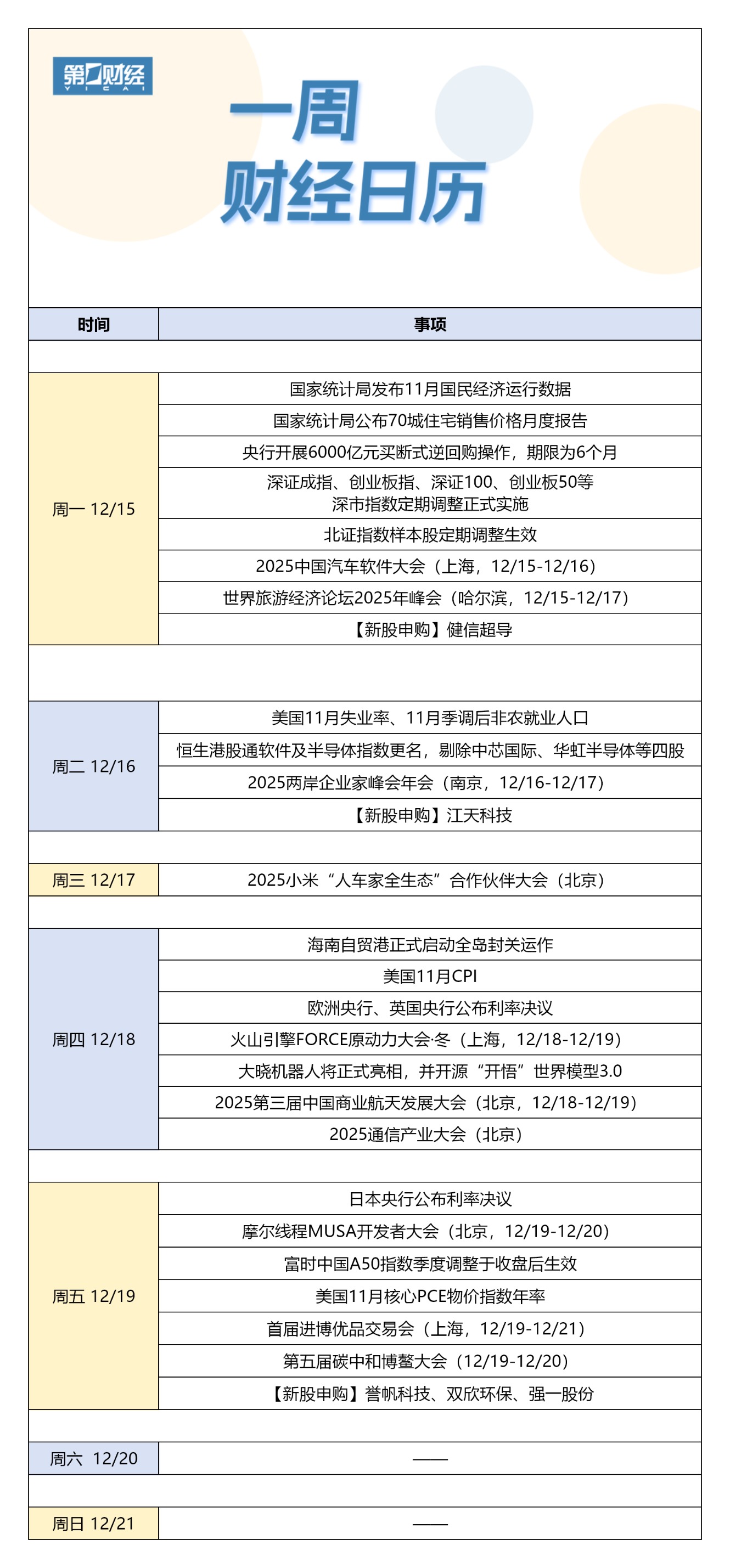
【下周财经日历】12月15日-12月21日
Di Yi Cai Jing· 2025-12-13 12:43
Group 1 - The National Bureau of Statistics released the national economic operation data for November, indicating ongoing economic trends [1] - The National Bureau of Statistics published the monthly report on residential sales prices in 70 cities, reflecting the real estate market conditions [1] - The People's Bank of China conducted a 600 billion yuan reverse repurchase operation with a term of six months, aimed at providing liquidity [1] Group 2 - The Hainan Free Trade Port officially launched its full island closure operation, marking a significant step in economic development [2] - The European Central Bank and the Bank of England announced their interest rate decisions, impacting monetary policy in their respective regions [2] - The U.S. November Core PCE Price Index year-on-year data was released, providing insights into inflation trends [2]
新华财经晚报:2025年我国电影票房破500亿元
Xin Hua Cai Jing· 2025-12-13 10:46
Key Points - The Chinese government aims to achieve "no out-of-pocket" expenses for childbirth within the policy framework by 2026, adapting to population development strategies and enhancing maternity insurance [1] - China's film box office is projected to exceed 50 billion yuan by 2025, with domestic films accounting for 81.90% of the total box office revenue [1] - The Ministry of Finance emphasizes the need to utilize various government bond funds effectively, issue ultra-long special bonds, and support "two new" initiatives to boost economic growth and consumer spending [2] - A new national standard for data security in electronic product information clearance will be implemented starting January 1, 2027, aimed at preventing data leakage in the second-hand electronics market [3]
SpaceX寻求上市,马斯克或成全球首位“万亿美元富豪”
Sou Hu Cai Jing· 2025-12-13 10:02
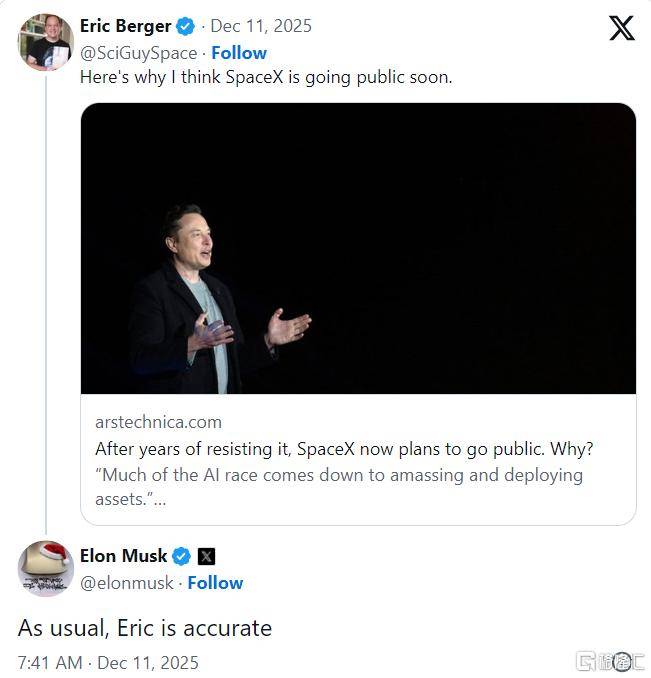
马斯克有望成为全球首位"万亿美元富豪"。(01:18) 本周,马斯克与科技媒体人在社交媒体的互动中透露出,旗下的太空探索技术平台SpaceX可能很快会 上市。彭博社本周报道称,SpaceX正在寻求在明年的中后期上市,目标估值约为1.5万亿美元,这一估 值规模也将媲美沙特阿美在2019年创下的约1.7万亿美元纪录。根据彭博财富指数,马斯克持有SpaceX 大约42%的股权。这意味着,马斯克有望成为全球首位"万亿美元富豪"。 本周,马斯克与科技媒体人在社交媒体的互动中透露出,旗下的太空探索技术平台SpaceX可能很快会 上市。彭博社本周报道称,SpaceX正在寻求在明年的中后期上市,目 ...
估值8000亿美元、碾压OpenAI!SpaceX瞄准“史上最大IPO”
Sou Hu Cai Jing· 2025-12-13 05:41
Core Viewpoint - SpaceX is set to become the highest-valued private company globally with an internal stock valuation of approximately $800 billion, surpassing OpenAI's $500 billion valuation record. The company is preparing for an IPO as early as 2026 to fund its ambitious projects, including the Starship rocket and lunar base [1][4]. Group 1: Valuation and IPO Plans - SpaceX's internal stock transaction values the company at around $800 billion, which is expected to exceed a potential IPO valuation of $1.5 trillion [1][3]. - If successful, SpaceX's IPO could raise over $30 billion, making it the largest IPO in history, surpassing Saudi Aramco's $29 billion record [1][4]. - The CFO indicated that the internal share price rose from $212 to $421, reflecting a nearly 100% increase in valuation since July [4]. Group 2: Revenue Projections - SpaceX is projected to generate approximately $15 billion in revenue by 2025, with estimates for 2026 ranging between $22 billion and $24 billion [6]. - The anticipated $1.5 trillion valuation at IPO would imply a revenue multiple of 100 times the expected sales in 2025 [7]. Group 3: Market Reactions and Strategic Implications - The IPO speculation has led to discussions about the potential consolidation of Musk's technology ventures under a single entity, possibly creating a larger "Tesla Group" [8]. - Analysts suggest that if Tesla does not invest in SpaceX, it would be surprising, given the synergies in AI and autonomous vehicle development [9]. - Concerns have been raised regarding Musk's ability to focus on multiple high-stakes projects, which may lead to dissatisfaction among Tesla shareholders [10][11].
航天动力:连续三个交易日内收盘价格涨幅偏离值累计达到20%
Zheng Quan Ri Bao Wang· 2025-12-12 13:47
证券日报网讯12月12日晚间,航天动力(600343)发布公告称,公司股票于2025年12月10日、11日、12 日连续三个交易日内收盘价格涨幅偏离值累计达到20%,属于《上海证券交易所交易规则》规定的股票 交易异常波动情形。经公司自查,并书面询证控股股东及向实际控制人核实,截至目前,不存在对公司 应披露而未披露的重大信息。 ...

睿创微纳:公司目前在星上载荷和地面终端均有所布局
Zheng Quan Ri Bao Wang· 2025-12-12 13:41
Group 1 - The company, Ruichuang Weina, is actively involved in both satellite payloads and ground terminals, indicating a diversified approach in its operations [1] - The company aims to explore more application areas to leverage the growth opportunities presented by the commercial space industry [1]

把算力射上天的Space X,才真值1.5万亿
阿尔法工场研究院· 2025-12-12 11:32
Core Viewpoint - SpaceX is not merely a space transportation company but is engaged in a significant "physics arbitrage" that could redefine global financial systems and create a new economic entity in space [8][9][32]. Group 1: SpaceX's Business Model - SpaceX's valuation of $1.5 trillion cannot be justified by its role as a delivery service; instead, it represents ownership of a "private highway toll" for global financial transactions [8][14]. - The Starlink service, with 8.5 million broadband users, is just the tip of the iceberg, as its true value lies in monopolizing speed through laser inter-satellite links, which operate at the speed of light in a vacuum [11][12]. - The financial implications of this speed advantage in high-frequency trading (HFT) could translate to billions in risk-free profits annually [13]. Group 2: Space-Based Computing and Legal Implications - SpaceX is pioneering "orbital edge computing," which circumvents the physical limitations of terrestrial data centers, such as cooling and energy constraints [18]. - By placing AI training servers and sensitive databases in orbit, SpaceX operates in a legal vacuum, free from the jurisdiction of any single nation [20][21]. - This strategy positions SpaceX as a "data offshore paradise," allowing it to operate without the regulatory constraints faced by traditional companies [21][22]. Group 3: Market Dominance and Future Outlook - SpaceX controls 65% of active satellites, effectively monopolizing the market and limiting competition through "orbital land-grabbing" [23][24]. - The potential IPO in 2026 is seen as a pivotal moment for understanding the new economic landscape, as SpaceX's value creation through data extraction parallels the historical wealth generated from oil [33]. - The company is not just focused on Mars colonization but is fundamentally reshaping the operational framework of Earth through its space-based infrastructure [33].
“太空数据中心”成AI必争之地?马斯克与贝佐斯互掐,Altman也想插一脚
美股研究社· 2025-12-12 11:07
Core Viewpoint - The article discusses the emerging competition in the space of AI data centers, driven by tech billionaires like Elon Musk and Jeff Bezos, who are exploring the potential of deploying AI computing capabilities in orbit to address the growing energy consumption challenges on Earth [4][6]. Group 1: Industry Trends - The trend of moving data centers to space aims to overcome physical limitations on Earth, particularly the significant power requirements for AI model training and inference [6]. - Supporters envision a future where satellites equipped with AI chips operate in orbit, powered by abundant solar energy, and transmit processed data back to Earth [6]. - The potential for space-based data centers is highlighted by the fact that satellites can harness solar energy at a rate 30% stronger and up to six times more total energy than on Earth, while also benefiting from near-zero temperatures for cooling [7]. Group 2: Key Players - Elon Musk's SpaceX plans to utilize upgraded Starlink satellites for AI computing, potentially valuing the company at $800 billion [4]. - Jeff Bezos's Blue Origin is also developing technology for orbital AI data centers, with significant progress on the New Glenn rocket project [8]. - Other tech leaders, including OpenAI's Sam Altman and Google's executives, are exploring opportunities in this space, with Google planning to deploy test satellites carrying AI chips by early 2027 [9][10]. Group 3: Challenges and Considerations - Despite the promising outlook, there are significant engineering challenges and cost-effectiveness questions regarding the deployment of data centers in space [5][11]. - Technical hurdles include temperature management, radiation protection, and the transmission of large data volumes back to Earth without delays [11]. - The skepticism surrounding the feasibility of space-based data centers is rooted in concerns about whether they can compete with terrestrial facilities, especially as ground-based power limitations are alleviated [12].