信息传输

Search documents
11月份国民经济延续稳中有进发展态势 - 国家统计局
Guo Jia Tong Ji Ju· 2025-12-29 09:36
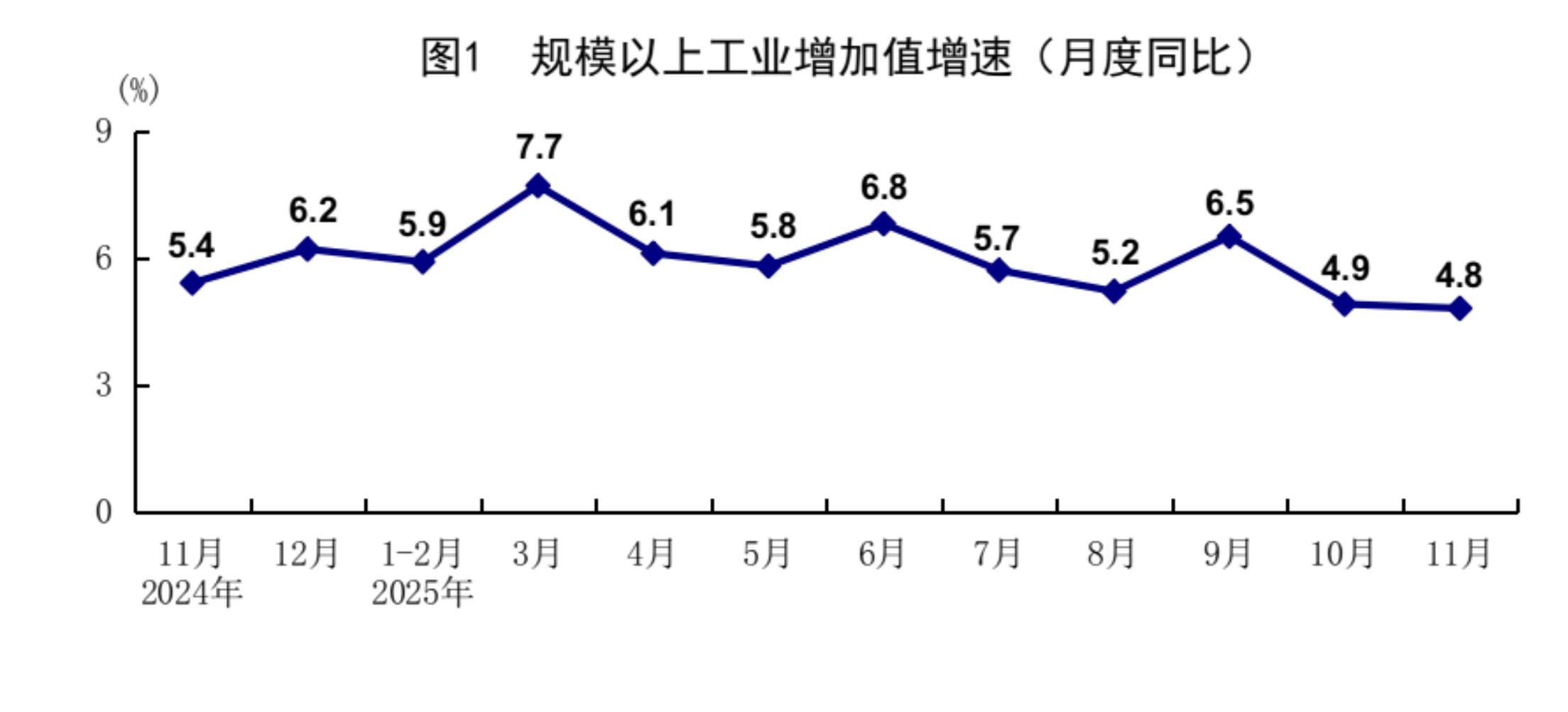
(2025年12月15日) 国家统计局 11月份,在以习近平同志为核心的党中央坚强领导下,各地区各部门认真贯彻落实党中央、国务院决策 部署,坚持稳中求进工作总基调,深入实施更加积极有为的宏观政策,纵深推进全国统一大市场建设, 着力推动高质量发展,生产供给基本平稳,就业形势总体稳定,市场价格继续改善,新质生产力稳步发 展,经济运行延续总体平稳、稳中有进发展态势。 一、全年粮食实现丰收,稳定在1.4万亿斤以上 全年全国粮食产量14298亿斤,比上年增加167.5亿斤,增长1.2%,稳定在1.4万亿斤以上。其中,秋粮 产量10732亿斤,比上年增加163.6亿斤,增长1.5%。全国谷物产量13204亿斤,比上年增加158.4亿斤, 增长1.2%。粮食播种面积增加、单产提高。全国粮食播种面积17.91亿亩,比上年增加134.8万亩,增长 0.1%;粮食单产399.1公斤/亩,每亩产量比上年增加4.4公斤,增长1.1%。 二、工业生产稳定增长,装备制造业和高技术制造业增长较快 11月份,全国规模以上工业增加值同比增长4.8%,环比增长0.44%。分三大门类看,采矿业增加值同比 增长6.3%,制造业增长4.6%,电力、热 ...

国家统计局关于2024年国内生产总值最终核实的公告 - 国家统计局
Guo Jia Tong Ji Ju· 2025-12-29 09:36
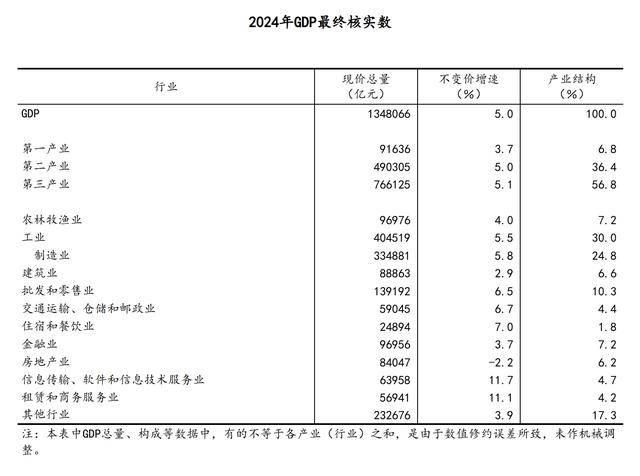
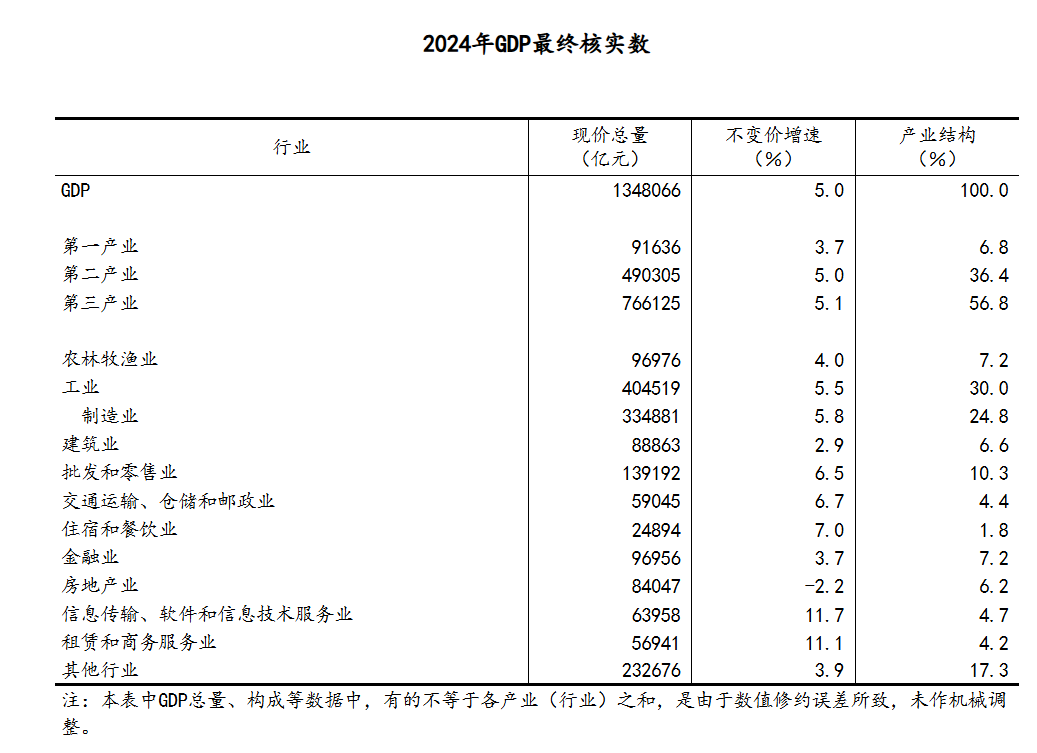
Group 1 - The core point of the article is the final verification of China's GDP data for 2024, which shows a total nominal GDP of 13,480.66 billion yuan, a decrease of 10.18 billion yuan from the preliminary estimate, with a year-on-year growth of 5.0% at constant prices, consistent with the preliminary estimate [1][2][4]. Group 2 - The primary industries contributed 91.64 billion yuan with a growth rate of 3.7% [5]. - The secondary industries accounted for 490.305 billion yuan, growing at 6.8% [5]. - The tertiary industries reached 766.125 billion yuan, with a growth rate of 5.1% [5]. - The agricultural sector, including forestry, animal husbandry, and fishery, grew by 4.0% [5]. - The industrial sector, which includes manufacturing, grew by 5.5% [6]. - The construction industry saw a growth of 2.9% [6]. - The wholesale and retail sector grew by 6.5% [6]. - The transportation, warehousing, and postal sector grew by 6.7% [6]. - The accommodation and catering sector grew by 7.0% [6]. - The financial sector grew by 3.7% [6]. - The real estate sector experienced a decline of 2.2% [6]. - The information transmission, software, and IT services sector grew by 11.7% [6]. - The leasing and business services sector grew by 11.1% [6]. - Other industries grew by 3.9% [6].
【数据发布】国家统计局关于2024年国内生产总值最终核实的公告
中汽协会数据· 2025-12-26 09:37
Core Viewpoint - The final verification of China's GDP for 2024 shows a total nominal GDP of 13,480.66 billion yuan, a decrease of 10.18 billion yuan from the preliminary estimate, with a year-on-year growth rate of 5.0% at constant prices, consistent with the preliminary estimate [1]. Summary by Categories GDP Overview - The final verified nominal GDP for 2024 is 13,480.66 billion yuan, reflecting a reduction of 10.18 billion yuan from the preliminary figure [1]. - The year-on-year growth rate at constant prices is 5.0%, unchanged from the preliminary estimate [1]. Industry Breakdown - **Primary Industry**: - Current value: 91,636 billion yuan - Growth rate: 3.7% - Contribution to GDP: 6.8% [4] - **Secondary Industry**: - Current value: 490,305 billion yuan - Growth rate: 5.0% - Contribution to GDP: 36.4% [4] - **Tertiary Industry**: - Current value: 766,125 billion yuan - Growth rate: 5.1% - Contribution to GDP: 56.8% [4] Specific Sector Performance - **Agriculture, Forestry, Animal Husbandry, and Fishery**: - Current value: 96,976 billion yuan - Growth rate: 4.0% - Contribution to GDP: 7.2% [4] - **Industrial Sector**: - Current value: 404,519 billion yuan - Growth rate: 5.5% - Contribution to GDP: 30.0% [4] - **Manufacturing**: - Current value: 334,881 billion yuan - Growth rate: 5.8% - Contribution to GDP: 24.8% [4] - **Construction**: - Current value: 88,863 billion yuan - Growth rate: 2.9% - Contribution to GDP: 6.6% [4] - **Wholesale and Retail Trade**: - Current value: 139,192 billion yuan - Growth rate: 6.5% - Contribution to GDP: 10.3% [4] - **Transportation, Storage, and Postal Services**: - Current value: 59,045 billion yuan - Growth rate: 6.7% - Contribution to GDP: 4.4% [4] - **Accommodation and Catering**: - Current value: 24,894 billion yuan - Growth rate: 7.0% - Contribution to GDP: 1.8% [4] - **Financial Sector**: - Current value: 96,956 billion yuan - Growth rate: 3.7% - Contribution to GDP: 7.2% [4] - **Real Estate**: - Current value: 84,047 billion yuan - Growth rate: -2.2% - Contribution to GDP: 6.2% [4] - **Information Transmission, Software, and IT Services**: - Current value: 63,958 billion yuan - Growth rate: 11.7% - Contribution to GDP: 4.7% [4] - **Leasing and Business Services**: - Current value: 56,941 billion yuan - Growth rate: 11.1% - Contribution to GDP: 4.2% [4] - **Other Industries**: - Current value: 232,676 billion yuan - Growth rate: 3.9% - Contribution to GDP: 17.3% [4]
国家统计局公布2024年GDP最终核实结果
Sou Hu Cai Jing· 2025-12-26 01:53
Core Insights - The National Bureau of Statistics of China has released the final verification of the GDP for 2024, showing a total nominal GDP of 13,480.66 billion yuan, which is a decrease of 10.18 billion yuan from the preliminary estimate. The GDP growth rate at constant prices is 5.0%, unchanged from the preliminary figure [1][4]. Group 1: Overall GDP Data - The final verified nominal GDP for 2024 is 13,480.66 billion yuan, a reduction of 10.18 billion yuan from the preliminary estimate [1]. - The GDP growth rate at constant prices is 5.0%, consistent with the preliminary calculation [1]. Group 2: Sectoral Breakdown - The primary industry contributed 91,636 billion yuan with a growth rate of 3.7%, accounting for 6.8% of the GDP [2]. - The secondary industry reached 490,305 billion yuan, growing at 5.0%, representing 36.4% of the GDP [2]. - The tertiary industry totaled 766,125 billion yuan, with a growth rate of 5.1%, making up 56.8% of the GDP [2]. - The agricultural sector (including forestry, animal husbandry, and fishery) generated 96,976 billion yuan, growing at 4.0% [2]. - The industrial sector produced 404,519 billion yuan, with a growth rate of 5.5% [2]. - The manufacturing sector accounted for 334,881 billion yuan, growing at 5.8% [2]. - The construction industry reached 88,863 billion yuan, with a growth rate of 2.9% [2]. - The wholesale and retail sector generated 139,192 billion yuan, growing at 6.5% [2]. - The transportation, warehousing, and postal sector produced 59,045 billion yuan, with a growth rate of 6.7% [2]. - The accommodation and catering sector reached 24,894 billion yuan, growing at 7.0% [2]. - The financial sector generated 96,956 billion yuan, with a growth rate of 3.7% [2]. - The real estate sector saw a decline, totaling 84,047 billion yuan with a negative growth rate of 2.2% [2]. - The information transmission, software, and IT services sector grew significantly at 11.7%, totaling 63,958 billion yuan [2]. - The leasing and business services sector reached 56,941 billion yuan, growing at 11.1% [2]. - Other industries contributed 232,676 billion yuan, with a growth rate of 3.9% [2].
国家统计局:经最终核实2024年GDP现价总量为1348066亿元
Guo Jia Tong Ji Ju· 2025-12-26 01:39
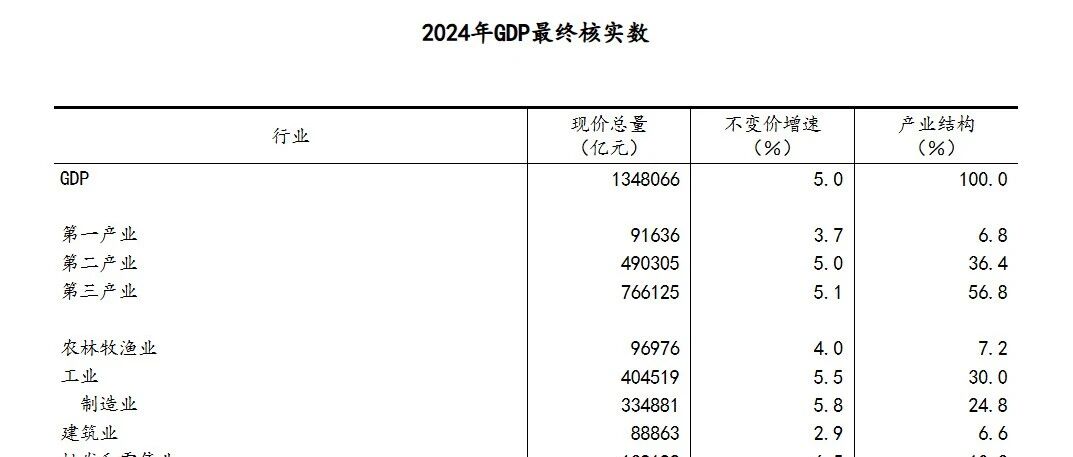
Core Insights - The National Bureau of Statistics of China announced the final verification of GDP data for 2024, revealing a total GDP at current prices of 13,480.66 billion yuan, which is a decrease of 10.18 billion yuan from the preliminary estimate [1] - The GDP growth rate at constant prices for 2024 is confirmed at 5.0%, consistent with the preliminary estimate [1] Industry Breakdown - The first industry (agriculture, forestry, animal husbandry, and fishery) contributed 91.636 billion yuan with a growth rate of 3.7%, accounting for 6.8% of GDP [3] - The second industry (including manufacturing and construction) totaled 490.305 billion yuan, growing at 5.0%, representing 36.4% of GDP [3] - The third industry (services) reached 766.125 billion yuan, with a growth rate of 5.1%, making up 56.8% of GDP [3] - Notable sectors include: - Manufacturing at 334.881 billion yuan with a growth rate of 5.8% [3] - Information transmission, software, and IT services at 63.958 billion yuan, growing at 11.7% [3] - Real estate sector showing a decline at -2.2% with a total of 84.047 billion yuan [3]
国家统计局关于2024年国内生产总值最终核实的公告
Guo Jia Tong Ji Ju· 2025-12-26 01:30
Core Points - The final verified GDP for 2024 is 13,480.66 billion yuan, which is a decrease of 10.18 billion yuan compared to the preliminary estimate, while the year-on-year growth rate at constant prices remains at 5.0% [1][4]. Group 1: GDP Overview - The GDP at current prices for 2024 is 1,348,066 million yuan, reflecting a reduction from the preliminary figure [1][4]. - The GDP growth rate at constant prices is confirmed at 5.0%, consistent with the preliminary estimate [1][4]. Group 2: Sector Contributions - The primary industry contributed 91,636 million yuan with a growth rate of 3.7%, accounting for 6.8% of GDP [4]. - The secondary industry, including manufacturing, contributed 490,305 million yuan with a growth rate of 5.0%, representing 36.4% of GDP [4]. - The tertiary industry showed the highest growth rate at 5.1%, contributing 766,125 million yuan, which is 56.8% of GDP [4]. Group 3: Industry-Specific Data - The manufacturing sector grew by 5.8%, contributing 334,881 million yuan [4]. - The construction industry experienced a slower growth rate of 2.9%, contributing 88,863 million yuan [4]. - The information transmission, software, and IT services sector had a significant growth rate of 11.7%, contributing 63,958 million yuan [4]. - The real estate sector faced a decline of 2.2%, contributing 84,047 million yuan [4].
成渝地区高校科技成果转化发布281项成果
Si Chuan Ri Bao· 2025-12-25 00:23
Group 1 - The Chengdu-Chongqing region has gathered 27,000 high-tech enterprises, with a regional collaborative innovation index growth of 82.5% [1] - The region has jointly reorganized 25 national key laboratories and approved the establishment of one new laboratory, with 11 large scientific devices accelerating construction [1] - The conference released 281 technology achievements related to 14 key industrial sectors, including pharmaceuticals, artificial intelligence, advanced materials, and new energy vehicles [1] Group 2 - The "Sichuan Province High-Tech Industry Development Report (2025)" indicates that by 2024, there will be 4,912 large-scale high-tech enterprises in the province, with high-tech manufacturing enterprises at 2,183, a year-on-year growth of 9.92% [2] - High-tech industries achieved operating income of 1,752.23 billion yuan, reflecting a year-on-year growth of 5.70%, indicating a steady progress in overall development [2] - The Chengdu Plain Economic Zone is a core growth driver, with high-tech manufacturing and service industries accounting for over 80% and 90% of their respective revenues [2]
11月全社会用电量同比增长6.2% 充换电服务业用电量增长60.2%
Ren Min Ri Bao· 2025-12-24 22:14
Core Insights - In November, the total electricity consumption in China reached 835.6 billion kilowatt-hours, marking a year-on-year growth of 6.2% [1] - Cumulatively, from January to November, the total electricity consumption was 9460.2 billion kilowatt-hours, with a year-on-year increase of 5.2% [1] Industry Breakdown - The primary industry consumed 11.3 billion kilowatt-hours in November, reflecting a year-on-year increase of 7.9% [1] - The secondary industry consumed 565.4 billion kilowatt-hours, with a year-on-year growth of 4.4%. Within this, industrial electricity consumption grew by 4.6%, and high-tech and equipment manufacturing sectors saw a 6.7% increase [1] - The tertiary industry consumed 153.2 billion kilowatt-hours, with a significant year-on-year growth of 10.3%. Notably, the charging and swapping service industry experienced a 60.2% increase, while the information transmission, software, and IT services sector grew by 18.9% [1] Growth Comparison - The growth rate of total electricity consumption in November improved by 3.4 percentage points compared to the same month last year [1] - The year-on-year growth rate of electricity consumption in high-tech and equipment manufacturing exceeded the average growth rate of the manufacturing sector by 2.5 percentage points [1]
11月份全社会用电量 同比增长6.2%
Xin Lang Cai Jing· 2025-12-24 18:49
Core Insights - In November, the total electricity consumption reached 835.6 billion kilowatt-hours, marking a year-on-year increase of 6.2% [1] Industry Breakdown - The primary industry consumed 11.3 billion kilowatt-hours, with a year-on-year growth of 7.9% [1] - The secondary industry consumed 565.4 billion kilowatt-hours, showing a year-on-year increase of 4.4%, with industrial electricity consumption growing by 4.6% and high-tech and equipment manufacturing sectors increasing by 6.7% [1] - The tertiary industry consumed 153.2 billion kilowatt-hours, reflecting a year-on-year growth of 10.3%, with the charging and swapping service industry and information transmission, software, and IT services growing by 60.2% and 18.9% respectively [1] - Urban and rural residential electricity consumption reached 105.7 billion kilowatt-hours, with a year-on-year increase of 9.8% [1] Cumulative Data - From January to November, total electricity consumption accumulated to 9460.2 billion kilowatt-hours, representing a year-on-year growth of 5.2% [1] - The primary industry accumulated 137.4 billion kilowatt-hours, with a year-on-year increase of 10.3% [1] - The secondary industry accumulated 6043.6 billion kilowatt-hours, showing a year-on-year growth of 3.7% [1] - The tertiary industry accumulated 1820.4 billion kilowatt-hours, reflecting a year-on-year increase of 8.5% [1]
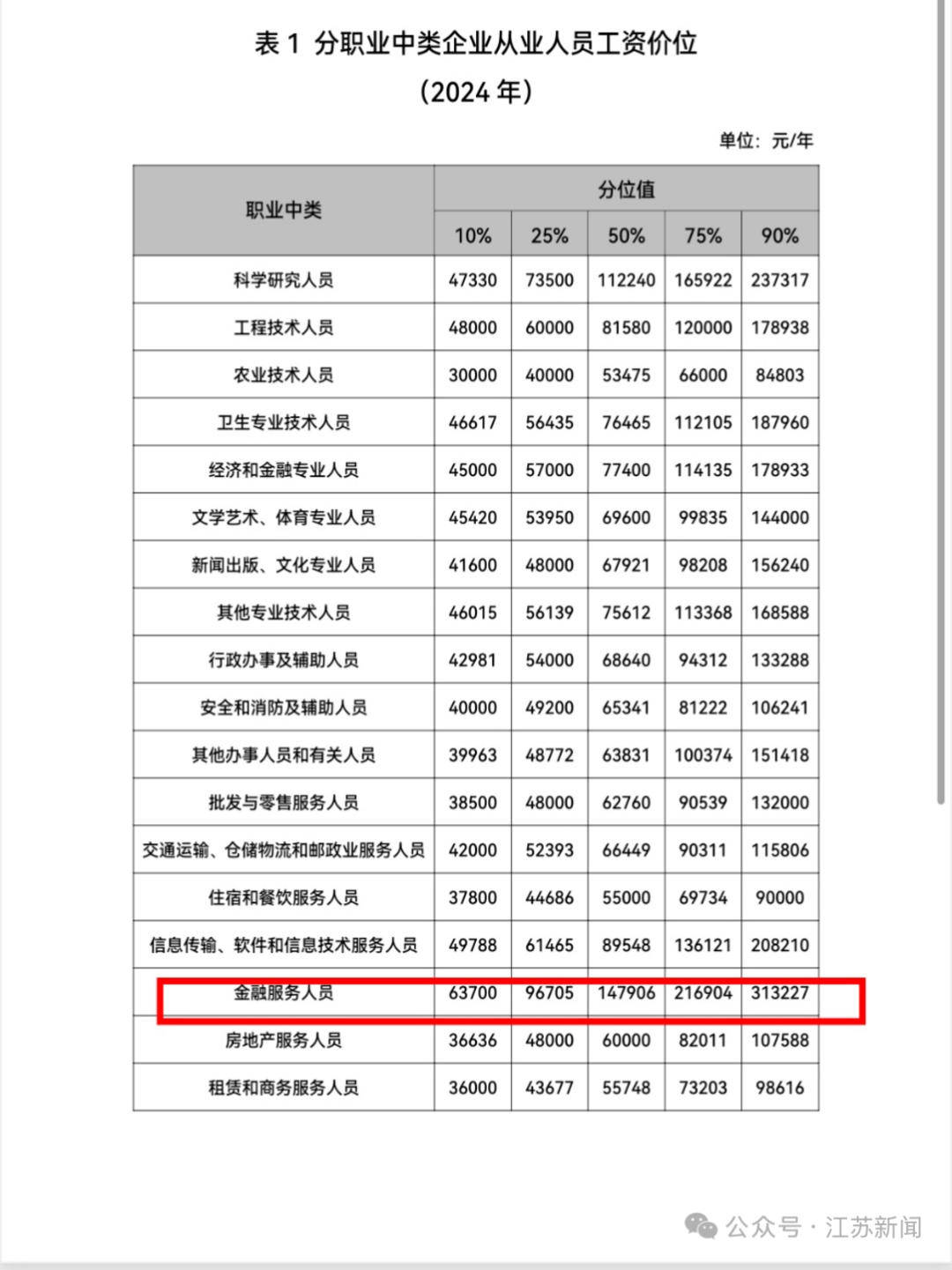
江苏最新工资价位发布!
Sou Hu Cai Jing· 2025-12-24 13:40
从发布的数据来来看,数字经济行业最赚钱,数字经济产业从业人员收入待遇优厚。记者梳理发现,在公布的不同职业人群中,工资价位排在前三位的均 为数字经济产业从业人员。工资价位指企业从业人员在报告期内的工资水平,包括基本工资、奖金、津贴和补贴、加班加点工资和特殊情况下支付的工资 等,它在一定程度上体现了劳动力市场价格水平。本次发布的企业从业人员工资价位主要包括不同职业从业人员工资价位、不同行业技能人才工资价位、 部分数字职业从业人员工资价位,数据基于2024年度企业职工工资数据,采用加权方法处理,工资价位按10%、25%、50%、75%、90%等五个分位值发 布。 12月23日,江苏省人社厅发布2024年度人力资源市场工资价位。 在不同职业从业人员工资价位中,金融服务人员以分位值90%313227元排在第一位。 表 1 分职业中类企业从业人员工资价位 (2024年) 单位:元/年 | 职业中类 | | | 分位值 | | | | --- | --- | --- | --- | --- | --- | | | 10% | 25% | 50% | 75% | 90% | | 科学研究人员 | 47330 | 73500 ...