房地产代建

Search documents
行业透视|城投还未开工的3.6亿㎡土地中,代建企业应该关注哪些?
克而瑞地产研究· 2025-06-19 09:16
Core Viewpoint - The article emphasizes the increasing focus of construction companies on government investment projects, particularly in the context of a competitive market where the supply of available land is diminishing, leading to challenges in expansion and development opportunities for construction firms [1][3]. Group 1: Market Dynamics - Government investment companies have played a crucial role in stabilizing the land market since 2021, with their land acquisition ratio consistently exceeding 50% from 2022 to 2024 in 30 key cities [3][4]. - Despite the high acquisition rates, the development capabilities of these investment companies have not kept pace, resulting in a significant amount of undeveloped land, totaling over 3.6 billion square meters across more than 4,200 plots [4][5]. Group 2: Development Opportunities - The 3.6 billion square meters of undeveloped land presents a potential opportunity for construction companies to explore and capitalize on, especially as the market begins to stabilize [4][18]. - The article highlights that the majority (95.3%) of the undeveloped land was acquired independently by government investment companies, indicating a concentrated opportunity for construction firms to engage in these projects [4]. Group 3: Regional Insights - The article identifies that cities in central and western China, such as Xuzhou, Chongqing, and Changsha, have a larger volume of undeveloped land, making them attractive for construction companies looking to expand [6]. - Conversely, cities like Shenzhen and Fuzhou have smaller undeveloped land areas, leading to higher competition among top construction firms [6]. Group 4: Land Characteristics - Approximately 32.3% of undeveloped plots have a low plot ratio (below 2), which aligns with the current market trend towards "better housing" and presents an opportunity for construction firms to create value [8][9]. - The article notes that 43% of undeveloped plots are smaller than 100,000 square meters, suggesting that smaller plots may be more suitable for construction firms to manage effectively [14][15]. Group 5: Strategic Focus - The article concludes that construction companies should focus on specific cities and types of undeveloped land to maximize their growth potential, emphasizing the importance of strategic resource allocation [18].

多业态操盘手 远洋建管300米高空突围代建红海
Xin Lang Zheng Quan· 2025-06-17 07:56
Core Insights - The renovation of the 70-story skyscraper in Tianjin is a critical test for the capabilities of the company in the construction management sector [1] - The construction management industry in China has shifted from a "blue ocean" to a "red ocean" by 2025, indicating increased competition and market differentiation [1][2] Industry Overview - The top five companies in the construction management sector saw a year-on-year growth of only 3.5% in new contract signing in 2024, while companies ranked 6th to 20th experienced a significant growth of 21.9% [1] - Some companies in the lower tier are facing elimination risks due to intense competition, with several failing to secure new projects in the first quarter of 2025 [1] Company Performance - Despite the overall slowdown in industry growth, the company has demonstrated strong growth by successfully winning contracts for multiple large-scale projects in major cities such as Beijing, Shanghai, and Shenzhen [2] - The company is tasked with a complex project at the Tianjin International Center, which includes office renovation, leasing, daily operations, and hotel consulting services, showcasing its comprehensive capabilities [2] - The company's success is attributed to its backing by the parent group, which has over 30 years of experience and a well-coordinated resource network across various industry sectors [2]
不卷价格卷服务? 美的置业开启代建商业模式重塑之路
2 1 Shi Ji Jing Ji Bao Dao· 2025-06-11 01:05
Core Viewpoint - The real estate industry is entering a phase of high-quality development, with companies exploring light asset operational models, and the construction and management business becoming a competitive arena for real estate firms [2][3] Industry Overview - The scale of the construction and management sector is growing, with the top 30 construction companies projected to reach a total contracted area of 914 million square meters in 2024, a year-on-year increase of 23%. New signed area is expected to be 193 million square meters, up 6% year-on-year [2] - Despite growth, the construction industry is highly competitive, with leading firms deepening their advantages while smaller companies face shrinking survival space. The industry is returning to the essence of "service as an asset," emphasizing the importance of professional service capabilities and brand reputation [2] Company Strategy - Midea Real Estate's entry into the construction and management sector aligns with its "light and heavy dual focus" strategy, responding to the demand for specialized services in the industry [4] - The company emphasizes that development capabilities do not equate to construction management capabilities, highlighting the need for a comprehensive understanding of client needs and the creation of value through effective service delivery [6][7] Service Model - Midea Real Estate aims to provide one-stop services from construction to property management, setting a high bar for project participation to ensure quality and long-term business sustainability [6][7] - The company differentiates itself by not engaging in price wars but instead focusing on quality service and long-tail effects through ongoing property management and commercial operations [7] Market Positioning - Midea Real Estate targets potential clients such as state-owned enterprises and financially strong institutions lacking real estate development experience, ensuring project safety and profitability through rigorous assessments [7][9] - The company has successfully secured and operated several benchmark projects, demonstrating its market capabilities and strategic approach in established cities [8][9] Operational Achievements - As of the end of 2024, Midea Real Estate's property management area reached 75.38 million square meters, a 15% year-on-year increase, with significant revenue from industrial park contracts and commercial operations [12] - The company has developed a comprehensive service capability across various sectors, including healthcare and industrial park management, showcasing its ability to meet diverse client needs [11][12] Conclusion - Midea Real Estate's transformation path reveals that light asset strategies are not merely about collecting management fees but involve upgrading service capabilities, with a focus on maximizing client value [13]
专题回顾 | “蓝海变红海”,头部代建企业立身之道
克而瑞地产研究· 2025-06-10 09:10
Group 1 - The construction agency industry is entering a phase of stable development, with a gradually stabilizing head enterprise structure after three years of rapid expansion [5][6][9] - The number of enterprises entering the construction agency sector has reached saturation, leading to a slowdown in growth momentum, with new construction scale in 2024 reaching 215 million square meters, a 13% year-on-year increase, but a significant drop in growth rate compared to 2023 [6][7] - The industry faces challenges from a sluggish macroeconomic environment, intensified competition, and policy uncertainties, impacting the demand for construction agency services [7][8] Group 2 - The construction agency sector is experiencing intensified competition, but the leading enterprises are maintaining their positions through unique core competencies and brand advantages [3][14] - The choice of construction agency enterprises by clients has evolved from "single service procurement" to "strategic ecosystem co-construction," emphasizing long-term partnerships and value co-creation [11][12] Group 3 - Greentown Management leads in scale, supported by a standardized system that enhances product reputation and brand premium [15][16] - Blue City Group has established significant advantages in niche areas, particularly in affordable housing and public construction, leveraging its brand and product capabilities [20][21] - Jindi Management has a robust project management system and a diverse client base, with a focus on high-quality customer structures and comprehensive service offerings [25][26] Group 4 - Runze Management, as a subsidiary of China Resources Land, has a strong presence in government construction projects, achieving a revenue of 1.18 billion yuan and managing an area of 7.607 million square meters [27][28] - The long-term strategy of construction agencies should focus on building core competencies and creating value through professional services, moving from a scale expansion model to a high-quality development model [35][36]

代建双周报 | 绿城中国前5月代建销售约311亿元;旭辉建管在东北中标首个不良资产盘活项目(2025.5.24-6.6)
克而瑞地产研究· 2025-06-06 09:18
Group 1 - The core viewpoint of the article highlights significant developments in the construction and real estate management sector, showcasing various projects and their financial implications [1][2][3] - Greentown China reported a total sales amount of approximately 31.1 billion yuan from its entrusted construction projects in the first five months [1][9] - CIFI Construction Management secured its first non-performing asset revitalization project in Northeast China, covering an area of about 250,000 square meters [2][3] Group 2 - Greenland Intelligent Manufacturing successfully won three benchmark project development and management service contracts [1][3] - China State Construction Engineering Corporation (CSCEC) won a bid for the Guangzhou Wenchong Street old village renovation project, valued at 2.07 billion yuan [1][6] - The total construction area for the Hainan Longji and Heyuefu project is 220,900 square meters, with a total floor area of 157,100 square meters [3][4] Group 3 - The Xiamen Wai Fu Primary School project, managed by China International Trade Real Estate, has successfully completed its construction [1][9] - The project sales area for the first five months reached 2.33 million square meters, with a sales amount of approximately 31.1 billion yuan [1][9] - Jiangsu Guolian Blue City Construction Management Co., Ltd. won a bid for the Huai'an Yellow River Driving School residential project, with a transaction amount of 348 million yuan [9][10]
专题 | “蓝海变红海”,头部代建企业立身之道
克而瑞地产研究· 2025-06-04 08:57
Core Viewpoint - The future of the construction agency industry will maintain a "stronger will remain strong" and "characteristics will prevail" development trend, emphasizing "long-termism" and companies with "core competitiveness" to build a moat in the transition from "blue ocean to red ocean" in the construction agency track [1][35]. Group 1: Industry Development Phase - The construction agency sector is entering a phase of stable development after three years of rapid and "barbaric" expansion, with increasing competition and market saturation [5][6]. - The new construction scale in 2024 reached 215 million square meters, doubling from 2020, but the growth rate has significantly slowed, with a year-on-year increase of only 13%, down 14 percentage points from 2023 [6][7]. - The industry is influenced by several factors, including a sluggish macroeconomic environment, increased competition, and short-term uncertainties from policy changes [7][8]. Group 2: Challenges Facing the Industry - The construction agency industry faces multiple challenges, including the contradiction between high-quality development and price competition, as well as the shrinking profit margins against the backdrop of excessive profit commitments [11][12]. - The logic for clients selecting construction agencies has evolved from "single service procurement" to "strategic ecosystem co-construction," prioritizing long-term partnerships and risk-sharing capabilities [11][12]. Group 3: Core Competitiveness of Leading Companies - Four leading companies—Greentown Management, Blue City Group, Jindi Management, and Runzhi Management—have accumulated advantages and experience during the "blue ocean" period, which serve as their capital and confidence in facing the "red ocean" [14][35]. - Greentown Management leads in scale, supported by a standardized system that enhances product reputation and brand premium [15][16]. - Blue City Group has established significant advantages in niche areas, particularly in affordable housing and public construction, and emphasizes long-term partnerships with government clients [20][21]. - Jindi Management has a robust project management system and a diverse client base, with a focus on high-quality customer structures [25][26]. - Runzhi Management, as a subsidiary of China Resources Land, has a strong presence in government projects and public construction, leveraging its central enterprise resources for competitive advantages [27][28]. Group 4: Long-termism as a Development Foundation - The construction agency industry, transitioning to a light-asset model, has a stronger counter-cyclical effect, becoming a vital survival strategy for many companies [35]. - Companies should focus on building core competitiveness, exploring niche markets, and creating long-term stable partnerships with clients to maximize value [37][38].

行业透视|现房销售一旦落地,对代建市场有何影响?
克而瑞地产研究· 2025-05-29 09:17
Core Viewpoint - The shift towards selling completed properties is fundamentally changing the funding model for real estate companies, leading to a significant decline in investment returns and a push towards light-asset development strategies [2][4][5] Group 1: Impact of Current Housing Sales - The current housing sales model necessitates developers to have sufficient self-funding, resulting in longer development cycles and decreased capital turnover [5][6] - This shift is prompting companies to adjust their business portfolios, with a noticeable move towards light-asset operations such as construction management [5][6] - Over 100 real estate companies have engaged in project management, with 49 establishing independent management platforms, indicating a growing trend towards specialized construction management [5][6] Group 2: Land Transaction Trends - The decline in land transactions and the need for local government financing will lead to an increased proportion of residential construction management projects [7][8] - Despite a decrease in land acquisition, the overall scale of the construction management market is expected to remain stable, with a focus on commercial projects [7][8] Group 3: Market Penetration by City Tier - The penetration rate of construction management is expected to rise, particularly in first-tier cities, while second-tier cities will stabilize and third- and fourth-tier cities may decline [9][10] - First-tier cities have historically low penetration rates, but this is expected to increase as companies seek to engage in local government projects to optimize land resources [10] Group 4: Changes in Construction Management Models - The trend towards "small equity operation" in construction management is increasing, necessitating adjustments in payment structures and timelines [12] - Companies are facing challenges related to funding pressures and extended return cycles, requiring a re-evaluation of payment rules linked to project milestones [12] Group 5: Intensifying Competition in Construction Management - The construction management sector is experiencing intensified competition, with a potential for a "second" round of industry reshuffling as new entrants gain market share [13][14] - Companies must enhance their service capabilities and operational efficiency to remain competitive, leveraging digital tools to improve project delivery [14][15] - Establishing long-term partnerships with local government platforms is crucial for aligning interests and ensuring project success [16]
行业透视|35%代建项目售价高于平均值,苏州代建市场潜力可期
克而瑞地产研究· 2025-05-26 09:47
Core Viewpoint - Suzhou is experiencing rapid growth in the construction agency model, with a significant increase in market penetration, although it still represents a minority of the market, accounting for less than 20% of total transactions [2][4][23]. Group 1: Market Penetration and Trends - By 2024, 31% of new projects in Suzhou will be construction agency projects, making it the city with the highest penetration rate among monitored cities [3][4]. - The share of land acquired by state-owned enterprises (城投公司) has increased significantly, from 35% in 2021 to 86% in 2023, indicating a growing demand for construction agency projects [4][22]. - Despite the increasing number of construction agency projects, their market share remains low, with only 3% of total transaction volume in 2023 and 6% in 2024 [6][23]. Group 2: Project Performance and Location Impact - Some construction agency projects have high absorption rates, exceeding 80%, while others struggle with rates below 50%, primarily due to location differences [7][23]. - Projects located in core areas with better amenities tend to perform better in terms of sales compared to those in less favorable locations [7][10]. Group 3: Pricing Dynamics - Only 35% of construction agency projects have average selling prices above the city average, largely due to the nature of land acquisition by state-owned enterprises in non-core areas [8][10]. - High-quality, low-density projects can command higher prices, indicating that product quality can outweigh location advantages [13][10]. Group 4: Key Players and Future Opportunities - Major players in Suzhou's construction agency market include Longfor, CIFI, and Renheng, which together account for over 50% of the market [17][18]. - There are significant opportunities for expansion in areas like Xiangcheng and Wuzhong, where many state-owned land parcels remain undeveloped [22][23].
房地产,不再只是行家的游戏
盐财经· 2025-05-23 10:14
Core Viewpoint - The article discusses the evolving dynamics of the real estate market in Guangzhou, highlighting the contrasting trends in mortgage rates and the emergence of innovative development models that prioritize consumer needs and digital transformation in the industry [2][4][6]. Group 1: Market Trends - On May 20, the five-year loan market quotation rate (LPR) was lowered, leading to a 10 basis point reduction in mortgage rates in Beijing and Shanghai, while Guangzhou saw a 10 basis point increase, indicating a potential recovery in market confidence [2]. - Despite the localized recovery in Guangzhou, the overall real estate market remains subdued, with only a few developers benefiting from the current conditions [4]. - The successful launch of the Longhu Yalun Central Scenic project, which sold nearly all its initial offerings, reflects a selective market recovery [4][25]. Group 2: Development Strategies - The article emphasizes the shift from speculative investment to a focus on residential attributes, with developers needing to understand what constitutes a "good residence" [6][18]. - The traditional development model is being replaced by a collaborative approach, where the role of construction companies is evolving to emphasize their professional capabilities [6][27]. - The Longhu Yalun Central Scenic project utilized a data-driven approach for market positioning, leveraging a comprehensive digital platform to analyze various factors influencing real estate development [12][29]. Group 3: Consumer Insights - New consumer expectations are driving developers to create products that offer real value, with a focus on emotional and functional needs in housing [19][24]. - The project features a 9,000 square meter real-life display area to enhance customer experience and showcase the advantages of low density and large land area [21]. - The design of the 139 square meter units includes luxury features typically found in larger homes, catering to the demand for high-quality living spaces at competitive prices [22][24]. Group 4: Digital Transformation - The use of Building Information Modeling (BIM) and virtual construction technologies is highlighted as a key factor in improving design efficiency by 30% and reducing risks associated with project changes [14][17]. - The integration of digital tools throughout the project lifecycle—from design to construction and marketing—ensures a high level of precision and customer confidence [17][31]. - The article notes that the real estate industry has lagged in digital transformation, with only 69% of companies adopting digital practices, but companies like Longhu Longzhizao are leading the charge in changing this trend [30][31].


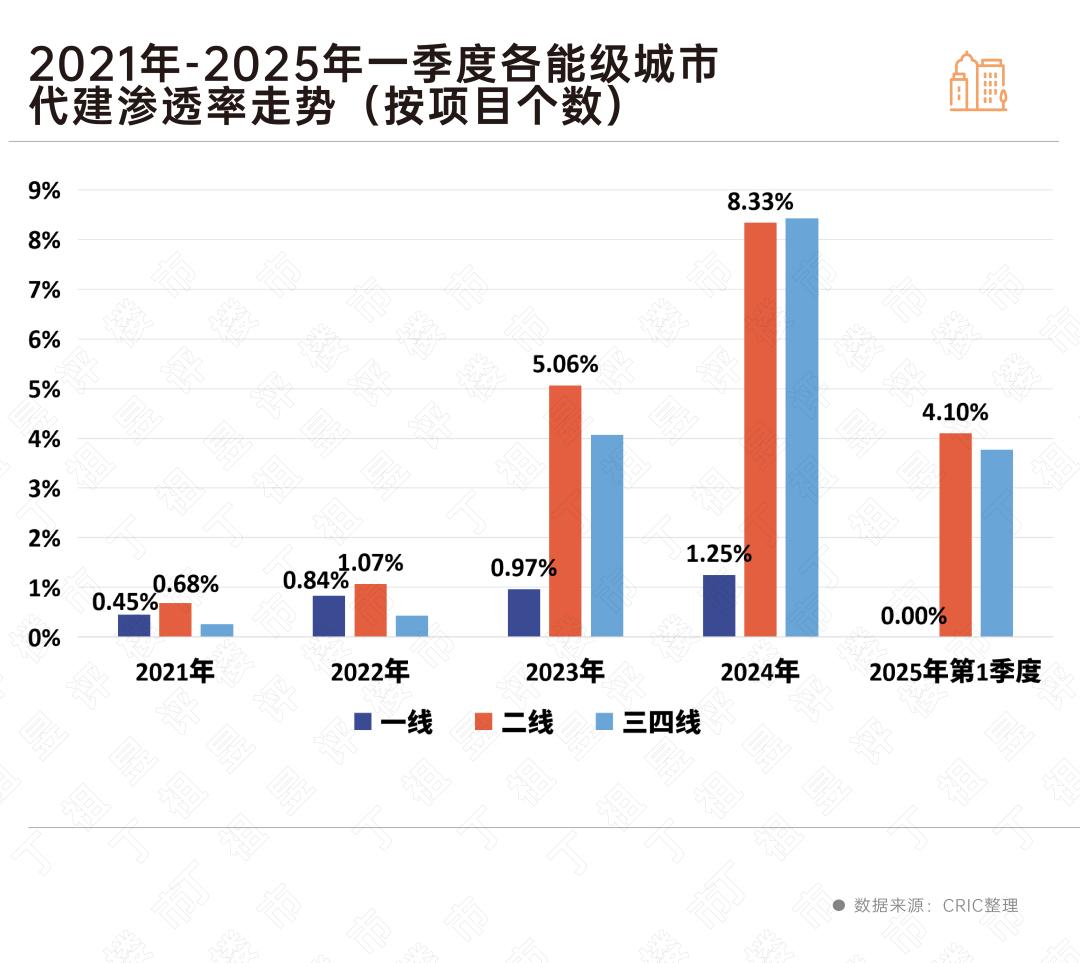
代建渗透率不到1%的一线城市,还有机会!
3 6 Ke· 2025-05-22 02:11
Core Insights - The construction agency model has become a significant topic in the real estate industry, transitioning from a "blue ocean" to a "red ocean" market [1] - The penetration rate of construction agency projects is significantly higher in second and third-tier cities compared to first-tier cities, where opportunities are scarce [2][4] Summary by Categories Market Penetration - The highest penetration rate for construction agency projects in second and third-tier cities exceeded 8%, while first-tier cities remained around 1% [2] - In the past four years, the share of construction agency projects in new launches in first-tier cities was less than 1%, compared to an industry average of 2.4% [4] Opportunities in First-tier Cities - Guangzhou is highlighted as a potential city for construction agency opportunities, particularly in public infrastructure projects beyond residential developments [3] - Despite low overall penetration, Guangzhou and Beijing have slightly higher rates, exceeding 1%, but still lag behind cities like Wuxi and Suzhou [4] Land Acquisition Trends - Land acquisition by city investment companies in first-tier cities is low, with a significant portion of land located in suburban areas [7][11] - The willingness of major state-owned enterprises to acquire land has increased, driven by the need to maintain market stability [7] Competitive Landscape - The construction agency market in first-tier cities is dominated by leading companies, making it challenging for smaller or new entrants to secure projects due to high entry barriers [7][16] - The overall market in first-tier cities shows resilience, but demand for construction agency projects is concentrated in core second-tier cities [10][16] Pricing and Performance - Construction agency projects in first-tier cities tend to have higher pricing compared to surrounding projects, with price increases ranging from 2% to 53% [14] - The operational, brand, and product strengths of leading construction agency firms contribute to better sales performance compared to their competitors [14]