
有色金属矿采选业

Search documents
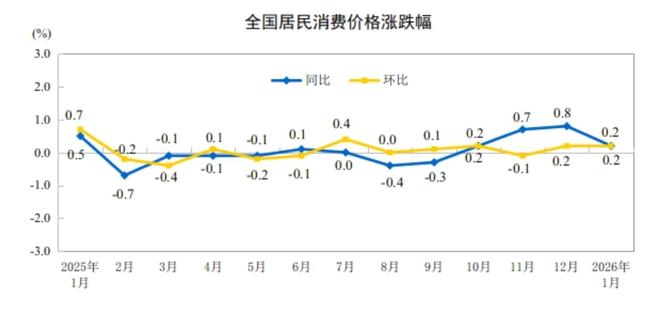
1月份CPI同比上涨 PPI同比降幅收窄
Zheng Quan Ri Bao· 2026-02-11 16:29
Group 1: Consumer Price Index (CPI) Insights - In January, the Consumer Price Index (CPI) increased by 0.2% month-on-month and year-on-year, indicating a moderate recovery in consumer demand [1][2] - The core CPI, excluding food and energy, rose by 0.3% month-on-month, marking the highest increase in six months [3] - Food prices decreased by 0.7%, contributing to a decline in the CPI year-on-year by approximately 0.11 percentage points, while service prices increased by 0.1% [2][3] Group 2: Producer Price Index (PPI) Insights - The Producer Price Index (PPI) rose by 0.4% month-on-month, marking the fourth consecutive month of increase, with a year-on-year decline of 1.4% [4] - Key industries showed price increases due to improved supply-demand structures and the effects of capacity governance [4][5] - Domestic prices in the non-ferrous metal and petroleum sectors exhibited divergence due to international price fluctuations, with non-ferrous metal mining prices increasing significantly [6]
紫金矿业20260211
2026-02-11 15:40
Summary of the Conference Call on Zijin Mining Company Overview - **Company**: Zijin Mining - **Industry**: Mining (Gold and Copper) Key Points and Arguments Financial Projections - Expected net profit for 2026 is approximately **926 billion CNY** with gold price at **100 CNY per gram** and copper price at **100,000 CNY per ton** [1] - Current PE ratio is estimated to be between **9 to 10 times**, indicating significant undervaluation compared to the industry average of **12 to 18 times** [1] Strategic Goals - By **2028**, Zijin aims to rank among the top three globally in terms of resource reserves, production, sales revenue, and profit for copper and gold [2] - The company has adjusted its production guidance, increasing gold production targets from **100 tons** to **130-140 tons** [3] Production Capacity and Growth - Copper production is projected to reach **150-160 million tons** by **2028**, surpassing competitors like Glencore and Freeport [3][8] - Significant increases in production are expected from acquisitions and expansions, including the **Kamoa Copper Mine** and **Giant Copper Mine** [7][8] - Lithium production is also targeted to grow from **2.5 million tons** to **27-32 million tons** by **2028** [5][10] Acquisition and Expansion Strategy - Recent acquisitions include the **Joint Gold Mine** and **Sakhalin Gold Mine**, which are expected to contribute significantly to production increases [5][6] - The company has a strong track record of turning around underperforming mines, such as the **Bole Copper Mine**, which was transformed from a loss-making entity to profitability within six months of acquisition [16][17] Market Position and Competitive Advantage - Zijin Mining is positioned to become a leading international mining company, leveraging its technological capabilities to extract value from low-grade ores [12][18] - The company has developed a systematic approach to mining that allows it to profit from previously unprofitable assets [14][18] Industry Trends and Market Outlook - The gold and copper markets are expected to experience upward price trends due to geopolitical tensions and strategic metal reserves initiatives by major economies [19][20] - The long-term outlook for copper supply remains constrained, which could lead to price increases [20] Investment Recommendation - The current valuation of Zijin Mining is considered low, with a potential upside as the company continues to expand its production and improve operational efficiencies [22] - The company is recommended as a strong investment opportunity due to its growth potential and strategic positioning in the mining sector [22] Additional Important Insights - The company emphasizes its commitment to sustainable practices and ESG (Environmental, Social, and Governance) standards in its operations [4] - There are risks associated with macroeconomic fluctuations and metal price volatility that could impact short-term stock performance [21][22]

国家统计局:1月份CPI环比上涨0.2% PPI同比下降1.4%
Guo Jia Tong Ji Ju· 2026-02-11 12:51
Group 1: CPI Analysis - In January, the Consumer Price Index (CPI) increased by 0.2% month-on-month and year-on-year, with the core CPI (excluding food and energy) rising by 0.8% year-on-year [1][4] - The year-on-year CPI growth rate declined mainly due to the high base effect from the previous year's Spring Festival, with food prices decreasing by 0.7%, impacting the CPI by approximately 0.11 percentage points [1][6] - Energy prices fell by 5.0% in January, contributing to a 0.34 percentage point decrease in the year-on-year CPI, with gasoline prices down 11.4% [1][6] Group 2: Core CPI and Consumer Demand - The core CPI continued to rise, with a month-on-month increase of 0.3%, the highest in six months, driven by higher prices for air tickets and travel services [2] - Prices for essential consumer goods remained stable, with fresh vegetable prices down 4.8% and pork prices up 1.2% [2][8] - The demand for various services, including household services and entertainment, showed moderate price increases, indicating a recovery in consumer demand [2][8] Group 3: PPI Analysis - The Producer Price Index (PPI) rose by 0.4% month-on-month, marking the fourth consecutive month of increases, while the year-on-year decline narrowed to 1.4% [3][11] - The increase in PPI was influenced by the ongoing development of a unified national market, leading to price rises in sectors such as cement and lithium-ion battery manufacturing [2][3] - Input factors, including international metal prices, significantly affected domestic prices, with non-ferrous metal mining prices up 22.7% year-on-year [3][18] Group 4: Price Changes by Category - In January, food and beverage prices decreased by 0.2% year-on-year, with significant declines in egg and meat prices impacting the CPI [6][11] - Other categories showed mixed results, with prices for household goods and services rising by 2.6% year-on-year, while transportation and communication prices fell by 3.4% [6][11] - The prices of industrial producer goods varied, with production materials experiencing a year-on-year decline of 1.3%, while living materials saw a decrease of 1.7% [13][15]

沪市公司2025年业绩预告“透视”:资源品量价齐升 电子行业“AI拉动”效应明显
Zhong Guo Jin Rong Xin Xi Wang· 2026-02-11 12:33
Group 1: Overall Market Performance - As of February 9, 2026, 271 companies on the Shanghai Stock Exchange have issued positive performance forecasts for 2025, with 168 expecting profit increases and 85 companies turning losses into profits [1] - In the Sci-Tech Innovation Board, 391 companies have disclosed their expected performance for 2025, with nearly 60% of these companies anticipating year-on-year net profit growth, including 39 companies expecting over 100% profit growth [1] - The year 2025 is seen as a pivotal year for the "14th Five-Year Plan," showcasing resilience and structural highlights in the operations of companies listed on the Shanghai Stock Exchange [1] Group 2: Nonferrous Metals Industry - The nonferrous metals industry is projected to see an industrial added value growth of 6.9% in 2025, surpassing the national average by 1.0 percentage points, with production of ten major nonferrous metals exceeding 80 million tons for the first time [2] - The total profit of large-scale enterprises in the nonferrous metals sector is expected to reach 528.45 billion yuan, a year-on-year increase of 25.6%, marking a historical high [2] - Leading companies in the nonferrous metals sector are exhibiting a "volume-price resonance" characteristic, with significant increases in production and prices of key minerals like gold, copper, cobalt, and lithium contributing to profit growth [2] Group 3: Key Companies in Nonferrous Metals - Zijin Mining is expected to achieve a net profit of 51 to 52 billion yuan in 2025, representing a year-on-year increase of 59% to 62%, driven by rising prices of gold, silver, and copper [2] - Luoyang Molybdenum, the largest cobalt producer globally, anticipates a net profit of 20 to 20.8 billion yuan for 2025, reflecting a year-on-year increase of 47.80% to 53.71% [3] - Huayou Cobalt expects a net profit of 5.85 to 6.45 billion yuan in 2025, with a year-on-year growth of 40.80% to 55.24%, benefiting from upstream resource production and recovering downstream material business [3] Group 4: Electronics Industry - The electronics industry is experiencing significant growth driven by AI, with smart hardware becoming a primary growth engine [4] - Huaqin Technology forecasts a revenue of 170 to 171.5 billion yuan in 2025, a year-on-year increase of 54.7% to 56.1%, and a net profit of 4 to 4.05 billion yuan, reflecting a growth of 36.7% to 38.4% [4] - Shengyi Technology anticipates a net profit of 3.25 to 3.45 billion yuan, representing a year-on-year increase of 87% to 98%, driven by strong demand in automotive electronics and AI servers [4] - Rockchip is expected to achieve a revenue of 4.387 to 4.427 billion yuan in 2025, with a net profit of 1.023 to 1.103 billion yuan, reflecting a year-on-year growth of 71.97% to 85.42% [4]



罕王黄金(03788) - 自愿性公告 - 获纳入MSCI中国小型股指数成份股
2026-02-11 12:20
香港交易及結算所有限公司及香港聯合交易所有限公司對本公告的內容概不負責,對其準確性或完整 性亦不發表任何聲明,並明確表示,概不就因本公告全部或任何部分內容而產生或因依賴該等內容而 引致的任何損失承擔任何責任。 自願性公告 獲納入 MSCI 中國小型股指數成份股 本公告乃由中國罕王控股有限公司(「本公司」,連同其附屬公司,統稱為「本集團」)在 自願的基礎上發佈,旨在向本公司股東及潛在投資者提供本集團的最新發展情況。 本公司董事會(「董事會」)欣然宣佈,在摩根士丹利資本國際公司(「MSCI」)二零二六年 二月指數審議結果中,本公司將獲納入MSCI中國小型股指數(MSCI China Small Cap Index)成份股,於二零二六年二月二十七日收市後生效。 MSCI是全球知名的獨立指數公司,覆蓋全球資本市場。MSCI指數為全球投資經理廣 泛使用的投資基準之一,MSCI指數成份股的變動可能對機構投資者調整或優化投資組 合的決策具有一定影響力。 董事會相信,本公司獲納入MSCI中國小型股指數成份股代表資本市場對本公司價值及 表現的認同,預期將有利於提升本公司影響力及增加本公司股份買賣的流動性,從而 進一步提升本公司 ...
盛达资源:未来几年资本开支聚焦德运、伊春、广西等矿山开发及优质资源并购
2 1 Shi Ji Jing Ji Bao Dao· 2026-02-11 11:04
Core Viewpoint - The company plans significant capital expenditures in the coming years focused on the development of multiple mining projects and resource acquisitions [1] Group 1: Capital Expenditure Plans - The capital expenditure plan includes the development of the DeYun Mining Bayannaoer silver polymetallic mine, the Yichun Jinshi Mining 460 Highland copper-molybdenum mine, and the Guangxi Jinshi Mining Miaohuang copper-lead-zinc-silver mine [1] - The company aims to enhance production efficiency at existing mines and increase resource reserves through exploration [1] - The financing strategy will involve a combination of self-funding, financing from financial institutions, and secondary market financing to meet funding needs [1]

1月核心CPI温和上涨 节前重要民生商品量足价稳
Bei Jing Shang Bao· 2026-02-11 11:01
Group 1 - In January, the national consumer price index (CPI) increased by 0.2% year-on-year, with core CPI (excluding food and energy) rising by 0.8% [1][3] - The CPI increase was influenced by the Spring Festival timing and a significant drop in energy prices due to international oil price fluctuations [1][3] - The new base year for CPI and producer price index (PPI) is set to 2025, with the impact of this base year change on CPI and PPI monthly year-on-year indices averaging approximately 0.06 and 0.08 percentage points, respectively [1][8] Group 2 - Food prices decreased by 0.7%, contributing to a 0.11 percentage point decline in the year-on-year CPI, while non-food prices increased by 0.4% [4][5] - Core CPI showed a moderate increase, with a 0.3% month-on-month rise, marking the highest level in six months, driven by rising prices in travel and household services [5] - The PPI decreased by 1.4% year-on-year but increased by 0.4% month-on-month, marking four consecutive months of month-on-month increases [6][7] Group 3 - The new base year CPI classification includes adjustments to better reflect changes in consumer spending, with new categories added such as home security devices and internet medical services [8][9] - The overall weight changes in the CPI categories are minimal compared to the 2020 base year, with an increase in service weights and a decrease in consumer goods weights [9]

河钢资源(000923) - 2026年2月11日投资者关系活动记录表
2026-02-11 09:54
Group 1: Production and Operational Challenges - The company has implemented safety measures in response to extreme weather, including a weather warning system and drainage system maintenance [2] - Heavy rainfall in January 2026 led to increased underground water levels, causing flooding in some mine tunnels [2] - Despite the flooding, the company successfully executed emergency measures, ensuring no casualties or major safety incidents occurred [2] Group 2: Project Development and Delays - The progress of the No. 6 crusher for the copper phase II project has been affected by the flooding, leading to delays in construction [2][3] - The expected production start date for the copper phase II project will be postponed due to the impact of the flooding [3] - The company is assessing recovery efforts and aims to resume work as soon as safety and operational conditions allow [3] Group 3: Financial and Dividend Policies - The company emphasizes sustainable development as the basis for future dividend plans, balancing profitability, cash flow, and investment needs [3] - The commitment to maintaining a stable dividend policy is highlighted to protect investor interests [3] Group 4: Technical Capabilities - The copper phase II project utilizes the natural caving method, which is advantageous in terms of mining capacity, efficiency, and cost [3] - The company has established technical reserves and a skilled workforce from previous successful applications of the natural caving method in the copper phase I project [3]

中矿资源:公司所属加拿大Tanco矿山是全球现有在产的以铯榴石为主矿石的矿山,具有较高的经济开采价值
Mei Ri Jing Ji Xin Wen· 2026-02-11 09:29
Core Viewpoint - The company has confirmed that its Tanco mine in Canada is a significant source of cesium and rubidium salts, which are in high demand and have substantial economic value [1] Group 1: Product Pricing and Market Demand - The company was asked about the current prices of cesium and rubidium salts sold externally, as well as any price increases since 2025 [1] - The company stated that its cesium and rubidium salt products are diverse and cater to various market needs [1]

固定收益点评:物价上涨一定伴随利率上升吗?
GOLDEN SUN SECURITIES· 2026-02-11 09:10
1. Report Industry Investment Rating - No relevant information provided 2. Core Viewpoints of the Report - The current price increase is not a comprehensive upward movement, and it is difficult to have a trend impact on interest rates. The structural recovery of prices due to supply - side issues makes the foundation for overall economic recovery and comprehensive price increases unstable. The central bank may keep the monetary policy stable or make only minor adjustments, and the bond market pressure is limited [5][29] 3. Summary by Related Content CPI and PPI Data in January - CPI growth slowed down in January, with the year - on - year increase narrowing by 0.6 percentage points to 0.2% and a month - on - month increase of 0.2%. PPI decline narrowed, with a year - on - year decline of 1.4%, and the decline narrowed by 0.5 percentage points compared with the previous month. The month - on - month growth rate rebounded, with a 0.4% increase [1][8] Factors Affecting CPI - The Spring Festival factor pulled down the CPI in January. After excluding the Spring Festival factor, the year - on - year CPI growth rate in January was about 0.8%, basically the same as the previous month. The core CPI year - on - year increase was 0.8%, with a 0.4 - percentage - point decline from the previous month, also largely affected by the Spring Festival [1][8] - The price of gold still had a significant impact on CPI. The other supplies and services industry had a year - on - year growth of 13.2% in January. After excluding this item, the year - on - year CPI and core CPI in January were - 0.2% and 0.1% respectively, and the overall price level remained low [2][10] - The Spring Festival factor had the greatest impact on food prices, which was the main reason for the CPI decline. In January, food prices decreased by 0.7% from 1.1% in the previous month. The tourism service price was weak due to the Spring Festival misalignment effect [15][17] Factors Affecting PPI - The recovery of industrial product prices accelerated, mainly due to the increase in the prices of imported non - ferrous metals and electronic products. In January, the prices of non - ferrous metal mining, smelting and processing industries increased by 5.7% and 5.2% respectively month - on - month. The price of the computer, communication and other electronic equipment manufacturing industry increased by 0.5% month - on - month [2][19] - In January, the PPI of living materials decreased by 1.7% year - on - year, with the decline expanding by 0.4 percentage points compared with the previous month [19] Relationship between Price Increase and Interest Rate - Generally, price increases are accompanied by rising interest rates through supply and demand channels. However, the current single and imported price increase has not improved corporate profitability and is unlikely to increase financing demand. The central bank may not significantly respond to this type of price increase [3][23]