资产管理

Search documents
达利欧:美国经济全靠1%顶尖员工,60%劳动者处境困难
财富FORTUNE· 2025-11-03 13:05
Core Insights - The article discusses the complex state of the U.S. economy, highlighting significant internal disparities that prevent it from being viewed as a cohesive whole [1][3] - Ray Dalio emphasizes the increasing dependence on a narrow sector, particularly the technology industry, which is driving economic dynamics [1][3] - The article aligns with Moody's report indicating that 22 states are experiencing economic contraction, while only 16 states are growing [3] Economic Disparities - Dalio points out that only about 3 million people, or 1% of the U.S. population, are leading the artificial intelligence sector, which is crucial for global reliance [1] - In contrast, 60% of the U.S. population is part of a lower-income group, facing significant challenges such as low literacy levels [1][3] - The article cites that 54% of American adults read at a sixth-grade level or below, which contributes to low productivity [3] Wealth Inequality - Since 2020, wealth has increasingly concentrated at the top of the income ladder, with the bottom 50% of the population seeing a wealth increase of just over $2 trillion, while the top 0.1% nearly doubled their assets from $12.17 trillion to $22.33 trillion [4][5] - Dalio raises concerns about the implications of wealth redistribution, suggesting it is a complex issue that significantly impacts national productivity [5] Consumer Spending Dynamics - The article notes that the highest income group has increased spending to approximately 170 basis points, while middle and lower-income groups have only increased spending to about 120 basis points [5] - The overall U.S. economy is largely driven by the affluent class, and any shift in their spending behavior could pose significant risks to economic stability [5]

57岁公募大佬,没能等到花开
Hu Xiu· 2025-11-03 11:52
Core Viewpoint - The sudden passing of Wang Guobin, founder and general manager of Quanguo Fund, has deeply saddened the asset management industry, marking a significant loss for both his family and the investment community [1][3]. Group 1: Wang Guobin's Contributions - Wang Guobin was a pioneer in China's asset management industry, founding the first securities asset management company, Dongfanghong Asset Management, and promoting value investing principles [4][6]. - Under his leadership, Dongfanghong Asset Management achieved remarkable performance, with products like Dongfanghong No. 4 yielding a return of 456.6% from 2009 to 2017, establishing the brand as a leader in value investing [6][7]. - Wang emphasized a focus on fundamental company growth rather than speculative trading, advocating for investments in "fortunate industries and capable companies" [5][12]. Group 2: Quanguo Fund's Journey - Quanguo Fund was established during a challenging market period, specifically at the onset of a bear market in 2022, which posed significant performance pressures on the firm [2][10]. - Despite initial struggles, Quanguo Fund's performance improved significantly in 2023, with its first public product achieving a return of 47.46% year-to-date as of October 31 [10][11]. - The fund's investment strategy continues to reflect Wang's value investing philosophy, focusing on stable growth companies rather than trending sectors [11][12]. Group 3: Legacy and Impact - Wang Guobin's commitment to value investing and his foresight in avoiding risky business models, such as channel business, showcased his deep understanding of the asset management landscape [8][9]. - His ability to adapt to market changes while maintaining a focus on long-term value creation has left a lasting impact on the industry [12][14]. - Wang's dedication to nurturing talent within the industry has resulted in many successful fund managers emerging from his mentorship, further solidifying his legacy [7][9].
重磅论坛在港举行!
中国基金报· 2025-11-03 11:34
Core Viewpoint - The "China Asset Management Forum 2025 (Hong Kong)" highlighted the significant opportunities in China's asset management industry, emphasizing the transition from savings to investments among residents and the expected high-quality development of the sector during the 14th Five-Year Plan period [2][4][5]. Group 1: Market Position and Growth - China has become the world's second-largest asset management market, with a substantial annual release of wealth amounting to trillions of yuan, creating immense demand for wealth management [2][5]. - As of mid-2025, China has established itself as the second-largest public fund market globally, and by July 2023, its ETF market surpassed Japan, becoming the largest in the Asia-Pacific region [5][6]. Group 2: International Engagement and Opportunities - The forum showcased the opening of China's capital markets and the unique advantages of Hong Kong, aiming to enhance the global influence of China's asset management industry [2][4]. - Since the removal of foreign ownership limits in public fund management companies in early 2020, nine institutions have been approved to establish wholly-owned public fund companies in China, and over 300 foreign private equity managers are now operating in the country [4][5]. Group 3: Future Trends in Asset Management - The Chinese asset management industry is transitioning towards high-quality development, focusing on value creation rather than just scale [16][18]. - Key trends identified include fee reform, internationalization, technological innovation, the rise of index-based investments, and the integration of ESG principles into investment strategies [18][19][21]. Group 4: Economic Context and Structural Opportunities - China's economic structure is undergoing a transformation, with emerging industries such as renewable energy, electric vehicles, artificial intelligence, and biotechnology presenting high-growth investment opportunities [8][22]. - The forum emphasized the importance of understanding local managers for international investors looking to enter the Chinese market, as well as the need for Chinese asset managers to comprehend overseas institutional investors [10][12].

2025上市公司与金融机构可持续发展典型案例征集
清华金融评论· 2025-11-03 11:01
Core Viewpoint - The article emphasizes the transition of sustainable development from a strategic concept to a critical measure for high-quality economic growth in China, particularly highlighting 2025 as a pivotal year for deepening practical implementation of sustainability initiatives [3]. Group 1: Policy and Regulatory Framework - The Chinese government has introduced several policies, including the "Central Enterprises ESG Special Action Guidelines (2025)" and the "Management Measures for Information Disclosure of Listed Companies," mandating the integration of sustainable development into corporate governance and shifting from optional to standardized disclosure of non-financial information [3]. - Financial institutions are evolving from advocates of sustainability to key actors, embedding ESG principles into their strategies and operations, and promoting green finance and responsible investment practices [3]. Group 2: Case Collection Initiative - Tsinghua Financial Review has launched a "2025 Sustainable Development Typical Case Collection" to create a high-level platform for sharing best practices in green finance and sustainability governance, aiming to establish industry benchmarks and facilitate experience sharing [4]. - The collection targets various institutions, including banks, insurance companies, asset management firms, and listed companies, encouraging them to submit representative and innovative sustainability practices [6]. Group 3: Submission Themes and Requirements - The case collection focuses on three main dimensions: climate change response, social responsibility, and corporate governance, with specific topics such as pollution control, waste management, and supply chain safety [7]. - Submissions must reflect the positive contributions of financial institutions and listed companies to sustainable development, with a requirement for authenticity and a good reputation [8]. Group 4: Selection and Publication - Selected cases will be reviewed by an expert panel from Tsinghua Financial Review, with outstanding examples published across various media platforms and opportunities for case representatives to share their experiences at hosted events [12].
曾为灯塔,化作星辰 知名投资大佬去世
财联社· 2025-11-03 10:22
Core Viewpoint - The passing of Wang Guobin, founder of Quanguo Fund and a prominent figure in value investing in China, is a significant loss for both the fund and the investment community [1][11]. Group 1: Wang Guobin's Contributions and Legacy - Wang Guobin had 31 years of experience in the securities industry and was a pioneer of the value investing philosophy in China, recognized as one of the most successful value investors in the A-share market [6][16]. - He founded Quanguo Fund in 2022, aiming to restart the public offering business and published his first book, "Investing in China" [6][18]. - Quanguo Fund's mission is to maximize long-term value for investors, continuing Wang's legacy of loyalty and trust in asset management [1][19]. Group 2: Industry Reactions and Tributes - The news of Wang Guobin's death prompted widespread mourning in the investment community, with many industry leaders expressing their shock and sorrow [1][12][13]. - Tributes highlighted his wisdom, energy, and the significant impact he had on the industry, with colleagues recalling his mentorship and insights [13][14][15]. Group 3: Quanguo Fund's Structure and Vision - Quanguo Fund was established with a registered capital of 100 million yuan, featuring a clear equity structure with major shareholders including Wang Guobin and Ren Li, each holding 35% of the shares [18]. - The fund implemented employee stock ownership plans to enhance long-term commitment among its staff, with nearly 20% of shares allocated to these plans [18]. Group 4: Investment Philosophy - Wang Guobin emphasized the importance of value investing, particularly during market volatility, advocating for a focus on objective realities and enduring wisdom [19][20]. - His investment approach combined value and growth investing principles, focusing on companies with clear business models, strong governance, and competitive advantages [20].
瀚亚投资:亚洲多国政府推出新一轮刺激措施 短期继续普遍看好风险资产
Zhi Tong Cai Jing· 2025-11-03 08:16
Group 1 - The core viewpoint indicates that economic growth in the US and East Asia is expected to slow in the coming months until policy stimulus measures drive recovery in early 2026 [1] - The Federal Reserve announced a 25 basis point reduction in the federal funds rate target range to 3.75% to 4.00% in October, with another expected cut in December [1] - Asian central banks are anticipated to further lower interest rates in 2025 and the first half of 2026, positively impacting the Asian economy and earnings until the second half of 2026 [1] Group 2 - Japan's GDP growth is expected to stagnate in Q3 and remain weak in Q4 due to declining exports and industrial production, although leading indicators suggest a rebound later in the year [2] - China's economic outlook for 2026 will be guided by new stimulus measures focusing on consumer subsidies and industrial investment, particularly in the technology sector [2] - India's economic activity indicators are at a turning point, with government fiscal stimulus measures expected to enhance growth in early 2026 [2] Group 3 - Stock and fixed income performance has been outstanding in 2025, with double-digit returns across various markets, leading to significantly higher stock valuations compared to the beginning of the year [3] - The investment team remains generally optimistic about risk assets in the short term, particularly favoring emerging markets and Asia due to positive economic data [3] - China is a key market of interest, with upcoming political meetings expected to provide insights into future market directions [3]
千亿资管公司换帅
Zhong Guo Ji Jin Bao· 2025-11-03 08:05
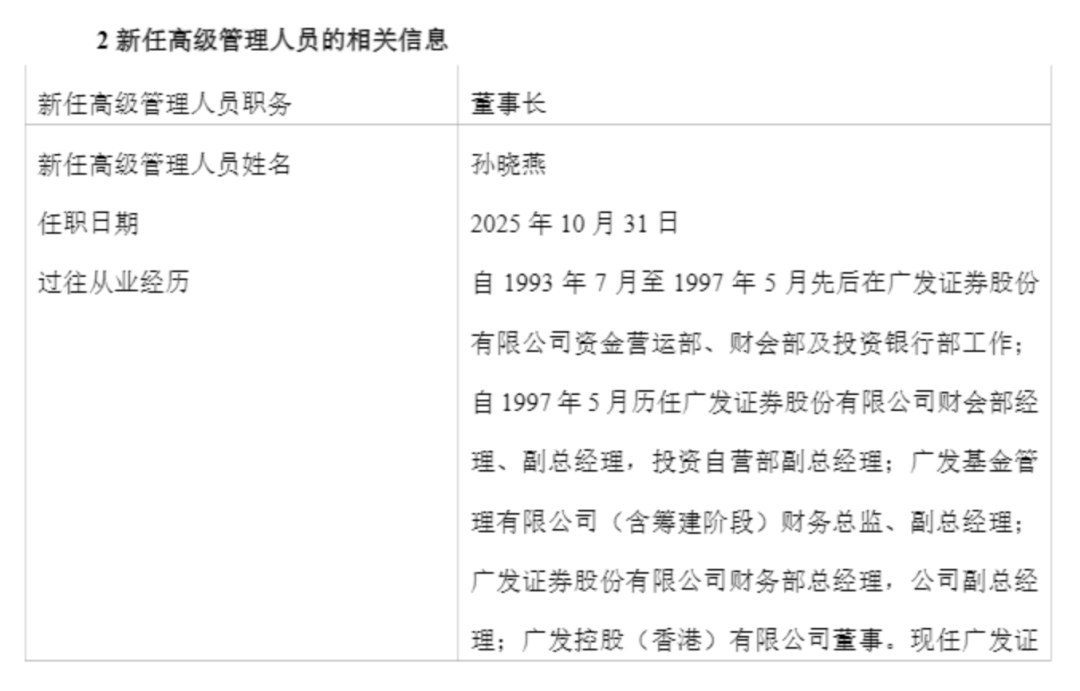
Group 1 - The core point of the article is the announcement of a leadership change at GF Securities Asset Management, with Sun Xiaoyan appointed as the new chairman, effective October 31, 2025, replacing Qin Li [1][3]. Group 2 - Sun Xiaoyan has a long history with GF Securities, having worked in various key departments since July 1993, including operations, finance, investment banking, and investment management [2]. - Prior to her new role, Sun Xiaoyan held multiple positions, including executive director, executive vice president, and financial director at GF Securities, as well as a director at GF Fund Management [3]. - As of the announcement date, GF Asset Management had a total asset management plan size of 250.645 billion yuan, which represents a decrease of 1.13% compared to the end of 2024 [3].

千亿资管公司换帅
中国基金报· 2025-11-03 08:02
【导读】广发资管换帅!孙晓燕出任董事长 近日, 广发证券资产管理(广东)有限公司(以下简称广发资管)发布高级管理人员变更公 告,宣布公司董事长职务发生变动。 孙晓燕女士新任公司董事长,秦力先生因工作安排不再担任董事长职务,相关职务任免自 2025 年 10 月 31 日起生效。 | 新任高级管理人员职务 | 重事长 | | --- | --- | | 新任高级管理人员姓名 | 孙晓燕 | | 任职日期 | 2025年10月31日 | | 过往从业经历 | 自 1993 年 7 月至 1997 年 5 月先后在广发证券股份 | | | 有限公司资金营运部、财会部及投资银行部工作; | | | 自 1997年5月历任广发证券股份有限公司财会部经 | | | 理、副总经理,投资自营部副总经理;广发基金管 | | | 理有限公司(含筹建阶段)财务总监、副总经理; | | | 广发证券股份有限公司财务部总经理,公司副总经 | | | 理;广发控股(香港)有限公司董事。现任广发证 | 校对:乔伊 制作:舰长 审核:许闻 版权声明 《中国基金报》对本平台所刊载的原创内容享有著作权,未经授权禁止转载,否则将追究法律责任。 授 ...


许正宇:香港许多资产管理公司正考虑将货币市场基金进行代币化的机会
Ge Long Hui· 2025-11-03 02:44
Core Viewpoint - The Secretary for Financial Services and the Treasury of Hong Kong, Xu Zhengyu, stated that many asset management companies in Hong Kong are considering the opportunity to tokenize money market funds [1] Group 1 - Hong Kong asset management companies are exploring the tokenization of money market funds [1]
独家专访!全球超长线成长股捕手Baillie Gifford,最新发声
中国基金报· 2025-11-02 06:05
Core Viewpoint - Baillie Gifford is committed to long-term investment in China, focusing on discovering high-quality growth companies and enhancing collaboration with diverse clients [1][8][9] Group 1: Investment Strategy and Market Insights - The firm has been investing in China since 1999, utilizing a dual research mechanism between its Shanghai and Edinburgh offices to maintain a global perspective while being locally informed [1][10] - Lorna Kennedy emphasizes that 2023 is the busiest year post-pandemic, with over 10 investment professionals visiting China, indicating a strong commitment to understanding local market dynamics [1][10] - The firm aims to expand its business scale and client diversity while continuously identifying quality growth companies in China [8][9] Group 2: Understanding Chinese Investors - Chinese investors exhibit different risk preferences when selecting overseas investment managers, often starting with fixed-income products before gradually moving to multi-asset allocations [6][7] - There is a need to educate local investors about the growth potential of global equities, as many are initially hesitant due to unfamiliarity with foreign companies [6][7] Group 3: Innovation and Competitive Edge - Baillie Gifford maintains an open mindset towards innovation, recognizing that China is achieving significant advancements in various fields, often at lower costs compared to Western counterparts [10][12] - The firm has a dedicated team in Shanghai that identifies emerging investment opportunities, such as Horizon Robotics, which may be overlooked by other global managers [10][12] Group 4: Long-term Investment Philosophy - The company focuses on understanding the business logic of companies rather than becoming domain experts in specific fields, allowing for a broader investment approach [12][13] - Baillie Gifford prioritizes long-term growth engines, including internet platforms, power batteries, AI chips, and autonomous driving, highlighting the global competitiveness of Chinese companies [13][19] Group 5: Role of AI in Investment - While AI can enhance research efficiency, it cannot replace human optimism and imagination regarding future growth potential [2][19] - The firm believes that long-term investment decisions should be based on fundamental analysis and industry trends, which AI cannot fully quantify [19][20]