创新药

Search documents
阿里云收入再创新高,南向资金加码港股科技龙头!港股通科技ETF招商(159125)冲击三连涨
2 1 Shi Ji Jing Ji Bao Dao· 2025-11-26 02:57
Group 1 - The core viewpoint of the articles highlights the significant rise in Hong Kong's internet and innovative pharmaceutical sectors, driven by strong performances from major companies like Alibaba and Meituan, as well as increased investment from southbound funds [1][2] - Alibaba's Q2 FY2026 earnings report showed revenues of 247.795 billion yuan, exceeding market expectations, with a 15% year-on-year growth when excluding sold businesses, and cloud business revenue reaching a record high of 39.8 billion yuan, up 34% year-on-year [1] - The continuous investment in AI by leading internet companies in Hong Kong is noted, indicating a strategic priority in AI infrastructure, model development, and application scenarios, which could create a positive development loop [1] Group 2 - Southbound funds have significantly increased their investments in major tech companies, with net purchases exceeding 10 billion HKD for Xiaomi and Alibaba, and over 2 billion HKD for Tencent and Meituan [1] - Citic Securities suggests that due to the current underweight position of mainland investors in Hong Kong stocks, southbound funds will continue to increase their allocation, benefiting from the complete AI industry chain and the influx of quality A-share companies listing in Hong Kong [2] - The valuation of the Hong Kong Stock Connect Technology ETF is noted to be at a price-to-earnings ratio of 24.8, which is lower compared to global tech indices like Nasdaq and ChiNext, indicating a valuation advantage [2]



创新药板块活跃 中恒集团涨停
Xin Lang Cai Jing· 2025-11-26 02:53
Core Viewpoint - The innovative drug sector is experiencing significant activity, with multiple companies reaching their daily price limits. Group 1: Company Performance - Zhongheng Group, Fuyuan Pharmaceutical, Hainan Haiyao, and Peking University Pharmaceutical have all hit the daily limit up [1] - Xinhua Pharmaceutical, ST Xiangxue, and Xinnowei are among the stocks with notable gains [1]


医药板块强势拉升,粤万年青、金迪克20%涨停
Zheng Quan Shi Bao· 2025-11-26 02:51
Core Viewpoint - The pharmaceutical sector experienced a strong rally on the 26th, particularly in innovative drugs and vaccine concepts, with several companies seeing significant stock price increases [1] Industry Summary - Recent advancements in the small nucleic acid drug field have garnered significant attention from both the industry and investors, marking a transition from concept validation to the brink of industrial rise [1] - By 2025, breakthroughs in delivery technology are expected to expand indications from the liver to cardiovascular and CNS areas, coupled with the commercialization of major products and substantial mergers by multinational pharmaceutical giants, indicating a golden development period driven by "technological breakthroughs + commercial realization" [1] - According to Everbright Securities, domestic pharmaceutical companies are accelerating their R&D progress, with many entering clinical research phases since 2025. The focus should be on leading innovative drug companies with advanced technology platforms and differentiated pipelines, as well as innovative industry chain companies likely to benefit from the overall industry upturn [1] - The investment approach in the pharmaceutical sector should increasingly emphasize the clinical value logic, addressing clinical needs of patients and doctors, influenced by domestic medical insurance policies and global expansion strategies, which are assigning higher premiums to clinical value [1] - From the perspective of clinical value, the innovative drug industry chain and innovative medical devices are viewed positively [1]


上证180ETF指数基金(530280)冲击3连涨,机构建议配置上哑铃型策略
Xin Lang Cai Jing· 2025-11-26 02:38
Core Viewpoint - The overall market sentiment remains cautiously optimistic, with no significant negative trends observed in the fundamental performance of key sectors, particularly in technology and growth stocks [1] Group 1: Market Performance - As of November 26, 2025, the Shanghai 180 Index rose by 0.30%, with notable increases in stocks such as Haiguang Information (3.95%) and Zhongke Shuguang (3.53%) [1] - The Shanghai 180 ETF Index Fund also saw a slight increase of 0.17%, marking its third consecutive rise [1] Group 2: Sector Analysis - The technology growth sector, including communications and semiconductors, continues to show strong performance, suggesting that recent market adjustments may be positioning for future gains [1] - Despite a slowdown in policy support compared to the first half of the year, the overall market remains in a loose monetary environment, which is expected to support recovery in the technology sector [1] Group 3: Investment Strategy - A "barbell strategy" is recommended for investment, suggesting to maintain positions in growth sectors like communications, semiconductors, and innovative pharmaceuticals while being cautious with short-term operations [1] - Defensive investments in dividend-paying sectors are advised to mitigate risks during market fluctuations [1] Group 4: Index Composition - The Shanghai 180 Index comprises 180 large-cap stocks selected for their market capitalization and liquidity, reflecting the overall performance of core listed companies in the Shanghai securities market [2] - As of October 31, 2025, the top ten weighted stocks in the index account for 26.29% of the total index, with notable companies including Kweichow Moutai and China Ping An [2]





港股创新药ETF(159567)涨超3%,成交额超10亿元!10月医疗医药资产投融资创新高
Sou Hu Cai Jing· 2025-11-26 02:36
招商证券研报表示,根据 PitchBook 和其有数据库分析,全球医疗医药资本市场的回暖趋势在今年持续 推进,10月总投融资规模升至约1,120亿美元,创年内新高,医疗医药资产吸引力持续提升医疗器械领 域10月份出现大额并购,聚焦于战略性补强核心业务、拓展高增长潜力细分市场,反映出企业对创新技 术的持续投入与信心。 浙商证券研报认为中国本土创新药进入"工程师红利"兑现期,中国本土创新药已经得到MNC充分认 可。"工程师红利"下,更高效临床效率,更优异/优效的临床数据等优势,持续强化本土创新药未来确 定性的国际化/BD以及估值突破前景。 市场11月26日消息,今日港股市场三大指数高走,盘面上生物医药板块涨幅居前。ETF方面,截至 10:15,港股创新药ETF(159567)涨3.31%,盘中成交额超10亿元,换手率超12%,交投活跃。 热门个股方面,三生制药、荣昌生物涨超6%,恒瑞医药等涨超5%,石药集团、康方生物、君实生物、 信达生物等涨超4%。 港股创新药ETF(159567)紧密跟踪国证港股通创新药指数,前十大成份股包含百济神州、信达生物、 三生制药等港股创新药板块龙头,锐度鲜明,其中包含多只AI制药龙头 ...
费率最低的港股通创新药ETF南方(159297)涨超3%,冲击三连阳
Ge Long Hui· 2025-11-26 02:32
Group 1 - The Hong Kong innovative drug sector opened high today, with companies like 3SBio and InnoCare rising by 6%, and CSPC Pharmaceutical and Rongchang Bio increasing by 5%, contributing to a 3.27% rise in the Hong Kong Stock Connect Innovative Drug ETF (159297), which also saw a net subscription of 16 million shares, marking three consecutive days of gains [1][2] - CSPC Pharmaceutical's ActRIIA/B antibody JMT206 injection clinical trial application was approved for obesity treatment, and its self-developed chemical class 1 new drug SYH2061 injection received FDA approval for clinical trials. The company's executive chairman, Cai Dongchen, has increased his holdings by a total of 44.87 million shares in the past month [2] - The Federal Reserve's interest rate cut expectations have risen significantly, with a December rate cut probability now at 80% [2] Group 2 - There has been a significant increase in demand for flu-related medications, testing, and online consultations, with Meituan's platform reporting over a 100% increase in orders for specific flu medications since November. Alibaba Health's platform noted a more than 500% week-on-week increase in the number of buyers for antiviral flu medications in the last two weeks [2] - The Hong Kong Stock Connect Innovative Drug ETF (159297) recently underwent a major update, removing CXO companies to enhance the purity of innovative drugs to 100%. The frequency of sample adjustments has increased from semi-annual to quarterly, allowing for faster updates of constituent stocks [2] - Since its launch on September 22, the ETF has added 1.2 billion shares, achieving a growth rate of 295.26%, with a total management and custody fee rate of 0.2%, making it one of the lowest-cost options in its category, and it allows T+0 trading without QDII quota restrictions [3]
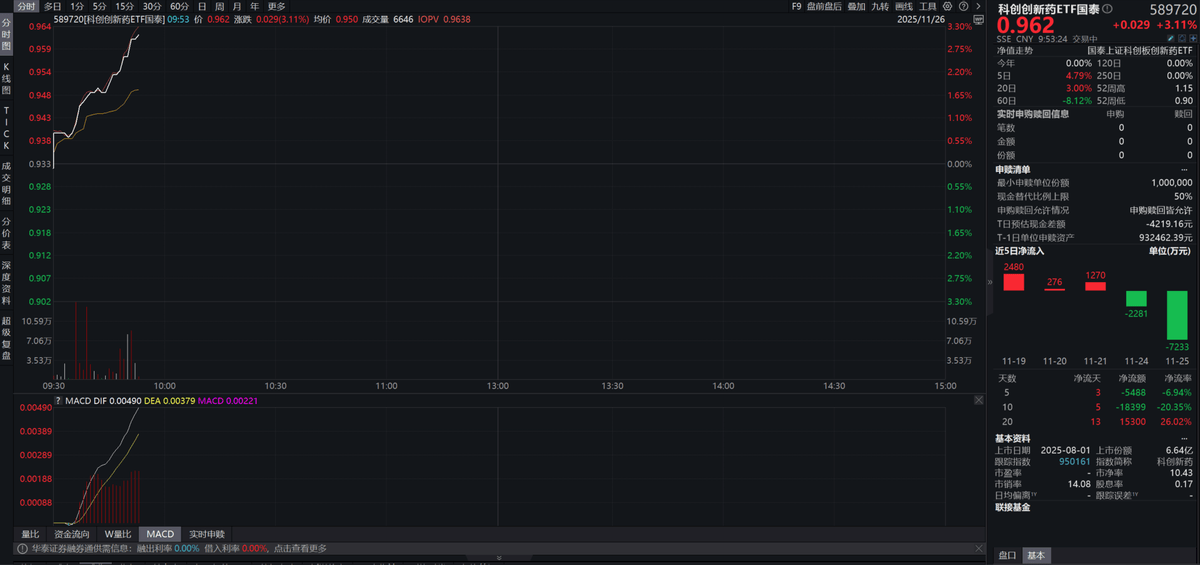
20cm速递|科创创新药ETF国泰(589720)涨超1.6%,近20日净流入超1.5亿元,“技术突破+商业兑现”双主线驱动
Mei Ri Jing Ji Xin Wen· 2025-11-26 02:22
Group 1 - The policy landscape is evolving with the conclusion of negotiations for the national medical insurance directory and commercial insurance drug directory in 2025, creating a new payment channel for high-value innovative drugs, potentially generating an annual payment scale of approximately 20 billion yuan [1] - The innovative drug sector is experiencing a positive trend of "high growth and reduced losses," with revenue reaching 48.56 billion yuan in the first three quarters of 2025, representing a year-on-year growth of 21.41%, while the net profit loss has significantly narrowed [1] - The number of approved domestic innovative drugs has been steadily increasing, capturing market share across various therapeutic areas, and many domestic innovative drugs are achieving value upgrades through international licensing deals, injecting new momentum into sector growth [1] Group 2 - The small nucleic acid drug sector is gaining significant attention due to recent global advancements, transitioning from concept validation to the brink of industrial rise, driven by breakthroughs in delivery technology and the expansion of indications [1] - The commercialization of heavyweight products and substantial mergers and acquisitions by multinational pharmaceutical giants are validating the industry's growth, marking a golden development period driven by "technological breakthroughs and commercial realization" [1] Group 3 - The Guotai Innovation Drug ETF focuses on innovative drug companies listed on the Sci-Tech Innovation Board, tracking a representative index of 30 high-quality companies, primarily in the high-growth biotech sector [2] - During the market rebound from September 24, 2024, to October 31, 2025, the Sci-Tech Innovation Drug Index and the Hang Seng Hong Kong Stock Connect Innovation Drug Index saw increases of 143.70% and 135.34%, respectively, indicating potential for better sharing of the Sci-Tech Innovation Board's elasticity as market risk appetite recovers [2]
港股科技ETF(513020)涨近1.5%,网罗港股互联网龙头+芯片+新能源+创新药
Mei Ri Jing Ji Xin Wen· 2025-11-26 02:18
Core Viewpoint - The Hong Kong stock market's technology sector continues to rebound, with the Hong Kong Technology ETF (513020) rising nearly 1.5% and a net inflow of over 220 million yuan in the past five days [1] Group 1: Alibaba's Financial Performance - Alibaba reported its Q2 fiscal year 2026 earnings, showing a 34% year-on-year growth in cloud revenue [1] - AI-related product revenue has achieved triple-digit year-on-year growth for nine consecutive quarters [1] - Capital expenditure for the quarter was 31.5 billion yuan, with approximately 120 billion yuan spent on AI and cloud infrastructure over the past four quarters [1] Group 2: AI Product Development - Alibaba's self-developed AI assistant, Qianwen APP, has surpassed 10 million downloads within a week of its public testing starting on November 17 [1] - The growth rate of Qianwen APP's downloads exceeds that of several well-known AI applications, including ChatGPT, Sora, and DeepSeek, indicating strong market response [1] Group 3: Hong Kong Technology ETF - The Hong Kong Technology ETF (513020) tracks the CSI Hong Kong Stock Connect Technology Index, which includes leading technology stocks in internet, chips, new energy, and innovative pharmaceuticals [1] - The ETF comprises popular stocks such as Alibaba, Xiaomi, Tencent, Meituan, Lenovo, BYD, and SMIC, making it a quality target for investors looking to capitalize on the rebound in the Hong Kong market [1]

创新药集体大涨!利好频出,高弹性港股通创新药ETF(520880)放量涨超3%
Mei Ri Jing Ji Xin Wen· 2025-11-26 02:18
Group 1 - The Hong Kong innovative drug sector has rebounded strongly, with leading stocks like Heng Rui Pharmaceutical and Sanofi both rising over 4% [1] - The Hong Kong Stock Connect innovative drug ETF (520880) has over 70% of its holdings in leading innovative drug stocks, showing a rise of over 3% in early trading [1] - Significant positive news for major innovative drug companies includes Sanofi's plan to spin off its minoxidil brand for a listing on the Hong Kong Stock Exchange and the approval of clinical trial applications for ActRIIA/B antibody JMT206 by Shiyao Group [1] Group 2 - The Hong Kong innovative drug sector has undergone sufficient adjustments since September and may now be in a cost-effective allocation zone [2] - The Hong Kong Stock Connect innovative drug ETF (520880) and its linked fund (025221) passively track the Hang Seng Hong Kong Stock Connect Innovative Drug Select Index, which exclusively invests in innovative drug R&D companies [2] - As of the end of September, the index has shown a cumulative increase of 108.14% this year, outperforming other innovative drug indices [2]
“技术突破+商业兑现”双主线驱动,20cm标的科创创新药ETF(589720)涨超3%
Sou Hu Cai Jing· 2025-11-26 02:16
Group 1 - The innovative drug sector is showing a positive trend of "high growth and reduced losses," with significant developments in the small nucleic acid drug field, leading to a daily fluctuation of 20% in the innovative drug ETF (589720), which has risen over 3% [1][3] - By the third quarter of 2025, the innovative drug sector achieved a revenue of 48.56 billion yuan, representing a year-on-year growth of 21.41%, while the net profit loss has significantly narrowed [3] - The establishment of a commercial insurance directory for innovative drugs is expected to create a potential funding pool of approximately 20 billion yuan annually, enhancing the payment channels for high-value innovative drugs [3] Group 2 - The innovative drug ETF (589720) has outperformed Hong Kong's innovative drug sector by nearly 10 percentage points since the "924 market" in 2024, indicating a higher performance recovery elasticity [5] - The innovative drug industry is experiencing broad development opportunities driven by continuous breakthroughs in overseas markets, policy benefits, and the steady improvement of Chinese innovative drug companies' R&D capabilities [4][5] - The small nucleic acid drug field is entering a golden development period characterized by "technological breakthroughs and commercial realization," with advancements in delivery technology expanding indications beyond the liver to cardiovascular and CNS areas [3]