Funds

Search documents
易方达基金董事会“换血”:12个月五董事更迭 万亿巨头治理结构或生变
Xin Lang Ji Jin· 2025-07-10 07:08
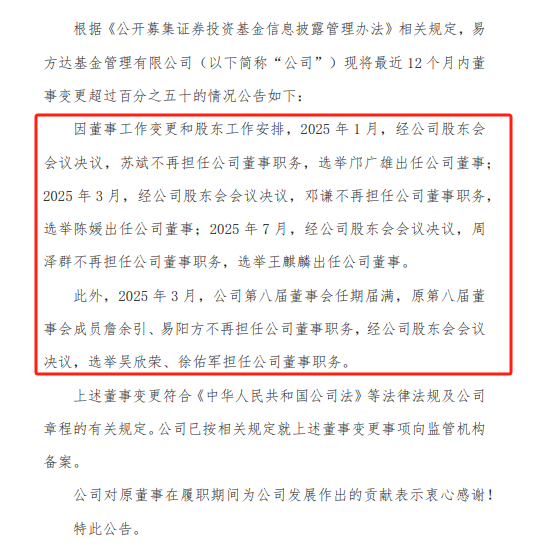
Core Viewpoint - E Fund has undergone significant board changes, with over 50% of its directors replaced in the past 12 months, marking a new governance cycle for the company, which manages over 2 trillion yuan in assets [1][7]. Board Changes - The board has seen a high-frequency turnover, with five new directors appointed in a series of adjustments throughout the year [2][5]. - Key changes include the resignation of Chairman Zhan Yuyin and the appointment of new directors such as Kwan Guangxiong and Chen Yuan, reflecting a shift in governance dynamics [2][4]. Management Adjustments - The company has experienced a broader management reshuffle, with several senior executives, including the Chief Information Officer and multiple vice presidents, stepping down to focus on investment management [5][7]. - The new board composition includes individuals with strong ties to major shareholders, indicating increased shareholder influence in governance [4][10]. Business Performance - Despite the leadership changes, E Fund has shown robust growth, with total assets reaching 2.02 trillion yuan and non-monetary assets at 1.39 trillion yuan as of Q2 2025, maintaining its position as an industry leader [7]. - The company has also seen significant growth in new fund issuance and ETF scale, with new fund sizes exceeding 18.1 billion yuan and ETF growth of 73.2 billion yuan, ranking second in market increments [7][8]. Challenges Ahead - The new governance team faces challenges in maintaining research and investment advantages while navigating the competitive landscape and balancing international expansion with wealth management [10].

换手率超30%!30年国债ETF(511090)交投活跃盘中成交近50亿元,机构:把握债市调整后的布局机会
Sou Hu Cai Jing· 2025-07-10 06:23
Group 1 - The 30-year Treasury ETF (511090) has been adjusted with a latest quote of 124.7 yuan as of July 10, 2025 [1] - The trading volume of the 30-year Treasury ETF was active, with a turnover of 30.93% and a transaction value of 4.974 billion yuan, while the average daily transaction over the past week was 6.237 billion yuan [1][2] - The current scale of the 30-year Treasury ETF has reached 16.103 billion yuan [2] Group 2 - Citic Securities indicates that the bond market is influenced by multiple factors, including the potential for effective policies to curb disorderly competition and promote industry clearing, which could support inflation and impact the bond market [2] - There are concerns regarding the sustainability of improvements in the fundamentals and inflation, compounded by weak domestic and external demand, as well as fiscal and real estate pressures, leading to a moderate short-term policy effect [2] - The current monetary policy remains relatively loose, providing ample liquidity and strong allocation demand to support the bond market [2] Group 3 - Short-term vulnerabilities in the bond market are heightened due to compressed spreads, high leverage, and low funding rates, while strong performance in equity and commodity markets disrupts the bond market [2] - It is suggested to monitor the performance of risk assets in July to seize opportunities for positioning in the bond market after adjustments [2] - The 30-year Treasury ETF closely tracks the China Bond 30-Year Treasury Index, which consists of publicly issued and tradable 30-year treasury bonds with a remaining maturity of 25-30 years [2]
2025年6月基金投顾投端跟踪报告:主动权益仓位提升,红利策略和周期主题基金受青睐
Ping An Securities· 2025-07-10 03:43
Group 1 - The report indicates an increase in active equity positions, with a preference for dividend strategies and cyclical theme funds [4][10][27] - As of the end of June 2025, there are 446 fund advisory combinations on the Tian Tian Fund APP, an increase of 5 from the previous month, with a notable dominance of equity-debt central combinations [10][11] - The performance of the equity-debt central combinations shows that the aggressive type outperformed similar FOF products over the past year, while balanced and conservative types underperformed [16][19] Group 2 - The report highlights that the active equity funds favored by advisory combinations include cyclical themes, dividend strategies, growth styles, value themes, and technology themes [41][46] - The QDII funds that received significant allocations include the Huaxia Hang Seng Technology ETF and the Southern Nasdaq 100 A [47][52] - The report notes that the most favored passive equity funds include those focused on low volatility dividend strategies and Hong Kong banking sectors [53][54] Group 3 - The report tracks the changes in fund positions, indicating that conservative combinations reduced mixed funds while increasing index funds, and aggressive combinations reduced passive equity funds while increasing active equity funds [34][40] - The report also details the top ten active equity funds favored by advisory combinations, with a focus on value style and cyclical themes [43][46] - The report provides insights into the performance of thematic and regional advisory combinations, noting that the medical and renewable energy sectors outperformed their benchmarks [25][27][31]
基金降费“接力赛”:超千只产品入“低价”行列
Huan Qiu Wang· 2025-07-10 02:46
Group 1 - The fund industry is experiencing a wave of fee reductions, with over 20 funds announcing lower management and/or custody fees, aimed at reducing investor holding costs [1][2] - The number of "low-fee" fund products with management fees at 0.15% or below has surpassed 1,050 [1] - Major fund companies such as E Fund, Guotai Junan, and others have implemented fee reductions, with some funds lowering management fees significantly, such as a drop from 0.90% to 0.55% [1] Group 2 - The current wave of fee reductions reflects the ongoing deepening of public fund fee reforms, with expectations for a third phase focusing on sales fees to accelerate [2] - The China Securities Regulatory Commission (CSRC) has indicated that further reductions in fund sales fees are expected to save investors approximately 45 billion yuan annually starting in 2025 [2] Group 3 - As the number of low-fee products increases, fund companies are exploring more refined charging models, such as tiered service fees based on holding periods to encourage long-term investment [4] - The continuous fee reductions are pushing the industry towards a more standardized and inclusive direction, while fund companies are encouraged to strengthen their research capabilities to attract and retain investors [4]
公募费改两周年记:头部“卷”指数,中小机构忙“降本”
Bei Jing Shang Bao· 2025-07-09 15:17
Core Insights - The public fund industry in China is undergoing significant transformation due to the fee reduction reform initiated by the China Securities Regulatory Commission (CSRC) in July 2023, which has led to a shift in focus from active to passive fund management [1][3][8] - The reform has resulted in a notable decline in management fees, particularly affecting small and medium-sized fund management companies, which are struggling to maintain profitability [6][10] - The emergence of new fund models, such as floating fee rate funds, aims to align the interests of fund managers and investors more closely, enhancing the overall investment experience [9][11] Group 1: Fee Reduction Impact - The fee reduction reform has set a cap on management fees for active equity funds at 1.2% and custody fees at 0.2%, effective from July 7, 2023, impacting both new and existing funds [3][4] - As a result of the reform, the issuance of equity index funds has surged, with new issuance reaching 1,880.59 billion yuan in the first half of 2023, marking a significant shift towards passive investment strategies [4][5] - The competitive landscape for ETFs has intensified, with many large public funds focusing on passive products to drive revenue growth amid declining management fees [5][10] Group 2: Challenges for Small and Medium-sized Firms - Small and medium-sized public funds are facing severe challenges, with over 56% of fund managers reporting a decline in management fee income, some experiencing drops exceeding 50% [6][7] - These firms are focusing on improving product performance rather than expanding their offerings, as they struggle to compete for market share and access to distribution channels [7][10] - The pressure to reduce costs has led to cuts in marketing and operational expenses, impacting the overall growth potential of these smaller firms [8][10] Group 3: Strategic Adaptations - The industry is witnessing a structural reform aimed at enhancing the quality of fund offerings, with a focus on consolidating resources towards leading products [8][10] - Fund managers are increasingly investing in research and development capabilities to improve performance and attract investors, despite the pressure on fees [10][11] - The introduction of floating fee rate funds is seen as a way to better align the interests of fund managers with those of investors, potentially improving investor satisfaction and retention [9][11]

What Recent CEF Distribution Cuts Mean, And Why I'm Not Concerned
Seeking Alpha· 2025-07-09 07:58
Group 1 - The CEF/ETF Income Laboratory manages portfolios targeting safe and reliable yields of approximately 8% through closed-end funds (CEFs) and exchange-traded funds (ETFs) [2][3] - The service is designed for both active and passive investors, providing features such as managed income portfolios, monthly payers for faster compounding, 24/7 chat, and trade alerts [2][3] - The focus is on high-yield opportunities in the CEF and ETF space, particularly as interest rates begin to decline [2]


下半年基金“降费”启幕:仅7个交易日有超20只产品出手
Huan Qiu Wang· 2025-07-09 07:13
Core Viewpoint - The fund market has initiated a wave of fee reductions, with over 20 funds announcing lower fees, including mixed, bond, money market funds, and FOF products [1][3][4] Group 1: Fee Reductions Announced - E Fund announced a reduction in custody fees for two bond funds, lowering the annual custody fee rate from 0.10% to 0.05% starting July 11 [1] - Guotai Fund reduced the management fee rate from 0.40% to 0.30% and the annual custody fee from 0.10% to 0.05% for its fund starting July 8 [3] - Fuguo Fund adjusted the management fee for its A-class fund shares from 0.60% to 0.40% and for Y-class shares from 0.30% to 0.20% starting July 1 [3] - Several money market funds, including Debang Deli and Dongwu Zengxinbao, have also lowered management, custody, and service fees [3] Group 2: Overall Fee Trends - Nearly 30 funds have actively reduced their fee rates to 0.15% or below this year, with a total of 1,050 fund products currently in this low fee range according to Wind data [3] - The public fund fee reform is progressing steadily, with the first two phases focusing on management and transaction fees, while the third phase will target sales fees [4] - The chairman of the China Securities Regulatory Commission indicated that starting in 2025, further reductions in fund sales fees are expected to save investors approximately 45 billion yuan annually [4]

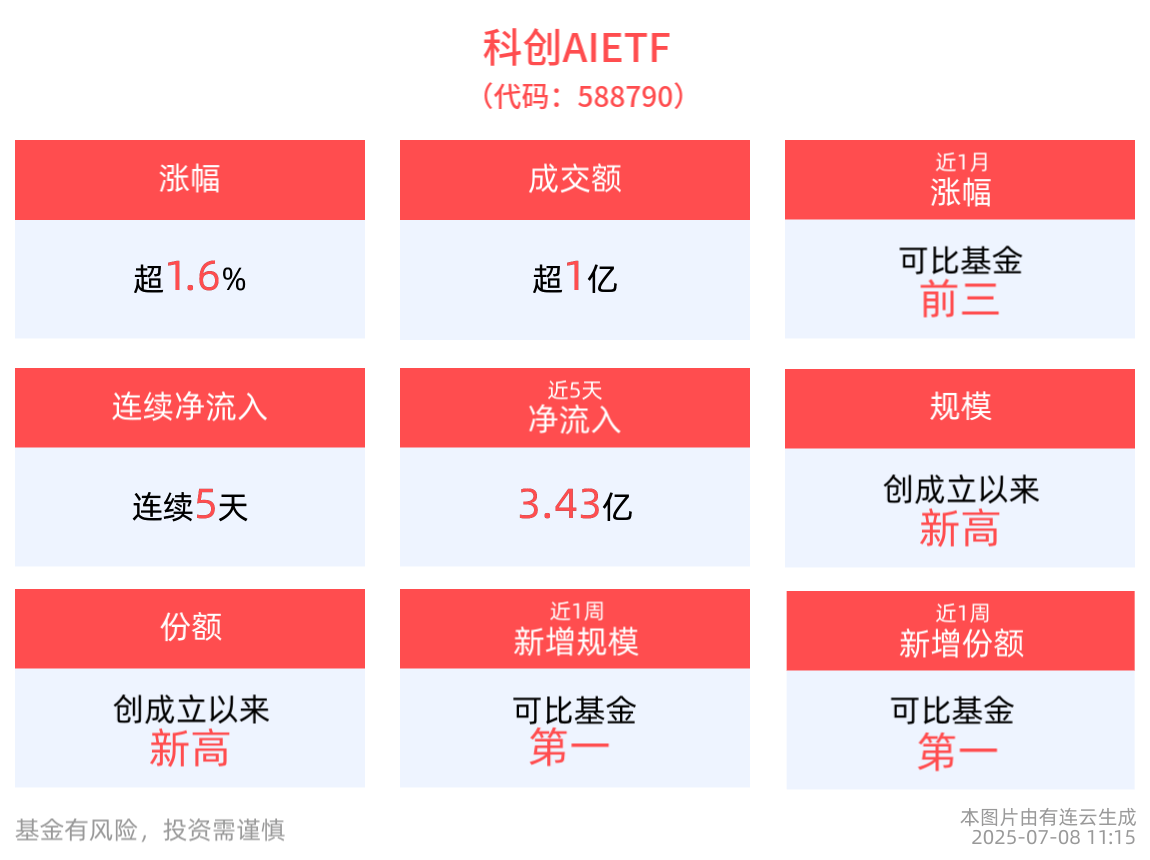
科创AIETF(588790)盘中涨近2%,最新规模、份额均创新高,马斯克宣布xAI新一代Grok4大模型即将发布
Sou Hu Cai Jing· 2025-07-08 03:36
Core Viewpoint - The AI sector is experiencing significant growth, driven by advancements in technology and increasing demand for AI applications across various industries, as evidenced by the performance of the Sci-Tech AI ETF and the upcoming launch of the Grok4 model by xAI [3][4][5]. Group 1: Market Performance - As of July 8, 2025, the Sci-Tech AI Index (950180) rose by 1.77%, with notable increases in constituent stocks such as Lexin Technology (688018) up 8.25% and Hehe Information (688615) up 4.07% [3]. - The Sci-Tech AI ETF (588790) has seen a recent price increase of 1.61%, with a current price of 0.57 yuan, and a two-week cumulative increase of 1.63%, ranking 3rd among comparable funds [3]. - The total scale of the Sci-Tech AI ETF reached a new high of 44.00 billion yuan, ranking 1st among comparable funds [4]. Group 2: Fund Flows and Investment Trends - The Sci-Tech AI ETF has experienced continuous net inflows over the past five days, with a maximum single-day net inflow of 118 million yuan, totaling 343 million yuan, averaging 6.85 million yuan per day [4]. - Leveraged funds are increasingly being allocated to the Sci-Tech AI ETF, with the latest margin buying amounting to 772,810 yuan and a margin balance of 24.8 million yuan [4]. Group 3: Performance Metrics - The Sci-Tech AI ETF has achieved a net value increase of 13.29% over the past six months, ranking 677th out of 3,432 index stock funds, placing it in the top 19.73% [5]. - Since its inception, the ETF's highest monthly return was 15.59%, with an average monthly return of 9.71% during rising months [5]. - The ETF's management fee is 0.50% and the custody fee is 0.10%, which are relatively low compared to comparable funds [6]. Group 4: Index Composition and Valuation - The Sci-Tech AI Index is composed of 30 large-cap stocks that provide foundational resources, technology, and application support for the AI industry, with the top ten stocks accounting for 68.03% of the index [7]. - The index's valuation is currently at a historical low, with a price-to-book ratio (PB) of 7.41, which is below 97.69% of the time since its inception, indicating strong valuation attractiveness [6].
上半年超七成公募基金盈利,你赚钱了吗?丨招财猫
Sou Hu Cai Jing· 2025-07-07 14:11
Core Insights - The public fund industry in the A-share market has shown remarkable performance in the first half of the year, with 74.59% of funds achieving positive returns, and 84 funds exceeding a 50% return rate [1][2] - The active equity funds have outperformed the overall market, with an average return of 6.89% and 74.19% of products generating positive returns [2][4] Fund Performance - The top-performing active equity funds include those focused on innovative pharmaceuticals and the Beijing Stock Exchange, with notable returns such as 82.45% for the CITIC Construction Investment fund [4][5] - The pharmaceutical sector has also seen strong performance, with related funds achieving returns of 73.96%, 70.50%, and 68.15% [5] Market Indices - The Shanghai Composite Index rose by 2.76%, while the ChiNext Index increased by 0.53%, indicating a relatively stable market environment [2] Dividend Distribution - Public funds distributed a total of 1275.11 billion yuan in dividends, marking a 37.53% increase year-on-year, with bond funds contributing over 80% of the total [7][9] - The top dividend-paying fund was the Huatai-PB CSI 300 ETF, distributing 83.94 billion yuan [9] Fund Issuance and Subscription - The issuance of public funds has rebounded, with 680 new funds launched in the first half of the year, a 7.94% increase year-on-year [10] - Equity funds accounted for over 70% of new issuances, with a significant rise in passive index funds [10][11] - The net subscription for non-money public funds reached 53.18 billion yuan, a 189.65% increase compared to the previous year [11]

每日钉一下(三种方式,提高人力资产的价值)
银行螺丝钉· 2025-07-07 13:59
Group 1 - The core concept of fund advisory is to address the issue where "funds make money, but investors do not" [4] - Fund advisory services are designed to help investors achieve better returns through professional guidance [5] - The emergence of fund advisory reflects the need for specialized advice in the investment sector, similar to other professional fields [2][3] Group 2 - Fund advisory is compared to other advisory roles, such as doctors for health issues and lawyers for legal problems, highlighting the importance of expert guidance [7]