
商业火箭

Search documents
国产商业火箭“批量上天” 未来三年将进入洗牌关键期
Bei Jing Shang Bao· 2025-10-22 00:13
Core Insights - The domestic commercial rocket industry is transitioning from a verification phase of "launchable and deliverable" to a scaling phase characterized by "frequency, deliverability, and efficiency" driven by technological breakthroughs, policy support, and surging market demand [2][3][4]. Industry Developments - Recent successful launches include the Kuaizhou-1A rocket by China Aerospace Science and Technology Corporation, which has completed nine flights, delivering a total of 73 satellites into orbit with a cumulative payload exceeding 9 tons [2]. - In October 2023, the Zhuque-3 rocket by Blue Arrow Aerospace successfully completed its first flight phase, indicating progress in the operational capabilities of commercial rockets [2][3]. - The domestic commercial launch schedule for 2023 includes at least 20 missions, with nine completed in August alone [3]. Market Dynamics - The commercial space sector is experiencing a significant increase in demand, particularly for remote sensing satellites, communication constellations, and scientific experimental satellites [5]. - The industry is forming a "whole rocket traction + supporting cluster" structure, with local production rates for propulsion systems and control equipment significantly increasing [5]. Policy and Infrastructure Support - Recent policy changes, such as the simplified approval process for commercial launches, are facilitating the growth of the industry [4]. - The establishment of new commercial launch infrastructure, such as the Dongfeng Commercial Space Innovation Test Area, is enhancing the testing and launching capabilities for private rockets [5]. Future Outlook - The next three years are expected to be a critical period for industry reshuffling, with companies that possess comprehensive autonomous capabilities and differentiated business models likely to emerge as leaders [6]. - The commercial space industry in China is projected to grow from a market value of 1 trillion yuan in 2020 to approximately 2.3 trillion yuan by 2024, with a compound annual growth rate of 22.9% [5].


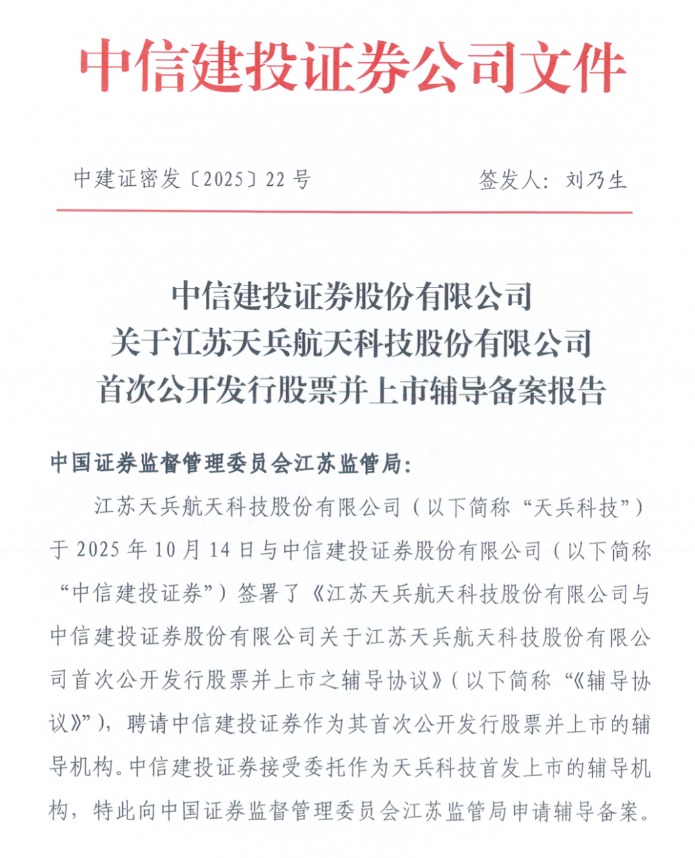
本周新增天兵科技、新鑫矿业等7家企业完成境内IPO辅导备案
Sou Hu Cai Jing· 2025-10-19 03:52
Core Viewpoint - The China Securities Regulatory Commission (CSRC) disclosed that seven companies have recently received domestic listing counseling registration from October 13 to 19, indicating a growing interest in IPOs within the market [1] Group 1: Newly Registered Companies - The seven companies that received counseling registration include Jiangsu Tianbing Aerospace Technology Co., Ltd., Xinjiang Xinxin Mining Co., Ltd., Xuyu Optoelectronics (Shenzhen) Co., Ltd., Shanghai Shanyuan Electronic Technology Co., Ltd., Qingdao Wuxiao Group Co., Ltd., Zhongke Fuhai Technology Co., Ltd., and Wuhu Youpai Nursing Products Technology Co., Ltd. [1] - Tianbing Technology is noted as another commercial rocket "unicorn" that has initiated listing counseling this year, having recently completed nearly 2.5 billion yuan in financing, setting a record for the largest single financing amount for a private rocket company in China [1] - Xinjiang Xinxin Mining is already listed on the Hong Kong Stock Exchange, with a current market capitalization of nearly 6 billion Hong Kong dollars [1] Group 2: Previous IPO Attempts - Xuyu Optoelectronics, Shanyuan Technology, Wuxiao Group, and Youpai Co. have previously initiated IPO counseling [1] - Wuxiao Group attempted to enter the A-share market as early as 2014, having submitted an application to the Shanghai Stock Exchange's main board, but later withdrew the application within the same year [1]
又一商业火箭“独角兽”启动IPO征程
Shang Hai Zheng Quan Bao· 2025-10-18 07:05
Core Viewpoint - Jiangsu Tianbing Aerospace Technology Co., Ltd. (referred to as "Tianbing Technology") has completed its IPO guidance filing with the Jiangsu Securities Regulatory Bureau, marking a significant step in its growth within China's commercial aerospace sector [1][4]. Company Overview - Tianbing Technology was established on April 11, 2019, with a registered capital of 390 million yuan. The legal representative and controlling shareholder is Kang Yonglai, who holds a direct shareholding of 23.49% [1][4]. - The company is a high-tech enterprise that specializes in the development of next-generation liquid rocket engines and medium to large liquid launch vehicles, positioning itself as a leader in the commercial aerospace industry [4][5]. Leadership and Team - Kang Yonglai, a PhD in engineering, has nearly 20 years of experience in rocket technology research and project management. He has held significant positions at the China Academy of Launch Vehicle Technology [4]. - The core team of Tianbing Technology consists of industry veterans, with an average age of 38. Notably, 67% of the team holds senior professional titles, and 95% have a master's degree or higher [5]. Industry Position and Achievements - Since its inception, Tianbing Technology has rapidly ascended to the top tier of the commercial aerospace sector in China. The successful maiden flight of its self-developed Tianlong-2 medium liquid launch vehicle occurred in April 2023 [5]. - The Tianlong-3 large liquid launch vehicle is expected to achieve a payload capacity exceeding 20 tons to low Earth orbit, comparable to SpaceX's Falcon 9, and is designed to meet the demands of China's satellite internet deployment [5][6]. Recent Developments - In August 2023, Tianbing Technology, along with Blue Arrow Aerospace and CAS Space, was selected for the "Thousand Sails Constellation" project, with the highest comprehensive score among the bidders [6]. - The company has established a comprehensive industrial chain for rocket research, large-scale manufacturing, and dedicated launch facilities, aiming for an annual production capacity of 50 Tianlong series rockets and 500 Tianhu series rocket engines [6]. Financing and Valuation - Tianbing Technology has completed multiple rounds of financing, with its recent Pre-D and D rounds raising nearly 2.5 billion yuan, supported by several well-known institutions [6][7]. - In June 2024, the company is set to complete an additional 1.5 billion yuan in C+ round financing, further solidifying its financial position in the industry [7].
国内首款全碳纤维复合材料火箭企业,完成天使轮融资
Sou Hu Cai Jing· 2025-08-20 16:38
Core Insights - Microglow Launch has completed several million yuan in angel round financing, focusing on the commercial aerospace sector with a strong team experienced in rocket and missile research [1] - The company has developed a closed-loop capability covering design, materials, manufacturing, and launch, with a focus on carbon fiber technology for rocket construction [1][2] Company Overview - Founded in March 2025, Microglow Launch is led by CEO Gao Huan, an expert in rocket assembly technology [1] - The core team includes national-level researchers and has established partnerships with domestic carbon fiber companies to develop aerospace-grade materials [1][2] Technological Innovations - The WG-1 Microglow-1 medium-sized reusable launch vehicle is the world's first rocket to integrate three core technologies: full-flow staged combustion cycle, carbon fiber composite materials, and liquid oxygen-methane [1] - The use of carbon fiber allows for a 10% increase in payload capacity and a 25% improvement in economic efficiency, with the rocket's carrying coefficient reaching 3.14% [2] Material Advancements - Microglow Launch is the first in China to apply carbon fiber technology extensively in rocket construction, covering 90% of the rocket's structure [2] - The company has successfully manufactured and tested carbon fiber tanks with diameters of 1.4 meters and 3.35 meters, and is working on a 3.8-meter diameter tank [2][3] Weight Reduction and Cost Efficiency - Traditional metal rocket tanks account for 25% of the total weight, while Microglow Launch's innovations reduce tank weight by 40%, significantly lowering launch costs [3] - Each kilogram of weight reduction translates to a cost saving of 750,000 yuan for launching a 500-kilogram satellite [3] Engine Development - The Huaguang-1 engine is the first in China and the third globally to utilize a full-flow staged combustion cycle, achieving over 99% fuel combustion efficiency and enhancing payload capacity by 30% [3] Market Landscape - The Chinese commercial aerospace sector is highly competitive, with 38 companies vying for limited launch orders, leading to aggressive pricing strategies from established players [4] - New entrants like Microglow Launch face significant challenges from traditional aerospace giants and other emerging companies [4]
国内首款全碳纤维复合材料火箭企业,完成天使轮融资
DT新材料· 2025-08-20 16:05
Core Viewpoint - The article highlights the recent angel round funding of several million yuan completed by the domestic commercial aerospace company, Weiguang Qihang, which focuses on developing medium-sized reusable launch vehicles using advanced carbon fiber technology and innovative engine designs [2][4]. Company Overview - Weiguang Qihang was established in March 2025, led by a core team with extensive experience in rocket and missile research and development, including national-level researchers [2]. - The company has developed a closed-loop capability covering design, materials, manufacturing, and launch, with a focus on vertical integration to ensure technical consistency and cost control [2]. Technological Innovations - The WG-1 Weiguang No.1 medium-sized liquid reusable launch vehicle is the world's first to integrate three core technologies: full-flow staged combustion cycle, carbon fiber composite materials, and liquid oxygen-methane [2]. - The use of carbon fiber technology allows for a 40% weight reduction in the rocket's storage tank compared to traditional metal tanks, significantly enhancing payload capacity and economic efficiency [3][4]. - The company has successfully manufactured and tested carbon fiber storage tanks with diameters of 1.4 meters and 3.35 meters, and is currently working on a 3.8-meter diameter tank, which will fill a technological gap in the domestic market [3]. Engine Development - The Huaguang No.1 engine is the first in China and the third globally to adopt a full-flow staged combustion cycle, achieving a fuel combustion efficiency of over 99%, which can increase the rocket's payload capacity by 30% [4]. - This engine design is complex, requiring the management of two pre-combustion chambers for liquid oxygen and methane, leading to higher efficiency and better propellant utilization [4]. Market Context - The Chinese commercial aerospace sector is highly competitive, with 38 companies vying for limited launch orders, leading to aggressive pricing strategies from established players [5]. - New entrants like Weiguang Qihang face significant challenges in this competitive landscape, where traditional aerospace giants and international companies like SpaceX maintain a strong market position [5].

国泰海通晨报-20250812
Haitong Securities· 2025-08-12 02:17
Group 1: Strategy and Market Outlook - The report maintains a tactical overweight view on A-shares and US stocks for August, driven by improving risk appetite and favorable macroeconomic conditions [4][5][20] - The strategic asset allocation (SAA) plan is set with a target allocation of 45% equities, 45% bonds, and 10% commodities, with a maximum deviation of 10% [4][19] - The tactical asset allocation (TAA) plan forecasts a 2025 annualized return of 55%, with a Sharpe ratio of 1.65, suggesting strong performance in equity assets [5][20] Group 2: Construction Industry Insights - Historical reviews of three central Xinjiang work conferences indicate significant price elasticity for construction companies in the Xinjiang region, with notable stock price increases following these events [7][9] - Xinjiang's fixed asset investment grew by 16.2% in the first five months of 2025, with industrial investment increasing by 22.8%, particularly in wind and solar energy projects [8] - The establishment of the New Tibet Railway Company with a registered capital of 95 billion yuan is expected to boost infrastructure projects in Xinjiang, with a total investment plan of 3.47 trillion yuan for 500 key projects [9][10] Group 3: Aerospace Industry Developments - The report highlights a critical shortage in China's rocket launch capacity, which is a bottleneck for low Earth orbit satellite deployment [11][13] - The acceleration of low Earth orbit satellite networks is emphasized, with a target of deploying approximately 23,000 satellites by 2030, necessitating significant improvements in rocket launch capabilities [13][14] - The development of reusable rockets and liquid fuel technologies is identified as essential for enhancing launch capacity and reducing costs [14]
国泰海通 · 晨报0812|策略、建筑工程、航空航天
国泰海通证券研究· 2025-08-11 14:15
Group 1: Market Strategy and Asset Allocation - The core viewpoint emphasizes an improvement in risk appetite supporting global equity allocation value, with a tactical overweight on A-shares and US stocks as of August [3] - The current low interest rate environment necessitates higher demands for asset allocation research, with a strategic asset allocation (SAA) plan yielding an annualized return of 9.1% and a Sharpe ratio of 1.57 as of the end of July [3] - The proposed strategic benchmark allocation is set at 45% for equities, 45% for bonds, and 10% for commodities, with a deviation limit of 10% [3] Group 2: Tactical Asset Allocation Insights - The enhancement of risk appetite is identified as a key factor influencing current tactical asset allocation, with expectations of continued strong performance in equity assets supported by various factors including technological breakthroughs and government support for capital markets [4] - The tactical asset allocation (TAA) plan anticipates a 55% weight in equities, 40% in bonds, and 5% in commodities, reflecting optimism for A-shares and Hong Kong stocks, as well as marginal optimism for US and Japanese stocks [4] - Caution is advised regarding government bonds due to market risk appetite adjustments and redemption pressures, while commodity prices, particularly oil, may face dual pressures from supply and demand [4] Group 3: Infrastructure Opportunities in Xinjiang - Historical reviews of three central work conferences on Xinjiang indicate significant stock price increases for key construction companies following these meetings, with notable gains such as 45.6% for Beixin Road and Bridge after the first conference [10] - Fixed asset investment in Xinjiang increased by 16.2% in the first five months of the year, with industrial investment rising by 22.8%, particularly in wind and solar energy projects [11] - The establishment of the Xinjiang Tibet Railway Company with a registered capital of 950 billion yuan highlights ongoing infrastructure investment, with plans for 500 key projects totaling 3.47 trillion yuan by 2025 [12] Group 4: Coal Chemical Industry Development - The coal chemical sector in Xinjiang is projected to experience a construction peak, with planned projects exceeding 800 billion yuan, driven by policy support [13] - Companies like China Chemical and Donghua Technology are positioned to capitalize on traditional coal chemical market opportunities, with significant new orders reported [13] Group 5: Aerospace and Satellite Deployment - The acceleration of low Earth orbit (LEO) satellite deployment is identified as a critical area, with a projected need for 2.3 million satellites by 2030, necessitating enhanced rocket launch capabilities [18] - Current rocket launch capacity is insufficient to meet the demand for satellite deployment, with an annual requirement of 1,500-2,000 tons compared to the current capacity of approximately 200 tons [19] - Reusable rocket technology is highlighted as a key factor in reducing launch costs, with liquid fuel rockets becoming the mainstream choice for new generation reusable rockets [20]
国泰海通:低轨卫星加速部署 商业火箭应势启航
Zhi Tong Cai Jing· 2025-08-11 06:05
Group 1 - The rapid acceleration of low Earth orbit (LEO) satellite constellation deployment is creating a significant demand for rocket launch capacity in China [2][3] - China's current annual rocket launch capacity is approximately 200 tons, which is significantly below the required 1500-2000 tons needed for LEO satellite deployment [3] - The development of reusable rockets and liquid fuel technologies is essential for enhancing launch capacity and addressing the bottleneck in LEO satellite constellation deployment [4] Group 2 - Major national projects like "Starlink Constellation" and "Thousand Sails Constellation" aim to deploy around 23,000 satellites by 2030, indicating a critical phase for LEO satellite deployment in China [2] - The competition in the global LEO satellite market is intensifying, with limited frequency resources leading to a "first come, first served" scenario [2] - The market for rockets is expected to reach a scale of hundreds of billions by 2030, necessitating at least 64 rocket launches per year to meet the planned constellation deployment [3]

国泰海通|新能源:低轨卫星加速部署,商业火箭应势启航
国泰海通证券研究· 2025-08-10 14:39
Core Viewpoint - The current insufficient rocket capacity in China is a core bottleneck for low Earth orbit (LEO) satellite networking, and developing reusable rockets and liquid fuel technologies is key to enhancing capacity, with a focus on the commercial rocket industry [1][2][3]. Group 1: Low Earth Orbit Satellite Networking - The acceleration of LEO satellite networking is driven by their advantages such as wide coverage, low latency, and flexible deployment, making them essential for ground communication networks [2]. - Limited frequency resources create a "first come, first served" characteristic for satellite constellation construction, leading to intensified global competition in this field [2]. - Major national projects like "Starlink Constellation" and "Thousand Sails Constellation" are advancing rapidly, with plans to deploy approximately 23,000 satellites by 2030 [2]. Group 2: Rocket Capacity and Market Potential - The current average annual rocket capacity in China is about 200 tons, significantly lower than the required 1,500-2,000 tons for LEO satellite deployment, indicating that rocket capacity is the main constraint for satellite networking [3]. - To meet the planned networking requirements by 2030, an average of at least 64 rocket launches per year is needed, which could lead to a market space of over 100 billion by 2030 [3]. Group 3: Technological Advancements - Reusable rocket technology is crucial for reducing launch costs, with the potential to lower single launch costs to below one-third of current levels [4]. - Liquid fuel rockets are becoming the mainstream choice for next-generation reusable rockets due to their adjustable thrust, strong restart capabilities, and high system adaptability [4]. - The rapid development of commercial rockets is expected to create significant market growth opportunities in key technology areas such as high-performance materials, advanced engine manufacturing, and precision sensors [4].

蓝箭航天启动IPO辅导!科创板有望迎来首家商业航天公司
Zheng Quan Shi Bao Wang· 2025-07-30 08:11
Group 1 - The core viewpoint is that Blue Arrow Aerospace is preparing for an IPO on the Sci-Tech Innovation Board, marking the potential first commercial aerospace company to list in this sector [1][5]. - The company has signed a counseling agreement with China International Capital Corporation (CICC) for its IPO preparations [5]. - The Sci-Tech Innovation Board has expanded its listing criteria to include cutting-edge fields such as artificial intelligence, commercial aerospace, and low-altitude economy, focusing on technology-driven companies that are not yet profitable but have significant commercial prospects [5][6]. Group 2 - Blue Arrow Aerospace, founded in 2015, is one of the earliest private commercial rocket companies in China, having successfully launched the world's first liquid methane rocket, Zhuque-2, in 2023 [6]. - The company has raised approximately 10 rounds of financing since its establishment, with the latest round in December 2024, where the National Manufacturing Transformation and Upgrade Fund invested 900 million yuan, the largest single investment in the company's history [6]. - The commercial rocket industry in China is expected to reach a market size of several hundred billion yuan by 2027, driven by a significant demand for launch capacity [5][6].
