电信运营

Search documents
中国联通(600050.SH):结构调整基金已累计减持1.0764%公司股份
Ge Long Hui A P P· 2026-02-03 11:40
Core Viewpoint - China Unicom (600050.SH) has completed a share reduction plan initiated by the Structural Adjustment Fund, which has significantly decreased its stake in the company [1] Summary by Category Share Reduction Details - The Structural Adjustment Fund has reduced its holdings in China Unicom by a total of 337 million shares, which represents 1.0764% of the company's total share capital [1] - This reduction includes 313 million shares sold through centralized bidding, accounting for 1.0000% of the total share capital, and 23.89 million shares sold via block trading, representing 0.0764% of the total share capital [1] Current Holdings - Following the completion of the reduction plan, the Structural Adjustment Fund now holds 5.00% of China Unicom's shares [1]

上调游戏、金融等行业增值税税率?专家:传言不实
券商中国· 2026-02-03 11:34
Core Viewpoint - Recent rumors regarding the adjustment of value-added tax (VAT) rates for industries such as gaming and finance have been circulating, suggesting a potential increase in the gaming industry's tax rate from 6% to 32%. However, industry experts and company representatives have stated that these rumors lack credibility and are unfounded [1][2]. Group 1 - The current VAT law in China, effective from January 1, specifies three main tax rates: 6%, 9%, and 13%. Financial services and internet value-added services are subject to a 6% rate, making the rumored increase to 32% baseless [1]. - Experts emphasize that the highest VAT rate in China is currently 13%, and there is no provision for a 32% rate, further debunking the rumors [1]. - The recent announcement by major telecom operators regarding VAT adjustments pertains to the classification of services rather than an increase in tax rates. Services like SMS and internet access have been reclassified from 6% to 9%, but this does not affect the gaming or financial sectors [2]. Group 2 - Industry professionals agree that making short-term adjustments to VAT rates is challenging, and significant changes shortly after the implementation of the VAT law are unlikely [2]. - The adjustment process for VAT rates requires rigorous legislative or administrative procedures, indicating that the possibility of increasing VAT rates for specific industries in the near term is very low [2].


中国联通:股东结构调整基金累计减持公司股份约3.37亿股,减持计划实施完毕
Mei Ri Jing Ji Xin Wen· 2026-02-03 11:17
(记者 曾健辉) 每经AI快讯,中国联通2月3日晚间发布公告称,公司收到结构调整基金的通知,截至2026 年2 月3 日, 结构调整基金本次减持计划已实施完毕。结构调整基金已通过集中竞价方式累计减持公司股份约3.13亿 股,占公司总股本的1%;通过大宗交易方式累计减持公司股份约2390万股,占公司总股本的0.0764%; 合计减持公司股份约3.37亿股,占公司总股本比例为1.0764%。 每经头条(nbdtoutiao)——特朗普的"完美人选"颠覆美联储?解码凯文·沃什的"新政构想":左手放水 右手抽水,要靠AI驯服通胀,拒做美债"大买家" ...
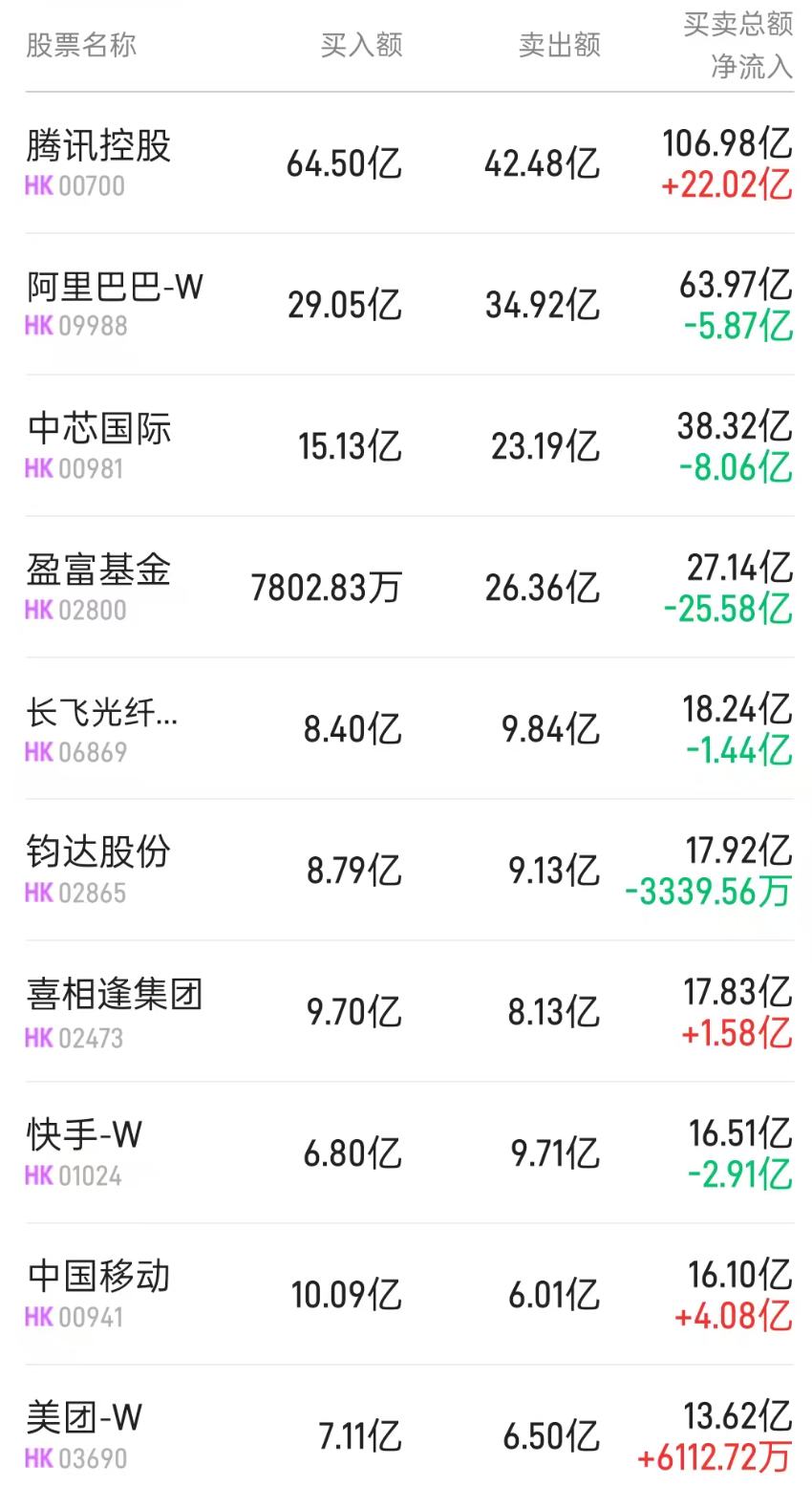
北水成交净买入9.52亿 科网及芯片股明显分化 内资抛售盈富基金超37亿港元
Zhi Tong Cai Jing· 2026-02-03 11:15
2月3日港股市场,北水成交净买入9.52亿港元,其中港股通(沪)成交净买入17.33亿港元,港股通(深)成交净卖出7.81亿港 元。 北水净买入最多的个股是腾讯(00700)、南方恒生科技(03033)、中国移动(00941)。北水净卖出最多的个股是盈富基金 (02800)、中芯国际(00981)、阿里巴巴-W(09988)。 | 股票名称 | 买入额 | 卖出额 | 买卖总额 | | --- | --- | --- | --- | | | | | 净流入 | | 腾讯控股 | 64.50亿 | 42.48 7, | 106.98亿 | | HK 00700 | | | +22.02亿 | | 阿里巴巴-W | 29.05亿 | 34.92 Z | 63.97亿 | | HK 09988 | | | -5.87 亿 | | 中芯国际 | 15.13 乙 | 23.19 乙 | 38.32亿 | | HK 00981 | | | -8.06 Z | | 盈富基金 | 7802.83万 | 26.36亿 | 27.14 Z | | HK 02800 | | | -25.58亿 | | 长飞光纤 ... | 8.4 ...





中国联通:国企结构调整基金完成减持1.0764%股份
Di Yi Cai Jing· 2026-02-03 11:05
中国联通公告,股东中国国有企业结构调整基金股份有限公司减持计划已完成,2025年11月3日至2026 年2月3日通过集中竞价减持3.13亿股、大宗交易减持2389.87万股,合计减持3.37亿股,占总股本 1.0764%,减持价格区间4.8~5.53元/股,成交金额17.82亿元,当前持股15.63亿股,占总股本5.00%。 ...
资金动向 | 北水大幅加仓腾讯,连续7日抛售中芯国际
Ge Long Hui A P P· 2026-02-03 10:35
Group 1: Stock Movements - Tencent Holdings saw a net buy of 19.55 billion, while the net sell for the Yingfu Fund was 37.63 billion [1] - Southbound funds have continuously net bought Xiaomi for four days, totaling 21.6392 billion HKD, while net selling for SMIC has lasted for seven days, totaling 29.6606 billion HKD [4] Group 2: Tax Adjustments and Impacts - Concerns arise regarding potential VAT increases for internet service companies following the adjustment for telecom companies, although some institutions believe this concern is overstated [5] - Morgan Stanley's report indicates that the VAT adjustment for telecom services will impact net profits of China Mobile, China Telecom, and Unicom by 7.1%, 12.6%, and 11.9% respectively, with China Mobile facing the least impact due to its higher gross margins [5] Group 3: Semiconductor Industry Trends - Domestic chip manufacturers, including Guokai Micro, Zhongwei Semiconductor, and Yingjixin, have announced price increases of up to 80% across key sectors such as storage and MCU [5] - The trend of rising prices in the domestic chip market is expected to continue into the first half of 2026, with more companies likely to follow suit [5] Group 4: Optical Fiber Industry Insights - The optical fiber industry is experiencing a clear upward price trend, driven by increased demand from telecom operators and seasonal stocking ahead of the Spring Festival [6] - Recent price increases in fiber optics are expected to persist, with major domestic clients likely to accept these price hikes [6]

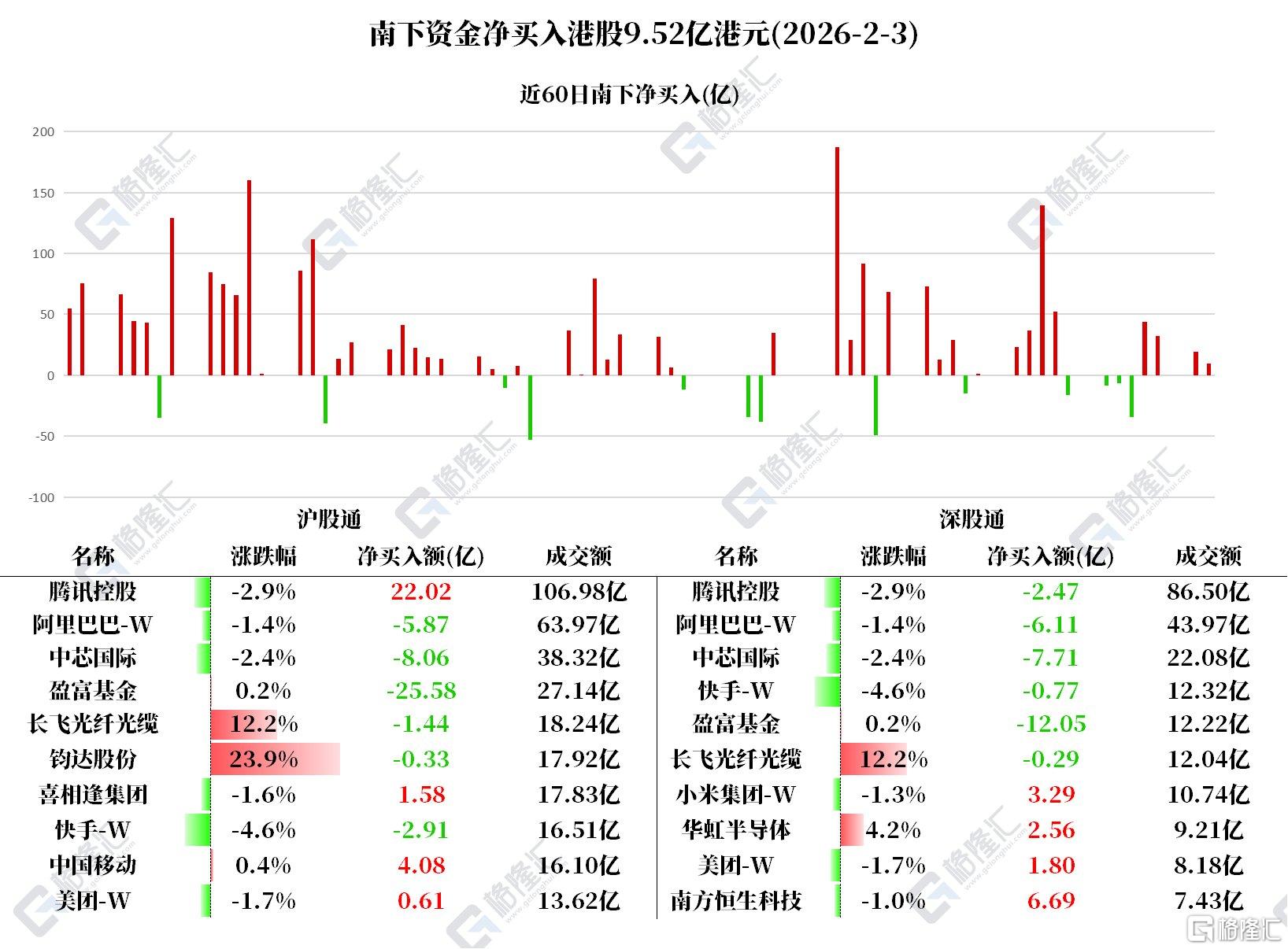
北水动向|北水成交净买入9.52亿 科网及芯片股明显分化 内资抛售盈富基金超37亿港元
Zhi Tong Cai Jing· 2026-02-03 10:04
智通财经APP获悉,2月3日港股市场,北水成交净买入9.52亿港元,其中港股通(沪)成交净买入17.33亿港元,港股通(深) 成交净卖出7.81亿港元。 北水净买入最多的个股是腾讯(00700)、南方恒生科技(03033)、中国移动(00941)。北水净卖出最多的个股是盈富基金 (02800)、中芯国际(00981)、阿里巴巴-W(09988)。 | 股票名称 | 买入额 | 卖出额 | 买卖总额 | | --- | --- | --- | --- | | | | | 净流入 | | 腾讯控股 | 64.50亿 | 42.48亿 | 106.98亿 | | HK 00700 | | | +22.02亿 | | 阿里巴巴-W | 29.05亿 | 34.92 Z | 63.97 亿 | | HK 09988 | | | -5.87 亿 | | 中芯国际 | 15.13亿 | 23.19 乙 | 38.32亿 | | HK 00981 | | | -8.06 Z | | 盈富基金 | 7802.83万 | 26.36亿 | 27.14亿 | | HK 02800 | | | -25.58 亿 | | 长飞光纤 . ...
地方两会聚焦消费扩内需 传统消费与新型消费双轨并进
Sou Hu Cai Jing· 2026-02-03 09:53
Group 1 - The core viewpoint emphasizes the importance of consumption as a key driver for expanding domestic demand and building a strong domestic market, with various local governments implementing measures to enhance consumption capabilities and optimize supply [2] - Traditional consumption quality enhancement and the cultivation of emerging consumption are progressing simultaneously, supported by advancements in digital technology that enrich consumption supply [2] - Operators leverage their digital advantages and robust infrastructure to actively engage in the entire consumption chain, enhancing basic consumption quality and creating new digital consumption scenarios [2] Group 2 - The upgrade of basic consumption is crucial for market stability, with digitalization and intelligence being core paths for traditional industries' transformation [3] - Operators utilize technologies like 3D modeling and big data analysis to assist traditional manufacturers in offering personalized services, thus meeting diverse consumer demands [3] - The shift from standardized to personalized products enhances production efficiency and resource utilization, catering to consumers' desire for unique products [3] Group 3 - The application of humanoid robots in traditional service models represents a significant breakthrough, improving service efficiency and customer satisfaction [4] - Operators are injecting "digital intelligence" into traditional industries, promoting their transformation towards smart, customized, and service-oriented models [4] Group 4 - New technologies, particularly AI, are rapidly reshaping consumption scenarios and fostering a new "AI + consumption" ecosystem [5] - Operators are focusing on family digital consumption needs, launching diverse AI products to enhance the digital experience at home [5] - Initiatives like the "AI+" action plan and AI smart screens are designed to provide personalized and convenient services for families [5] Group 5 - The silver economy is a new growth point, with operators developing AI products tailored for the elderly to bridge the digital divide [6] - Customized services for seniors, such as AI phones and smart monitoring products, are being introduced to enhance their digital consumption experience [6] Group 6 - Operators are optimizing digital consumption service processes through AI technology, significantly improving service efficiency [7] - Innovations like AI customer assistants and smart service agents are enhancing customer service quality and enriching the digital consumption supply [7] Group 7 - Service consumption is rapidly expanding, driven by rising income levels and changing consumer attitudes, with a focus on sectors like education, culture, and health [8] - Operators are utilizing advanced technologies to ensure robust communication support for high-traffic events, enhancing user experience [8] Group 8 - In the cultural and tourism sectors, operators are employing technologies like 5G, AI, and VR/AR to develop smart applications that enrich visitor experiences [9] - Continuous advancements in digital technology and operator engagement are expected to drive new developments in China's consumption market, contributing to a sustainable economic growth model [9]



手机套餐要涨价了?中国移动们税率上调,eSIM或缓解成本压力
3 6 Ke· 2026-02-03 09:45
Core Viewpoint - The recent adjustment of the value-added tax (VAT) rate from 6% to 9% for telecom services by China's three major operators is expected to impact their revenue and profit, leading to potential price increases for consumers in the future [1][3][12]. Group 1: Tax Rate Adjustment - The adjustment of the VAT rate will affect the income and profit of telecom companies, as they have explicitly stated in their announcements [3][5]. - The classification of telecom services will change from "value-added telecom services" to "basic telecom services" starting January 1, 2026, indicating that services like mobile data and broadband are now considered essential [3][5]. - The increase in VAT does not mean an immediate price hike for consumers, but it will reduce the net income that operators can retain from the same amount of revenue [5][14]. Group 2: Pricing Dynamics - Despite the tax increase, the overall trend in mobile data pricing has been downward, making it challenging for operators to raise prices without risking customer dissatisfaction [8][9]. - The competitive landscape among telecom operators, including the ease of number portability, complicates the decision to increase prices, as it could lead to customer churn [8][12]. - Historical data shows that high pricing strategies have not been sustainable, as seen with the introduction of 5G services, which initially had high costs but have since seen significant reductions in pricing to encourage adoption [9][11]. Group 3: Future Growth Strategies - The operators are facing pressure to find new growth avenues due to limited user growth and shrinking profit margins, exacerbated by rising operational costs and tax adjustments [12][14]. - Innovations like eSIM technology are being explored as potential new revenue streams, allowing for more flexible pricing models and the ability to attract new users without the need for physical SIM cards [14][15]. - The market is cautious about any price increases, as consumer sensitivity to pricing has heightened, making it essential for operators to carefully consider their strategies moving forward [12][14].
突发三大利空压顶!黄金闪崩,茅台却涨价,周末三大消息炸锅,但这个方向被马斯克点燃了
Sou Hu Cai Jing· 2026-02-03 07:55
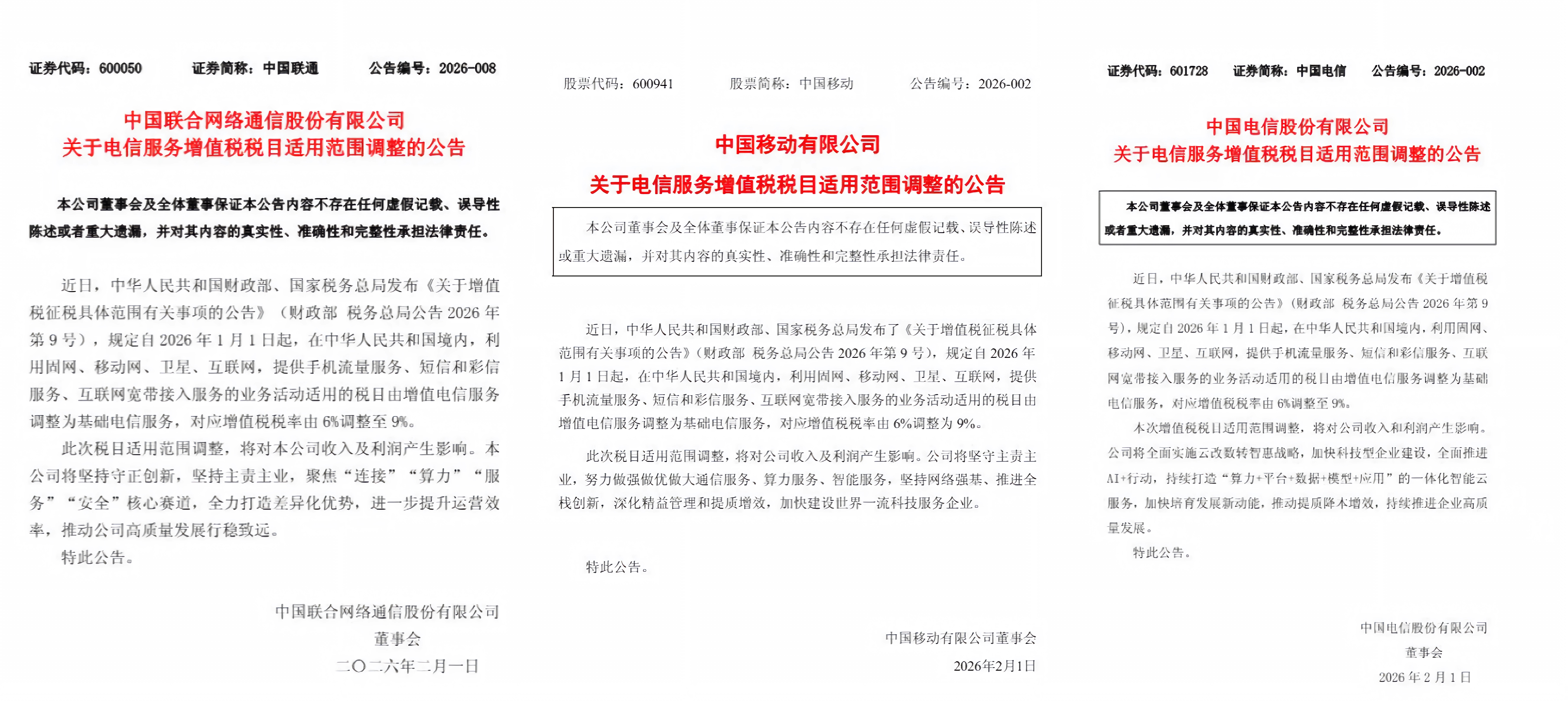
这个周末,市场消息面可谓是冰火两重天,让人心跳加速。 一边是国际黄金白银价格上演"高台跳水",一夜之间暴跌超过10%,让持有资源股的投资者心头 一紧。 另一边,飞天茅台的批发价却悄悄实现了"三连涨",每瓶价格反弹了100元,给冰冷的大消费板块带来了一丝暖意。 12 and manufa 3 113 still be berger read An 0 更引人关注的是,特斯拉的老板埃隆·马斯克又扔下了一个重磅炸弹:他的SpaceX公司正在申请发射一个由多达100万颗卫星组成的超级星座。 与此同时, 国内也有三件大事需要面对:最新的制造业PMI数据不及市场预期,显示经济复苏的根基仍需夯实;中国移动、中国联通、中国电信三大运营商集体发布公 告,自2026年起,部分业务的增值税税率将从6%上调至9%;而距离农历春节,只剩下最后的10个交易日。 这一连串的消息,究竟哪个影响最大? 它们是把市场推向更深的调整,还是在恐慌中埋下了新的机会? 我们梳理了每一个关键信息,试图为你呈现一个清 晰的节前市场图景。 上周五,纽约商品交易所的黄金期货价格跌破了每盎司4800美元的重要关口。 这不仅仅是普通的下跌,单日跌幅超过了10%。 ...