
绿色能源

Search documents
郑栅洁人民日报撰文:坚持扩大内需这个战略基点
Ren Min Ri Bao· 2025-11-28 01:29
Core Viewpoint - The Chinese government emphasizes the importance of expanding domestic demand as a strategic foundation for long-term development and stability, aiming to enhance the domestic circulation's internal vitality and reliability during the 14th Five-Year Plan period [1][8]. Achievements in Expanding Domestic Demand - Since the 18th National Congress, domestic demand has become the main driving force for economic growth, contributing an average of 93.1% to economic growth from 2013 to 2024, with final consumption and capital formation contributing 55% and 38.1% respectively [2][3]. - By 2024, final consumption expenditure and capital formation will reach 76.3 trillion yuan and 54.8 trillion yuan, respectively, which are 2.7 times and 2.2 times the levels in 2012 [2]. Upgrading Consumption and Investment Structures - The sales of new energy vehicles have ranked first globally for ten consecutive years, with the domestic penetration rate of passenger cars increasing from less than 0.1% in 2013 to 48.9% in 2024 [3]. - The share of service consumption in per capita consumption expenditure rose from 39.7% in 2013 to 46.1% in 2024, while online retail sales of physical goods accounted for 26.8% of total retail sales by 2024, up from 10.8% in 2015 [3]. Policy Framework for Expanding Domestic Demand - The government has implemented various policies to promote consumption and investment, including the "Strategic Plan for Expanding Domestic Demand (2022-2035)" and the issuance of long-term special bonds to support major national strategies [4][5]. Addressing New Challenges in the 14th Five-Year Plan - The 14th Five-Year Plan period presents new challenges, including the need to enhance domestic consumption and investment efficiency, as well as to address the low service consumption ratio compared to developed countries [9][10]. - The government aims to meet the diverse and personalized needs of the population, particularly in areas such as healthcare, education, and cultural tourism, to improve living standards [9][10]. Implementation of Key Projects - The government plans to implement significant engineering projects in urban renewal, strategic transportation, and new energy systems, while also focusing on service consumption infrastructure [14][15]. Promoting a Unified National Market - Efforts are being made to eliminate barriers to market access and improve the efficiency of the domestic market, including reducing the number of negative lists for market entry and enhancing the logistics system [15].
国家发改委郑栅洁:完善交通、能源等领域价格形成机制
Ren Min Ri Bao· 2025-11-28 01:25
Core Viewpoint - The article emphasizes the importance of implementing a strategy to expand domestic demand, which is crucial for China's long-term development and stability [1] Achievements Since the 18th National Congress - Domestic demand has become the main driving force for economic growth, contributing an average of 93.1% to economic growth from 2013 to 2024, with final consumption and capital formation contributing 55% and 38.1% respectively [2] - By 2024, final consumption expenditure and capital formation reached 76.3 trillion yuan and 54.8 trillion yuan, respectively, which are 2.7 times and 2.2 times that of 2012 [2] - The structure of consumption and investment has continuously upgraded, with the penetration rate of new energy vehicles rising from less than 0.1% in 2013 to 48.9% in 2024 [3] - China has become a globally influential super-large market, with significant growth in per capita consumption of white goods and mobile phones [3] Policy Framework and Implementation - A comprehensive policy framework has been established to promote consumption and investment, including the "Strategic Plan for Expanding Domestic Demand (2022-2035)" [4] - Employment and social security policies have been implemented to increase residents' income, with per capita disposable income growing at an average annual rate of 6.1% from 2013 to 2024 [5] - Major projects in transportation, energy, and ecological protection have been initiated to enhance supply-side advantages and foster new development momentum [6] New Challenges and Requirements for the 15th Five-Year Plan - The 15th Five-Year Plan period is critical for expanding domestic demand amid complex international and domestic conditions [8] - There is a need to address issues such as weak consumer motivation and investment efficiency, as well as barriers in the unified national market [9] - The strategy to expand domestic demand is essential for meeting the diverse needs of the population and improving living standards [9] Strategic Actions for the 15th Five-Year Plan - Efforts will focus on boosting consumer spending by optimizing the environment and reducing restrictions on consumption [12] - Investment structures will be optimized to stimulate private investment and enhance the quality of projects [13] - Major landmark engineering projects will be implemented in key areas such as urban renewal and new energy systems [14] - The construction of a unified national market will be advanced to eliminate barriers and promote the smooth flow of goods and factors [15]
署名文章 | 郑栅洁人民日报撰文:坚持扩大内需这个战略基点
Ren Min Ri Bao· 2025-11-28 01:09
Core Viewpoint - The article emphasizes the importance of implementing a strategy to expand domestic demand, which is crucial for China's long-term development and stability [1] Achievements Since the 18th National Congress - Domestic demand has become the main driving force for economic growth, contributing an average of 93.1% to economic growth from 2013 to 2024, with final consumption and capital formation contributing 55% and 38.1% respectively [2] - By 2024, final consumption expenditure and capital formation will reach 76.3 trillion yuan and 54.8 trillion yuan, which are 2.7 times and 2.2 times the levels in 2012 [2] - The structure of consumption and investment has been continuously upgraded, with the penetration rate of new energy vehicles rising from less than 0.1% in 2013 to 48.9% in 2024 [3] - China has become a globally influential super-large market, with significant growth in per capita consumption of white goods and mobile phones [3] Policy Framework and Implementation - A comprehensive policy framework has been established to promote consumption and investment, including the "Strategic Plan for Expanding Domestic Demand (2022-2035)" [4] - Employment-first policies and social security system improvements have led to an average real growth of 6.1% in per capita disposable income from 2013 to 2024 [5] - Major projects in transportation, energy, and ecological protection have been initiated to enhance domestic demand and supply capabilities [6] New Challenges and Requirements for the 15th Five-Year Plan - The 15th Five-Year Plan period is critical for expanding domestic demand amid complex international and domestic conditions [8] - There is a need to address issues such as low consumer spending and investment efficiency, as well as barriers in the unified national market [9] - The strategy to expand domestic demand is essential for meeting the diverse needs of the population and improving living standards [9] Strategic Actions for Expanding Domestic Demand - Measures to boost consumer spending include optimizing the environment for consumption and reducing restrictions [11] - Effective investment expansion strategies focus on optimizing investment structures and enhancing the efficiency of investments [13] - Implementation of major landmark projects in key sectors such as urban renewal and new energy systems is planned [14] - Efforts to deepen the construction of a unified national market will focus on eliminating barriers and promoting the smooth flow of goods and factors [15]
郑栅洁发表署名文章
财联社· 2025-11-28 00:13
Core Viewpoint - The article emphasizes the importance of expanding domestic demand as a strategic foundation for China's long-term development and stability, highlighting the need for a complete domestic demand system to support high-quality growth and a new development pattern [3][10]. Achievements in Expanding Domestic Demand - Since the 18th National Congress, China has significantly improved the quality of domestic supply and continuously released consumption and investment demand, with domestic demand contributing an average of 93.1% to economic growth from 2013 to 2024 [4][6]. - Final consumption expenditure and capital formation reached 76.3 trillion yuan and 54.8 trillion yuan in 2024, respectively, which are 2.7 times and 2.2 times the levels in 2012 [4]. - The structure of consumption and investment has been upgraded, with the penetration rate of new energy vehicles reaching 48.9% in 2024 and service consumption accounting for 46.1% of per capita consumption expenditure [5]. Policy Framework for Expanding Domestic Demand - A comprehensive policy framework has been established to promote consumption and investment, including the "Strategic Plan for Expanding Domestic Demand (2022-2035)" and the issuance of long-term special bonds to support major national strategies [6][7]. - Employment and social security policies have been implemented to increase residents' income, with per capita disposable income growing at an average annual rate of 6.1% from 2013 to 2024 [7]. New Challenges and Requirements for the 14th Five-Year Plan - The 14th Five-Year Plan period presents new challenges, including the need to enhance domestic consumption and investment efficiency, as well as to address the low service consumption ratio compared to developed countries [11]. - Expanding domestic demand is essential for countering external shocks and ensuring economic stability amid rising global uncertainties and competition in technology and industry [10]. Implementation of the 14th Five-Year Plan - Key strategies include boosting resident consumption by optimizing the environment and reducing restrictions, as well as expanding effective investment by enhancing the structure and efficiency of investments [14][15]. - Major landmark projects will be implemented in areas such as urban renewal, energy systems, and public service infrastructure to meet the evolving needs of the population [16]. - Efforts will be made to deepen the construction of a unified national market, eliminating barriers to the flow of goods and factors, and promoting a competitive market environment [17].


美机构盘点“21万亿在美投资承诺”
Sou Hu Cai Jing· 2025-11-27 03:49
Group 1 - The actual investment situation in the U.S. is significantly lower than the claimed $21 trillion, with Bloomberg Economics estimating it to be only a few trillion dollars [1] - The White House claims that current deals have secured trillions in manufacturing and job opportunities, as well as new export opportunities for U.S. companies [1] - Bloomberg's analysis of 137 projects revealed that out of the reported $9.6 trillion, only $7 trillion can be considered as real investments [2] Group 2 - Among the $9.6 trillion, $2.6 trillion are not direct investments but agreements related to natural gas purchases or bilateral trade expansions [2] - $3.5 trillion of the investment projects are based on commitments from various countries, with over half relying on intangible promises [2] - The private sector contributed $3.5 trillion, with $2.9 trillion related to data centers and AI infrastructure, primarily driven by tech companies like Apple, Meta, and Nvidia [2] Group 3 - The significant investment commitments from sovereign nations add complexity to the $21 trillion target, with notable commitments from the UAE, Qatar, Saudi Arabia, and Japan often tied to trade expansions rather than new capital expenditures [3] - The automotive industry is experiencing strategic adjustments rather than new investments, as companies shift back to gasoline vehicle production due to the cancellation of electric vehicle subsidies [3] - Recent private sector investments include Nokia's $4 billion commitment for AI-related network connections and Foxconn's $569 million investment in Wisconsin [3]
美机构盘点“21万亿美元在美投资承诺”:实际不足数万亿美元
Huan Qiu Shi Bao· 2025-11-26 22:55
【环球时报驻美国特约记者 冯亚仁】"现任美国政府所说的21万亿美元对美投资热潮实际上不足数万亿 美元。"彭博经济研究在对白宫官方公布的各类项目进行分析之后得出结论。该机构称,实际的投资情 况远比目标要小得多。 对于类似质疑,白宫方面也有回应。彭博社援引白宫发言人库什·德赛的话表示:"目前的交易已经确保 了数万亿美元的在美制造和就业,为美国公司带来了数万亿美元的商业机会,以及数万亿美元的新出口 机会。" 白宫方面曾多次表示,各国政府与企业将在年底前承诺高达21万亿美元的对美投资。这一数字相当于美 国年度经济产出的七成。美媒称,随着数据的逐项核实,这股"投资热潮"的相关情况逐渐显露出来。 报道称,最早给出官方数字的是白宫。其相关页面上显示,自新总统上任以来,"美国及外国投资总 额"为9.6万亿美元。彭博经济研究对清单上137个项目逐一审视,发现这9.6万亿美元中有7万亿美元可被 视为真正投资。 据财经咨询网站GuruFocus25日报道,这场"投资热潮"的核心,来自拜登时期开始扩张、并在之后进一 步加速的人工智能产业。与AI相关的2.9万亿美元,主要来自苹果、Meta、英伟达等科技企业以及价值 5000亿美元的" ...
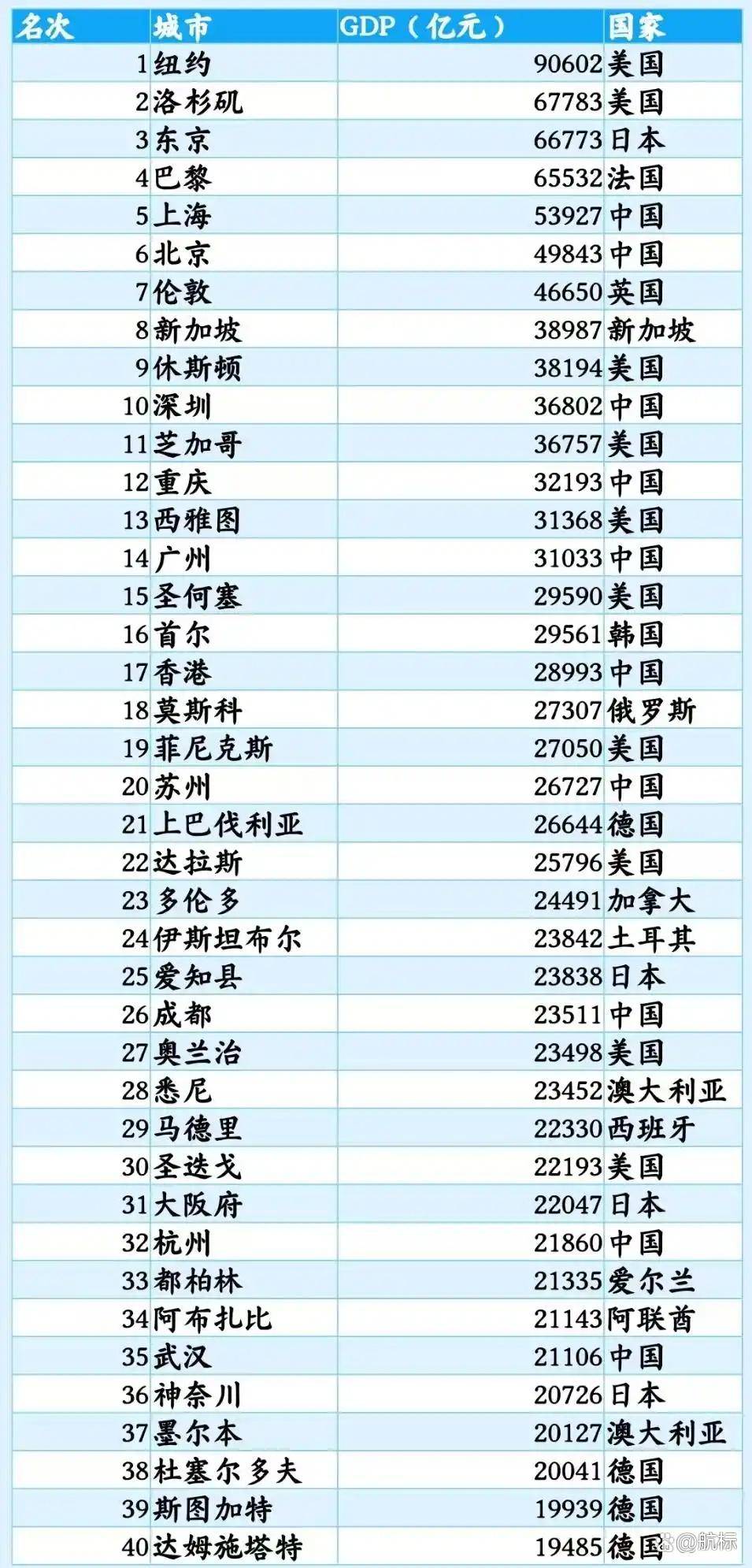
全球GDP40强城市洗牌:巴黎首破6.5万亿,苏州逼近香港,武汉远超墨尔本!
Sou Hu Cai Jing· 2025-11-26 19:10
Core Insights - The 2024 Global City GDP Top 40 list reveals significant economic advancements in major cities, driven by national strategic benefits, with U.S. cities leading in technology clusters, Chinese cities accelerating through regional development policies, and European cities solidifying their positions via industrial upgrades [1] Group 1: Key City Performances - Paris has surpassed a GDP of 65.5 trillion yuan, marking a significant milestone as Europe's economic "ballast" [1][3] - Suzhou's GDP gap with Hong Kong has narrowed to 220 billion yuan, showcasing the city's rapid manufacturing growth against Hong Kong's financial hub status [1][5] - Wuhan's GDP of 21,106 billion yuan has overtaken Melbourne's 20,127 billion yuan, highlighting the release of potential in regional hubs [1][7] Group 2: Growth Drivers - Paris's economic strength is supported by its strategic location as a European transport and financial hub, alongside the digital transformation of luxury brands like LVMH, which has seen online revenue reach 35% [3] - Suzhou's industrial upgrades, driven by the "smart transformation" policy, have led to a 20% increase in annual patent applications in semiconductor firms, with its logistics efficiency enhancing foreign trade resilience [5] - Wuhan's growth is attributed to its status as a national central city, with significant advancements in the optoelectronics sector, where it holds 35% of national fiber optic communication patents [7] Group 3: Economic Restructuring - The reshuffling of global city GDP rankings reflects a precise alignment of self-positioning and national strategies, with cities leveraging their geographical advantages, industrial innovations, and supportive policies [9]
通讯丨微电网里的大能量——中非绿色能源合作赋能可持续发展
Xin Hua She· 2025-11-25 07:40
目前,三一硅能已在非洲八国签约20余个微电网项目。三一集团设在南非的总部基地也将建设"光伏 +储能"产线,助力南非打造非洲绿色工业枢纽。 中国长期支持非洲绿色发展,仅中非合作建设的光伏电站装机容量累计已超过1.5吉瓦。湖南大学参与 撰写的《非洲绿色发展指数与中非绿色发展合作报告(2024)》指出,中国有着成熟的政策体系、先进 的绿色技术、强大的创新能力、丰富的环境治理经验等独特优势,而非洲大陆有迫切的发展需求和本土 发展战略。 新华社内罗毕/长沙11月24日电 通讯|微电网里的大能量——中非绿色能源合作赋能可持续发展 新华社记者张格 张玉洁 李卓群 几内亚圣图火车站室外地面上,8832平方米的深蓝色光伏板整齐铺展。今年10月,三一硅能微电网项目 在此完成送电调试并正式投运,实现光储协同和全负荷绿色供电,光伏年发电量约400万千瓦时。 在撒哈拉以南非洲,由于人口分散、电网覆盖率有限,许多地区仍依赖成本高昂的柴油发电。而且,基 础电网薄弱长期制约电力供应,成为阻碍经济发展的关键因素。 针对企业面临的普遍"痛点",中国企业提供了量身定制的解决方案——三一集团旗下三一硅能为当地企 业带来光伏微电网整体方案,通过"源网 ...
二〇二五能源转型大会在京开幕 张玉卓殷勇致辞
Xin Lang Cai Jing· 2025-11-22 23:34
Core Insights - The 2025 Energy Transition Conference opened in Beijing, emphasizing the importance of green energy transformation and international cooperation in achieving carbon neutrality goals [1] Group 1: Energy Transition Strategy - The Chinese government has established a new energy security strategy focusing on "four revolutions and one cooperation," guiding the country's energy transition [1] - The 14th Five-Year Plan outlines significant goals for achieving peak carbon emissions, highlighting the commitment to green energy initiatives [1] Group 2: Local Government Initiatives - Beijing has accelerated its green and low-carbon energy transition, optimizing its energy structure historically and developing a robust green energy industry ecosystem [1] - The city aims to become a benchmark for international green economies during the 14th Five-Year Plan, focusing on comprehensive green transformation in economic and social development [1] Group 3: Technological Innovation and Industry Support - Emphasis on technological leadership, particularly in solid-state battery technology, to drive innovative green technology [1] - The development of a multi-energy complementary system is prioritized, alongside the cultivation of competitive green energy enterprises [1] Group 4: Demonstration and Investment Opportunities - The establishment of zero-carbon demonstration parks and other green energy applications is a key focus to create iconic scenarios and business models [1] - The Future Science City is highlighted as a hub for energy innovation, inviting scientists and investors to participate in high-quality energy development opportunities [1]
COP30大会中国角系列活动受关注
Zhong Guo Hua Gong Bao· 2025-11-21 03:17
Group 1 - The 30th United Nations Climate Change Conference (COP30) is being held in Belem, Brazil, from November 10 to 21, attracting significant attention from environmentalists worldwide [1] - The China Corner forum, co-hosted by the Ministry of Ecology and Environment of China, CGTN, and UNITAR, focuses on building green and low-carbon cities, with over a hundred participants from various sectors discussing global urban green transformation [1] - The Vice Minister of Ecology and Environment of China, Li Gao, highlighted China's achievements and successful experiences in low-carbon city construction during his speech [1] Group 2 - Shan Yubing, Chairman of Colin Energy Technology (Beijing) Co., Ltd., emphasized the critical role of enterprises in promoting green energy and efficient utilization transformation [2] - Colin Energy has explored smart energy, green hydrogen, and biomass applications, collaborating with local governments and international organizations to find replicable and scalable green clean technology solutions [2] - The China Corner also hosted a roundtable forum themed "Green Technology Leading Urban Prosperity and Sustainable Future," focusing on how green technology can drive urban economic growth, create jobs, and promote international cooperation [2]