
铁路运输

Search documents
国家开发银行2025年发放铁路贷款超2000亿元
Jin Rong Shi Bao· 2026-01-28 00:40
Core Viewpoint - The China Development Bank (CDB) is committed to supporting the construction of the "Eight Vertical and Eight Horizontal" high-speed rail network by leveraging its long-term financing advantages and collaborating closely with the China National Railway Group and its subsidiaries [1] Group 1: Project Support and Financing - By the end of 2025, the CDB aims to support high-speed rail projects with an operational mileage exceeding 42,500 kilometers, accounting for over 85% of the total operational mileage of the "Eight Vertical and Eight Horizontal" high-speed rail network [1] - The bank will utilize medium- and long-term loans and new policy-based financial instruments to support the construction of major railway projects, including the Shanghai-Chongqing and Chongqing-Kunming high-speed rail lines [1] Group 2: Strategic Focus and Future Plans - The CDB plans to enhance its role as a key bank for infrastructure construction, focusing on major railway engineering projects and improving the capacity of conventional railway trunk lines [1] - Future efforts will include supporting multi-modal transport and digital upgrades, as well as promoting the international expansion of high-speed rail [1]
乘坐静音车厢,有啥注意事项?(深阅读)
Ren Min Ri Bao· 2026-01-28 00:32
Core Viewpoint - The introduction of "quiet carriages" on trains aims to enhance passenger experience by providing a quieter travel environment, addressing the diverse needs of travelers [2][3][11] Group 1: Quiet Carriage Implementation - Starting February 1, over 8,000 high-speed trains will offer quiet carriage services, covering major routes and passenger corridors across the national high-speed rail network [3] - G-series trains are nearly fully covered by quiet carriages, while D-series trains have about 80% coverage, excluding sleeper and certain types of trains [3] - Quiet carriages are typically located at the front or rear of the train and are designated as second-class seating [3][4] Group 2: Passenger Guidelines and Compliance - Passengers wishing to use quiet carriages can select trains marked with a "quiet" label and request priority seating in these carriages [4] - Guidelines for maintaining silence include keeping electronic devices on silent, avoiding loud conversations, and supervising children to prevent noise [7][8] - Train staff will actively monitor compliance and remind passengers of the quiet rules, using visual aids to guide behavior [8] Group 3: General Conduct in Other Carriages - All passengers are encouraged to maintain a civilized and quiet environment in all carriages, not just the quiet ones [9] - The railway department promotes awareness through announcements and staff monitoring to minimize noise across all carriages [9] - Initiatives like the "play area" for children in certain trains aim to cater to family needs while maintaining a peaceful atmosphere [10]

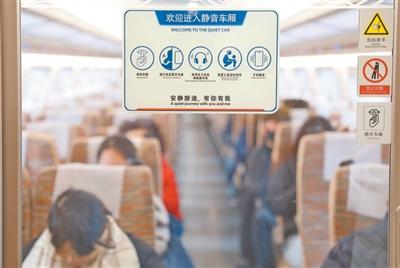
乘坐静音车厢,有啥注意事项?
Xin Lang Cai Jing· 2026-01-28 00:15
Core Viewpoint - The introduction of "quiet carriages" on trains aims to enhance passenger experience by providing a quieter travel environment through specific measures and guidelines [1][2][3]. Group 1: Quiet Carriage Implementation - Starting from February 1, over 8,000 high-speed trains will offer quiet carriage services, covering major routes and passenger corridors across the national high-speed rail network [2]. - G-series trains are nearly fully covered by quiet carriages, while D-series trains have about 80% coverage, excluding sleeper and certain types of trains [2]. - Quiet carriages are typically located at the front or rear of the train and are designated as second-class seating [2][3]. Group 2: Passenger Guidelines and Enforcement - Passengers wishing to use quiet carriages can select trains marked with a "quiet" label and opt for a seat in the quiet carriage during ticket purchase [3]. - To maintain a quiet environment, measures include lowering audio volume, closing entertainment systems, and providing reading materials [4][5]. - Passengers are expected to adhere to quiet agreements, which include keeping noise to a minimum, using headphones, and supervising children to prevent disturbances [5]. Group 3: General Conduct in Other Carriages - All passengers are encouraged to maintain a civilized and quiet atmosphere in all carriages, not just the quiet ones [6]. - The railway department promotes awareness through announcements and staff monitoring to minimize noise in non-quiet carriages [6]. - Additional services, such as "play areas" for children, are being developed to cater to diverse passenger needs while maintaining a comfortable environment [6][7].
广清城际铁路南延线(广州白云站至花都站)今日开通
Xin Lang Cai Jing· 2026-01-28 00:12
Core Viewpoint - The opening of the Guangzhou-Qingyuan Intercity Railway South Extension Line enhances connectivity in the Guangdong-Hong Kong-Macao Greater Bay Area, promoting regional integration and improving transportation efficiency [2]. Group 1: Line Details - The Guangzhou-Qingyuan Intercity Railway South Extension Line is 22 kilometers long and includes four stations: Shenshan Station, Jianggao Station, Baiyun Lake Station, and Guangzhou Baiyun Station [2]. - With the new line, the total length of the Guangzhou-Qingyuan Intercity Railway reaches 79.9 kilometers, linking key transportation hubs such as Guangzhou Baiyun Station, Guangzhou North Station, and Qingyuan Station [2]. Group 2: Operational Efficiency - The railway operates under a "stop at every station + express service" model, with an average of 72 train sets running daily and a train interval of 27 minutes [2]. - Travel times from Guangzhou Baiyun Station to key destinations are 16 minutes to Guangzhou North Station, 34 minutes to Qingcheng Station, and 48 minutes to Feixia Station [2]. Group 3: Ticketing System - The South Extension Line supports a dual ticketing system that includes "intercity railway public transport multi-payment + 12306," allowing for flexible ticket options such as single-journey and periodic tickets [3]. Group 4: Transfer Improvements - The opening of the new line has led to adjustments in the operational schedule and starting points for some routes, enhancing the overall travel experience [4]. - Passengers can quickly transfer between different transport modes at Guangzhou Baiyun Station without needing a second security check, facilitating seamless connections between intercity, national rail, and metro services [4].
站城融合 让“旅客流”成“商业流”
Xin Lang Cai Jing· 2026-01-28 00:11
Core Viewpoint - The integration of train stations and urban areas in Beijing aims to transform passenger flow into commercial flow, creating a multifunctional urban space that combines transit, services, and experiences [1][2]. Group 1: Transportation Integration - The proposal emphasizes optimizing traffic connections at major train stations, such as enhancing the layout and flow of vehicles at Beijing West Station and Beijing South Station to improve overall traffic efficiency [1]. - Specific suggestions include redesigning taxi and ride-hailing zones to streamline vehicle and pedestrian movement, thereby reducing congestion at drop-off areas [1]. Group 2: Space Utilization and Aesthetics - Recommendations include releasing public spaces and integrating them with surrounding parks to enhance the aesthetic appeal and cultural significance of the stations, particularly at Beijing West Station [2]. - Systematic renovations at Beijing South Station are suggested to improve green spaces and service facilities, creating a more pleasant waiting environment for passengers [2]. Group 3: Commercial Development - The development of a comprehensive commercial ecosystem around transportation hubs is highlighted, with a focus on creating seamless consumer experiences that encourage spending immediately upon exiting the station [2]. - The proposal includes enhancing the cultural display functions at transportation hubs to promote local products and services, thereby strengthening the cultural identity of the area [2].
从“那时”到“这时”丨铁路从“米”到“环”再提速
He Nan Ri Bao· 2026-01-27 23:17
Core Viewpoint - The article highlights the significant transformation of the Zhengzhou railway hub, emphasizing the development of a "cross" high-speed rail network in Henan province, which enhances connectivity and supports economic growth in the region [4][5][6]. Group 1: Railway Development - Zhengzhou has evolved from a city reliant on steam locomotives to a modern hub with advanced high-speed trains, showcasing the dramatic changes in railway services over the years [4][5]. - The province has established a "cross" high-speed rail network, making high-speed rail stations accessible in all provincial cities, covering over 53% of the national population within a 3-hour travel radius [5][6]. Group 2: Economic Impact - The high-speed rail network facilitates direct connections between cities, allowing for resource sharing among various industries such as equipment manufacturing, new energy materials, modern food production, and deep processing of agricultural products [6]. - Projects like the Jiaozuo-Jiyuan and Pingdingshan-Luoyang high-speed rail lines are accelerating, with the potential to create a closed-loop network linking multiple cities, enhancing regional economic collaboration [6][7]. Group 3: Future Plans - The government work report for 2026 outlines plans to expedite the construction of several high-speed rail projects, including the Pingdingshan-Luoyang and Zhengzhou South Station lines, aiming to foster inter-city cooperation and economic development [7]. - The proposed circular high-speed rail line is expected to serve as a new engine for high-quality development in the Central Plains, promoting efficient movement of people, goods, and information within the region [7].
迎接春运“大考” 筑牢安全防线
Xin Lang Cai Jing· 2026-01-27 23:08
(来源:安徽新闻网) 转自:安徽新闻网 还有6天时间,一场被称为"人类最大规模周期性迁徙"的春运又将徐徐拉开帷幕。 2026年春运将从2月2日开始,至3月13日结束,为期40天。受超长春节假期等影响,相关部门预测,今 年春运期间我国全社会跨区域人员流动量和铁路、民航客运量均有望创历史同期新高。 1月27日,2026年全省春运工作会议在合肥召开。记者从会上获悉,经初步预测,全省客流总体规模预 计创历史新高,公铁水航等营业性运输预计发送旅客约5700万人次,同比增长3.5%;全省高速公路出 口流量预计约7100万辆,日均约178万辆,同比增长约9%。 春运不仅是公铁水航等交通运输系统的年度"大考",还涉及文旅、教育、工会、人社、共青团等多部 门。为做好"多手联弹",我省已启动春运工作协同机制,结合实际,研究起草了《安徽省2026年春运工 作方案》,对2026年春运工作进行部署安排。 增加运力供给是确保旅客"走得了""走得好"的基础条件。会议强调,公铁水航各单位要加强客流动态研 判,针对高峰期,充分挖掘运能潜力,及时调配列车开行规模;要增加道路水路运力投放,做好高铁 站、机场等综合客运枢纽到发旅客的集疏运服务,强化 ...
2月1日起,提供服务的动车组将超8000列 乘坐静音车厢,有啥注意事项?(深阅读)
Ren Min Ri Bao· 2026-01-27 22:25
Core Viewpoint - The introduction of "quiet carriages" on trains aims to enhance passenger experience by providing a quieter travel environment, addressing the diverse needs of travelers [1][2]. Group 1: Quiet Carriage Implementation - The quiet carriage service will be available on over 8,000 high-speed trains starting February 1, covering major routes and passenger corridors across the country [2]. - G-series trains are nearly fully covered by the quiet carriage service, while D-series trains have about 80% coverage, excluding sleeper and concentrated power trains [2]. - Quiet carriages are typically located at the front or rear of the train and are designated as second-class carriages [2][3]. Group 2: Passenger Guidelines and Enforcement - Passengers wishing to use the quiet carriage must select the "quiet" option when purchasing tickets, and no standing tickets will be sold for these carriages [3]. - To maintain a quiet environment, the train staff will implement various measures, including lowering audio volume and providing visual reminders [4]. - Passengers are expected to adhere to specific quiet agreements, such as keeping noise to a minimum and using headphones for electronic devices [5]. Group 3: General Conduct in Other Carriages - All passengers are encouraged to maintain a civilized and quiet environment in all carriages, not just the quiet ones [6]. - The railway department will continue to promote quiet behavior through announcements and staff monitoring in non-quiet carriages [6]. - Additional services, such as "play areas" for children, are being introduced to cater to specific passenger needs while maintaining overall comfort [6][7]. Group 4: Future Developments - The railway department will monitor the effectiveness and social response to the quiet carriage service and make adjustments as necessary to improve passenger experience [7].
提升城际铁路可持续发展能力
Jing Ji Ri Bao· 2026-01-27 22:15
Core Viewpoint - The National Development and Reform Commission (NDRC) has issued guidelines for the sustainable development of intercity railways, aiming to create a well-structured, efficient, and economically viable intercity rail network to promote high-quality integration of urban clusters [1][2]. Group 1: Policy and Guidelines - The guidelines include 12 measures focusing on planning, operational optimization, and establishing a sustainable development mechanism for intercity railways [1]. - This is the first national-level document specifically addressing the development of intercity railways, emphasizing the need for appropriate infrastructure development without excessive advancement [1][2]. - The document clarifies the functional positioning of intercity railways, which should cater to medium and short-distance travel needs, specifically for commutes, leisure, and business within 1 to 2 hours [2]. Group 2: Operational Standards and Requirements - New intercity railway projects must have a minimum dual-direction passenger flow density of 15 million trips per year, and projects with insufficient passenger density after five years will be paused [2][3]. - The guidelines prohibit the construction of high-speed railways or urban transit systems under the guise of intercity railways, ensuring a clear distinction in functionality [2]. Group 3: Financial Mechanisms and Investment - The guidelines promote the establishment of a long-term funding mechanism, requiring a minimum capital contribution of 50% for new intercity railway projects [3]. - Projects that do not secure funding sources for debt repayment or operational losses will not be approved, while encouraging private sector participation in financing [3]. Group 4: Management and Quality of Service - The document emphasizes comprehensive management throughout the planning, construction, and operation phases of intercity railways, highlighting the importance of providing quality service for sustainable development [3]. - The intercity railway system is recognized as a crucial component of multi-level rail transport, supporting modern industrial systems and promoting collaborative industry chain division [3].
河南:以“枢纽之翼”驱动中原经济腾飞
Xin Lang Cai Jing· 2026-01-27 22:08
(来源:中国改革报) 在时代大潮中,河南枢纽经济发展的首要路径在于通过政策与规划,破除限制要素流动的体制机制障 碍,建构低成本、高效率的发展环境。这一路径的核心并非单纯的政策叠加,而是以"降低全社会物流 成本"为牵引,实施系统性的经济政策与规划引领。在此过程中,需注意统筹不同运输方式的衔接,实 现航空、铁路、公路、水运的联动与整合,形成多式联运的高效体系。需要注意创新技术是提升枢纽经 济效率的关键,应积极引导和扶持相关高科技企业,借此推动智能化技术在枢纽经济中的应用。此外, 枢纽经济离不开国际市场和区域合作,政策规划应注重制定开放型经济政策。 优质健康的营商环境是枢纽经济高质量发展的重要支撑,要以高远战略制定一系列政策措施为相关企业 提供良好的发展和竞争条件。要简化行政审批流程,提高行政审批效率,破除跨区域迁移难、经营成本 高等痛点。要降低市场准入门槛,进一步降低物流、交通、信息等行业的市场准入门槛,吸引更多国内 外社会资本进入枢纽经济相关行业,营造出适度竞争的营商环境。要提供税收优惠与政策支持,对关键 领域的企业,特别是创新型企业,提供税收减免和财政补贴,提升企业参与积极性。此外,枢纽经济的 健康发展离不开 ...