风电

Search documents
工业硅&多晶硅日评20251120:上方承压-20251120
Hong Yuan Qi Huo· 2025-11-20 01:36
Report Industry Investment Rating - Not provided Core Viewpoints - The current supply - demand situation in the industrial silicon market remains weak, and the silicon price is under pressure. For polysilicon, the downstream restocking willingness is limited, and there is pressure for the spot price to continue rising, which restricts the upside space of the futures market [1] Summary by Related Content Industrial Silicon - **Price Information**: The average price of non - oxygenated 553 (East China) industrial silicon remained flat at 9,350 yuan/ton, and the average price of 421 (East China) remained flat at 9,750 yuan/ton. The closing price of the futures main contract rose 4.57% to 9,390 yuan/ton [1] - **Supply Situation**: The southwest production area has entered the high - cost dry season. Some silicon enterprises stopped production at the end of October, and the overall production in November is expected to drop below 400,000 tons. The north has a slight increase in furnace operation [1] - **Demand Situation**: Polysilicon and organic silicon enterprises are reducing production, and the demand for industrial silicon may decline. Silicon - aluminum alloy enterprises purchase as needed, and the downstream's willingness to stock up at low prices is limited [1] - **Investment Strategy**: The current supply - demand situation remains weak, and there is pressure on the silicon price. The trading strategy is to operate within a range, and pay attention to the registration of new warehouse receipts [1] Polysilicon - **Price Information**: N - type dense material remained flat at 51 yuan/kg, N - type re - feeding material rose 0.29% to 52.30 yuan/kg. The closing price of the futures main contract rose 4.63% to 54,625 yuan/ton [1] - **Supply Situation**: Silicon material enterprises are reducing production, but with new capacity coming on stream, the output in October may increase slightly, and it is expected to drop to about 120,000 tons in November [1] - **Demand Situation**: The polysilicon market is trading lightly, with few new transactions. The downstream is resistant to high - priced resources, waiting for industry policy guidance [1] - **Investment Strategy**: The downstream restocking willingness is limited, and there is pressure for the spot price to continue rising. The trading strategy is to go long on dips before the supply - side reform policy is implemented, and pay attention to protecting profits for existing long positions [1] Industry News - Yunnan Energy Investment won the bid for the Dazhushan Wind Farm Project in Huize County, Yunnan, with an expected installed capacity of 25,000 kilowatts [1] - Germany's new photovoltaic installed capacity in October was 1,145 megawatts. The installed capacity of ground - mounted photovoltaic systems exceeded that of rooftop systems in October, while the opposite was true in September. The demand for rooftop systems continued to decline [1]
新能源产业发展有哪些“痛点”?如何破题?这场“群聊”干货满满→
Qi Huo Ri Bao· 2025-11-20 00:11
Core Insights - The integration of futures and spot markets is essential for the high-quality development of the new energy industry, transitioning from an optional strategy to a necessary one [3][12] - The futures market has become an indispensable risk management platform for new energy companies, helping them stabilize operations amid price volatility [2][8] Group 1: Industry Overview - Sichuan is a key clean energy base in China, with nearly 200 new energy companies and 11 local listed firms, generating approximately 207.9 billion yuan in revenue [2] - The province has established a strong industrial framework supported by solar, wind, and hydrogen energy, with significant contributions from leading companies like Tongwei Group and others [2] Group 2: Challenges and Solutions - The new energy sector faces challenges such as rapid technological changes, price fluctuations of raw materials, and complex global trade environments [3] - Futures integration provides innovative financial tools to stabilize production and optimize resource allocation, essential for the industry's healthy development [3][12] Group 3: Economic Insights - The macroeconomic landscape is characterized by K-shaped differentiation, with growth in technology and energy transition sectors, while traditional industries face adjustment pressures [4] - By 2026, the replacement of traditional fuels by new energy sources is expected to accelerate significantly, indicating a shift in market dynamics [4] Group 4: Financial Strategies - The practice of hedging through futures is increasingly recognized, with a 60% year-on-year increase in commodity hedging amounts among A-share listed companies [8] - Companies are encouraged to adopt comprehensive risk management strategies that align with their core business operations to effectively mitigate risks [8] Group 5: Future Directions - The integration of futures markets into the energy sector is seen as a critical opportunity for companies to enhance their competitive advantage [12] - There is a consensus among industry experts that deep integration and ecological co-construction will be the mainstream direction for future development [13]



电力设备新能源2026年度投资策略:全球新型储能堪当大任,新质生产力领航发展
Guoxin Securities· 2025-11-19 15:01
Group 1: Power Equipment Industry Insights - The power equipment sector is expected to see significant growth driven by overseas expansion and advancements in technology, particularly in 800V HVDC systems, with key companies to watch including Sifang Co., Jinpan Technology, and Xuchang Electric [1][36] - The wind power sector is projected to maintain a growth rate of 10%-20% in new installations in 2026, supported by strong order backlogs and stable pricing, with major players like Goldwind Technology and Sany Renewable Energy highlighted [1][39] - The overall profitability of wind turbine manufacturers is recovering, with exports contributing positively to performance, indicating a synchronized recovery in both domestic and international markets [1][39] Group 2: Lithium Battery Industry Trends - The lithium battery supply chain is anticipated to experience a reversal in the downward price trend, with significant profit recovery expected in 2026, particularly for solid-state batteries and large-scale energy storage cells [2][72] - New technologies such as steel-shell batteries and silicon anodes are expected to achieve mass production in 2026, laying the groundwork for widespread application from 2027 to 2030 [2][72] - The electrification transition is driving explosive growth in global energy storage demand, with key companies like CATL and EVE Energy recommended for investment [2][72] Group 3: Photovoltaic Industry Developments - The photovoltaic sector is undergoing supply-side adjustments, with innovations like low-silver and silver-free pastes becoming critical for cost reduction, and the market is expected to see the ramp-up of these technologies in 2026 [3][72] - The profitability of silicon material is recovering, and the industry is gradually expanding into semiconductor fields, indicating a shift in focus for photovoltaic companies [3][72] - Investment opportunities are emerging in new technologies such as solid-state batteries and flexible converters, with companies like Xiamen Tungsten and Wolong Electric Drive highlighted for their potential [3][72] Group 4: Investment Recommendations - The report suggests focusing on companies that are expanding overseas and improving performance, particularly in the lithium battery and wind turbine sectors, with specific recommendations for companies like CATL and Goldwind Technology [3][37] - The anticipated acceleration in capital expenditure in the AIDC sector is expected to benefit domestic power equipment manufacturers, with a focus on companies like Sifang Co. and Jinpan Technology [36][37] - The report emphasizes the importance of monitoring the recovery of pricing and profitability in the wind power sector, particularly for leading companies in the supply chain [39][68]



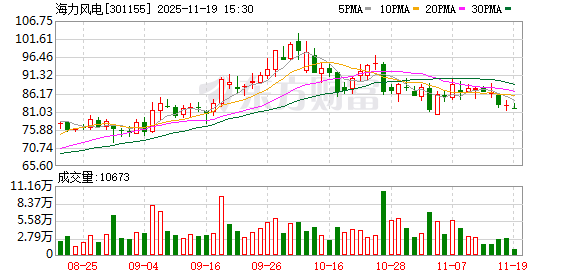
海力风电:公司坚定推进“海上+海外”的“两海”战略
Zheng Quan Ri Bao· 2025-11-19 14:13
Core Viewpoint - The company is committed to advancing its "Two Seas" strategy, focusing on both offshore and overseas markets, and aims to enhance international cooperation and market presence [2] Group 1: Strategic Initiatives - The company is actively expanding its production capacity and adjusting its product structure to improve its deep-sea product development capabilities [2] - The company plans to leverage its export hubs in Qidong and Zhanjiang to facilitate international partnerships and market expansion [2] Group 2: Future Outlook - The company is laying the groundwork for accepting overseas orders through infrastructure improvements at export terminals [2] - Specific order details will be disclosed in accordance with information disclosure regulations in regular reports or special announcements [2]


一图看懂:主动优选基金经理,在2025年3季报里都说了啥?
银行螺丝钉· 2025-11-19 13:56
Core Insights - The article provides an overview of fund managers' perspectives and strategies based on their recent quarterly reports, highlighting different investment styles and market outlooks [1][2]. Group 1: Fund Manager Perspectives - Fund managers express varying views on market conditions, with some maintaining optimism about equity assets due to low interest rates and the potential for corporate earnings recovery [17][18]. - Different investment styles are categorized, including deep value, growth value, balanced, and growth styles, each with distinct characteristics and focus areas [19][35][51]. Group 2: Deep Value Style - Deep value managers focus on low valuation metrics such as low P/E ratios and high dividend yields, primarily investing in sectors like finance, real estate, and energy [10][12]. - Historical performance shows that this style performed well in 2016-2017 and 2021-2024, while underperforming in 2019-2020 [15][16]. Group 3: Growth Value Style - Growth value managers prioritize companies with strong profitability and stable cash flows, often holding stocks for the long term [20][22]. - Concerns about market risks and valuation levels are noted, with some managers highlighting the extreme valuation disparities across sectors [22][24]. Group 4: Balanced Style - Balanced style managers seek a combination of growth and value, focusing on companies with favorable PEG ratios and exploring opportunities across various sectors [35][36]. - They emphasize the importance of maintaining a diversified portfolio while identifying high-quality investment opportunities [40][46]. Group 5: Growth Style - Growth style managers focus on high revenue and earnings growth, often investing in emerging industries such as AI, renewable energy, and technology [51][62]. - The article notes a shift in focus from technology to consumer sectors as the market stabilizes, with an emphasis on identifying companies with strong growth potential [55][58]. Group 6: Market Outlook - The overall market sentiment is cautiously optimistic, with expectations of continued structural opportunities despite potential short-term volatility [40][62]. - Fund managers are adjusting their portfolios in response to macroeconomic conditions, focusing on sectors with strong growth prospects and managing risks associated with high valuations [31][70].
中国诚通发展集团(00217)附属与都兰大雪山风电订立售后回租协议
智通财经网· 2025-11-19 13:48
Core Viewpoint - China Chengtong Development Group has entered into a sale and leaseback agreement with Dulan Daxueshan Wind Power Co., Ltd., indicating a strategic move to enhance its asset management and financing capabilities [1] Group 1 - The agreement involves Chengtong Financing Leasing, a wholly-owned subsidiary, purchasing leasing assets, specifically wind power generation equipment [1] - The lease term is set for two years, with the option for early termination based on the terms and conditions of the sale and leaseback agreement [1]
中国诚通发展集团附属与都兰大雪山风电订立售后回租协议
Zhi Tong Cai Jing· 2025-11-19 13:46
Core Viewpoint - China Chengtong Development Group (00217) announced a sale and leaseback agreement with Dulan Daxueshan Wind Power Co., Ltd. for wind power equipment, indicating a strategic move to enhance its asset management and liquidity [1] Group 1 - The agreement involves Chengtong Financing Leasing, a wholly-owned subsidiary, purchasing leasing assets from the lessee [1] - The lease term is set for two years, with the option for early termination based on the terms and conditions of the sale and leaseback agreement [1]
中国诚通发展集团(00217.HK)与都兰大雪山风电订立售后回租协议
Ge Long Hui· 2025-11-19 13:14
Core Viewpoint - China Chengtong Development Group announced a sale and leaseback agreement with Dulan Daxueshan Wind Power, indicating a strategic move to enhance its asset management and liquidity [1] Group 1 - The agreement involves Chengtong Financing Leasing, a wholly-owned subsidiary, purchasing leasing assets from the lessee [1] - The leaseback period is set for two years, with options for early termination based on the terms of the agreement [1]
IPO雷达 | 定西高强八成收入来自五大客户,核心产品售价走跌
Xin Lang Cai Jing· 2025-11-19 12:11
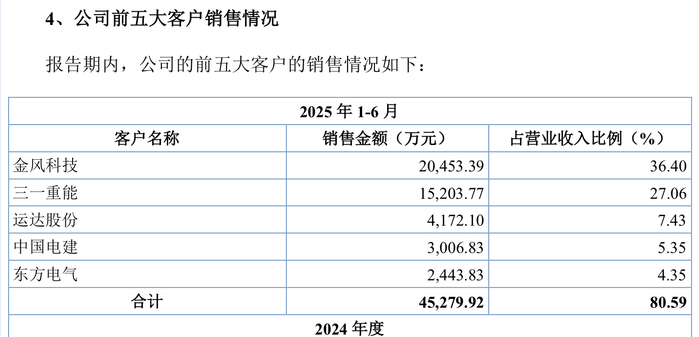
Core Viewpoint - Dingshi Gaoqiang is officially aiming to list on the Beijing Stock Exchange after years on the New Third Board, facing challenges from subsidy reductions and increased competition in the wind power industry [1][2]. Company Overview - Dingshi Gaoqiang, established in August 1997, specializes in the research, production, and sales of high-strength fasteners, primarily used in wind power, nuclear power, petrochemical, and heavy equipment sectors [3]. - The company has shown stable revenue growth, with revenues of 447 million, 592 million, 799 million, and 562 million yuan from 2022 to the first half of 2025, and net profits of 47.64 million, 49.02 million, 61.03 million, and 46.12 million yuan during the same period [3]. Customer Dependency - The top five customers contributed over 80% of the company's revenue, with Goldwind Technology and Sany Heavy Energy accounting for over 60% of total sales [3][4]. - In the first half of 2025, the sales amounts from the top five customers totaled approximately 452.8 million yuan, representing 80.59% of total revenue [4]. Accounts Receivable - The accounts receivable balance has significantly increased, with the ratio of accounts receivable to revenue rising from 43.31% in 2024 to 84.7% in the first half of 2025, primarily due to large-scale purchases from key customers [6]. - Approximately 60% of the sales amounts from Goldwind Technology and Sany Heavy Energy were recorded as accounts receivable in the first half of 2025 [6]. Pricing Pressure - The average selling price of the core product, wind power fasteners, has decreased from 12,200 yuan per ton in 2022 to 8,467.77 yuan per ton in the first half of 2025, reflecting a downward trend due to increased competition and customer bargaining power [7][8]. - The gross margin has declined from 20.73% in 2022 to 16.26% in 2024, with a slight recovery to 18.74% in the first half of 2025 [8]. Expansion Plans - To enhance competitiveness, Dingshi Gaoqiang plans to raise 385 million yuan for two expansion projects and to supplement working capital, as the company’s debt has increased from 223 million yuan in 2022 to 654 million yuan in the first half of 2025 [8]. - The company’s asset-liability ratio stands at 52.45%, higher than the industry average of 37.84% [8]. Industry Challenges - The wind power industry is facing challenges due to subsidy reductions, with the government gradually phasing out financial support for wind power projects, leading to potential instability in electricity prices [9].

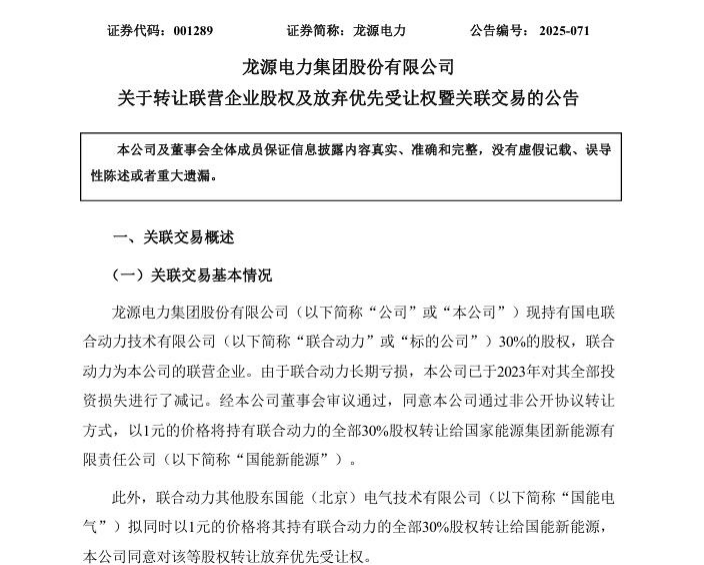
龙源电力拟1元转让巨亏资产 设立3家子公司加码海上风电
Xi Niu Cai Jing· 2025-11-19 11:48
Core Points - Longyuan Power announced the transfer of its entire 30% stake in United Power to State Energy Group New Energy for 1 yuan, resulting in Longyuan no longer holding any equity in United Power [1][3] - United Power has been in a long-term loss situation, with a net asset value of -7.137 billion yuan and a net profit of -574 million yuan for the first nine months of 2025 [3] - Longyuan Power has already written down the entire investment loss in 2023, so the 1 yuan transfer is not expected to significantly impact current profits [3] Group 1 - Longyuan Power is simultaneously increasing its investment in offshore wind power by establishing new subsidiaries with State Energy Jiangsu Electric and other partners, contributing a total of 153 million yuan [4][6] - The new subsidiaries will focus on developing and operating several offshore wind projects in Jiangsu, including a 150,000 kW project in Rudong and a 400,000 kW project in Dafeng [6] - The establishment of these subsidiaries is aimed at leveraging local resource advantages and enhancing expertise in the offshore wind sector, which is expected to have a positive long-term impact on the company's operations [6]